QUAERITUR: using old Mass rubrics in the new Mass

From a reader:

Recently, our apostolate targeted priests to say the Ordinary Form properly as well, and even encourage the use of the rubrics of the Extraordinary Form, in the Novus Ordo. Nonetheless, one of our priest consultants (who is very, very supportive of Summorum Pontificum, and the proper celebration of the Liturgy) told me that according to Canon Law (and some of his Canon Lawyer friends) that it is forbidden to do so. And that the priest celebrant must only do exactly what is written in the rubrics of the Ordinary Form. I guess my question was, is this is indeed the case? And would you consider the Ordinary Form celebrated in the rubrics of the Extraordinary a liturgical abuse?

Technically, there is not to be a mixing of the rites or forms.   I would consider the Novus Ordo celebrated more like the TLM to be an improvement.  BUT!… BUT… there is at this point to be no mixing of the forms.

On the other hand, the Pope says that there should be a mutual enrichment.

Mutual enrichment will certainly be easier to figure out in the case of a priest’s ars celebrandi and with music, and with perhaps issues of the calendar and the addition of new feasts, etc.

Mutual enrichment will eventually have to occur with rubrics as well.  That is the point of “organic growth” over time.  I don’t know how that will work out or when.  I suspect it will take a long time.  First, use the older Mass is increasing.  Also, younger priests are celebrating the newer form of Mass with fewer abuses than their older brethren.  There are also those priests who say the Novus Ordo having learned also the older form.   Then there will be the factor of the shrinking of congregations attending the Novus Ordo and the slow increase of those going to the older Mass.

For now I would say that the older form of Mass should be celebrated as it is in the book.

I think the Novus Ordo should be celebrated as the book says, just saying the black and doing the red… but in close continuity with our many centuries of tradition, and under the clear influence of the older Mass.  In some ways the Novus Ordo hasn’t had a chance yet, since it has been so abused by so many for so long.  Yes, we must admit that the very structure of it and the use of vernacular and the dreadful table altars have opened the Novus Ordo up to far more abuse.   But the Novus Ordo has to be given a chance.

Lastly, it is said by some (by me) that the more the Novus Ordo is celebrated like the older form, the better it is.  If that is the case… if the older form is truly the paradigm, doesn’t that raise a question?

Posted in ASK FATHER Question Box, SUMMORUM PONTIFICUM | Tagged ,
22 Comments

Noblesse ought to oblige.

PLEASE CHECK THE UPDATES, below.

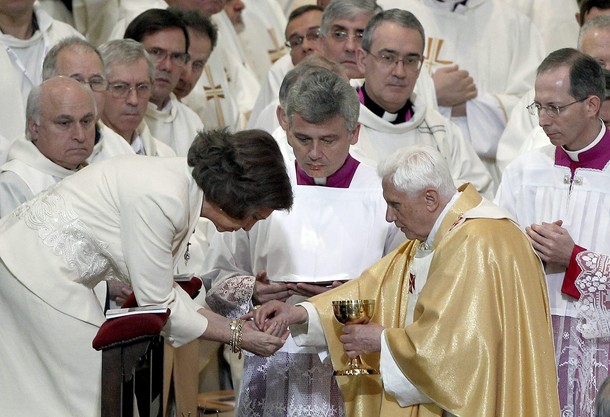
In Spain at Sagrada Familia Queen Sophia refused to kneel before GOD and receive the Body of her Divine Saviour in the manner that the same Divine Savior’s Vicar on earth has pointed to as the most appropriate.

UPDATE: 10 Nov 1015 GMT:

A friend sent this and I must, in justice, share it with everyone (edited).

As much as we would like it or suppose it, Queen of Spain never converted to Catholicism….

Remember, they even had a double wedding, one catholic, one orthodox, as forbidden as that may be in general. It still is common practice in Greece.

She however is by far the best and most faithful member in the Royal Family, and she does not fear to be unpopular in shabby Spain, even on the usual social issues ….

So the way she received communion is the orthodox one, and none other she would accept. And receiving communion is according to can. 844 § 3.

I was unaware that the Orthodox received in the hand.  I thought they received under both kind and directly in the mouth through the use of a spoon.

Nevertheless, I happily receive correction in this matter if this is the reason why the Queen received in that manner.   At the same time, when one is in Rome, one does best to receive as the Romans.  When I go to am Eastern Catholic Church and receive the Sacrament, I receive in their manner of receiving.  Food for thought.

UPDATE: 10 Nov 2344 GMT:

Someone sent via email:

I suggest you watch the video from the Barcelona mass. The picture of
the queen is a little misleading. She wasn’t at the kneeler in front
of the Pope. He went over to her and she was on a platform above him
in a very awkward position. I doubt she was being disrespectful.

Of course there was no link to the video.

Posted in Liturgy Science Theatre 3000, New Evangelization, Our Catholic Identity |
94 Comments

A social engineering experiment that didn’t work so well

It looks as if the openly homosexual Episcopalian bishop Gene Robinson is going to resign.

I suspect he will not be joining a Ordinariate of Anglicanorum coetibus.

It seems that Robinson wants more time with his “husband”.

Blech.

I guess that was a social engineering experiment that didn’t work so well.

I’ll now go wash.

Posted in Throwing a Nutty | Tagged
14 Comments

QUAERITUR: harmonizing with the priest during the doxology

From a reader:

Please don’t think I’m a heretic, but I was at one of those great
circumstances where multiple celebrants sang the last part of the
Eucharistic prayer (which I think is the doxology). They sang it
together and on key. That is so wonderful.

I would love to have a musical setting where it would be possible for
a cantor, choir, or congregation to harmonize with the celebrant(s). I understand it would confuse roles to have non-priests sing any of the same words as the priests. How would I explore this?

You don’t explore it.  It is forbidden for anyone other than the celebrant and, if present, concelebrants to sing that part at the end of the Eucharistic Prayer(s).  Even priests or bishops who are present, but not concelebrating, cannot sing that together with the celebrant.

Posted in ASK FATHER Question Box | Tagged
30 Comments

QUAERITUR: I heard “excommunication” in the words of absolution!

From a reader:

While I am praying my Act of Contrition in the Confessional, I hear
the priest praying in Latin. Sometime I hear him say the Latin word
for excommunication and this always makes me afraid that he has judged
that one of my sins was extra bad… something that needed an
un-excommunication. Is it normal for a priest to use that word?

No, do not make that assumption and don’t worry about this at all.

The older form of absolution, which more traditionally-minded priests of the Latin Church can use, includes a line about lifting whatever censure might have been incurred to the extent that he has the faculty to lift them and there is need.

The usual form was and is, with my emphases:

May our Lord Jesus Christ absolve you. And I by His authority release you from every bond of excommunication (suspension) and interdict, in so far as I am empowered and you have need. And now I absolve you from your sins; in the name of the Father, and of the Son, + and of the Holy Spirit. R.: Amen.

You can see the logic of the formula.  First, the censure is lifted so that the person is able to receive the absolution of sins, and then the sins are absolved.

Also, it is not uncommon that priests start reciting the formula quietly once they hear you getting on with your Act of Contrition.  That is pretty standard.

Posted in ASK FATHER Question Box | Tagged
6 Comments

The dangers of English… Shakespeare… !

This is from Jihad Watch by Robert Spencer with my emphases and comments.

Apparently there is an Islamic faith watchdog group in Britain which makes sure everything is according to Hoyle in schools.  Some inspectors are linked to “radical Islamist organizations”.

Some of the concerns for children in Islamic schools, are disconcerting.

[…]

The schools, the Islamic Shakhsiyah Foundation establishments in Haringey, north London, and Slough, Berks, received more than £113,000 of public funding and became the subject of national controversy after being exposed in The Sunday Telegraph.

One of the Foundation’s trustees, Farah Ahmed, who is also headmistress of the Slough school, wrote a chapter in a Hizb ut Tahrir pamphlet attacking the National Curriculum for its “systematic indoctrination” of Muslim children “to build model British citizens”[Can you imagine the arrogance of educators of children in Britain imagining that children in Britain should know anything about Britain so they can fit into British society?]

She criticised “attempts to integrate Muslim children” into British society as an effort “to produce new generations that reject Islam”.

She described English as “one of the most damaging subjects” [! Consider what sorts of things have been written in English!  I am writing this in English for the love of God!] a school can teach and attacked fairy tales, saying that these “reflect secular and immoral beliefs that contradict the viewpoint of Islam”. [I think we are talking about “fairy tales” in the rather more traditional sense… the Brothers Grimm and all that.  Pretty threatening stuff: the bad guy is always punished by the end.]

She also attacked the “obvious dangers” of Shakespeare, including “Romeo and Juliet, which advocates disobeying parents and premarital relations”.  [My my!  It might be a good idea to read R&J before condemning it.  The star-crossed lovers get married before the consummation, don’t they.  As far as the disobedience issue is concerned, how can we forget that the disobedient ingrates wind up dead at the end.  Not exactly a happy ending.  What could be wrong with that?  Wouldn’t at least poor Juliet be killed under sharia law?]

[…]

If they don’t like Romeo and Juliet, what they would think about Othello?

Posted in The future and our choices | Tagged
13 Comments

5 Anglican bishops intend to use Anglicanorum coetibus

Keep repeating: Benedict XVI is the Pope of Christian Unity.

From the UK’s best Catholic weekly, the Catholic Herald, comes this about Anglican bishops who will be coming into unity with England’s Church of origin the Catholic Church.

Five traditionalist Anglican bishops have officially resigned this morning with the intention of taking up an English Ordinariate when it is set up.

This morning, the Rt Rev Rowan Williams, the Archbishop of Canterbury accepted the resignation of three flying Church of England and two retired assistant bishops in what is a major development in the move towards establishing an Ordinariate in Britain.  [I have always loved that image of a “flying bishop”, … in his Sopwith Camel, lappets streaming…]

[…]

Dr [Anglican Archbp. of Canterbury Rowan] Williams said: “I have today with regret accepted the resignations of Bishops Andrew Burnham and Keith Newton who have decided that their future in Christian ministry lies in the new structures proposed by the Vatican. We wish them well in this next stage of their service to the Church and I am grateful to them for their faithful and devoted pastoral labours in the Church of England over many years.”

The Catholic liason officer for the Ordinariate, Bishop Alan Hopes, an auxiliary of Westminster said: “We welcome the decision of Bishops Andrew Burnham, Keith Newton, John Broadhurst, Edwin Barnes and David Silk to enter into full communion with the Catholic Church through the Ordinariate for England and Wales, which will be established under the provisions of the Apostolic Constitution Anglicanorum Coetibus.”

The bishops are due to discuss the Ordinariate at their plenary meeting next week.

Full statement of the resigning Church of England Bishops:

Like many in the catholic tradition of Anglicanism, we have followed the dialogue between Anglicans and Catholics, the ARCIC process, with prayer and longing. We have been dismayed, over the last thirty years, to see Anglicans and Catholics move further apart on some of the issues of the day, and particularly we have been distressed by developments in Faith and Order in Anglicanism which we believe to be incompatible with the historic vocation of Anglicanism and the tradition of the Church for nearly two thousand years.  [Two points.  Christianity has been around a long time, but the Anglican Church hasn’t.  Also, if Anglicanism and Catholicism have been moving apart, that isn’t because the Catholic Church has shifted her doctrine.]

The Apostolic Constitution, Anglicanorum cœtibus, given in Rome on 4th November 2009, was a response to Anglicans seeking unity with the Holy See. With the Ordinariates, canonical structures are being established through which we will bring our own experience of Christian discipleship into full communion with the Catholic Church throughout the world and throughout the ages. This is both a generous response to various approaches to the Holy See for help and a bold, new ecumenical instrument in the search for the unity of Christians, the unity for which Christ himself prayed before his Passion and Death. It is a unity, we believe, which is possible only in eucharistic communion with the successor of St Peter.

As bishops, we have even-handedly cared for those who have shared our understanding and those who have taken a different view. We have now reached the point, however, where we must formally declare our position and invite others who share it to join us on our journey. We shall be ceasing, therefore, from public episcopal ministry forthwith, resigning from our pastoral responsibilities in the Church of England with effect from 31st December 2010, and seeking to join an Ordinariate once one is created.

We remain very grateful for all that the Church of England has meant for us and given to us all these years and we hope to maintain close and warm relationships, praying and working together for the coming of God’s Kingdom.

We are deeply appreciative of the support we have received at this difficult time from a whole variety of people: archbishops and bishops, clergy and laity, Anglican and Catholics, those who agree with our views and those who passionately disagree, those who have encouraged us in this step and those who have urged us not to take this step.

The Right Revd Andrew Burnham
The Right Revd Keith Newton
The Right Revd John Broadhurst
The Right Revd Edwin Barnes
The Right Revd David Silk

[…]

Posted in Brick by Brick, Pope of Christian Unity | Tagged ,
45 Comments

Baseball card news!

Remember the sisters who had a rare Honus Wagner baseball card?

220K

Posted in Linking Back | Tagged
2 Comments

QUAERITUR: sandals

From a reader:

When I was on vacation at Lookout Mountain, Georgia USA, I saw the
Priest wearing SANDALS with his vestments. Yeah – that surprised me,
too! Is this normal?

Shoes are rather new-fangled inventions, actually.

And there are many priests who belong to religious orders which require that they be “discalced… shoeless”.  They generally wear sandals.

I would instead focus on what the priest is doing during Holy Mass.

Posted in ASK FATHER Question Box | Tagged
26 Comments

A priest’s thoughts about celebrating “ad orientem” for the first time

Do you remember the Monty Python sketch about the funniest joke in the word?  It was so funny that it would kill you.  Even just seeing a couple words of the joke on paper would put you in the hospital.

If you have been reading this blog for a while you have seen my opine that  when priests learn the older form of Holy Mass in the Roman Rite, they are never the same thereafter.   Even when they get a taste of the Novus Ordo celebrated in continuity with the older form of Mass, they are affected.

A friend alerted me to this from the blog of Rev. Know-it-all, the alter ego of Fr. Richard Simon, Pastor of St. Lambert Parish, Skokie, IL.

My emphases and comments.

A reflection on Liturgy celebrated “ad orientem”

Instead of the usual “Rev. Know it all” this week, I would like to share some reflections on a recent experience. At the end of a conference on the Church Fathers, I said the ordinary form of the Mass, the so called Novus Ordo,  in the English language. [Nota bene.] It was no different from any other Novus Ordo Mass, with one exception.

For the Offertory, Canon and Our Father I faced the altar, not the congregation. I said the opening prayers form the presider’s chair, where I remained for the readings. I wore a microphone as usual. I then read the Creed and the prayers of the faithful, went down to receive the offerings of bread and wine, and then went to the altar directly, not going around behind it. The deacon and I turned to the congregation at the prayer “Pray brethren..” I next turned to the congregation at the sign of peace and then again at the “Lord, I am not worthy…” After the distribution of Holy Communion I returned to the presider’s chair and finished the Mass as usual. The music was very simple, very little organ, mostly plain chant in English, some Latin used in the ordinary parts of the Mass, all prayers and readings in English. I had warned the congregation that I would do this one time only as part of the conference that we were having at the parish. I faced away from the congregation for about 14 of 55 minutes, all told.

I did it as an experiment. I suspect that the Council Fathers of Vatican II never envisioned Mass facing the people. I wanted to know what the Mass of Vatican II would really be like, some English, some Latin, Gregorian chant, unaccompanied singing and a balance of facing toward people when addressing them and facing the altar with them when addressing the Father. I think this is what is called in the rubrics of the Missal when it indicates that the priest should face the people six times during the Mass: [Which leads to the question: “Why, therefore, not do it all the time…?”]

1)When giving the opening greeting (GIRM 124).
2)When giving the invitation to pray at the end of the offertory, “Pray brethren” (GIRM 146).
3)When giving the greeting of peace (GIRM 154).
4) When displaying the Host and Chalice before Communion and saying: “Behold the Lamb of God” (GIRM 157).
5) When inviting the people to pray before the post communion prayer (GIRM 165).
6)When giving the final blessing (Ordo Missae 141).

The fact that these rubrics exist, seems to assume that the priest is facing away from the people at some time during the liturgy.

After Mass, comments were varied. Some people loved it, most didn’t like it, some were infuriated. In particular I got angry fingers in the face, from someone who said that “the Pope had sent a letter to all priests telling them that they had to face the people.” How do you prove something that never happened? Rome has never said anything about having to face the people during Mass. One must do so only six times. It is one of the great mysteries of our times why, overnight, most of the altars in Catholic Churches were turned around[The late great liturgical scholar Fr. Klaus Gamber said that the turning of the altars was the change that did the most damage after Vatican II.]

[…]

[Read carefully…]

I, however, wish I had not said Mass facing away from the congregation, and not because of the anger directed at me. I am a Catholic priest. I am used to people being angry with me. I wish I had not said Mass in what I believe to be the posture assumed by the Fathers of the Second Vatican Council, because it was one of the most beautiful experiences of my priestly life. You cannot imagine what it was like to say words like “we” and “our Father” and “us” while standing at the head of a congregation that was turned together in a physical expression of unity. No matter how one might argue to the contrary, it is impossible to say “we” while looking at 500 people and not be speaking to them.

The Mass is a prayer addressed to the Father, and despite our best intentions, we clergy address it to the congregation at whom we are looking. You cannot help it. The human face is a powerful thing. Last Saturday night I realized for the first time that I was part of a family of faith directed toward the same heavenly Father. I felt as if I was part of a church at prayer. It was not my job. It was my church. I never realized how very lonely it is to say Mass facing the people. I am up there looking at you. I am not part of you. For 13 or 14 minutes. You weren’t looking at me. We were looking at God.

I love the Tridentine Mass, or as we are supposed to be calling it now, the “extraordinary form.” I think that the Holy Father has been very wise in allowing its revival for those to whom it is meaningful. Its sense of solemnity is very beautiful and enshrines an essential dimension of the mystery of worship. I taught Latin for about 25 years, I understand the complex rituals of the old Mass. They mean a lot to me. Still, I don’t think that we should return to the exclusive use of Latin. I think the Council Fathers were right to simplify the mass.

[…]

Read the rest there.

WDTPRS KUDOS to this Fr. Know-It-All.

Keep celebrating ad orientem, friend.

We need an altar revolution.  We have to take back our proper orientation.

Pray for the Holy Father, who is helping us back to continuity in our worship and our identity.

Posted in ASK FATHER Question Box, Brick by Brick, Fr. Z KUDOS, Mail from priests | Tagged
45 Comments