I wonder if this is how Catholics who voted for Obama will feel in a couple months.

From Omaha.com
A new take on tradition for incoming Lincoln bishop
By Joe Duggan
WORLD-HERALD BUREAULINCOLN — He’s got folk rockers Mumford & Sons and the Avett Brothers on his iPod.
He’s on Twitter and Facebook.
And he’s passionate about poetry, art and classical English literature.
But when it comes to Roman Catholic doctrine, Lincoln’s incoming bishop says he’s ready to carry the torch of his predecessors who have made the Lincoln Diocese one of the most traditional in the country.
“The Diocese of Lincoln has never suffered an identity crisis,” said Auxiliary Bishop James Conley of the Denver Archdiocese. “In other words, the church in Lincoln has always known who she is. People want to be a part of this because people want to know where the church stands.”
The 57-year-old native of Overland Park, Kan., will be installed Nov. 20 as the ninth bishop of Lincoln, a diocese that includes 96,000 Catholics in 135 parishes across southern Nebraska.
He will replace retired Bishop Fabian Bruskewitz, 77, who led the diocese for two decades.
The diocese is known for traditional church practices, such as boy-only altar servers and distributing Communion in the form of consecrated bread, not, as a general rule, from the cup. And unlike in many other Catholic churches, women in the Lincoln Diocese are not permitted to give the Eucharist to their fellow worshippers.
Conley said he has no plans to change those practices.
Bruskewitz, who has said he strove to preserve the “undistorted” Catholic faith, also made decisions and took actions that generated controversy.
For example, in 1996, he excommunicated Catholics who belonged to a list of 10 organizations he said opposed fundamental church teachings, such as opposition to abortion, gay marriage and assisted suicide. Among the listed groups were Planned Parenthood and Call to Action, an organization seeking church reforms such as ordination of women.
The excommunications will remain in force, Conley said.
“It can have a medicinal purpose,” Conley said. “The purpose is to not cut them off, but to persuade them to come back.”
[…]
The incoming bishop said he also wants to keep and strengthen the impressive track record Lincoln has in promoting vocations to the priesthood and the religious life. With 44 men currently studying for the priesthood, the diocese has the highest ratio of seminarians to Catholics in the nation, he said.
[…]
The Canonical Defender, the distinguished Ed Peters, has some comments on his fine blog In The Light Of The Law about civil consequences of Catholic marriage ceremonies. In the USA marriage ceremonies are also the civil act. In Italy, there are two steps, ecclesiastical and civil.
Some first thoughts on Weigel’s call to reconsider civil consequences for Catholic weddings
November 14, 2012
George Weigel writes in a thought-provoking essay that we should, among other things, “accelerate a serious debate within American Catholicism on whether the Church ought not pre-emptively withdraw from the civil marriage business, its clergy declining to act as agents of government in witnessing marriages for purposes of state law.”
Okay, a few thoughts toward that acceleration.
First for precision: the Church is not in the civil marriage business, we are in the religious marriage business. [Bingo.] Our clergy act fundamentally as ecclesiastical officers at our weddings. The few clerics who from time to time (notwithstanding 1983 CIC 285 § 3) attempt to act as purely civil agents at weddings do so with virtually no canonical support. See e.g., CLSA Advis. Op. 1984-55 Provost, CLSA Advis. Op. 1988-98 Wallace, and CLSA Advis. Op. 2005-76 Jorgensen (all rejecting civil-only agency) vs. CLSA Advis. Op. 1987-128 Cuneo (who leaves open a small possibility for such service).
Second and more important, it is not strictly speaking for the Church to “withdraw” from “civil marriage”, for the decision to accord civil recognition to ecclesiastical ceremonies like weddings is the State’s to make, not the Church’s. [hmmm…. well… a bishop could, probably, decide to tell his priests not to do anything with civil marriage papers/licences.] As Catholics we do what we do, namely, solemnize weddings as we think fit, while the State does what the State does, namely, accord civil recognition to those events (like, e.g., letting spouses file joint tax returns and inherit property) as it thinks fit. Now, I grant it’s very convenient for the State to recognize Catholic weddings, but if the State decides not to do so, well, okay.* Catholics are still going to marry in the eyes of the Church and ecclesiastical consequences will still flow from such religious acts—or not, as the case may be—but, in any event, independently from whether the State chooses to recognize that ceremony. In short, I’m not sure how the Church can “withdraw” civil recognition of its ceremonies or, for that matter, demand it. [Again, can’t a bishop tell priests not to do anything with civil paperwork?]
It is painful, of course, to watch the State’s definition of marriage careen toward something unrecognizable under natural or ecclesiastical law, but eliminating true marriages from the pool of unions treated as marriage by the State is not the solution to the State’s errors. [Hmmm… could it keep us from being sued by homosexual activists who want to harass the Church into obedience?] Moreover, if the day arrives wherein State power is turned against a pastor who refuses a “gay wedding”, we must and will refuse cooperation with that simulation of a sacrament (e.g. 1983 CIC 841, 1379) as best we can (e.g. 1983 CIC 1370 § 3, 1373). But, that day has not arrived yet [It will.] and I see no need to surrender societal goods (such as the convenience, and even meetness, [! For those of you from Fridley, that means “suitability”, “propriety”.] of civil recognition of Catholic weddings) that have not yet been demanded of us.
Third, the Church’s interest in marriage predates and transcends the State’s, obviously, but the Church nevertheless recognizes the legitimate interests of the State in marriage and tries, in a myriad of ways, to accommodate those interests (see e.g. 1983 CIC 1071 § 1, n. 2). Sorting through those modi vivendi is not something for individuals to take upon themselves and to accelerate this discussion is not to go pedal-to-the-metal, folks! (Weigel did not suggest that, but we are posting before a public that does not always observe his prudence).
Fourth . . . well, there are several other aspects of this matter that need to be discussed, but this is just a blog post, and one can’t cover everything. + + +
* The American State does not recognize ecclesiastical annulments (even those declared on grounds identical to the State’s) yet no one seem the worse off for it. Canonists disagree, by the way, about whether the Church should grant canonical recognition to civil annulments. See e.g. CLSA Advis. Op. 1995-84 Ingels and CLSA Advis. Op. 1988-100 Provost (arguing yes) vs. CLSA Advis. Op. 1995-86 McKenzie (arguing no); either way, though, the granting of ecclesiastical effects to civil actions is clearly the Church’s decision to make, not the State’s. Mutatis mutandis, I suggest it is for the State to decide whether to grant civil effects to Catholic weddings.
It WILL happen that homosexuals harass the Church with law suits. A foreshadowing was certainly the way poor Fr. Guarnizo was set up and then thrown to the wolves. It is just a matter of time.
Again, could not bishops determine that priests will not concern themselves with any of the civil paperwork? I don’t know.
Here is the Russian Orthodox Metropolitan Hilarion’s letter to the new Anglican Archbishop of Canterbury:
Dear Brother and Lord Bishop,
I would like to extend to you wholehearted congratulations on your election as Head of one of the oldest episcopal chairs founded by St. Augustine of Canterbury in the 7th century. [Problematic statement, that, since Anglican bishops aren’t really bishops at all … but let’s go on.]
You have been entrusted with the spiritual guidance of the entire Anglican Communion, a unique [shrinking] union of like-minded people, which, however diverse the forms of its existence in the world may be, needs one ‘steward of God’ (Tit. 1:7) the guardian of the faith and witness to the Truth (cf. Jn. 18:37).
The Russian Orthodox Church and the Churches of the Anglican Communion are bonded by age-old friendly relations initiated in the 15th century. [! Indeed.] For centuries, our Churches would preserve good and truly brotherly relations encouraged both by frequent mutual visits and established theological dialogue and certainly by a spirit of respect and love which used to accompany the meetings of our hierarchs, clergy and ordinary believers [, and anti-papists].
[Watch this…] Regrettably, the late 20th century and the beginning of the third millennium have brought tangible difficulties in relations between the Russian Orthodox Church and the Churches of the Anglican Communion. The introduction female priesthood and now episcopate, the blessing of same-sex ‘unions’ and ‘marriages’, the ordination of homosexuals as pastors and bishops – all these innovations are seen by the Orthodox as deviations from the tradition of the Early Church, which increasingly estrange Anglicanism from the Orthodox Church and contribute to a further division of Christendom as a whole.
We hope that the voice of the Orthodox Church will be heard by the Church of England and Churches of the Anglican Communion, and good fraternal relationships between us will revive.
I wish you God’s help in your important work.
“May the God of love and peace be with you” (2 Cor. 13:11).
+Metropolitan Hilarion of Volokolamsk
A little grim, but, hey… who can deny that Anglicans are going off the cliff?
Benedict XVI is the Pope of Christian Unity.
From The Guardian:
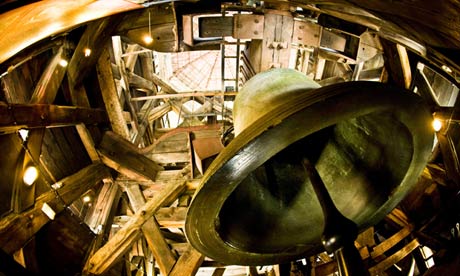
Notre Dame's famous Emmanuel bell - not one of those being replaced - rings in the south belltower of the Paris cathedral. Photograph: Peter Barritt/Alamy
Ding dang … Notre Dame moves to scrap out-of-tune bells
Paris cathedral’s move to replace its old bells with new ones for its 850th anniversary fails to chime with heritage lobby
Their names sound pretty enough – Angélique-Françoise, Antoinette-Charlotte, Hyacinthe-Jeanne and Denise-David – but the noise they make together has been described as “discordant” and enough to drive Quasimodo deaf all over again.
Some have gone as far as to call them cheap, old and ugly.
Thus, there were expected to be few tears shed when the four bells, whose tolling has marked the march of time and a funereal adieu for the great and good at Notre Dame cathedral for 156 years, were taken from their belfry and consigned to the scrapheap.
Made and hung in 1856 to replace those torn from the cathedral during the French Revolution and melted down to make cannon – a fate that befell 80% of France’s church bells at the time – they were, declared the French campanologist and music expert Hervé Gouriou, “one of the most dreadful sets of bells in France … damaged and badly tuned”.
To mark the cathedral’s 850th anniversary next year, a new set of eight bells, intended to recreate the sound of the 18th-century bells made famous by Victor Hugo’s fictional Hunchback of Notre Dame, are being struck at a foundry in Normandy.
Now, however, dozens of cultural associations from France and abroad and at least one religious group have been going like the proverbial clappers to stop the bells being destroyed.
Father Alain Hocquemiller, the prior of a religious community in Normandy, went as far as to bring in the bailiffs to serve a legal notice to save them. He claims he was prompted to act after learning of plans to declassify the bells and melt them down for scrap.
Under a law dating back to 1905, Notre Dame belongs to the French government, which gives the Catholic church the exclusive right to use it, so the bells, which weigh between 767kg and 1.91 tonnes each, belong to the state.
“I consulted a lawyer who told me it was the gratuitous destruction of France’s religious heritage and that’s not allowed by law,” Hocquemiller told reporters.
The four grandes dames are currently at the French bell foundry Cornille-Havard, which is making the new bells using medieval methods, including pouring bronze into moulds made from clay, horse manure and horsehair. They will be named after eight important figures in French history, with the design reflecting their namesakes.
Notre Dame’s great south tower bell, the 13-tonne Emmanuel installed in 1685 and widely considered the most remarkable in Europe – which rang for the coronation of kings and to mark the end of the two world wars – was cut down by revolutionaries, but escaped destruction and was rehung on the orders of the Emperor Napoleon in 1802.
Father Patrick Jacquin, rector and archpriest at Notre Dame, told Le Parisien newspaper: “Forty cultural organisations have requested the dilapidated bells, but they don’t belong to the church. End of story.
“The bells are not for sale, not for destruction, not for melting down. On 2 February 2013 we will unveil eight new bells that will be blessed. Everything we have done has been in the open, nothing is hidden.”
He added: “This isn’t the first time the cathedral is the theatre for stories and fantasies, but given the choice, I prefer those of Victor Hugo.”
Did you that the blessing of a bell is not, traditionally, not like other blessings. It is far more complex. It is usually done by a bishop. It is actually referred to as a “baptism”. Bells are given names, like people. They speak with a voice.
In the Roman Ritual there is a blessing for any old bell. Bells for church use are consecrated with a rite in the Roman Pontifical. Here is one of the blessing prayers from the Roman Ritual:
The priest puts incense into the thurible, and sprinkles the bell with holy water while walking around it. While he does so the choir sings the Asperges. Then he incenses it, again walking around it, as the choir sings the following antiphon (for the music see the music supplement):
Antiphon: Lord, let my prayer come like incense before you.
Then the celebrant continues:
Let us pray.
O Christ, the almighty ruler, as you once calmed the storm at sea when awakened in the boat from the sleep of your human nature, so now come with your benign help to the needs of your people, and pour out on this bell the dew of the Holy Spirit. Whenever it rings may the enemy of the good take flight, the Christian people hear the call to faith, the empire of Satan be terrified, [Can you imagine a phrase like that in the dreadful, watered-down Book of Blessings?] your people be strengthened as they are called together in the Lord, and may the Holy Spirit be with them as He delighted to be with David when he played his harp. And as onetime thunder in the air frightened away a throng of enemies, while Samuel slew an unweaned lamb as a holocaust to the eternal King, so when the peal of this bell resounds in the clouds may a legion of angels stand watch over the assembly of your Church, the first-fruits of the faithful, and afford your ever-abiding protection to them in body and spirit. We ask this through you, Jesus Christ, who live and reign with God the Father, in the unity of the Holy Spirit, God, forever and ever.
All: Amen.
P: To the honor of St. N.All: Amen.
If the bell is for a consecrated church, there is a Rite in the Roman Pontifical.
Also, here is something from the Catholic Encyclopedia:
Points of law
In medieval England it was distinctly laid down that the church bells and ropes had to be provided at the cost of the parishioners. The canon law assumed that cathedral had five or more bells, a parish church two or three, while the churches of the medicant orders, like public oratories, were originally limited to one. The solemn ceremony of benediction provided in the Pontifical can only be carried out by a bishop or by a priest specially empowered, and it is only to be employed in the case of bells intended for church use. For other bells, a simpler blessing is provided in the “Rituale”. Numerous prohibitions exist against the church bells being used for “profane” purposes, e.g. for summoning meetings or for merely secular festivities and in particular for executions. In Catholic ecclesiastical legislation the principle is maintained that the control of the bells rests absolutely with the clergy. In cathedral churches according to the Cermoniale Episcoporum” this jurisdiction is vested in the Sacrista. Theoretically, the actual ringing of the bells should be performed by the ostiarius and in the conferring of this minor order the cleric is given a bell to ring, but for centuries past his functions have everywhere become obsolete, and lay bell-ringers have been almost exclusively employed. Finally, we may note a decision of the secular courts given in an action brought against the Redemptorists of Clapham, England, in 1851, whereby an injunction was granted to restrain these Fathers from ringing their bells at certain hours, at which, as it was complained, such ringing caused unreasonable annoyance to residents in the neighbourhood.
Acton Institute was mentioned more than once – favorably and unfavorably – at the recent USCCB meeting during discussion of a statement about economics (subsequently killed by a vote of the bishops).
Acton Institute responds to National Catholic Reporter [aka Fishwrap] article on bishops’ economic statement
Here is the comment posted this this morning on the National catholic Reporter article titled, “Statement on economy denounced by archbishop fails to pass.”
Full statement follows:
An important clarification.
Archbishop Fiorenza’s assertion that the Acton Institute views Rerum Novarum as “no longer applicable today” is incorrect. The archbishop is most likely basing this claim on a June 2012 America Magazine blog post by Vincent Miller titled, “Sirico Completely Wrong on Church’s Social Teaching.”
In the post, Miller cites an interview Fr Robert Sirico, president of the Acton Institute, did with the New York Times on a story about Duquesne University and the attempt by adjunct professors to organize a union there. Miller claimed that Fr Sirico’s comment to the Times was “astounding in its ignorance or mendacious misrepresentation of the basis for the Church’s support for unions.”
To which Fr Sirico replied on the Acton PowerBlog:
“Anytime I can get a progressive/dissenting Catholic magazine/blog like the Jesuit-run America simultaneously to quote papal documents, defend the Magisterium of the Catholic Church, embrace the Natural Law and even yearn for a theological investigation “by those charged with oversight for the Church’s doctrine” of a writer suspected of heresy, I consider that I have had a good day.” [ROFL!]
And further on:
Mr. Miller jumps to the conclusion that by saying that Leo’s observations of the circumstances for workers in 1891 were historically contingent, I am somehow arguing that what Leo said has no bearing today. Now, that is a particularly odd reaction because the entire thrust of Leo’s encyclical, beginning with its title, was precisely aimed at looking around at the “new things” (Rerum Novarum) [Actually, in Latin res novae means “revolution”, in a negative sense.] that were emerging in his day, and reflecting upon them in the light of Scripture, Tradition and the Natural Law. If the situation in Pittsburgh and the graduate students teaching part time courses in 2012 is remotely comparable to the subsistence living conditions under which many workers lived in the latter part of the 19th century, this has somehow escaped my notice.
Nonetheless, I am delighted to see Mr. Miller is vigilant about the Church teaching and his citations from magisterial texts; not a single line of any of those cited do I disagree with.
Read the whole thing HERE.:
John Couretas
Communications Director
Acton Institute
Did you see this video?
YouTube description:
Clinton Eugene Curtis testified under oath, before the Ohio State legislature, that he wrote a program to rig elections. This program would flip the total vote from the real winner to the candidate who had been pre-selected to win by the electronic vote counting machines….
[wp_youtube]Hbf3iaEbAuY[/wp_youtube]
Just because it’s nice:
[wp_youtube]S2NexHZrXP4[/wp_youtube]
And…
[wp_youtube]Dgr7vlwl2Is[/wp_youtube]
By the way, Rome Reports really needs a new voice-over person. Perhaps someone who knows how to pronounce names.
This, from UCANEWS make me angry:
Pell does not speak for the whole Church says retired bishop
The retired bishop, Geoffrey Robinson, says he would be prepared to break the seal of confession in order to report sexual abuse. [?!?]
Bishop Robinson has told The World Today that Archbishop [Yes, he is Archbishop of Sydney, and also a Cardinal] George Pell is an embarrassment who is out of step with the majority of Australia’s bishops and should no longer speak for the Catholic Church in Australia on the issue of sexual abuse by the clergy. [Is Robinson saying that the majority of bishops should break the Seal of Confession?]
Bishop Robinson won international attention for his published work on the need for the Church to confront the abuse problem, but he told Tim Palmer that he’s not sure that making it mandatory to report sex abuse crimes that are revealed in the confession box would make a difference.
GEOFFREY ROBINSON: I’m not sure how useful it would be. Offenders in this field, in paedophilia, do not go to confession and confess. They’ve convinced themselves that what they’re doing is right, there’s an extraordinary amount of distorted thinking that goes on.
And also I think they’re afraid of what the priest would say to them. That he would not simply, you know, give them absolution. He would make, you know, all sorts of demands on them.
So I really don’t think that it would achieve everything that a lot of people seem to hope for from it.
TIM PALMER: What if it were a matter of a victim, a person of identifiably tender years coming in and describing something that constituted assault. What would your view be of that then?
GEOFFREY ROBINSON: I would listen to them, find out what I could there, and then I would ask them to give me permission to refer the matter.
You know, that would be my first way, to get them to give me permission because in any case, if I can’t give the name of the victim to the police then there’s not a great deal the police can do. Even if I gave them the name of the alleged offender, there’s not much they can do without having the victim.
So that would be my, always be my first step, to try to get the victim to give me permission to speak to the police.
TIM PALMER: Let’s say these are serious allegations. What would be your next step if you can’t get that cooperation?
GEOFFREY ROBINSON: If the person won’t go that far then I would have to make a decision, and if I really thought that young people were at serious risk here then I would speak to the police.
TIM PALMER: You would break the seal of confession?
GEOFFREY ROBINSON: Well, you know, I’d have to weigh a lot of things up – did I know the name of the alleged offender? Did I know the name of the alleged victim? If I didn’t, if it’s simply someone who comes into confessional who’s not known to me, then obviously I can’t tell the police that.
I would be prepared to break the seal of confessional because you have to weigh up the greatest good, and here the greatest good is surely the protection of innocent people.
TIM PALMER: Do you think that that could become part of the church’s protocol, should become part of the church’s protocol, that weighing up things, priest be at least given the discretion to break the seal of – or be encouraged to break the seal of confession if, for example, a victim comes in and describes a sexual assault?
GEOFFREY ROBINSON: The major problem the Australian bishops have in dealing with this entire issue is that their hands are tied. Most of the changes that are needed must come from the Pope, and if he won’t move, then the Australian bishops have their hands tied.
The chances of getting the Pope to say that priests could break the seal of confessional are, well, nil. [And that, ladies and gents, is why we have Popes.]
TIM PALMER: I’m aware you didn’t see George Pell’s full response yesterday, but what do you make of Archbishop George Pell’s position on these issues?
GEOFFREY ROBINSON: Um… this is a difficult one. He’s not a team player, he never has been. Now on this subject too he’s not consulting with anyone else, he’s simply doing his own thing. I personally believe he’s doing it very badly indeed and I think the other Australian bishops, as one of the very first questions they need to face, they’ve got to confront him and determine who it is that speaks in their name and who doesn’t.
TIM PALMER: You seem to be suggesting he’s an embarrassment almost to the other bishops.
GEOFFREY ROBINSON: Well the other bishops would have to speak for themselves but I have to say that on this subject he’s a great embarrassment to me and to a lot of good Catholic people.
Full Story: Pell an ’embarrassment’, says retired bishop
Source: ABC News
I’ll keep the combox closed on this one.

Coat of Arms by D Burkart









A Daily Prayer for Priests


They find you a pro-life agent in your area who commits to giving a portion of the fee to a pro-life group!

PLEASE subscribe via PayPal if it is useful. Zelle and Wise are better, but PayPal is convenient.
A monthly subscription donation means I have steady income I can plan on. I put you my list of benefactors for whom I pray and for whom I often say Holy Mass.
In view of the rapidly changing challenges I now face, I would like to add more $10/month subscribers. Will you please help?
For a one time donation...



Help Monks in Wyoming (coffee – UPDATED LINK) and Norcia (beer) and the wonderful "Soap Sisters" of Summit, NJ!


Please follow me on Twitter!










Visits tracked by Statcounter
since Sat., 25 Nov. 2006: