United Nations: access to contraception is a “universal human right”

This is what your taxes fund:

United Nations Declares Access To Contraception A ‘Universal Human Right’

For the first time, the U.N. Population Fund (UNFPA) explicitly described family planning as a ‘universal human right.’ In its annual report, the organization said that improved access to contraception and other methods of family planning could greatly improve the lives of women around the world: ‘Family planning has a positive multiplier effect on development,’ Dr. Babatunde Osotimehin, executive director of the fund, said in a written statement. ‘Not only does the ability for a couple to choose when and how many children to have help lift nations out of poverty, but it is also one of the most effective means of empowering women. Women who use contraception are generally healthier, better educated, more empowered in their households and communities and more economically productive. Women’s increased labor-force participation boosts nations’ economies.’

Precisely what the Obama Administration has been pushing at home and abroad.

Posted in Dogs and Fleas, Emanations from Penumbras, Liberals, Our Catholic Identity, Religious Liberty, The future and our choices | Tagged , , , , , , ,
36 Comments

REQUEST: Images of Mary: Our Lady of the Clergy

Does anyone out there have a larger version of this image? Does anyone have an original of the card which could be scanned?

Notre Dame du Clergé … Our Lady of the Clergy.

Our Lady of the Clergy

Other LARGE images of Mary depicted as Queen of the Clergy or Queen of Priests are welcome.

Posted in Mail from priests, Priests and Priesthood | Tagged , ,
6 Comments

Tackling the problem of teaching convincingly what the Church offers about homosexuality

A video of interest HERE.

Posted in "How To..." - Practical Notes, New Evangelization, One Man & One Woman, Our Catholic Identity, The Campus Telephone Pole, Year of Faith | Tagged ,
31 Comments

USCCB: “Celiac Disease, Alcohol Intolerance, and the Church’s Pastoral Response” (Gluten, mustum, etc.)

From the Newsletter of the USCCB’s Liturgy Committee for October:

Celiac Disease, Alcohol Intolerance, and the Church’s Pastoral Response

Celiac disease is an immune reaction to eating gluten, a protein found in wheat, barley, and rye. For those with the disease, eating gluten triggers an immune response in the small intestine. Over time, this immune reaction damages the small intestine’s lining and hinders absorption of some nutrients. The intestinal damage often causes stomach pain, diarrhea, and weight loss, and can lead to serious complications. A Mayo Clinic-led analysis published in 2012 estimates that roughly 1.8 million Americans have the disease, but around 1.4 million of them are unaware that they have it.
Given the serious health risk for those suffering gluten intolerance, it is important for pastors and other Church leaders not only to be aware of the reality, but prepared to address the situation of Catholics with celiac disease who come to parishes and seek to receive Holy Communion in a safe, sensitive, and compassionate manner.

The Risk of “Cross-Contamination”

For those members of the faithful with gluten intolerance, even trace amounts of gluten can be damaging. It is important, therefore, to be mindful of “cross-contamination” when using either low-gluten hosts or when offering Holy Communion to someone only under the species of wine. It might be best, for example, for the communicant to prepare a pyx with the low-gluten host before Mass, in order to avoid the situation of a sacristan who has handled the other hosts also to handle the low-gluten ones. At Communion time, then, they could approach the sanctuary together with any Extraordinary Ministers of Holy Communion and receive the pyx from the celebrant with the words “The Body of Christ” (or, if possible, they could be given the pyx within the normal Communion line, provided “contamination” from handling of the pyx is avoided). Similarly, it might be necessary for someone who has permission to receive Holy Communion under the species of wine alone to prepare before Mass a chalice, which will not be part of the commingling rite and from which either they alone will receive or from which they will be the first to receive. Such precautions are not only medically necessary, but they demonstrate compassion to avoid singling out those who want to receive Communion, but are unable to receive one or the other species.

Low-Gluten Hosts and Mustum

The most recent Church teaching on the use of mustum and low-gluten hosts at Mass remains the letter from then-Cardinal Joseph Ratzinger on July 24, 2003 (Prot. n. 89/78-17498), which was addressed to the Presidents of Conferences of Bishops: HERE.

In that letter, pastors and the faithful are reminded that for bread to be valid matter for the Eucharist, it must be made solely of wheat, contain enough gluten to effect the confection of bread, be free of foreign materials, and unaffected by any preparation or baking methods which would alter its nature. The amount of gluten necessary for validity in such bread is not determined by minimum percentage or weight, though hosts which have no gluten are considered invalid matter for Mass. (In the Roman Rite, the bread prepared for the Eucharist must also be unleavened.)

Mustum is defined as grape juice in which fermentation has begun, but has been suspended with the result that its alcohol content (usually less than 1.0%) does not reach the levels found in most table wines. It should not contain additives and may be stored through freezing or other means. The process used for the suspension of fermentation must not alter the nature of the juice in any way. The amount of alcohol needed for validity in mustum is not determined by a minimum percentage or weight. Pasteurized grape juice in which all alcohol has been evaporated through high temperature preparations is invalid matter for Mass. In the United States, it is forbidden to sell wine without the addition of sulfates as preservatives. The Church has determined that the very small amount of sulfates is acceptable and does not make the matter invalid.

The lay faithful who are not able to receive Holy Communion at all under the species of bread, even of low-gluten hosts, may receive Holy Communion under the species of wine only, regardless of whether the Precious Blood is offered to the rest of the faithful present at a given celebration of Mass.

Permission for priests, deacons, or the lay faithful without distinction to use mustum or low-gluten hosts is within the competence of the diocesan Bishop. The authority to permit the lay faithful to use mustum and low-gluten hosts in the reception of Holy Communion may be delegated to pastors under canon 137 §1 of the Code of Canon Law. Medical certification of a condition justifying the use of mustum or low-gluten hosts for Holy Communion is not required. Such permission, once granted, stands for as long as the condition persists which occasioned the request for the original permission.

As a best practice, it is recommended that individuals with gluten and/or alcohol intolerance arrange through their parish the purchase any low-gluten hosts or mustum. This facilitates the oversight and good stewardship of the pastor who is responsible as mentioned above. It also “normalizes” the practice for the communicant, as well as keeping the purchase of liturgical supplies together in the parish budget.
It is also worth recalling that, through the doctrine of concomitance, the Church teaches that under either species of bread or wine, the whole Christ is received (cf. General Instruction of the Roman Missal, no. 282; Catechism of the Catholic Church, no. 1390). Thus, the faithful may be confident in the Real Presence of Christ in the Eucharist they receive, even under only one or the other species.

Obtaining Low-Gluten Hosts and Mustum

In the dioceses of the United States, there are three approved distributors of low-gluten hosts and two of mustum known to the Secretariat of Divine Worship. (Any additional low-gluten host and/or mustum distributors are strongly encouraged to contact the Secretariat so that an up-to-date listing may be maintained.)

Low-Gluten Hosts
Benedictine Sisters of Perpetual Adoration
Altar Breads Department
31970 State Highway P
Clyde, MO 64432-8100
Phone: (800) 223-2772
E-Mail: altarbreads@benedictinesisters.org
Web: www.BenedictineSisters.org
Gluten Content: 0.01%

Parish Crossroads P.O. Box 84 Zionsville, IN 46077-0084 Phone: (800) 510-8842 E-Mail: admin@parishcrossroads.com
Web: www.ParishCrossroads.com
Gluten Content: 0.016%

GlutenFreeHosts.com Inc.
100 Buckley Road
Liverpool, NY 13088
Phone: (800) 668-7324 ext. 1
E-Mail: info@glutenfreehosts.com
Web: www.GlutenFreeHosts.com
Gluten Content: 0.002%

Mustum

Mont La Salle Altar Wines
605 Trancas Street, Suite D
Napa, CA 94558
Phone: (800) 447-8466
E-Mail: info@montlasallealtarwines.com
Web: www.MontLaSalleAltarWines.com

Monks Wine & Candles
P.O. Box 681248 Schaumburg, IL 60168 Phone: (800) 540-MONK (6665) E-Mail: info@monkswineandcandles.com
Web: www.MonksWineAndCandles.com

Conclusion

“Any baptized person not prohibited by law can and must be admitted to Holy Communion” (can. 912). It is important for pastors to make every effort to accommodate and normalize the experience of Communion for the faithful, including those suffering from celiac disease. As this article points out, such can certainly be done within the norms of Church teaching.

Posted in "How To..." - Practical Notes, Liturgy Science Theatre 3000, The Drill | Tagged , , , , , , , , ,
62 Comments

QUAERITUR: Should priests be appointed for six year terms?

From a reader:

I am curious about the appointment of pastors (specifically diocesan priests). The bishop in the diocese I grew up in (usually) assigns pastors for life. The bishop of the diocese I now live in assigns them to six year terms which can be renewed for an additional 6 years. What does canon law say about this matter? I can see advantages to both systems.

Thank you for your service to the Church!

In the universal (Latin) law, pastors (parish priests) are appointed “for an indeterminate period of time,” (can. 522) and can only be removed for specific reasons and following a set procedure for doing so (canons 1740-1752). However, canon 522 does permit the Bishops’ Conference to establish a “specified period of time” for a pastor’s term of office. In the United States, the Bishops’ Conference set the norm that pastors can be appointed either indefinitely, or “to a six year term of office. The possibility of renewing this term is left to the discretion of the diocesan bishop.” This norm was approved by the Holy See and promulgated on 24 September 24 1984.

In my opinion the notion of a “term” for a pastor is an unhealthy thing overall.

It seems to me that the main reason for term-limits is to relieve the bishop from having to deal with conflict.

If a pastor is ineffective, or problematic, or simply ill-suited to that particular parish, the juridical procedure for removing him from office is fairly straight-forward.  However, it the procedure allows a pastor to argue his case as to why he should not be moved. The bishop then has to make a decision about how to proceed.  Press and fight or compromise? He is forced to deal with an unhappy pastor.

With the term-limited-pastor scenario, all a bishop has to do is wait out the problematic priest and then inform him that be is being moved. No room for discussion. No appeal.  No loose ends. No conflict.  Easy peasy.  Great for the bishop.

Good for the priest and parish?  Probably not.

Term-limits, from what I understand from priests who are pastors of parishes, undermine the priest’s ability to develop a sense of spiritual fatherhood in regard to his parish. If he’s only going to be there for six years, he spends one or two years settling in, finding the keys, learning the streets, etc.  He spends a couple years actually “pastoring” the place. Then he figures he’ll be moved and starts hesitating about undertaking projects.  He starts getting in head and heart ready to move.

Think of how long it took St. John Vianney to put his “pastoral program” into effect in Ars.  What would have happened had he only been there for six years?

Furthermore, the term-limit gives people the impression that the priest really isn’t running the parish.  The priests come and go, but the parish secretary, book keep, council, liturgist, etc., stay.  Who is running the place?  Not the priest, apparently.

I know priests who say that they think are getting to know the place well when they start baptizing the children of the first children they baptized.

I also have the impression that more priestly vocations come from parishes were there has been stability in the pastorate.  In my own case, Msgr. Schuler was at St. Agnes for 33 years as pastor.  In that time, there were 30 First Masses at St. Agnes.  Coincidence?  I think not.

Pros? Yes. A few.  Cons? More.

Thumbs down.


Posted in ASK FATHER Question Box, Our Catholic Identity, Priests and Priesthood, The Drill | Tagged , , , ,
41 Comments

QUAERITUR: Are priests required to wear clerical dress at all times?

From a reader:

Are preist required to wear them at all times?
Im sure you’ve been asked this before. I’m a new reader I cant find the answer on your blog. I’ve tried for two months. Can you answer or refer me to it? Thank you. P.S I really like your site.

I have indeed written about this.

No… and yes.

I’ll explain.

First, let it be said that  there is a relationship between habitus  (dress) and habitus (character, disposition).  This is one reason why Holy Church does lay down some guidelines for priests without making them iron-clad dictates.  They are for the good of the priest himself and for the good of the Catholic people and for the good of society as a whole.

At all times?  Let’s make some distinctions.  When I, a cleric, put on clothing, it is therefore clerical clothing insofar as I, a cleric, am wearing it.  But that is not what you mean.  Moreover, most clerics I know don’t wear clerical clothing when sleeping or bathing or swimming, etc.  We are not, after all, old-school jansenistic Sulpicians who required that sort of thing.  I have worn a cassock when riding a bicycle… carefully.

Let’s see some guidelines.

The Directory for the Ministry and Life of Priests, issued in 1994 by the Congregation for the Clergy and approved by Pope John Paul II states:

In a secularized and tendentiously materialistic society, where even the external signs of sacred and supernatural realities tend to be disappearing, the necessity is particularly felt that the priest – man of God, dispenser of His mysteries – should be recognizable in the sight of the community, even through the clothing he wears, as an unmistakable sign of his dedication and of his identity as a recipient of a public ministry. The priest should be recognizable above all through his behavior, but also through his dressing in a way that renders immediately perceptible to all the faithful, even to all men, his identity and his belonging to God and to the Church.

For this reason, the cleric should wear “suitable clerical clothing, according to the norms issued by the Episcopal Conference and according to legitimate local customs.” (Canon 284) This means that such clothing, when it is not the cassock, [NB: the cassock is the norm, the default, for the whole Latin Church.] should be distinct from the manner in which laymen dress, and in conformity with the dignity and sacredness of the ministry.

Apart from entirely exceptional circumstances, the non-use of clerical clothing on the part of the cleric can manifest a weak sense of his own identity as a pastor completely dedicated to the service of the Church (# 66).

On 18 November 1998, the Latin Rite de iure members of the National Conference of Catholic Bishops (now the USCCB) approved complementary legislation for canon 284 of the Code of Canon Law for the Latin Rite dioceses of the United States. This was granted recognitio by the Holy See.

Complementary Norm: The National Conference of Catholic Bishops, in accord with the prescriptions of canon 284, hereby decrees [So, this is not merely a recommendation.] that without prejudice to the provisions of canon 288 [“Permanent deacons are not bound by the provisions of canon 284”], clerics are to dress in conformity with their sacred calling.

In liturgical rites, clerics shall wear the vesture prescribed in the proper liturgical books. [NB:] Outside liturgical functions, a black suit and Roman collar are the usual attire for priests. The use of the cassock is at the discretion of the cleric. [This is interesting, because of the history of the use of the cassock in the USA.  And I believe it is still illegal to wear a cassock in England.]

In the case of religious clerics, the determinations of their proper institutes or societies are to be observed with regard to wearing the religious habit.

As President of the National Conference of Catholic Bishops, I hereby decree that the effective date of this decree for all the Latin Rite dioceses in the United States will be December 1, 1999.

Given at the offices of the National Conference of Catholic Bishops in Washington, DC, on November 1, 1999.

Most Reverend Joseph A. Fiorenza
Bishop of Galveston-Houston
President, NCCB

Reverend Monsignor Dennis M. Schnurr
General Secretary

“Usual” attire. There are, of course, reasonable exceptions to wearing the black suit and military collar (that’s what it is, by the way, a development of the collar of old military uniforms) or cassock.

The cassock remains the proper dress of a Catholic priest in all circumstances everywhere, though regional/culture differences are taken into account.  Moreover, the color of clerical garb will vary from region to region.  In hot countries, white can be used.  In Italy the bishops conference approved black, dark blue, and gray.

There can be particular law established by the local bishop.  In Rome, for example, John Paul II directed his Vicar General for the Diocese of Rome, Cardinal Poletti, to issue a decree that all secular priests in Rome must wear the cassock and religious their proper habits.  This was pretty much ignored, but the law is on the books.

Moreover, a priest should know what clerical garb to wear in each circumstance.  These days, Father can get by even at a formal occasion by wearing a black suit and Roman, military collar, usually with a shirt having doubled cuffs and links.  However, the proper dress for a formal occasion (“black tie”, “white tie”, “evening wear”, etc.) would really be the appropriate house cassock and sash and ferraiolo.

The custom of the U.S. was not for the secular priest to use the cassock in public, on the street as it were.  This is from the time of great anti-Catholicism in the USA.  A Council of Baltimore determined that priests would instead wear the frock coat.  The older generation of priests I was formed by instilled in me a resistance to wearing the cassock around town in the USA.  I pretty much lived in my cassock in Rome.  I note with interest that some young American priests these days are using the cassock as their street dress too.

Of course there are reasonable exceptions to wearing your “clerics”.  If I am going to climb a ladder to fix a window, or change the oil in the car, or hide as a fugitive from Obama’s Domestic Security Force during his administration’s fourth term, I won’t wear clerical clothing.  If I am going to be with a non-formally convened group priests only, depending on the reason for the gathering, I go in mufti, to borrow a military term.  When I do some heavy cooking, I wear clothes I can get dirty and that will protect me from burns, hot spills, etc.  As a matter of fact, sitting here in my B.O.Q. – aka The Steam Pipe Trunk Distribution Venue – as I bash away at my keyboard, I have on blue jeans and a t-shirt.  My Duluth Trading Company t-shirt and my Bates 8″ Durashock boots are both black, however!  Does that count?

Remember: There are good priests who are lax in wearing their clerical clothing in public and there are bad priests who wear it all the time.

Don’t rush to judgment about priests in this regard.

I would pay more attention to whether or not they hear confessions, say Mass properly, preach well, etc.
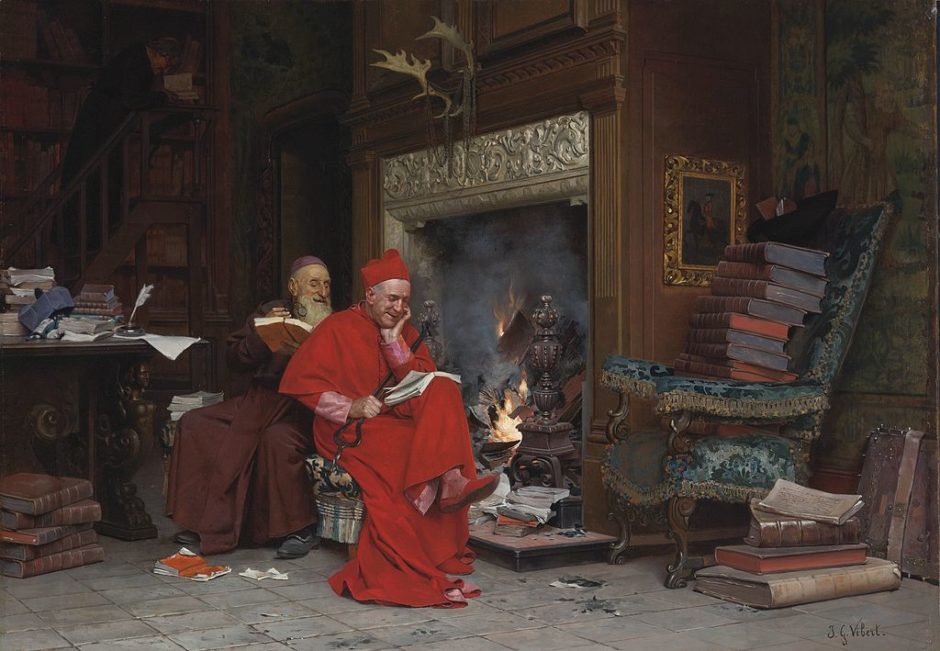
Posted in "How To..." - Practical Notes, ASK FATHER Question Box, New Evangelization, Our Catholic Identity, Priests and Priesthood | Tagged , ,
49 Comments

Robert Royal to U.S. Bishops: Be men. Be gentlemen. Be kind. Stop being nice!

From The Catholic Thing:

Quo Vadis – O, Bishops?
By Robert Royal

I am not a big fan of taking the long view. It may sometimes be wise, even necessary, in human terms. But I’m far more attracted by what is probably the most neglected of Jesus’ sayings: “I have come to bring fire on the earth, and how I wish it were already kindled!” (Lk. 12:49)

The U. S. bishops are meeting in Baltimore this week for their annual get-together. The scuttlebutt is that they will be mostly discussing matters internal to the Church in America. If they were asking my advice – for some reason, they seem to have forgotten to call – I would strongly urge that they begin with a collective session of lectio divina about kindling fires.

I’d also suggest a few other things. To start with, forget about being nice. It doesn’t work. Be gentlemen. Be kind. But forget nice. As learned Latinists, [HA HA HA HA HA HA!] you no doubt know that the word comes from nescius, which means ignorant. It came, early in modern languages, to mean foolish. Today, an idiomatic translation might be: clueless.

Kindness, of course, is a different matter entirely. Our Lord was kind – kind enough to tell people the truth. His combination of hard and soft is always what we need. Nietzsche, who was brought up among fussing women in a wishy-washy Protestant pastor’s home, emphasized the need to be hard. Like all heretics, he had a point, but rode it a bit too hard to the neglect of other truths.

Christianity, as Nietzsche noted, has been becoming overly feminized, as has the developed world. Mary is the model Christian and the people who have been pushing the Communio theology are right: our first orientation has to be passive, to receive what God is telling us as the Virgin received the Word into her womb.

Women are quite capable at times of some of the masculine virtues, of course. But forget the politically correct notion that there are no specifically male and female virtues. In the normal course of things, when the refrigerator needs to be moved, it’s father and son, not mother and daughter, who should do the heavy lifting.

And in the middle of the night, if there’s a noise downstairs that sounds like a burglar, you don’t nudge your wife and say, “Your turn. I went down to check last time.” Be men. Think big. Act big, too. Play big-league ball.

The LCWR, the media, and other softballers will continue to try to thwart you with talk of patriarchy and the old boys’ club. Be true gentlemen. Listen to all sincerely, but listen to God more.

Beware of the two great distortions, bordering on heresies, in our time:

“Judge not.” Yes, that’s in the Bible, but Christ had no difficulty also stating the difference between right and wrong. In fact, you may have noticed that there’s more than a little holy anger in the Gospels and dire prophetic warnings to individuals and whole groups. Christ is the model. Are you going to follow Him or take the easy way, the one that only seems compassionate? (See “nice” above.)

“But Jesus welcomed everyone.” Yes, he did, but on His terms, not theirs. If Christianity means just accepting everybody as they already are, indeed as they demand to be accepted – evil capitalists and mean orthodox Christians excepted, of course – why have a Church at all? The politicians are already quite prepared to tell everyone (with the same exceptions just noted) how wonderful, unless it’s “amazing,” they all are. Leave that sort of thing to the snake-oil salesmen.
Be clear about this. The person who invented the phrase, “It’s better to light one candle than to curse the darkness,” was no real Christian. Jesus does both, and Catholics are practitioners of the both/and, not the either/or.

[…]

Read the rest there.

Royal hit the nail on the head, or as the Latinist bishops would say, rem acu tetigit.


Posted in SESSIUNCULA | Tagged , , , ,
25 Comments

Do you have your 2013 Ordo for the Usus Antiquior?

Remember… Advent is coming…. FAST.

Fathers… do you have your 2013 Ordo for the Usus Antiquior as well as for the Novus Ordo.

The Roman Rite has two forms.  You should have an Ordo for both.

Posted in SESSIUNCULA | Tagged , ,
3 Comments

Brick by Brick in Brazil … Indiana. Priest starts up a TLM. People come.

For your Brick by Brick file,

Fr. John Hollowell in the Archdiocese of Indianapolis at his blog On The Rock says he has started celebrating Holy Mass in the Usus Antiquior of the Roman Rite… once a week.

I quibble with him calling it the “Latin Mass”, because the Novus Ordo can and ought to be said in Latin. But, that aside, his news is positive.

He has several videos in his blog entry.  In one of them, you can hear that the congregation is making the responses during the prayers at the foot of the altar.  Some of you will pounce on that.  That is a discussion for a different entry.  No rabbit holes.  This is about the happy event of a priest starting up the TLM in a parish.

He also says:

We’ve had a great turnout so far – we probably have two or three times the number of regular daily Mass attendees who come out for the Mass in Latin.

This is a concrete step for the New Evangelization.

Friends, I think we will be seeing more and more of this.

If the implementation of Summorum Pontificum has been slower than some would prefer, more and more young priests, the newly ordained, seminarians are interested in saying the older form of Holy Mass.  As they get ordained and as they are made pastors of parishes, we will see quite a few more places where TLM is celebrated.

The gravitational pull will increase even as the biological solution clears the way.


Posted in "How To..." - Practical Notes, Brick by Brick, Liturgy Science Theatre 3000, Mail from priests, New Evangelization, Our Catholic Identity, SUMMORUM PONTIFICUM | Tagged , ,
20 Comments

Beautiful “Adoration of the Magi” by artist Daniel Mitsui

As Christmas approaches, the esteemed artist Daniel Mitsui sent me another print, this time of the Adoration of the Magi. Very nice!

20121114-100915.jpg

A few details.

It was inspired by a 15th c. panel by the Master of the AH Monogram.

The Circumcision is depicted in the upper left.

20121114-100922.jpg

There is a millefleur pattern inspired by late-Medieval tapestry.

20121114-100927.jpg

He followed Ven. Bede’s explanation of the wisemen as representing all the races.

20121114-100932.jpg

I’m glad he included the critters.

20121114-100937.jpg

There are lots of great little details, such as OT foreshadowings of the Adoration by the Magi: three heroes bringing water to David, The Queen of Sheba at Solomon’s throne.

Beautiful colors.  As usual the photos don’t do them justice.

This would make a great Christmas present for someone (including yourself).

Contact Mr. Mitsui HERE.  Check out the other great religious art he has made.

Posted in Just Too Cool, The Campus Telephone Pole | Tagged , , ,
11 Comments
























