VP Biden’s last ditch effort to fool Catholics. Revolting.

From LifeNews:

Pro-Abortion Biden Claims He’s a “Practicing Catholic” In New Ad
by Steven Ertelt

In a last-ditch effort to get Catholic voters to support pro-abortion President Barack Obama, Vice-President Joe Biden, who also backs abortion, has released a new web ad. In the ad, he claims he is a “practicing Catholic” and he claims Obama’s record matches Catholic doctrine. [So why are the Catholic bishops suing the Obama Administration?]

“As a practicing Catholic like many of you, I was raised in a household where there was absolutely no distinction between the values my mom and dad drilled into us and what I learned from the nuns and priests who educated me,” Biden says. “We call it Catholic social doctrine: ‘Whatever you do to the least of these, you do for me.’” [This is so hard to read.  It’ll be harder to watch.]

Biden claims the Obamacare law, which funds abortions and prompts concerns over health care rationing, fulfills his claim that Obama has advanced Catholic doctrine as president. But Biden ignores the controversial HHS mandate that has sparked more than 100 lawsuits over its forcing religious groups to pay for abortion-inducing drugs and to fine them if they refuse.  [Biden said that Obamacare was a “big f-ing deal”.]

The new ad comes as at least one Catholic bishop says Biden shouldn’t receive communion because of his abortion views.

Michael Sheridan, Bishop of the Catholic Diocese of Colorado Springs, says pro-abortion Vice President Joe Biden shouldn’t receive communion form the Catholic Church — at least in his diocese.

[wp_youtube]qP5H64VYBpc[/wp_youtube]

Canon 915.

CLICK TO BUY CAN. 915 STUFF

Posted in 1983 CIC can. 915, Dogs and Fleas, Liberals, The future and our choices | Tagged , , , , , ,
62 Comments

Card.Cañizares: “It is normal to use the 1962 Missal.”

From Andrea Tornielli of Vatican Insider:

Cardinal Cañizares explains why he agreed to preside over [not just “preside over”] Saturday’s mass for faithful from the “Una cum Papa nostro” pilgrimage, in St. Peter’s Basilica
ANDREA TORNIELLI

“I gladly accepted to celebrate next Saturday’s mass for pilgrims who came to thank the Pope for the gift of the motu proprio Summorum Pontificum because it is a way to make others understand that it is normal to use the extraordinary form of the Roman Rite…[That’s right!] This was the answer Cardinal Antonio Cañizares Llovera, Prefect of the Congregation for Divine Worship, gave to Vatican Insider when asked about the meaning of next Saturday’s (3 November) mass which will be celebrated at 15:00 in St. Peter’s Basilica. This morning, the spokesman for the “Una cum Papa nostro” pilgrimage announced that Archbishop Augustine Di Noia, Vice President of Pontifical Commission Ecclesia Dei will be present at the mass.

VI: What is the point of the pilgrimage?

Card. Cañizares: “To give thanks to God and thank the Pope for the motu proprio he issued five years ago, recognising the value of the liturgy celebrated according to the missal of the Blessed John XXIII and marking continuity with the tradition of the Roman Rite. By recognising the previous liturgy one understands that reform does not mean doing away with older traditional practices.

VI: Why did you agree to celebrate mass for pilgrims who follow the pre-conciliar Rite?

Card. Cañizares: I agreed because it is a way to show people it is normal to use the 1962 missal: [Do I hear an “Amen!”?] there are two forms of the same Rite but there is only one Rite, so it is normal to use it during mass celebrations. [Did I mention that it’s normal?] I have already celebrated a number of masses according to the missal introduced by the Blessed John XXIII and I will gladly do so again on this occasion. The Congregation in which the Pope has called me to act as Prefect does not oppose the use of the old liturgy, although the task of our dicastery is to enhance the meaning of liturgical renewal according to the directives of the Sacrosanctum Concilium constitution and follow in the footsteps of the Second Vatican Council. In relation to this it must be said that the extraordinary form of the Latin Rite must draw inspiration from the conciliar Constitution which in the first ten paragraphs focuses on the true spirit of the liturgy and so is relevant to all rites.[I think some trads will freak out at that suggestion.  Perhaps they ought to read the first ten paragraphs of SC.]

VI: What is your opinion regarding the implementation of the motu proprio Summorum Pontificum, five years on?

Card. Cañizares: “I do not know the details regarding the world situation, partly because it is the Ecclesia Dei Commission that deals with this but I think that people are gradually beginning to understand that the liturgy is core to the Church and we have to revive the sense of mystery and sacredness in our celebrations. [Perhaps this could have been part of the discussion of the Synod of Bishops.] Furthermore, I believe that five years on we are able to better understand that it is not just about some faithful feeling nostalgia for the Latin Rite but about adding to the meaning of the liturgy. We are all part of the Church, we are all in one communion. Pope Benedict XVI explained this very well and on the first anniversary of the motu proprio, he recalled that “no one is unwelcome in the Church.”

Posted in "How To..." - Practical Notes, Benedict XVI, Brick by Brick, Liturgy Science Theatre 3000, New Evangelization, Our Catholic Identity, SUMMORUM PONTIFICUM, The future and our choices, Vatican II, Year of Faith | Tagged , , , , ,
14 Comments

Some Civics! In the case of an Electoral College tie…. Fr. Z POLL!

POLL BELOW

What happens if, in the presidential election, both candidates wind up with the same number of Electoral College votes? WaPo has some scenarios HERE.

Review: Popular vote does not elect a President as it does Representatives to Congress (Senators were once not elected by popular vote… we should go back to that, perhaps).

The Electors of the Electoral College elect the President and Vice President (who are not representatives of the people as much as they are executives of a federation of States). Popular vote, for the most part, designates the direction Electors must go in the actual presidential and vice-presidential election. Electors are in the individual states. They are chosen by the states and Washington DC, and they are “pledged” to cast their vote according to the popular vote in states (except I think in Nebraska and Maine, which are proportional rather than winner-take-all). Each state can have its own method of choosing Electors. Right now there are 538 Electors (the voting membership of the Congress, 435 Representatives + 100 Senators) and three for D.C.).  Popular vote normally determines how the state’s Electors in the Electoral College ought to cast their votes. The Electoral College elects the President and Vice President in two different ballots.  In theory, Electors could do their own thing in choosing for whom to vote.  Some infamous Electors have gone against the popular vote of their states.  If I remember correctly, the Supreme Court ruled that “faithless Electors” could be punished or their votes invalidated.  Thus, if some doofus elector voted for, say, Ron Paul, after Romney or Obama won the doofus’s “winner-take-all Electors” state, that doofus’s vote could be scratched and the doofus could be fined, etc.

My native Minnesota does not by law require the Electors to go by the popular vote, but neighboring Wisconsin does.

In any event, what happens if there is a tie in the popular vote of the states which ought to determine the Electoral College votes?  What then?

Let’s step back.  The Electors of the Electoral College vote on the Monday after the second Wednesday in December after the presidential election. They meet in their own states, not together in Washington. They vote for President and Vice President on separate ballots. The results are recorded on a Certificate of Vote. The state’s Certificates of Vote is sent to the Congress and to the National Archives. Each state’s electoral votes are counted in a joint session of Congress in the House chamber on 6 January of the next calendar year. The sitting Vice President, as President of the Senate, presides over the count and announces the results.

According to the Twelfth Amendment to the Constitution, Electoral College ties are resolved in a rather byzantine way, reflecting a different age of the world, for sure, but also a different role for the POTUS and VPOTUS than we sometimes imagine.  Let’s look:

The person having the greatest Number of votes for President, shall be the President, if such number be a majority of the whole number of Electors appointed; and if no person have such majority, then from the persons having the highest numbers not exceeding three on the list of those voted for as President, the House of Representatives shall choose immediately, by ballot, the President. But in choosing the President, the votes shall be taken by states, the representation from each state having one vote; a quorum for this purpose shall consist of a member or members from two-thirds of the states, and a majority of all the states shall be necessary to a choice.

Clear?

20121030-145004.jpgCan you imagine the squabbles in each state’s delegation?  California has 53 congressmen, but only vote.  The delegations of each state of the incoming, newly elected House, would have to determine among themselves how that one vote would be cast.  They’d go by a majority, I suppose.  Going by the Electoral College, California has 55 votes.  In this tie resolving scenario that number is reduced to 1, which would make California as influential as Rhode Island.  Remember: the President is the executive of a federation of States.

I think the ties for Vice President are handled in the Senate, rather than the House.  That also happened once in the early 1800’s.

Also, since in this tie scenario a party’s candidates for President and Vice President are no longer linked together, as they are on election day for us mere peons at the ballot box, the House could elect a President Romney and a Vice President Biden… or Ryan… or, I think, Obama.

Nisi fallor, the House has only elected the President once. In the early 1800’s there was a square off between Andrew Jackson, John Quincy Adams, someone else whose name escapes, and Henry Clay.  Nobody received enough votes to win outright.  Since the House could only choose from the top three candidates, Henry Clay was not eligible.  The House elected Adams, instead of Jackson, after Clay endorsed Adams. Adams then made Clay Secretary of State. Plus ça change, …. Calhoun was VP.  A lake was named after him in my native Minneapolis, by the way.

I like this system.  First, it underscores that this is a federation of States.  We have gotten away from talking about THESE United States and rather say THE United States.  “These” is, in my opinion, better though I slip on this all the time.

The federal government is encroaching on the sovereignty of States.  The Electoral College process reminds us that President is not the directly elected representative of the people, but rather an executive for the federation of States.  This is why there is an Electoral College and why, in my opinion, there should not be direct popular vote of the President of these United States.

That said, let’s have a POLL!

Please choose your best answer and give your reasons in the combox, below.

How should the President and Vice-President be elected?

View Results


Posted in "How To..." - Practical Notes, POLLS, The Drill | Tagged , , , , , , ,
81 Comments

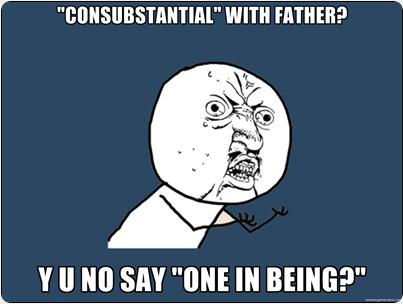
Meme Mass?

And this on the day I wrote about the Knox Bible.  Life is funny.

The amusing Eye of the Tiber has this:

Washington, DC––Citing a need for the Church to “reach out to its estranged youth,” the International Commission on English in the Liturgy requested, and has already begun intensive work on, an all-meme edition of the Roman Missal. Representatives from the Commission, unhappy with last year’s implementation of the new translation of the Missal, shared their concern that the Church is not “speaking the language of the people.” “Young people are unable to relate to [the Missal’s] rigid, academic language” said a spokesperson for the group, “and so we are taking it upon ourselves to bring them closer to the richness of the Catholic Faith through the most modern meme-linguistic-format.” Such meme-characters as “Bad Luck Brian,” “The Most Interesting Man in the World,” and “Skeptical Black Kid,” the new mouthpieces of the Roman Liturgy, would be projected on the bare walls of churches behind the altar, to allow for “full, active participation” of young people during the Sacred Rites.

Far-fetched you say?  Sure that’s satire, but consider this video, of some priests in France, isn’t of a Mass, well… you decide…

[wp_youtube]q8eau3L_py4[/wp_youtube]

Posted in Lighter fare | Tagged ,
40 Comments

Lutheran Ordinariate?

Could there be an Ordinariate for former Lutherans in a way similar to those for former Anglicans?

It is hard for me to see how. Perhaps it could be possible.

From CWN:

The president of the Pontifical Council for Promoting Christian Unity said in an interview that the Vatican would entertain a hypothetical proposal by Lutherans to establish ecclesial structures modeled on the ordinariates developed for Anglican communities that wish to enter into full communion with the Holy See.

Anglicanorum coetibus was not an initiative of Rome, but came from the Anglican church,” said Cardinal Kurt Koch, referring to the 2009 papal document that established the ordinariates. “The Holy Father then sought a solution and, in my opinion, found a very broad solution, in which the Anglicans’ ecclesial and liturgical traditions were taken into ample consideration. If similar desires are expressed by the Lutherans, then we will have to reflect on them. However, the initiative is up to the Lutherans.

Cardinal Koch also said that both “‘progressives and traditionalists suffer from the same ailment”: a refusal to interpret the Second Vatican Council with a hermeneutic of “renewal in continuity.

Both see the Council equally as a break, even if in a very different way,” he said. “The Holy Father has questioned this understanding of the conciliar hermeneutics of the break and proposed the hermeneutics of reform, which unites continuity and renewal.”

Benedict XVI is the Pope of Christian Unity.

Fuller article with Card. Koch’s comments HERE.

Posted in Pope of Christian Unity | Tagged , , , , , , ,
30 Comments

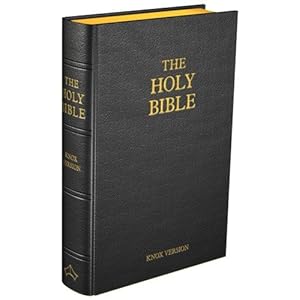
Baronius Press beautiful new edition of the Knox Bible

While preparing my post about Faith Magazine, I saw an article about Ronald Knox.

That reminded me that Baronius Press recently sent me a copy of their new, beautifully bound, edition of Knox’s translation of the Bible.

US HERE and UK HERE.

Some very smart people I know use the Knox translation often, even daily. As a matter of fact, two of the smartest people I know use it all the time. One of them told me “It’s THE most beautiful translation of the Bible in the English language.”  Fulton Sheen used the Knox version when quoting.

The Knox translation is not everyone’s cup of tea if they are into philology. It will be your cuppa, however, if you are longing for poetry in your reading of the Word.

Let me give you a sample from the beginning of the Book of Wisdom:

Listen, all you who are judges here on earth. Learn to love justice; learn to think high thoughts of what God is, and with sincere hearts aspire to him. Trust him you must, if find him you would; he does not reveal himself to one that challenges his power.  Man’s truant thoughts may keep God at a distance, but when the test of strength comes, folly is shewn in its true colours; never yet did wisdom find her way into the schemer’s heart, never yet made her home in a life mortgaged to sin. (1:1-4)

Sumptuous.

Let’s have a look at the new book from Baronius.

20121030-103202.jpg

Gold pages and two ribbons.

20121030-103208.jpg

Nice paper.

20121030-103213.jpg

Densely printed, no frills.

Yes, it is that really nice “bible paper”.

20121030-103218.jpg

They include Knox’s comments.

20121030-103223.jpg

There is also a preface by Scott Hahn.

This is a nice, but few frills, edition. There are no indices.  Baronious just printed the Knox Bible, without lots of additions.

The Baronius site cites Evelyn Waugh, who said:

It is unquestioned that for the past 300 years the Authorized Version has been the greatest single formative influence in English prose style. But that time is over …. When the Bible ceases, as it is ceasing, to be accepted as a sacred text, it will not long survive for its fine writing. It seems to me probable that in a hundred years’ time the only Englishmen who know their Bibles will be Catholics. And they will know it in Msgr. Knox’s version.

The Baronius site continues, explaining that…

[Knox’s] three aims were: accuracy, intelligibility, and readability. He was loyal to these principles without sacrificing the rhetorical power of the original and while deliberately keeping a few of the well loved archaisms in the text. He preferred lucidity to poetry, but as one of the finest literary craftsmen of 20th century England he avoided falling into banality.

Knox wrote a book On Englishing the Bible in which he explained himself (UK HERE).

I wonder what he would have thought of the translations of Holy Mass.

Perhaps I will add some reading from the new Baronius Knox Bible as one of my Year of Faith projects.

This would be a great gift for a priest or seminarian… along with a biretta.

Posted in Just Too Cool, The Campus Telephone Pole | Tagged , , , ,
24 Comments

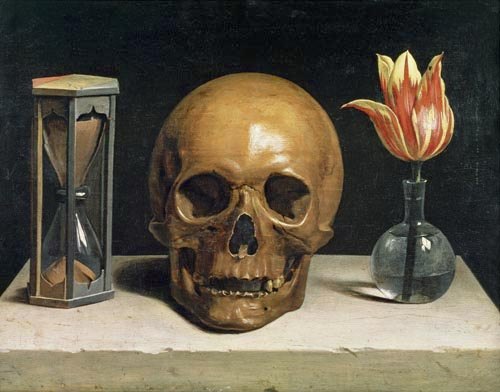
Memento mori!

Over at the amusing and often useful blog Art of Manliness there is a post about Memento Mori art.

“Memento mori!” means, “Be mindful of death!” or “Don’t forget that you are going to die so repent, confess your sins, and live a virtuous life!”

Here is a shot I took recently of a well-known sight in the Via Giulia in Rome (which I will probably see again soon).

Today, it’s my turn.  Tomorrow, it’s yours.

There are some good images over at the aforementioned blog.  Check them out.

The “Memento mori!” theme is often connected with the vanitas vanitatum theme in art, depicting the passing things of this world.  Even in many still life paintings (in Italian natura morta) there will be perhaps rotting fruit or wilting flowers.  They often aren’t in the painting merely so that the painter can show off his technique.

Treasure up your treasure in heaven, friends, and never put any created thing – even a person whom you love – on the highest throne of your heart.  God alone cannot be lost. In the hierarchy of our loves, God must have the highest place.  Only when God has the highest place in our lives can all our other relationships be rightly ordered.  This is why what we owe God by the virtue of Religion is so important.  This is why without a revolution in our liturgical worship all the initiatives of a new evangelization will far short.

Remember that you are going to die. You too, you Fishwrap editors, writers, readers. You too, you Tablistas.

So…

GO TO CONFESSION.

Ask yourself.  Is it really worth it to delay going to make a good confession?  Really?

As you look at the image, list, O list, to Liszt:

[wp_youtube]GBXA1tBiLw[/wp_youtube]

Posted in "How To..." - Practical Notes, Four Last Things, GO TO CONFESSION, New Evangelization, Our Catholic Identity, The future and our choices, Year of Faith | Tagged , , , , , , ,
11 Comments

Faith Magazine – a great resource!

Do you know about Faith magazine?

Faith is assembled and published as an actual magazine in England.  It is also offered entirely for free online.  Online you get the whole thing, not just selected articles.

Faith, the magazine, is associated with the “Faith Movement“.

Most of you readers will know automatically that if my friend Fr. Tim Finigan (see his blog The Hermeneutic of Continuity) is involved with Faith then it is more than likely not only theologically trustworthy, but also exceedingly useful.

You can look at and download back issues HERE.

Catholic publications are struggling to stay afloat.  Consider a subscription to a hard copy.  (They need to make that subscription link more apparent.) Yes, you can get the whole thing for free, but if they don’t have some cash flow, it will become harder and harder to provide it online.  Support the good Catholic publications.  I think we can argue that supporting sound Catholic publications, and blogs, is a spiritual work of mercy.  Many people benefit when we pool our resources and small gestures can accomplish large things.

In this Year of Faith subscribe to Faith.

UPDATE: 

People are saying that it is a little clunky to use the subscription feature.  Be patient.

Posted in "How To..." - Practical Notes, Brick by Brick, Our Catholic Identity, REVIEWS, The Campus Telephone Pole | Tagged ,
1 Comment

A critical look at the Synod and its aftermath

From The Catholic Thing comes a piece by Robert Royal in which he looks with a critical eye at the closing propositions of the Synod of Bishops.

My preface: The problem with criticizing the Synods of Bishops is that, by negative comments, you give ammo to liberals.  Liberals will squawk that greater power ought to have been given to this collegial body.  Liberals want to limit the power of the Roman Pontiff and the Roman Curia and extend greater governance of the Church to the college of bishops and the laity who should elect the bishops.  “If a Synod doesn’t do anything important,” they’ll say, “then it must be given more power so that it can do something!”  So, to criticize a Synod as ineffectual plays into the liberals’ hands.

That said, let’s have a peak at Royal’s piece.  He buries the lead, unfortunately, so let’s skip down a bit.

Sin and the Synod
By Robert Royal

[…]

Despite wide-ranging aims, there’s an awful lot that seems missing. [Yes.  Indeed there is.] Most significantly, the documents and proceedings rarely seem animated by what the Rev. Martin Luther King, Jr., once called “the fierce urgency of now.” And he was only talking about the Vietnam War; the bishops are dealing with the eternal destiny of souls. [To be fair, closing propositions of Synods aren’t usually informed by fire in the belly.  Come to think of it… neither are Synods.  Quaeritur… which actual Synod of Bishops made much of a difference?]

That’s evident in the forty-five “Propositions,” the final document passed by the Synod and passed on to the pope as he prepares the post-Synodal Apostolic Exhortation.

Cardinal Dolan remarked that the Synod participants wanted to make its other closing message (“to the People of God”) “positive, uplifting, evangelical” – generally a good approach in the modern world. But the Church needs something more if it hopes to cut through our cultural pandemonium.  [Royal might have, however, underscored Dolan’s intervention at the Synod about restoring the Sacrament of Penance.]

It may not be easy for the bishops to say openly, but our situation in a secularized world is not, as the Synod “Propositions” claim, “similar to that of the first Christians.” The early Christians lived in a pagan society untouched by the Good News.

Our culture is deeply shaped by rejection of that News and by a sustained effort to live life on explicitly non- or even anti-Christian grounds.

If we are not absolutely clear about that, much effort will be simply wasted.

The Synod also affirms that, “The message of truth and of beauty can help people escape from the loneliness and lack of meaning to which the conditions of post-modern society often relegate them.” Quite true. But these are only social and psychological problems that even non-Christians deplore.

[This is good…] When the text tries to say why the Faith is important per se, it speaks of “the splendor of a humanity grounded in the mystery of Christ” and other idealistic, but vague, aspirations. Can we no longer say that there is “no other name” in which we are saved, no other Person who can satisfy the human heart?

If we can’t say it, we can’t expect the world to believe it.

Speaking of being saved: a non-Catholic reading the “Propositions” would have a hard time knowing what there is to be saved from, religiously speaking.  [I think it is called “damnation”.] Violence, war, individualism are condemned and there is call for reconciliation; human rights, religious liberty, and freedom of conscience are affirmed. But even the gentiles largely agree with us about all that.

What’s not mentioned in the final documents? Pornography, sex (“sexuality” gets one mention, not the same thing, of course), drugs (though there are warnings about violence due to drug trafficking and drug addicts as among the new “poor”), materialism, and much else that you would think come high on any general list.

And sin. Sin does appear a few times, but it seems to be mostly an obstacle to justice and progress, and a factor in poverty and social exclusion. (Proposition 19)

Brief sections on conversion and holiness follow, and they are related to efforts needed in the new urban societies, parishes and “other ecclesial realities,” education, the option for the poor, and care of the sick.

There’s nothing wrong with this list, but is this an exciting “New” Evangelization?  [No.]

We’re well down to Proposition 33 before the sacrament of penance puts in an appearance and “a full reconciliation through the forgiveness of sins.”  [Who knows if the Propositions are in order of urgency?]

Bless me Synod Fathers, but it’s not a good idea at this point to add, “Here the penitent encounters Jesus, and at the same time he or she experiences a deeper appreciation of himself or herself.” [?!?] We know what you mean – I think – but you are flirting with some of the very forces you’re trying to overcome.

Why did God have to become man and die on a Cross for that?

Ten concluding sections of intra-Church activities follow: Sundays, liturgy, [Oh by the way.. liturgy…] the spiritual dimension, confirmation, baptism, popular piety etc., as related to the New Evangelization. Much of this appears in any Church document and Benedict will not spend much time contemplating these propositions when he prepares his Post-Synodal Exhortation.  [Do I hear an “Amen!”?]

I’ve remarked in this column before that what large-scale events like this mean in the life of the Church depends on what gets done when the talking stops. The mere fact that the Synod occurred may give participants and millions of others a new energy and fervor.  [This is my fear for the Year of Faith and New Evangelization.]

The bishops were right to say that the “primacy” in evangelization lies in “God’s grace.” It always flows – abundantly. Let’s hope the Church uses it – wisely.

Robert Royal is editor-in-chief of The Catholic Thing, and president of the Faith & Reason Institute in Washington, D.C. His most recent book is The God That Did Not Fail: How Religion Built and Sustains the West, now available in paperback from Encounter Books.

Once cheer for the Synod!

Now let’s see what actually gets done.

First, we will have to see how long it takes for the Post-Synodal Exhortation to come out.  Then we will have to see just how much the Post-Synodal Exhortation refers to the synodal propositions.  Then we will have count the days before the Exhortation is forgotten.

Remember Sacramentum caritatis?  I do.  I don’t think many other people do.  There were some good things in that document, including the discussion of ars celebrandi which I see pop up all too rarely.

We have to admit that Catechism of the Catholic Church was prompted in a Synod.  However, baseball insiders think that the idea was actually planted by curial officials through interventions at the Synod.  And there are more than one story about who actually proposed the CCC.  But I digress.

The problem with synodal propositions, and the documents that subsequently come out over the Holy Father’s name, are temporizing, non-committal, tentative.

The discussion Bp. Athanasius Schneider caused by his intervention at the 2005 Synod was a good thing.

Perhaps Card. Dolan’s plea about confession will get some play and not just be buried under the avalanche of banality that followed while the Synod slouched to its close.

Posted in New Evangelization, The Drill, The future and our choices, Year of Faith | Tagged , , , ,
17 Comments

An unexpected place in an unexpected place!

I have been reading another dystopian novels by James Wesley Rawles, Founders. (The first in the series is Patriots, the next is Survivors.)

I was pretty surprised to read this paragraph, about a couple who wind up being part of a principle vector of the plot as they escape from Chicago when the global economic collapse destroys our way of life.

The Laytons attended St. John Cantius Parish church in Chicago, three miles from their home. The trip to church was a straight shot up West Ogden Boulevard that took less than ten minutes. They had chosen to worship there because they celebrated Mass in Latin. The church’s brochure and website read: “St. John Cantius Parish is also privileged to offer daily the Holy Sacrifice of the Mass in the Extraordinary Form of the Roman Rite, commonly referred to as the Tridentine Latin Mass.” The Latin Mass meant a lot to Ken because that was his parents’ preference, and he had grown up hearing it. His parents were part of what was then a “renegade” church— back when the Latin Mass was banned. Terry was also raised Catholic, but had never attended a Latin Mass until just before she married Ken. She grew to love it. They decided that when they had children, they would give them a classical homeschooling, and include Latin in their curriculum.

The books give you a lot to think about.  Those links, above, will take you to a page where you can buy them.

Posted in Global Killer Asteroid Questions, Just Too Cool, TEOTWAWKI | Tagged , , ,
9 Comments