“It seemed like a good idea at the time….” – the new John Paul II “statue” in Rome

I was dying to find out the reaction to the new “statue” of John Paul II near Rome’s train station.  It is, in my opinion, horrendous.  In the pages of the Vatican’s newspaper L’Osservatore Romano there is a short blurb about this new blotch on the City.  Given the way L’OssRom has in the past gotten nearly everything wrong about the ultra-pro-abortion Pres. Obama, I figured I might find a pseudo-intellectual justification for the statues great thought-provoking depth.  It’s have provoked my thoughts, I’ll tell you.  But I digress.

In a piece by Sandro Barbagallo I read the acknowledgement that the face perched ominously on top of the menacing open-refrigerator-like glob, has “only a distant resemblance” to Bl. John Paul.  “In sum, the result does not seem to at the level of the intention.” Later, it says that the head is “excessively spherical”.

When sketches had been presented, the symbolism seemed clear.  And an idiot can figure out what this ugly thing was supposed to be saying to the onlooker. The writer also raises the point that, perhaps, given where it is situated and the number of people who will go past it the statue of Pope John Paul II could have been made in such a way that it resembled Pope John Paul II.

In an AP story I found these great quips.

Vatican spokesman, the Rev. Federico Lombardi, confirmed that the sketch “received a positive opinion by the culture commission” of the Holy See. What happened between sketch stage and the final result, he couldn’t say.

A Rome cleaning woman ventured some practical objections, as well as artistic. “With the shape of a cape, sooner or later the homeless people at the station will sleep inside it, and in no time, it will be full of bottles of beer,” said Grazia Liberti, 46, returning home after her night job.

It seemed like a good idea at the time….

Posted in Lighter fare, Throwing a Nutty | Tagged , , , , , ,
44 Comments

“The older rite is here to stay” – analysis of Universae Ecclesiae by Alcuin Reid

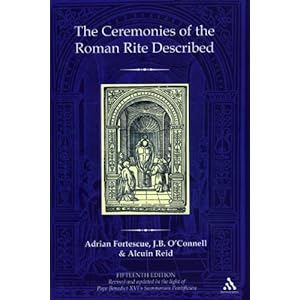
There is a piece on The Catholic Herald‘s site (full disclosure: I write regularly for CH now) about Benedict XVI’s provision in Summorum Pontificum and Universae Ecclesiae by Alcuin Reid who reedited Fortescue/O’Connell Ceremonies of the Roman Rite Described.

My emphases and comments.

The Pope has made clear the older rite is here to stay

By Dr Alcuin Reid on Friday, 20 May 2011

It may seem rather odd that Pope Benedict XVI?has expended so much energy on rules about the use of the old “Latin Mass” – after all, it would appear that most Catholics are content with the modern liturgy in the vernacular. [Which, to date, they really have never experienced.  The new translation will help to change that.  But… quaeritur…] Why, then, yet another set of rules from Rome in this Instruction?

The answer is found in the fact that, as the Instruction insists, the older rites are a “precious treasure to be preserved,” and that the Holy Father wants to offer this treasure “to all the faithful”, not as a quaint museum piece but as a living source of life and grace for the whole Church of today and into the future. All laity, clergy and religious should have access to its diverse riches. [The clear implication is that all should be exposed to the traditional Form.]

These latest rules envisage the inclusion of recent saints and some new texts in the older liturgy. They even foresee new editions of the missal and other liturgical books of the older rites: the older liturgy will continue to exist [attetnion…] and develop as it has over the centuries up until the Second Vatican Council. But it cannot, however, now have certain modern practices (altar girls, extraordinary ministers of Holy Communion, etc) imposed on it. Its integrity is guaranteed[NB: He doesn’t seem to think that the inclusion of new texts puts its “integrity” at risk.  Neither do I, depending on the texts, of course.  How can the inclusion of new saints harm its integrity?  How can the option of some additional prefaces be harmful?]

Of course, there are historical realities behind this Instruction and the 2007 Motu Proprio Summorum Pontificum which it clarifies. [1] In the first place there is the controversy over the liturgical changes that followed the Council. [Many changes were not foreseen by the mandates of the Council Fathers.  But… quaeritur…] Were they a legitimate development or did they involve a rupture with tradition? Neither of these documents settles that question, but the Instruction does, significantly, speak of the development of the Missale Romanum “until the time of Blessed Pope John XXIII” and of the “new Missal” approved for the Church in 1970 by Paul VI. [Sounds rather like a rupture.  No?] This authoritative recognition of a clear distinction between the two – both of which, the Instruction maintains, must be seen to be legitimate and valid – does admit a clear “difference” between that of Paul VI and what came before. Discussion of the implications of this will continue.  [Ever since Summorum Pontificum came out, I have argued that the Pope provided a juridical solution to the relationship of the EF and OF, but he did not settle the issue of whether there were two distinct rites. In Universae Ecclesiae, which moves the discussion into more theological grounds, with its reference to Summorum Pontificum as part of the Holy Father’s Magisterium, perhaps we are moving closer to an answer.]

[2] And then there is the more recent historical reality of widespread opposition to the use of older liturgical rites (not just the Mass, but the sacraments and the blessings and so on, as the Instruction makes clear) on the part of bishops, religious superiors and priests. That is why the Instruction was necessary: even after Summorum Pontificum established that in Church law everyone who wants the older liturgy is entitled to it, this opposition continued, sometimes [often] from high-ranking prelates. This Instruction underlines these rights and makes explicit what was implicit in Summorum Pontificum, namely that if these rights are denied Catholics, be they laity or clergy, have the right of appeal (“recourse”) according to the norms of canon law. It is unusual for Rome to advertise this in an Instruction, but in the light of the opposition it seems necessary.

One of the principal areas of dispute has been what constitutes the “stable group” that is required to request regular public celebrations of the old liturgy. The Instruction dismisses the various straw men put up since Summorum Pontificum in order to block requests for the older liturgy and insists that these groups can be small, can come from different parishes or even dioceses and that they can exist only for the purpose of worshipping the old rites. [And let it not be forgotten that the priest himself can be part of the small, stable group.]

This generosity of interpretation, which runs throughout the Instruction, is a fundamental principle in interpreting canon law: when ecclesiastical authority (the Pope in Summorum Pontificum) grants a favour for the good of people (the continued use of the older liturgy) it is to be applied generously and not restrictively. [odiosa restringenda, favorabilia amplianda]

One issue not resolved by this Instruction is what the older rites are to be called. It uses “ordinary form” and “extraordinary form” as well as “Antiquior Usus” (the “more ancient use”) of the Roman rite. [NB] Some commentators have insisted on an interpretation of “extraordinary” that is quite pejorative: the older rites have been regarded as an eccentric relative, mention of whose existence brings about a knowing smile and with whom close contact is seen as a risk. There is no foundation for this in either Summorum Pontificum or this Instruction. The terms “ordinary” and “extraordinary” are used in a sense of what is statistically normative, that is all. [Well… okay.  That is a good guess at what the Instruction means by Ordinary, though the Instruction does not say… which in itself is very interesting.  The Instruction does say, however, that the two forms are “alongside” one another.] Indeed, in the Latin text “ordinaria” and “extraordinaria” are not capitalised, whereas “Antiquior Usus” is. Given the derogatory use to which “extraordinary form” has been put, it is probably time to set it aside in favour of “the more ancient rites” or some such terminology. [A matter for discussion.]

There are, I suggest, two areas in which the Instruction is weak. [1] The first is in its assertion that seminarians should be given the opportunity to learn the older rites “where pastoral needs suggest it”. Some bishops will use the latitude permitted here to exclude such formation from seminaries. That will only serve to impoverish seminarians’ overall liturgical formation, for regardless of whether a diocese has a clear “pastoral” demand for the older rites, experience and knowledge of them on the part of future priests cannot but serve to enrich their grasp of liturgical theology and spirituality, and lay a good foundation for their liturgical ministry, even – perhaps especially – in the new rites.  [I agree.  This is a weakness.  However, it is understandable that in Japan there may not be quite as pressing a need as, for example, at Allen Hall or the North American College.  “But Father! But Father!”, I can hear the traddies yelling.  “Japan needs the old Mass too!”.  Yes, I agree.  It does.  It is a global need.  But we build brick by brick.  Still, I think that paragraph was a bit bloodless..]

[2] The other weakness is the Instruction’s curious restriction of the older rites of ordination to those communities supervised by the Ecclesia Dei commission in Rome. This denies diocesan bishops the pastoral freedom to judge which rite of ordination is best; it may discourage vocations. Priests have this freedom in respect of celebrations of the Mass and other sacraments: why this ungenerous restriction on bishops? [I have argued that most seminarians would want to be ordained in the older form.] Also, communities who are not under the Roman commission but who permanently use the older liturgy in accordance with Summorum Pontificum could find themselves having to use the new ordination rites. This is an anomaly that needs to be addressed.  [I hope that, soon, a diocesan bishop asks the PCED to grant permission for him to ordain his diocesan priests with the older book.]

These concerns aside, the Instruction Universæ Ecclesiæ underlines the fact that the older Roman rites are here to stay. When Cardinal Joseph Ratzinger was elected pope I wrote that “there is little doubt that we shall see freedom granted to the traditional Latin Mass”. That has now more than come to pass, and decisively. [Do I hear an “Amen!”?]

It may seem strange that this matter is a priority for Pope Benedict. But we need to remember, as he wrote in 1997, that “the true celebration of the sacred liturgy is the centre of any renewal of the Church whatever”. In the Holy Father’s judgment, free access to the Usus Antiquior is a necessary component of such renewal.  [I call it “the tip of the spear”.]

Dr Alcuin Reid is a cleric of the Diocese of Fréjus-Toulon, France, and editor of Ceremonies of the Roman Rite Described

Good analysis and he is surely correct about most of his points.  Even his guesses are rooted in sound reasons.

There won’t be a New Evangelization without a renewal of our worship.

Posted in "But Father! But Father!", Brick by Brick, Linking Back, New Evangelization, Our Catholic Identity, SUMMORUM PONTIFICUM, The Drill, The future and our choices, Universae Ecclesiae | Tagged , , , , ,
24 Comments

Wm. Oddie on the “tertium quid”

In the UK’s best Catholic weekly, The Catholic Herald, William Oddie has a piece today following up on the reports surrounding the Instruction on Summ0rum Pontificum, Universae Ecclesiae.

Let’s see some of it with my emphases and comments.

The Pope’s ambition, a powerful blend of the Novus Ordo and the Old Rite, could sweep the Church

There are too many difficulties attending both the Novus Ordo and the Old Rite

By William Oddie on Friday, 20 May 2011

An extremely interesting story by John Thavis – which appears currently on the Herald’s homepage under the headline “Pope’s ‘reform of the reform’ in liturgy to continue” – reports what seems to me a potentially wondrous proposed advance. But will it happen? There is a danger that what amounts to an entirely new proposal of a fresh liturgical development, going beyond both the Ordinary and the Extraordinary forms of the Mass to something possibly better than either, will sink without trace: so here’s my two penn’orth towards getting it noticed and talked about, and I hope acted on. Here’s what Cardinal Kurt Koch, president of the Pontifical Council for Promoting Christian Unity (of all things) said on Sunday:

“The Pope’s long-term aim is not simply to allow the old and new rites to co-exist, but to move toward a ‘common rite’ that is shaped by the mutual enrichment of the two Mass forms.”

The fact is that both existing forms, as at present celebrated, lack something. Much has been alleged and lengthily spelled out about the defects of the Novus Ordo, so I say nothing about them here. But the Old Rite (I intend to call it that in future: “Extraordinary Form” sounds like a physical defect of some sort) also presents its difficulties, if for no other reason than that it has become so unfamiliar to many if not most people. I have always thought it nonsensical and wrong that the Old Rite should be banned in the aftermath of Vatican II; the liberalisation of its use following Summorum Pontificum was long overdue. But the great and undoubted riches of the Old Rite, it has seemed to me since I recently began to attend it on Sundays, are impeded from re-entering the mainstream of the Church’s liturgical life by an almost insuperable barrier. It’s very difficult indeed for anyone not actually brought up with it (and that’s a large and growing proportion of congregations these days) to find out what is actually going on, except at certain key points when bells, the elevations and so on, indicate it unmistakeably.  [I don’t know about that.  I think quite a few young people get it pretty well after having been a few times.  It isn’t rocket science.]

Though I have been moved by the powerful atmosphere of devotion surrounding the celebrations of the 1962 Mass I have attended, especially during the silent prayer of consecration itself, I have struggled during most of the celebration to pinpoint what point in the Mass we have actually reached: just where I am and what is happening. [Certainly easier during Sung and Solemn Masses.] I have the text there in front of me, in both English and Latin: but when the Mass is being “said”, either virtually inaudibly or in total silence, it’s easy to get lost. [Really?  It is easy?] Look, this isn’t in any way a negative reaction. But it is a difficulty. I will just have to persevere. But it’s discouraging. I had already studied (and been greatly moved by the beauty of) the text. There were some landmarks in it I was watching out for, for instance that wonderful opening declaration “Introibo ad altare Dei”: but I never even heard it the first time, and still haven’t. We were miles past it when I caught up. Now, as I say, I will need to persevere: but most people who don’t have a long acquaintanceship with the old Mass and how to attend it will be put off. And that is a very great pity.  [I direct the reader’s attention at this point to my own discussions of ars celebrandi and the mutual enrichment theme.]

So the idea of a “common rite” that is “shaped by the mutual enrichment of the two Mass forms” is very attractive to me. The Novus Ordo, celebrated in Latin as a High Mass (as it is in what I am fortunate to be able to say is the church I attend on Sundays, the Oxford Oratory), is very moving as it is. To add, for instance, the whole introductory rite of the old Mass, asperges and all, would immensely enrich it even further. [The Novus Ordo foresees that.] In a new translation (which would have to be done to the same standard as that of the awaited translation of the Novus Ordo) it would help at churches which are, at the moment, liturgically struggling to get to the point of devotional take-off (I’m assuming, of course that there’ll be no guitars around by then: if there are, better for them to stick to the Novus Ordo we have rather than compromise the “enriched” form I look forward to having).

Meanwhile, the struggle to establish, often against the obstruction of local bishops, the absolute right of those who wish for it to have the old Mass, continues. As a story on this home page reports:

[…]

I have two motives in harrying the bishops in this matter: first, it’s a matter of justice: those who want the old Mass now have an actual right to it, and it’s the bishops’ pastoral duty actually to facilitate the implementation of that right. Second, the more the Old Rite is celebrated, the more likely, perhaps, will become what I would really like to see: a new rite, in which the best of the Novus Ordo (including two of the three new Canons) would be retained, with the whole liturgy enhanced by the riches of the Old Rite, now clearly and audibly celebrated for the first time: that could be a liturgical wonder which would sweep the Church.

I prattle, of course. There are too many enemies of any real “reform of the reform”, and they are too powerful, for any such thing to get off the ground anytime soon. Aren’t there? All the same, according to the Herald, Cardinal Koch says that this and nothing less is “the Pope’s long-term aim”. But how long is “long-term”? There’s the question. Ah, well.

I cut some, as you can see.  Read the whole thing there.

He is clearly an advocate of what I call the tertium quid.  But he seems to be suggesting that the tertirum quid should be created, rather than allowed to develop.

Posted in SUMMORUM PONTIFICUM, The Drill, Universae Ecclesiae | Tagged , , , , , , ,
26 Comments

QUAERITUR: A priest’s lack of reverence and fear of saying anything to him

From a reader:

At our daily NO Mass after the priest raises the Host and after raising the Chalice he never genuflects but merely bows by a slight inclination of his head. In addition before he begins the Offertory he adds the water to the wine. Might I add that throughout the Mass there is continual substitution of Creator God for Father etc. though not in the main prayers of the Mass–a “fishers of people” type thing. So the New Translation won’t mean much for this Mass! None of us dare say anything as I think there is pressure to discontinue this Mass altogether and it is the only early Mass for the working folk. So, is this an invalid or an illicit Mass? BTW there is no physical impairment to prevent the priest from genuflecting. Thank you, Father!

It is not invalid, though what the priest is doing is liturgical abuse.

If you are talking about “none of us dare”… that suggests that there are at least a few people who are upset by what this irreverent priest is doing.

If this Mass is in a precarious state on the schedule, and you don’t want to risk doing something to lose it, then get everyone together whom you know to be upset by this priest’s lack of respect for the congregation, for the Church’s liturgy, and for God, and make a pact just before Mass begins to pray to the priest’s guardian angel asking him to nag the priest into reverence, to move circumstances in his life so that he begins to see the point of being more reverent in his celebration of Mass and more respectful for the congregation.

Posted in "How To..." - Practical Notes, ASK FATHER Question Box, Liturgy Science Theatre 3000 | Tagged , ,
8 Comments

Friday meatless lunch. Not difficult.

Fridays are days of penance, which in the normal course of things means not eating meat.

Which also means that it is the only day I really want a cheeseburger.

Instead of a cheeseburger, for lunch I had these.

Homemade….

20110520-115641.jpg

And…

20110520-115650.jpg

How do you usually perform your regular Friday penance?

This is part of our Catholic identity.  It is also an obligation.

Posted in Fr. Z's Kitchen, Our Catholic Identity, The future and our choices | Tagged ,
39 Comments

Thanks due

I had an open intention today, so I said Mass again for benefactors, including some folks who sent donations since the last time I did this:

SV, JW, TS, AB, DM,
RN, AB, NM, RB, ER,
MC, KP, LS, MK, CS

Also, thanks to a seminarian who sent a couple items from the wishlist.  I will enjoy the linguine!

I was amused by a comment in my email from a reader who really didn’t like the new statue of, I think, John Paul II unveiled in Rome recently.

Can you add a ‘Donation’ button on your site so we can chip in money toward the ANFO and Det cord that it will take to destroy this pathetic blasphemy?

To the 17 National Security agencies reading this, I have no interest in ANFO and Det cord.  I would prefer repeated lightning strikes to melt it into a glowing puddle.

FUSO SUBITO!  FUSO SUBITO! FUSO SUBITO!

I wonder if frequent use of the donation button here, would result in lightning there.

[Where’s Vincenzo when you need him?]

Posted in SESSIUNCULA |
Comments Off on Thanks due

New statue of John Paul II in Rome – WDTPRS POLL

At Rome’s main train station today, the Stazione Termini, there was unveiled a 5 meter high bronze statue of Bl. John Paul.

What do you think of this statue?  Romans are divided, but not equally divided.

[wp_youtube]_QPxfoLx1SQ[/wp_youtube]

Chose your answer and leave a comment in the combox.

What do you think of the statue of John Paul II?

View Results

UPDATE:

The Roman daily of Corriere della Sera has a poll of its own.  HERE.

Posted in POLLS | Tagged , ,
218 Comments

OLDIE PODCAzT 30: Augustine on Peter and John; singing a Tridentine Requiem; St. Peter Celestine V

This time we hear St. Augustine of Hippo’s tr. 124 on the Gospel of John, in which he explores what Christ meant when He told Peter to follow Him but told John that He would have to stay until He came.

Also, I sang a “Tridentine” Requiem today for Msgr. Richard Schuler, whose 30th day after death has arrived. I have audio clips.

You might just hear a version of the Our Father in Latin sung in a tone you haven’t heard before if you haven’t been to a Requiem cantata.  In the Extraordinary Form for sung Masses on ferias and for Requiem Masses the priest sings the Our Father in a simpler tone, as also he does with the Preface.

We also dig into why St. Peter Celestine V, Pope (+1296) winds up in Dante’s Inferno.

Posted in Linking Back, Patristiblogging, PODCAzT, The Drill | Tagged , , , , , ,
6 Comments

The Feeder Feed: some variety

Here is some variety from the Feeder.

Here is Indigo Bunting.

Mrs. and Mr. Cardinal visited together!  I am glad to see he finally found a gal.

Here is Harris’s Sparrow.

Here is White-Throated Sparrow.

Here is Irritated … er um … Purple Finch.


Posted in The Feeder Feed | Tagged ,
9 Comments

Mass said for Osama Bin Laden?

The Canonical Defender himself, Dr. Ed Peters, has an interesting post on him interesting blog, In the Light of the Law.  My emphases.

A request for Mass to be celebrated for the repose of Osama Bin Laden’s soul that was printed in a Florida parish bulletin has irritated a number of people. Let’s try to sort it out.

First, it is obvious to the point of palpable that Catholics are free to pray for anyone, living or dead, and that such prayers are exercises in charity. CCC 958, 1032. Therefore, it is wrong to discourage others from praying for any human being.*

Second, a priest is free to offer Mass for anyone, living or dead. Canon 901, CCC 1371. The Pio-Benedictine restrictions against offering public Masses for certain persons (e.g., excommunicates per c. 2262) no longer bind. The faithful may now offer stipends for such Masses and priests may accept such stipends. Canons 945-946. A non-Catholic’s (let alone a non-baptized person’s) name should not, however, be proclaimed during the Eucharistic prayer. Ecumenical Directory (1993) n. 121.

These things being understood, however, it is, I suggest, a bit facile to conclude that Osama Bin Laden’s (or Hitler’s, or Stalin’s, or some other mass murders’) name should be printed in the parish bulletin as the object of a Mass intention.

Publishing the name of the person(s) for whom Mass is being offered is not required for the liceity, validity, or efficacy of either the stipend or the Mass. A pastor is free, therefore, to decline such publication according to his prudent judgment, and a bishop is free to issue wider particular directives in such matters if he deems it useful. Canons 381, 392, and 519. If the parochial printing of certain names as the objects of Mass intentions becomes a distraction to the faith community, instead of its serving as teaching moment, diocesan bishops might have to step in.

* I think it would offend pious ears to pray for canonized Saints and for those proclaimed Blessed (excepting those merely named Servant of God or even Venerable), but that might just be me. +++ [Not just you.]

Has anyone else seen Masses for the repose of the soul of Osama bin Laden?

Posted in "How To..." - Practical Notes | Tagged , , ,
83 Comments