“And with your spirit”

From the Catholic Herald, the UK’s best Catholic weekly, with my emphases and comments.  I edit because of length.  The author, Fr Milner died in December, [Stop now, dear reader, and say a prayer for the author.] a few months after writing this article.

Why ‘and with your spirit’ is right

Fr Austin J Milner OP explains the rationale for one of the most striking and controversial changes in the new English Mass translation

By Fr Austin J Milner OP

Perhaps one of the most difficult of the changes which people will be asked to make when the new translation of the Roman Missal comes into use will be that from “And also with you” to “And with your spirit”. People have got used to the former. It makes good sense. Why change it?

“And with your spirit” is the literal translation of et cum spiritu tuo, which itself is a literal translation from the Greek. This phrase, whether in Greek or in Latin, was quite strange to the ancient world. It appears only in Christian writings. It already forms part of greetings at the end of some of the Pauline Epistles: “The grace of our Lord Jesus Christ be with your spirit brethren. Amen” (Gal 6:18; cf Phil 4:23; Philemon 25); “The Lord be with your spirit. Grace be with you” (2 Tim 4:22).  [It is also in the Hebrew Old Testament in Ruth 2:4.]

[…]

Some today object that such an interpretation of the response gives too much emphasis to the priesthood of the one who presides to the detriment to the priesthood of the whole assembly. But this was certainly not the intention of Theodore of Mopsuestia or St John Chrysostom.

The former says in the homily already quoted: “It is in this sense that the phrase ‘And with your spirit’ is addressed to the priest by the congregation according to the regulations found in the Church from the beginning. The reason for it being that when the conduct of the priest is good it is a gain for the whole body of the Church, and when the conduct of the priest is unholy it is a loss to all. All of them pray that through peace the grace of the Holy Spirit may be accorded to him, so that he may strive to perform his service to the public suitably.”

And St John Chrysostom in a homily on Pentecost says: “If there was no Holy Spirit there would be no shepherds or teachers in the Church, for these also come through the Spirit. As St Paul says: ‘In which [flock] the Holy Spirit has established you shepherds and bishops’ (Acts 20:28). Do you not see how this also comes about through the Spirit? For if the Holy Spirit was not in the common father and teacher when just now he went up into the sanctuary and gave all of you the peace, you would not all have answered: ‘And with your Spirit.’

“For this reason, not only when he goes up into the sanctuary and when he addresses you and when he prays for you do you shout this answer, but when he stands at the sacred table and when he begins to offer the awe-inspiring sacrifice – the initiates will understand what I say – he does not touch the offerings before he himself has begged for you the grace of the Lord and you cry in answer to him: ‘And with your spirit.’ By this reply you are also reminded that he who is there does nothing, and that the right offering of the gifts is not a work of human nature, but that the mystic sacrifice is brought about by the grace of the Holy Spirit and his hovering over all. For he who is there is a man, it is God who works though him. Do not attend to the nature of the one you see, but understand the grace which is invisible. Nothing human takes place in this sacred sanctuary. If the spirit was not present there would be no Church assisting, but if the Church stands round it is clear that the Spirit is present” (PG 50,458-459).

This Syrian interpretation of “And with your spirit” is by no means the only one to be found in the various commentators on the liturgy, both eastern and western. But the fact that from the end of the fourth century this reply was only made to those in major orders confirms that it was a very widespread understanding.

So to conclude, when we begin again to say “And with your Spirit” instead of the banal “And also with you”, we should understand that we are not referring to the soul of the priest as distinct from his bodily existence. We are making reference to the awe-inspiring mystery of our common redemption and healing through the Holy Spirit whom the resurrected Jesus has sent into our hearts. In particular we are referring to the special grace gift of the Spirit by which men are made priests, praying that that grace will continue to enable them to perform all their duties in holiness in the service of the priestly people of God, and reminding ourselves that, as St John Chrysostom puts it, the minister at the altar “does nothing, and that the right offering of the gifts is not a work of human nature, but that the mystic sacrifice is brought about by the grace of the Holy Spirit and his hovering over all.”
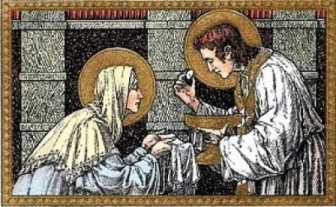
Posted in Brick by Brick, WDTPRS | Tagged ,
29 Comments

Funny stuff

From the National Catholic Register with my emphases and comment:

11 Craziest Things I’ve Ever Heard in Church

by Matthew Archbold

1) Whispered by a father in the pew behind me to his children who were being a little noisy: “When we get to the car I’m testing all of you on what the gospel was. And if you get it wrong you’re dead.”

2) Whispered by my daughter minutes before going up for her First Communion: “Dad, I think I’m gonna’ throw up.” (She did. Our parish priest later came to our home to offer her the Eucharist but she was still sick so we waited until the next week.)

3) Said by priest who noticed that two birds had flown into the Church and were dive bombing parishioners: “Oh, I know how to get the birds out of here. I’ll baptize them and then they’ll only come back twice a year on Christmas and Easter.” [I have a story about a bat and a wedding and gauzy white material that’s pretty funny.]

4) Deacon in January 2009: “There’s been a lot of talk about ‘hope’ recently and I think we’ve all gotten excited and inspired about it.” (I thought about raising my hand and saying “Not me” but I didn’t.)

5) Jesuit priest from the altar right after Communion: “Are the dancers ready?” Uh-oh.

6) Little girl talking to her younger sister just after Communion in the pew in front of us: “Ha ha. I get Communion but you’re too little.” This was accompanied by a little celebratory dance.

7) My nine year old daughter to my eight year old while walking into Church: “You have to sing because my teacher said you get twice the credit for praying if you sing.” That night they asked me if we could sing our nighttime prayers. I said no. [That’s the old “qui cantat bis orat” thing.  What they leave out is the “qui BENE cantat bis orat”.]

8) Priest: “Oh the Book of Revelation is a bunch of hooey.” [Fail.]

9) An usher said to me and my wife while handing us the bulletin: “Whoa five kids. You really take this Catholic thing seriously, huh?”

10) Priest at the beginning of Mass: “If this is your first time here, we do things a little differently…Now give the person next to you a hug.” [Not funny at all, really.]

11) During the homily a woman said to her husband: “This is a really boring bulletin.”

Posted in Lighter fare, SESSIUNCULA |
57 Comments

A March for Life in London?

From His Hermeneuticalness, Fr. Finigan:

The Catholic Herald is floating the idea of holding a March for Life in London. This is an excellent idea: we wouldn’t be able to match the scale of the US March but we could certainly make an impact. It would also be an important opportunity for the Catholic Church to witness to the value of human life as well as co-operating with those other Christians and people of other faiths who share our convictions on this issue.

The article recognises the possible problems but I agree that these could be overcome by marshalling some of our energetic and enthusiastic young pro-lifers. See: Let’s take courage and hold a March for Life in Britain.

For an idea of what happens in the USA, see the official March for Life website and many US blogs which cover it. You do need to look at the blogs to find out much about it. As the Herald said:

If you rely on the television or daily papers for your news this is probably the first you’ve heard of it. Even in the United States it barely registered in the mainstream media.Fr John Boyle was there and has posted a slideshow of photos from the march. It also worth looking at his advance information from a couple of weeks ago.

Posted in Emanations from Penumbras | Tagged
10 Comments

QUAERITUR: Prayer for distribution of Communion at TLM and what to respond?

QUAERITUR: Prayer for distribution of Communion at TLM and what to respond?From a reader:

Fr. Z: Our parish priest often resorts to using “Corpus Christi” from the Novus Ordo rubrics in the distribution of Holy Communion at our extraordinapeory form Traditional Mass— when the deacon is not present and presumably he believes the distribution of Holy Communion takes too long.

For those laymen familiar and unfamiliar with the differing rubrics, we are left to wonder if we’re supposed to say “Amen” or not reply?

A deeper question is whether or not this is allowed in the Traditional Mass, or are the rubrics supposed to be used as called for strictly in the 1962 missal?

I thought there was an instruction some time ago that stated “no mixing of rites” should occur between the two? I’ve been to extraordinary form Masses with the FSSP, Institute of Christ the King, Institute of Good Shepherd, SSPX and other diocesan priests, and no matter the number of those communicating, the priest always used the traditional formula.

Just today, after writing the PCED, I received this response from the PCED to my question: “Priests are not free to change the rubrics or to mix the two forms. Period.”

First, there is an old phrase “gratis asseritur, gratis negatur“.  Maybe you received a response from the PCED and may be you didn’t.  That must be demonstrated.  Send me a scan of the letter.  I will “anonymize” it and post it here.  If you have it, that is.

It is unlikely that any response from any dicastery of the Holy See would include that “Period.”  Just wouldn’t happen.  Period.

But assuming that there was such a response – a real response (there have been in the past), there are several issues here. Let’s tease them out.

First, there is the issue of “mutual enrichment” that is supposed to take place between the two forms of Roman Rite, according to the vision of Pope Benedict.  Then there is the response that came from the Pontifical Commission “Ecclesia Dei” (PCED) to, I believe, someone in Poland.

Apparently the time isn’t ripe for every kind of “mutual enrichment”.    It may be that we need a period of stability of the use of the two forms side by side before a “mutual enrichment” can take place.   Also, these things will have to take place gradually and then receive approval along the way… at some point.

I anticipate that some are virtually frothing to jump in with comments that the new Mass “Corpus Christi” during the  eternal-Mass-of-all-ages-exactly-the-same-as-it-was-since-even-before-the-Lord-printed-the-books-Himself would be an “impoverishment” of the TLM rather than an “enrichment”.

During distribution of Communion during the Novus Ordo, the priest/deacon… whatever… is to say “Corpus Christi” (“The Body of Christ”) and the communicant responds “Amen.”.  Straightforward.  Efficient.  That says just about all that needs to be said if the communicant is paying attention and is well-catechized, etc.

During distribution of Communion during the Extraordinary Form, the priest/deacon … no whatever… is to say, in Latin of course, “May the Body of Our Lord Jesus Christ keep your soul unto life everlasting. Amen.”  The communicant says nothing.

Ideally, if we were closer to the angels, we might not have to have any formula for the distribution of Communion.  But formulas there are.  And that older form surely helped to strengthen the priest’s and people’s understand of what the Lord was doing for them in the face of attacks on the Church’s doctrine and on the Mass during the theological revolts of the 16th and 17th centuries.   Today, let’s just say it, the faith of many congregations isn’t exactly exemplary.

Maybe it was a mistake to shorten that formula for distribution?   Maybe?

During the priest’s own Communion during the Extraordinary Form he says: “May the Body [Blood] of Our Lord Jesus Christ keep my soul unto life everlasting. Amen.”  But in the Ordinary Form this was changed to “keep me… custodiat me“, instead of “custodiat animam meam“.  I suspect the cutters and pasters of the Novus Ordo were worried that priest might be dualists if they said “animam meam“.  Indeed, I think there was a problem with a dualism, a kind of Jansenism among clergy trained in a certain place or under a certain regime … but I digress.

A simpler explanation is that those who tinkered with the Mass and pasted together the Novus Ordo were themselves tired of saying lots of prayers.  They jettisoned the prayers at the foot of the altar not so much because people were clamoring for them to be abolished, or that the “good of the faithful” required their suppression, but in large part because they themselves were tired of saying them and were bored by them.  They shortened Mass because they wanted a shorter Mass.  The same could apply to shorter offertory prayers and getting rid of the Last Gospel, repetition of readings, additional collects, etc.

I can understand why, if a priest is facing several hundred people for Communion and he is alone, and there is another Mass coming up, he would want to shorted that long form for Holy Communion.  Should he?  Probably not.  The PCED has said “no mixing” in letters/responses on paper to some of the faithful when asked if elements of the new Mass can be used in the old Mass.  In most cases of distribution of Holy Communion taking a few more minutes doesn’t threaten the stability of the parish or the health of anyone present.  Also, a few more minutes might underscore the fact that Catholics think that the reception of Holy Communion is fairly important in the larger scheme.

That said… if during Holy Mass in the Extraordinary Form the priest uses the newer, shorter form, stay calm.  Everything will be okay.  Just say “Amen.”

Someone has to.

Posted in "How To..." - Practical Notes, ASK FATHER Question Box, Wherein Fr. Z Rants | Tagged
40 Comments

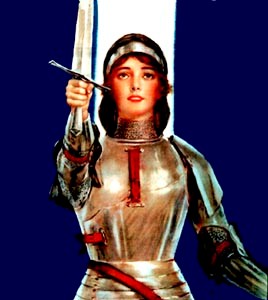
Benedict XVI on St. Joan of Arc

St. Joan of ArcI have long thought that St. Joan of Arc is a fine saint to inspire young people, including boys because of her martial spirit.
The Holy Father today spoke of St. Joan in his General Audience.

Here is the VIS account of the audience.  My emphases and comments.

JOAN OF ARC: BRINGING THE LIGHT OF THE GOSPEL INTO HISTORY

VATICAN CITY, 26 JAN 2011 (VIS) – During this morning’s general audience, celebrated in the Paul VI Hall in the presence of 3,000 people, Holy Father dedicated his catechesis to St. Joan of Arc (1412-1431), whom he described as “one of the ‘strong women’ who, at the end of the Middle Ages, fearlessly brought the splendid light of the Gospel into the complex events of history”. [I wonder if many Catholics today haven’t been cowed by the relentless secularism and relativism and even open anti-Catholic bigotry we find in the public square.  We need a revitalization of our Catholic identity.]

The life of Joan of Arc, who was born into a prosperous peasant family, took place in the context of the conflict between France and England known as the Hundred Years War. At the age of thirteen, “through the ‘voice’ of St. Michael the Archangel, Joan felt herself called by the Lord to intensify her Christian life and to act personally to free her people”.

She made a vow of virginity and redoubled her prayers, participating in sacramental life with renewed energy. “This young French peasant girl’s compassion and commitment in the face of her people’s suffering were made even more intense through her mystical relationship with God. One of the most original aspects of her sanctity was this bond between mystical experience and political mission”. said Benedict XVI.

Joan’s activities began in early 1429 when, overcoming all obstacles, she managed to meet with the French Dauphin, the future King Charles VII. He had her examined by theologians of the University of Poitiers who “delivered a positive judgment, they discovered nothing bad in her, and found her to be a good Christian”.

On 22 March of that year Joan dictated a letter to the King of England and his men, who were laying siege to the city of Orleans. “Hers was a proposal of authentic and just peace between two Christian peoples, in the light of the names of Jesus and Mary”, said the Holy Father. But the offer was rejected and Joan had to fight for the liberation of the city. Another culminating moment of her endeavours came on 17 July 1429 when King Charles was crowned in Reims.

Joan’s passion began on 23 May 1430 when she fell into the hands of her enemies at Compiegne and was taken to the city of Rouen. There a long and dramatic trial was held which concluded with her being condemned to death on 30 May 1431.

The trial was presided by two ecclesiastical judges, Bishop Pierre Cauchon [Somehow appropriate.] and the inquisitor Jean le Maistre, but in fact it was conducted by a group of theologians from the University of Paris. These “French ecclesiastics, having made political choices opposed to those of Joan, were predisposed to hold negative views of her person and mission. The trial was a dark page in the history of sanctity, but also a shining page in the mystery of the Church which is, … ‘at the same time holy and always in need of being purified’“.

“Unlike the saintly theologians who illuminated the University of Paris, such as St. Bonaventure, St. Thomas Aquinas and Blessed Duns Scotus, … the judges were theologians who lacked the charity and humility to see the work of God in this young girl. Jesus’ words come to mind, according to which the mysteries of God are revealed to those who have the hearts of children, but hidden from the wise and intelligent. Thus Joan’s judges were radically incapable of understanding her, of seeing the beauty of her soul“, the Pope said.

Joan died at the stake on 30 May 1431, holding a crucifix in her hands and invoking the name of Jesus. Twenty-five years later a trial of nullification, instituted by Pope Callixtus III, “concluded with a solemn sentence nullifying the condemnation and … highlighting Joan of Arc’s innocence and perfect faithfulness to the Church. Much later, in 1920, she was canonised by Pope Benedict XV“.

“The Name of Jesus invoked by this saint in the last instants of her earthly life was as the continual breath of her soul, … the centre of her entire life”, the Holy Father explained. “This saint understood that Love embraces all things of God and man, of heaven and earth, of the Church and the world. … Liberating her people was an act of human justice, which Joan performed in charity, for love of Jesus, hers is a beautiful example of sanctity for lay people involved in political life, especially in the most difficult situations”.  [In his first Message for the World Day for Peace, Pope Benedict spoke of the need of military intervention at times in order to establish the foundation upon which peace can be fostered.]

“Joan saw in Jesus all the reality of the Church, the ‘Church triumphant’ in heaven and the ‘Church militant’ on earth. In her own words, ‘Our Lord and the Church are one’. This affirmation … takes on a truly heroic aspect in the context of the trial, in the face of her judges, men of the Church who persecuted and condemned her”.

“With her shining witness St. Joan of Arc invites us to the highest degree of Christian life, making prayer the motif of our days, having complete trust in achieving the will of God whatever it may be, living in charity without favouritisms or limitations, and finding in the Love of Jesus, as she did, a profound love for His Church”.

OORAH!

Posted in Saints: Stories & Symbols | Tagged
66 Comments

Liverpool: reversing the order of the sacraments

The ancient Church, and in Eastern Churches today, the sacraments “of initiation” were given “continuously”, that is, all at once.  Even infants were confirmed after baptism and then given the Eucharist.   The separation of confirmation came about probably as a result of the large number of converts and children born into Christian families once Christianity was  legal and rapidly spreading.  The bishop couldn’t do them all himself.  Therefore, confirmation was delayed.

In some circles there is talk that the ancient practice should be restored.

From the UK’s best Catholic weekly, The Catholic Herald comes this story.

Archbishop puts Confirmation before Communion

By David V Barrett

From next year children in the Archdiocese of Liverpool will be confirmed before receiving their First Communion, reversing the usual order of sacraments in the Catholic Church.

A leaflet being sent to all parishes in the archdiocese next week explains the changes. It says: “These three sacraments make up the process of belonging to the Church (called Christian Initiation). The sacraments weren’t always in that order, and adults preparing for initiation have always received them in the original order: Baptism, Confirmation, Eucharist (Communion).”

From September 2012 children in the archdiocese who have been baptised will follow this order.

“Those aged eight by September 1 2012 will be invited to receive Confirmation and First Communion in the days between Ascension Sunday and the Feast of the Body and Blood of Christ (Corpus Christi) in 2013, and the same pattern will be followed each year after that,” the leaflet said.

The details are also on both the archdiocesan and Liverpool Metropolitan Cathedral websites. The decision to restore the order of the sacraments of initiation and to introduce a family catechesis approach, supported by parishes and schools, was made by Archbishop Patrick Kelly of Liverpool,?with?the encouragement of the Council of Priests, at the end of 2008.

The new procedure will involve families far more in the way children are prepared for the sacraments.

“Instead of teachers, catechists and priests teaching children and parents about the sacraments, they will help the parents to hand on their own faith to their children, fulfilling the privileges and responsibilities expressed in the Rite of Baptism. New resources will help parents to prepare their own children for these sacraments with the support of the local church community,” the leaflet says. [Some publisher will be happy.]

“These changes are meant to help us understand that sacraments are gifts of God’s grace, that parents are the first teachers of their children in the ways of faith, and that we are all called to get to know Jesus better throughout our life’s journey.” [And that will be accomplished by reversing the order of the sacraments?  They want to confirm at an earlier age because confirmation “helps them know Jesus”? I am not convinced that that is the purpose of the sacrament of confirmation.]

The families of these children will be invited to explore and celebrate the Sacrament of Reconciliation with them during Advent each year, while teenagers and their families will be invited to explore and celebrate Reconciliation during Lent each year.

The next two years will be a transition period from the old process to the new. In 2011 there will be no First Communions in most parishes. Children in Year 6 (aged 10-11) should be confirmed; in 2012 this will be children aged 8 to 11. From 2013 onwards the norm will be that children aged eight will receive Confirmation and Holy Communion during the same celebration.

There could be good reasons to reverse the order of sacraments.  However, I hope that their reasons reach beyond “getting to know Jesus better”.

I am sure that their catechetical materials will be thorough.

Posted in The Drill | Tagged ,
87 Comments

3-6 May – England – workshop for priests to learn the TLM

From the Latin Mass Society in the UK.

Latin Mass Society Announces 2011 Priests Training Conference
The Latin Mass Society has announced its seventh residential conference for priests who wish to learn the Extraordinary Form of Mass. The conference will take place at Buckfast Abbey, Buckfastleigh, Devon from Tuesday 3rd to Friday 6th May.

Tuition [read: instruction] will be given in small groups selected according to ability, and will cover Low Mass, Missa Cantata and Missa Solemnis. It is also hoped to provide tuition in the sacraments of baptism and marriage. Only rudimentary Latin is required.

There will also be a residential course for laymen wishing to learn to serve the Extraordinary Form.

The conference will begin late morning on the Tuesday, although there will be the opportunity for those travelling long distances to stay at Buckfast Abbey on the Monday night. The conference will end after lunch on the Friday.

There will be sung Mass in the Extraordinary Form each day; parts of the Office will also be sung.

The inclusive fee is £85 which covers all tuition, accommodation and board.

Application forms for both priests and servers training are available from the LMS office (020 7404 7284) or the LMS website (www.lms.org.uk).

Posted in Brick by Brick, The Campus Telephone Pole |
1 Comment

Pope Benedict comments on “social networking”

The Holy Father issued the text of his Message for the 85th annual World Mission Sunday.   It has a few interesting points for those of us who work online a great deal.

My emphases and comments.

Truth, Proclamation and Authenticity of Life in the Digital Age

Dear Brothers and Sisters,

On the occasion of the 45th World Day of Social Communications, I would like to share some reflections that are motivated by a phenomenon characteristic of our age: the emergence of the internet as a network for communication. It is an ever more commonly held opinion that, just as the Industrial Revolution in its day brought about a profound transformation in society by the modifications it introduced into the cycles of production and the lives of workers, so today the radical changes taking place in communications are guiding significant cultural and social developments.  [This is not a new observation for a papal document.  John Paul II said this too.] The new technologies are not only changing the way we communicate, but communication itself, [I guess the medium is the message after all!] so much so that it could be said that we are living through a period of vast cultural transformation. This means of spreading information and knowledge is giving birth to a new way of learning and thinking, with unprecedented opportunities for establishing relationships and building fellowship. [As well as for tearing people apart, in more than one way.]

New horizons are now open that were until recently unimaginable; they stir our wonder at the possibilities offered by these new media and, at the same time, urgently demand a serious reflection on the significance of communication in the digital age. This is particularly evident when we are confronted with the extraordinary potential of the internet and the complexity of its uses. As with every other fruit of human ingenuity, the new communications technologies must be placed at the service of the integral good of the individual and of the whole of humanity. If used wisely, they can contribute to the satisfaction of the desire for meaning, truth and unity which remain the most profound aspirations of each human being.

In the digital world, transmitting information increasingly means making it known within a social network where knowledge is shared in the context of personal exchanges. The clear distinction between the producer and consumer of information is relativized and communication appears not only as an exchange of data, but also as a form of sharing. This dynamic has contributed to a new appreciation of communication itself, which is seen first of all as dialogue, exchange, solidarity and the creation of positive relations. On the other hand, this is contrasted with the limits typical of digital communication: the one-sidedness of the interaction, the tendency to communicate only some parts of one’s interior world, the risk of constructing a false image of oneself, which can become a form of self-indulgence.

Young people in particular are experiencing this change in communication, with all the anxieties, challenges and creativity typical of those open with enthusiasm and curiosity to new experiences in life. Their ever greater involvement in the public digital forum, created by the so-called social networks, helps to establish new forms of interpersonal relations, influences self-awareness and therefore inevitably poses questions not only of how to act properly, but also about the authenticity of one’s own being. Entering cyberspace can be a sign of an authentic search for personal encounters with others, provided that attention is paid to avoiding dangers such as enclosing oneself in a sort of parallel existence, or excessive exposure to the virtual world. In the search for sharing, for “friends”, there is the challenge to be authentic and faithful, and not give in to the illusion of constructing an artificial public profile for oneself.  [Do you get the sense that the writer had Facebook in mind?]

The new technologies allow people to meet each other beyond the confines of space and of their own culture, creating in this way an entirely new world of potential friendships. This is a great opportunity, but it also requires greater attention to and awareness of possible risks. Who is my “neighbour” in this new world? Does the danger exist that we may be less present to those whom we encounter in our everyday life? Is there is a risk of being more distracted because our attention is fragmented and absorbed in a world “other” than the one in which we live? Do we have time to reflect critically on our choices and to foster human relationships which are truly deep and lasting? It is important always to remember that virtual contact cannot and must not take the place of direct human contact with people at every level of our lives.

In the digital age too, everyone is confronted by the need for authenticity and reflection. Besides, the dynamic inherent in the social networks demonstrates that a person is always involved in what he or she communicates. When people exchange information, they are already sharing themselves, their view of the world, their hopes, their ideals. It follows that there exists a Christian way of being present in the digital world: this takes the form of a communication which is honest and open, responsible and respectful of others. To proclaim the Gospel through the new media means not only to insert expressly religious content into different media platforms, but also to witness consistently, in one’s own digital profile and in the way one communicates choices, preferences and judgements that are fully consistent with the Gospel, even when it is not spoken of specifically. Furthermore, it is also true in the digital world that a message cannot be proclaimed without a consistent witness on the part of the one who proclaims it. In these new circumstances and with these new forms of expression, Christian [sic] are once again called to offer a response to anyone who asks for a reason for the hope that is within them (cf. 1 Pet 3:15).

The task of witnessing to the Gospel in the digital era calls for everyone to be particularly attentive to the aspects of that message which can challenge some of the ways of thinking typical of the web. First of all, we must be aware that the truth which we long to share does not derive its worth from its “popularity” or from the amount of attention it receives. We must make it known in its integrity, instead of seeking to make it acceptable or diluting it. It must become daily nourishment and not a fleeting attraction. The truth of the Gospel is not something to be consumed or used superficially; rather it is a gift that calls for a free response. Even when it is proclaimed in the virtual space of the web, the Gospel demands to be incarnated in the real world and linked to the real faces of our brothers and sisters, those with whom we share our daily lives. Direct human relations always remain fundamental for the transmission of the faith!

I would like then to invite Christians, confidently and with an informed and responsible creativity, to join the network of relationships which the digital era has made possible. This is not simply to satisfy the desire to be present, but because this network is an integral part of human life. The web is contributing to the development of new and more complex intellectual and spiritual horizons, new forms of shared awareness. In this field too we are called to proclaim our faith that Christ is God, the Saviour of humanity and of history, the one in whom all things find their fulfilment (cf. Eph 1:10). The proclamation of the Gospel requires a communication which is at once respectful and sensitive, which stimulates the heart and moves the conscience; one which reflects the example of the risen Jesus when he joined the disciples on the way to Emmaus (cf. Lk 24:13-35). By his approach to them, his dialogue with them, his way of gently drawing forth what was in their heart, they were led gradually to an understanding of the mystery.

In the final analysis, the truth of Christ is the full and authentic response to that human desire for relationship, communion and meaning which is reflected in the immense popularity of social networks. Believers who bear witness to their most profound convictions greatly help prevent the web from becoming an instrument which depersonalizes people, attempts to manipulate them emotionally or allows those who are powerful to monopolize the opinions of others. On the contrary, believers encourage everyone to keep alive the eternal human questions which testify to our desire for transcendence and our longing for authentic forms of life, truly worthy of being lived. It is precisely this uniquely human spiritual yearning which inspires our quest for truth and for communion and which impels us to communicate with integrity and honesty.

I invite young people above all to make good use of their presence in the digital world. I repeat my invitation to them for the next World Youth Day in Madrid, where the new technologies are contributing greatly to the preparations. Through the intercession of their patron Saint Francis de Sales, I pray that God may grant communications workers the capacity always to carry out their work conscientiously and professionally. To all, I willingly impart my Apostolic Blessing.

From the Vatican, 24 January 2011, Feast of Saint Francis de Sales

BENEDICTUS PP. XVI

Posted in SESSIUNCULA | Tagged
8 Comments

Your news

Do you have some good news to share?

Mine… the Pudding last night was a great success!

Posted in SESSIUNCULA |
61 Comments

Some thoughts about “heroic” virtue

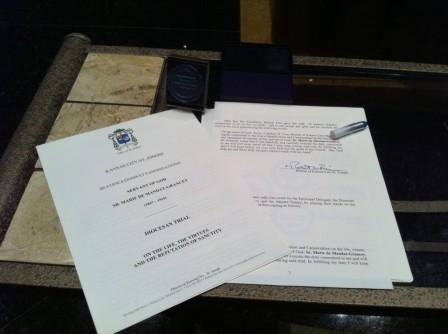
A few days ago something interesting happened in the Diocese of Kansas City-St. Joseph.   Bp. Robert Finn, may God grant him many and happy years, officially opened the canonical process, the cause of Servant of God Sr. Marie de Mandat-Grancey, a French nun who was a key figure in the recovery of Mary’s house at Ephesus.

Fore more information on Sr. Marie, check here.

For some great photos and the story of what happened in Kansas City – I recommend it – go to SERVIAM.

Here is a shot of the instrument, signed, by which Bp. Finn started the process.

Some thoughts about "heroic" virtue

This is the first step in a long process, which resembles the stages of a trial.  All manner of evidence is gathered, including documents, testimonies, etc., a case is made, and then presented for the scrutiny of canonists, theologians and other experts.

What are they trying to prove?  Initially that Sr. Marie lived a life of “heroic virtue”.

“But Father! But Father!”, some of you are about to say.  “Heroic virtue?  Really?  How can any of us aspire to such a thing!  That’s sounds terribly difficult!”

It isn’t easy, but it is possible.

We are all called to be saints.  God wouldn’t ask something of us that isn’t possible.  And when He asks things that are hard, He also provides the means and the occasions.  Even in your suffering, for example, or your obscurity, you can serve Him.  God knew you before the creation of the material universe.  He called you into being now, in this world.  Of all the possible worlds God could have created, He created this world, into which you would be born. He has a plan and purpose your you, if you will embrace it.

Back to the cause and back to “heroic” virtue.

Perhaps we should spend just a moment on what “heroic” virtue is all about.   It sounds rather dramatic and, frankly, unattainable by most people.

The term “heroic” comes from Greek (heros).  It points to valor, courage.  The term “heroic virtue” came into the west with a translation of Aristotle’s Nicomacheam Ethics by Robert Grossatesta (+1253).  From there it was brought into the the writings of scholastic philosophers, such as St. Thomas Aquinas.    It was more fully elaborated by the amazing Prospero Lambertini, who was elected Pope and took the name Benedict XIV.  After that, it became a common term when dealing with saints and causes of saints.

The supreme “heroic” Christian is the martyr, who especially in the moment of martyrdom exemplifies the charity that the Lord taught from the Cross.   So, that is a precise act of a Christian.  But “heroic” can also be applied to a large arc of a Christian’s life.

Every person is called to live in union with the Trinity, in charity.  In this life, we can only strive to live this way.  Only in the next life will we truly attain what we were called to.  Nevertheless, this life is what we have now.  By baptism we became members of Christ and temples of the Holy Spirit, the adopted children of the Father.  We can begin to live the life of charity and other virtues now, to the best degree we can with the help of God’s grace.  It takes both, our elbow grease (we are not Quietists) and God’s grace (we are not Pelagians).

We live in this fallen world, in this vale of tears, with wounds to our intellects and will, constantly dealing with the world, the flesh and the devil.

We are called to holiness.  We are actually called to holiness in a heroic degree.  Let’s understand “heroic” properly.

The “heroism” to which we are called does not consist mainly in great or famous or dramatic acts or accomplishments.  It might include those, but it does not mainly consist of those.  Every person has the possibility of this sort of heroism, even if he does nothing spectacular.  When it comes to the causes of saints, very often people with more dramatic or famous lives comes to the attention of others, and therefore they are more likely to be the subjects of causes.

Living a virtuous life even in the tedium of routine or the obscurity of everyday living can be heroic.

Accepting God’s will, living in conformity with God’s will is the true test of a Christian.  That is the essence of “heroic” virtue, not what appears outwardly to be heroic (though that may also be heroic, as in the dramatic case of the martyr).

Furthermore, people don’t, except by a rare gift from God, instantly or easily attain the state of living a life of virtue heroically.  Virtues are habits.  Some virtues, the theological virtues, are infused into us by God with baptism and sacraments.  They “dwell” in us “habitually” (“dwell” and “habit” are etymologically related… think of a “habitat” where critters “dwell”).  Virtues are habits, good practices and attitudes which are in us to a degree that it is easy for us to do them rather than hard.  This usually takes time and maturity.  We don’t suddenly, except by a special grace, become virtuous.  It can take a whole lifetime and many stumbles along the way.

With God’s help we must strive in the concrete details of our lives to avoid faults and even small imperfections, even if we don’t always succeed.  We have to want to succeed and try to succeed and make progress, not giving in to discouragement or, worse, despair, accepting God’s will and going forward with humility.

All the circumstances of our lives play a role in our living as Christians.  Each one of us is born into a particular time and place.   God gives different gifts to different people.  There is no one way to live as a Christian, except for the common calling to holiness.  We cannot be, however, content with mere mediocrity.

So, heroic virtue consists mainly in living in the state of grace, hating sin and imperfections and striving to overcome them while carrying out one’s vocation, always accepting God’s will with faith, hope and charity as we go forward during these short years on earth toward the goal of heaven, trusting that God’s providence guides all things.   This life may have moments which are dramatic and famous.  It will probably be rather plain and obscure.  But it is not mediocre.

Those are some thoughts about “heroic virtue”, so that when you hear the term, you don’t fall into the trap of assuming that the person in question was working miracles while alive, or was going without food in a cave for thirty years, or levitating off the ground at the mention of the Holy Name.

Posted in "How To..." - Practical Notes, Our Catholic Identity, Saints: Stories & Symbols, The Drill |
29 Comments