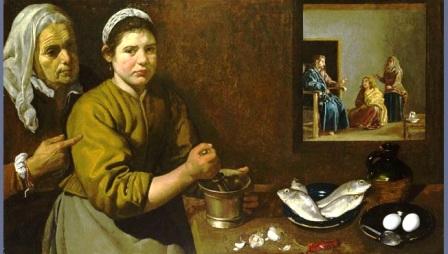
 In the National Gallery in London, you will find a painting by Velazquez entitled Christ in the House of Martha and Mary. I never fail to visit it when I visit that gallery.
The painting – a variation on the bodegón or kitchen/tavern scene, and a Flemish combination of domestic and sacred scenes – is a bit of a puzzle. It has layers. It is a little hard to tell if we are looking from the kitchen through a window into the room beyond, where the Lord is sitting with Mary and Martha, or if this is a painting within a painting. Could it be a mirror reflecting what is going on in the other room? Is that what the young woman is staring at? It is hard to tell whether this is a scene where the action in the kitchen is taking place simultaneously with that of the other room, or it this represents different chronological events.
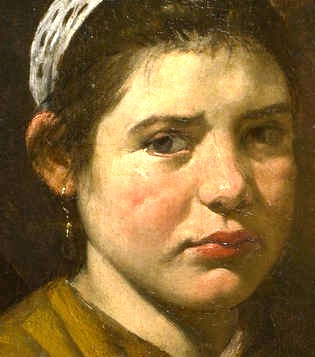
Take a good hard look. The pouty look on girl’s face, almost that of a child, shows her displeasure at being busy about many things in the kitchen.
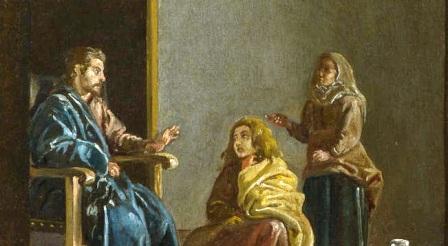
Mary of Bethany is in the other room with Christ. Martha is in the other room remonstrating and being corrected.
Instead of focusing her attention at the task at hand, whether she is looking at the scene which may be in a mirror, or whether she is simply put out – perhaps she was just terrorized by Martha who is on edge – she is on the point of frustrated tears.
Is the old women at the left telling the girl to pay attention to her work. Or is she pointing to the girl to warn you, the viewer of the painting.
This is you. Is this you?
What about the scene in in the other room viewed in the painting/mirror/window.
A discussion is taking place, no doubt about fascinating things. Christ lifts His hand. It will soon be bruised in falling and pierced with a spike. The hand is raised as if to say, "Wait! Be silent a moment! There is more to this than meets the eye." Christ is seated in the manner of a teacher with his hand raised in the act of unfolding the deeper meaning. The old woman’s hand is also raised. To teach you?
Is the girl upset because she can’t quite hear from the kitchen the amazing things the Lord is no doubt saying? Is she even farther removed from the "action" (which is actually resting contemplation) than Martha has been? Did she want to, perhaps, show herself off a little?
In the scene in the box, Mary’s hair is loose about her shoulders. Her hair, a "woman’s glory", is not in danger of being scorched in the cooking fires, or soiled as it brushes the surface of the kitchen work table. It won’t fall into Mary’s eyes or get matted on her sweaty forehead while cooking or cleaning. She can have her hair loose as she "just sits there". Mary has a wrap of some sort around her arm, which calls to mind the robe of the ancient Greek philosopher. A robe or wrap draped around arms, a conspicuous symbol that philosophers did not do manual work. They were dedicated to contemplation of the deeper questions.
Martha has no wrap. Martha’s assistant, the girl, (is it Martha a little earlier?) has her sleeve rolled up, exposing her forearm. Her hand is raw. There is a little bit of decoration on her rolled up sleeve which she won’t be able to show off now. Her hair her own "glory" is bound up and hidden. She had put on dangling earrings. When you are a servant girl, these little vanities might be big vanities. Vanitas vanitatum. Did she think she would be out there in the parlor as well. But now… here she is in the kitchen, hair pulled back, working with red and unattractive hands, puffy eyes.
Mary can just sit there and be pretty, and calm, in the presence of the desired One. Martha must work, be less fetching, even grimy and sweaty as she works for the ease of others.
Isn’t it true that sometimes we want to strip others of the joy they have when we can’t have it for ourselves? Have you ever resented that someone else was chosen for something?
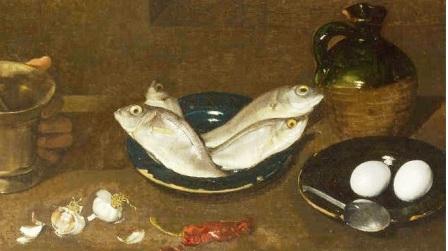
On the work table are instruments of labor, the girl’s and Martha’s.
Fish and eggs are Christian symbols. The oil flask calls our mind to the Passion, or else the coming death and burial of Lazarus. The cloves of garlic are a symbol of the resurrection, much like an orange is in art: because of peeling and the sections they breaks into. The pepper with its seeds can burn.
Most significant is the large mortar, which breaks things down.
This is the daily grind.
The old woman on the left, probably a serving woman in the house at Bethany, who NEVER had Martha’s opportunities, perhaps never had the girl’s opportunities, may be our conscience in this painting, revealing us more fully to ourselves (cf. GS 22).
In this life there is always a tension between the active and the contemplative, the daily grind and a true Christian’s desire for silence, recollection and prayer. There is a tension trap as well in the desire to be recognized or to have this or that position which is not to be had.
How do we rise to the challenge of bringing something of prayer and reflection to our daily work? How do we make quiet stillness fruitful by means of action, perhaps through corporal works of mercy? How to let go of vanity and ambition?
In heaven, action and contemplation will not be divided as they are here. We are still called, however, in our lives to inform each of these dimensions of Christian life with the other.
In Patristic terms, Martha is taken by St. Augustine as a figure of the active life and Mary of Bethany as a symbol of the contemplative life. Augustine has several pairings like this, including Rachel and Leah and also John and Peter.
Augustine was always trying to find the right balance of action and contemplation in his own extremely busy life, otium in negotio. While clearly desiring to carry out his duties as a bishop well, he wanted to remain a monk, in quiet prayer and contemplation of the deeper questions. How to resolve these seemingly contradictory styles of life?
Augustine’s examination of Mary and Martha is found primarily in Sermons 179, 103 and 104. In s. 179 Augustine explains James 1,19;22 using an exegesis of Luke 10, the episode of Mary and Martha we see in the painting. He emphasizes the deep attention we ought to give Scripture: factores verbi… et auditores… contrasting the former who put what they hear into practice with the later who listen only and then do nothing about what they hear.
S. 179 shows Augustine’s deep regard for his flock. He would rather be a listener but he must also be a doer. He sacrificed his own desires for the sake of his flock. Augustine says that it is dangerous to be a preacher, and exercise ministry. He placed himself in a dangerous position for his flock.
For Augustine, contemplation must necessarily lead to action in this life. While the ideal is to sit and listen (Mary) there nothing wrong with acting (Martha), indeed it is necessary to act. Martha the busy "minister" is doing something great, and she has a great gift… magnum ergo ministerium, magnum donum. What Mary does is still greater.
Augustine explains that there is a unity between the two lives because they come to the same eternal reward. The Person of Jesus is the focus of both Mary and Martha. In heaven their focus and roles will overlap and combine perfectly. One must arrive at the "better part" precisely by means of the active life. That is her lot. Heaven will be the perfect "fusion" of the active and contemplative dimensions of Christian life, though here in this vale of tears they are difficult at times to reconcile.
So, some bullet points:
- Have you been jealous of the good fortune of another? I offer this especially to clerics who are suffering from the dread fault of proud ambition.
- Have you resented you lot in life because you would rather be doing something else? Have a different vocation than that in which you feel trapped?
- Have you chaffed under what God’s will is for you in your vocation, "desiring this man’s art, and that man’s scope"?
- Have you been struggling in your daily grind?
Happy Feast of St. Martha.
UPDATE 2136 GMT:
Over at the blog Idle Speculations there is an entry which picks up on this entry, but which adds a great deal more, including a story based on the painting!


 is coming in.


 Did you hear that Holy Father has, inter alia, penned a book for children?
 And now for the really important things.
 pon a time I actually had made a little pamphlet on this… but I can’t find it. I will have to redo it in my copious free time.
 In the National Gallery in London, you will find a painting by Velazquez entitled
 Instead of focusing her attention at the task at hand, whether she is looking at the scene which may be in a mirror, or whether she is simply put out – perhaps she was just terrorized by Martha who is on edge – she is on the point of frustrated tears.
 kitchen the amazing things the Lord is no doubt saying? Is she even farther removed from the "action" (which is actually resting contemplation) than Martha has been? Did she want to, perhaps, show herself off a little?
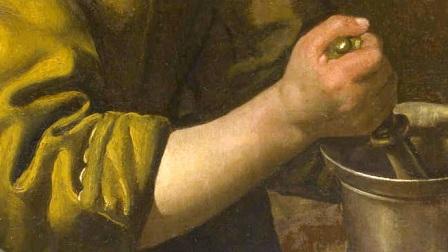 f the desired One. Martha must work, be less fetching, even grimy and sweaty as she works for the ease of others.










 Kathleen10 on Daily Rome Shot 1117 – A *POLL* about 2026-27: “Fr Z thanks so much for 2 reminders. 1. Using your Amazon link! For heaven’s sake it costs us nothing…”




























