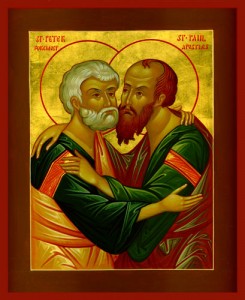
“Let those who are bound fear, those who are loosed fear.”

"Let those who are bound fear, those who are loosed fear."Tomorrow is a great day for the Roman Church and the Catholic Church throughout the world. 

Because tomorrow is an important feast, Holy Church has designated a vigil.  And vigils were always times of restraint and penance in preparation for the feast.

Let’s get some insight into the importance of Peter and Paul through the writings of St. Augustine.  Here is a starter from s. 295.

1. This day has been consecrated for us by the martyrdoms of the most blessed apostles Peter and Paul.  It’s not some obscure martyrs we are talking about.  Their sound has gone out into all the earth, and their words to the ends of the wide world (Ps 19:4).  These martyrs had seen what they proclaimed, they pursued justice by confessing the truth, by dying for the truth.  The blessed Peter, the first of the apostles, the ardent lover of Christ, who was found worthy to hear, And I say to you, that you are Peter.  He himself, you see, had just said, You are the Christ, the Son of the living God.  Christ said to him, And I say to you that you are Peter, and upon this rock I will build my Church (Mt 16:16.18).  Upon this rock I will build the faith which you have just confessed.  Upon what you have just said, You are the Christ, the Son of the living God, I will build my Church; because you are Peter.
            Peter, Rocky, from rock, not rock from Rocky.  Peter comes from petra, rock, in exactly the same way as Christian comes from Christ.  Do you want to know what rock Peter is called after?  Listen to Paul: I would not have you ignorant, brothers, the apostle of Christ says; I would not have you ignorant, brothers, that our fathers were all under the cloud, and all passed through the sea, and all were baptized in Moses in the cloud in the sea, and all ate the same spiritual food, and all drank the same spiritual drink.  For the drank from the rock that was following them, and the rock was Christ (1 Cor 10:1-4).  There you have where Rocky, Peter, is from.

In that passage, Augustine makes a close connection not only between the confession of Peter and the Church (which is what most Protestants think Christ did, and did only) but also between the person of Peter and the establishment of the Church.

But in Augustine’s understanding, Christ went beyond saying that His authority to bind and loose rested in the person of Peter alone.  He connects Peter and his actions with the Holy Spirit.  Augustine speaks of how Christ gave the keys to Peter and explains:

It is the dove that binds, the dove that looses, the building built upon the rock that binds and looses. 
Let those who are bound fear, those who are loosed fear.  Let those who are loosed be afraid of being bound; those who are bound pray to be loosed.  Each one is tied up in the threads of his own sins (Prv 5:22).  And apart from the Church, nothing is loosed.

Posted in Patristiblogging, Saints: Stories & Symbols, SESSIUNCULA | Tagged , ,
13 Comments

Dad’s quick comeback

From my email:

Dad’s quick comeback
 
A teenage boy had just passed his driving test and inquired of his father as to when they could discuss his use of the car.
 
His father said he’d make a deal: ‘You bring your grades up from a C to a B average, study your Bible a little, and get your hair cut. Then we’ll talk about the car.’
 
The boy thought about that for a moment, decided he’d settle for the offer, and they agreed on it.
 
After about six weeks his father said, ‘Son, you’ve brought your grades up and I’ve observed that you have been studying your Bible, but I’m disappointed you haven’t had your hair cut.
 
The boy said, ‘You know, Dad, I’ve been thinking about that, and I’ve noticed in my studies of the Bible that Samson had long hair, John the Baptist had long hair, Moses had long hair…and there’s even strong evidence that Jesus had long hair.’
 
His father replied, ‘Did you also notice they all walked everywhere they went?

Posted in Lighter fare |
11 Comments

Papal con-fab with Cards. Sodano and Schoenborn

Did you see this communique from the Holy See Press Office about the meeting of Benedict XVI with Card. Sodano and Card. Schoenborn?

I was about to work up a translation and then I found a note from a reader that the wonderful and persistent Anna Arco had already done the hard work of a recap and rendering.

Take it away Anna…

I don’t remember ever seeing anything quite like this.

My emphases and comments:

After Cardinal Sodano made a surprise speech at Easter criticising the media’s reports about abuse as “idle gossip”, [A very poor choice in his part, IMO…] Cardinal Schoenborn [Whose choices lately are increasingly difficult to explain…] publicly accused the former Secretary of State of having deliberately obstructed an investigation into accusations of child abuse against Cardinal Herman Groer of Vienna. In today’s meeting, Pope Benedict seems to have done several things: he has reminded Cardinal Schoenborn that the disciplining of members of the hierarchy is the responsibility of the Pope, he has clarified Sodano’s controversial comments about “idle gossip” and has brought the two men together. Interesting.

    VATICAN CITY, 28 JUN 2010 (VIS) – The Holy See Press Office released the following communique early this afternoon:

    “(1) The Holy Father today received in audience Cardinal Christoph Schonborn O.P., archbishop of Vienna and president of the Austrian Episcopal Conference. The cardinal had asked to meet the Supreme Pontiff personally in order to report on the current situation of the Church in Austria. In particular, Cardinal Schonborn wished to clarify the exact meaning of his recent declarations concerning some aspects of current ecclesiastical discipline, and certain of his judgements regarding positions adopted by the Secretariat of State – and in particular by the then Secretary of State of Pope John Paul II – concerning the late Cardinal Hans Hermann Groer, archbishop of Vienna from 1986 to 1995.

    “(2) Cardinal Angelo Sodano, dean of the College of Cardinals, and Cardinal Secretary of State Tarcisio Bertone S.D.B. were subsequently invited to join the meeting.

    “In the second part of the audience certain widespread misunderstandings were clarified and resolved, misunderstandings deriving partly from certain statements of Cardinal Christoph Schonborn, who expressed his displeasure at the interpretations given to his words.

    “In particular:

    “(a) It must be reiterated that, in the Church, when accusations are made against a cardinal, competency falls exclusively to the Pope; other parties may have a consultative function, while always maintaining due respect for persons.

    “(b) The word ‘chiacchiericcio’ (gossip) was erroneously interpreted as disrespectful to the victims of sexual abuse, towards whom Cardinal Angelo Sodano nourishes the same feelings of compassion, and of condemnation of evil, as expressed on various occasions by the Holy Father. That word, pronounced during his Easter address to Pope Benedict XVI, was taken literally from the pontifical homily of Palm Sunday and referred to the “courage that does not let itself be intimidated by the gossip of prevalent opinions”.

    “(3) The Holy Father, recalling with great affection his own pastoral trip to Austria, via Cardinal Christoph Schonborn sends his greetings and encouragement to the Church in Austria, and to her pastors, entrusting the journey to renewed ecclesial communion to the celestial protection of the Blessed Virgin, so venerated at Mariazell”.

Now… if the Holy Father would only haul in a few more Cardinals.

Posted in SESSIUNCULA | Tagged ,
31 Comments

Vesuvius A.D. 79: How the people in Pompeii died.

Vesuvius A.D. 79: How the people in Pompeii died.Biretta tip to rogueclassicism, which directed me to an article about how the people in Pompeii died during the famous eruption of Vesuvius.  There is a scholarly article called "Lethal Thermal Impact at Periphery of Pyroclastic Surges: Evidences at Pompeii" here, but a less dense summary here.

Let’s have a taste.

How did the victims of the Plinean Eruption of Vesuvius die?
by Greg Laden

Even at the most extreme edges of the flow of stuff out of the volcano Pompeii, at the far edge of the mud and ash that came from the volcano’s explosion, the heat was sufficient to instantly kill everyone, even those inside their homes.

And that is how the people at Pompeii, who’s remains were found trapped and partly preserved within ghostly body-shaped tombs within that pyroclastic flow, died. They did not suffocate. They did not get blown apart by force. They did not die of gas poisoning. They simply cooked. Instantly.

That is the conclusion of a study just published in PLoS ONE by Giuseppe Mastrolorenzo, Pierpaolo Petrone, Lucia Pappalardo and Fabio Guarino, entitled Lethal Thermal Impact at Periphery of Pyroclastic Surges: Evidences at Pompeii.

[..]

And thus, Pompeii becomes an important data point. At Pompeii, the remains of hundreds of individuals were found in the pyroclastic deposits from the famous 79 AD eruption, the one documented by Pliny the Younger and memorialized in countless books, a few movies, and a museum exhibit or two.

Yeah, like this:

(This video is no longer available.)

(Verily, one of Ernest Borgnine’s greatest films!)

The study modeled the physics of the eruption, tying a model to the ground with the physical and archaeological data. For context:

    The 79 AD Vesuvius eruption generated a sequence of six distinctive pyroclastic surges (S1 to S6) and flows with increasing power, which caused landscape modification as well widespread building collapse and fatalities [3]. The resulting ash deposits have thicknesses ranging from tens of metres near the vent to few millimetres at the flow periphery. In particular, the early three surges (S1 to S3) stopped ahead the northwestern walls of Pompeii, while the later ones (S4 to S6) over passed the town. The last two surges traveled up to a distance even exceeding 15 kilometres from the vent, whereas the S4 surge deposit least traces are confined within a few hundred of metres next to the south and southeastern walls.

The S4 surge, which deposited only a small blanketing of ash at the site, probably caused most of the fatalities in Pompeii. The 3 cm or so thick layer of ash was "emplaced suddenly in a single depositional event resulting from dusty gas mixture deflation in response to horizontal velocity and turbulence dumping at the flow termination."

In other words, it was like "phooofff" and everybody was dead and this dusting of ash was everywhere. And I don’t really mean to be flip about this … it is hard to imagine what is being described by this analysis in real terms.

Consider this: Imagine an area about 10 kilometers (just over 6 miles) around the volcano. Now imagine that area being covered with a blanket of very hot ashy air over the course of about 3 minutes. To help imagine this, pretend you are looking at the volcano when the explosion starts, and there is an airliner over the volcano heading for you at the same time. It is moving at top speed for such an aircraft, and when it reached you it has slowed to just over 100 mph. That represents the leading edge of the blanket of hot air and ash. Just at that moment, the blanket of air and ash deflates/dissipates, the air cooling and the ash settling. But first, all humans, probably all tetrapods (birds, mammals, etc) within that few miles of space have simply dropped dead. Since there is only a little ash, they are dirtied by it, but later, a larger deposit of ash is spewed out, and now all the dead are deeply buried. Or at least, that’s what I’m getting from this paper, more or less.

    … most of the victims are typically frozen in suspended actions (73% life-like stance, 27% sleep-like stance), showing as well as limb contraction (76%) and a large number of corpses presenting the pugilistic attitude (64%).

That "pugilistic attitude" bit is the appearance that the victim was fighting for his or life, but which actually occurs as a side effect of being cooked very quickly (or drying out more slowly in some cases). Everyone was killed and their bodies frozen in the position they were in at that time of instant death, plus a small bit of involuntary perimortem spasm. They were not suffocated, they were not killed by being blasted with an explosive force that knocked them down. They were cooked in situ.

    Finally, contrary to previous hypotheses, our findings based on the interdisciplinary volcanological and bio-anthropological study of the deposits and victims of the 79 AD Plinian eruption reveal that even at the extreme periphery of the S4 surge neither asphyxia nor impact force but heat caused the deaths. Actually, while impact force and exposure time to dusty gas dropped below lethal conditions, the pyroclastic cloud retained its high temperature thus being the main cause of instantaneous mortality for the Vesuvius area inhabitants, including people who were sheltered within buildings as far as in Pompeii.

The temperature was 250 to 300 degrees C, and the time of exposure was about 30 seconds or so. Death would have been during the first few seconds of that time. That temperature is enough to light gasoline and other fuels under certain conditions, but not enough to ignite clothing.

So, now you know how they died.

Posted in Global Killer Asteroid Questions, Just Too Cool, SESSIUNCULA | Tagged , ,
13 Comments

Your good news

What’s going on with you?  What is your good news?

Posted in SESSIUNCULA |
50 Comments

Wow… just… wow…. That’s ugly.

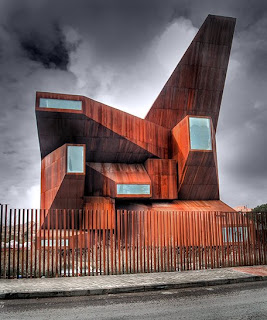
At the Italian site Fides et Forma, Francesco Collafemina has posted photos of supremely ugly churches. 

I mean… reeeeealllly ugly.

Wow... just... wow.... That's ugly.

This church is called Santa Monica.  I don’t think St. Monica or her son would be amused.

Wow... just... wow.... That's ugly.

And another view….

Wow... just... wow.... That's ugly.

Well.. not, that one.  Though I actually like it better.

And since this stuff might give you bad dreams, here is a photo of a nice church that looks like a church …. in Tuscany.

Posted in SESSIUNCULA |
46 Comments

Rabbi’s reaction to SCOTUS nominee Kagan

From CNA about POTUS’s SCOTUS’s nominee:

Rabbis say Kagan not a ‘kosher’ Supreme Court nominee

Rabbi's reaction to SCOTUS nominee KaganAlexandria, Va., Jun 27, 2010 / 06:13 pm (CNA).-
According to the National Rabbinical Alliance and its more than 850 Orthodox Jewish members, Supreme Court nominee Elena Kagan is not “kosher,” or fit to serve, on the court.

A Thursday press release on the part of the alliance said that “Elena Kagan is not kosher. She is not fit to sit on this Court — or any court." [I guess that would be a "no" vote.] The group also called on the Senate Judiciary Committee to refuse to confirm Kagan as replacement of retiring Justice John Paul Stevens.

Referencing Kagan’s past pro-abortion and pro-homosexual record, the alliance asserted that the nominee would hasten “society’s already steep decline into Sodom and Gomorrah.”  [Yep.  That’s a "no" vote.]

Spokesman for the Rabbinical Alliance, Rabbi Yehuda Levin, [WDTPRS has written of Rabbi Levin before.  He thinks left wing Catholics are destroying the Church.] told Cybercast News Service that most groups are happy when “one of their own” is nominated to such a prestigious position. “A great deal has been made about the fact that she would be the second Jewish woman on the court,” Levin noted. “We want to signal to people across the country that we take no pride in this.”  [OORAH!]

"We feel that Elena Kagan turns traditional Judaism on its head – from a concept of a nation of priests and holy people, she is turning it into, ‘Let’s homosexualize every segment of society. And by the way, partial-birth babies have no right to be delivered’," he declared.

Levin also expressed his bewilderment as to why Obama would have appointed Kagan. He said that “eventually, down the road, someone — or some group — is going to ‘take the hit’ for the crazy decisions that Kagan is bound to make,” he declared. “So we would have much preferred if President Obama had given this ‘distinction’ to another minority group, instead of singling out the Jews.”

The Rabbinical Alliance is hopeful that someone in the Senate will filibuster Kagan’s appointment.

Hearings for her confirmation begin on Monday in front of the Senate Judiciary Committee.


It will be interesting to see if any other Jewish Groups, more secular or left-wing rush to respond in support of Ms. Kagan.

Posted in Emanations from Penumbras, SESSIUNCULA | Tagged , , ,
14 Comments

The dark of the moon

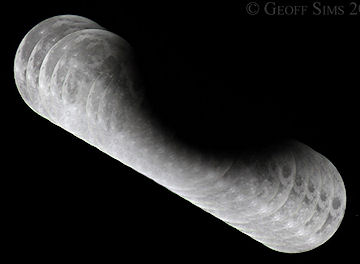
Did you see the Partial Lunar Eclipse?

I saw on Spaceweather that a photographer in Australia, Geoff Sims, did, and shot some photos.  He put them together to show the outline of Earth’s shadow!

The dark of the moon

Posted in Lighter fare, SESSIUNCULA | Tagged ,
2 Comments

Theologian says Jesus may not have died nailed to the Cross

From the Daily Telegraph comes this strange story  

Jesus did not die on cross, says scholar

Jesus may not have died nailed to the cross because there is no evidence that the Romans crucified prisoners two thousand years ago, a scholar has claimed.

The legend of his execution is based on the traditions of the Christian church and artistic illustrations rather than antique texts, according to theologian Gunnar Samuelsson.

He claims the Bible has been misinterpreted as there are no explicit references the use of nails or to crucifixion – only that Jesus bore a "staurus" towards Calvary which is not necessarily a cross but can also mean a "pole".

Mr Samuelsson, who has written a 400-page thesis after studying the original texts, said: "The problem is descriptions of crucifixions are remarkably absent in the antique literature.

"The sources where you would expect to find support for the established understanding of the event really don’t say anything."

The ancient Greek, Latin and Hebrew literature from Homer to the first century AD describe an arsenal of suspension punishments but none mention "crosses" or "crucifixion."

Mr Samuelsson, of Gothenburg University, said: "Consequently, the contemporary understanding of crucifixion as a punishment is severely challenged.

"And what’s even more challenging is the same can be concluded about the accounts of the crucifixion of Jesus. The New Testament doesn’t say as much as we’d like to believe."

Any evidence that Jesus was left to die after being nailed to a cross is strikingly sparse – both in the ancient pre-Christian and extra-Biblical literature as well as The Bible.

Mr Samuelsson, a committed Christian himself, admitted his claims are so close to the heart of his faith that it is easy to react emotionally instead of logically.

Mr Samuelsson said the actual execution texts do not describe how Christ was attached to the execution device.

He said: "This is the heart of the problem. The text of the passion narratives is not that exact and information loaded, as we Christians sometimes want it to be."

Mr Samuelsson said: "If you are looking for texts that depict the act of nailing persons to a cross you will not find any beside the Gospels."

A lot of contemporary literature all use the same vague terminology – including the Latin accounts.

Nor does the Latin word crux automatically refer to a cross while patibulum refer to the cross-beam. Both words are used in a wider sense that that.

Mr Samuelsson said: "That a man named Jesus existed in that part of the world and in that time is well-documented. He left a rather good foot-print in the literature of the time.

"I do believe that the mentioned man is the son of God. My suggestion is not that Christians should reject or doubt the biblical text.

"My suggestion is that we should read the text as it is, not as we think it is. We should read on the lines, not between the lines. The text of the Bible is sufficient. We do not need to add anything." 


Posted in SESSIUNCULA |
81 Comments

QUAERITUR: wrong readings at Sunday TLM

From a reader:

At my parish’s Extraordinary Form Mass this morning, the priest, I think accidentally, used the readings and prayers for the Sixth Sunday after Pentecost instead of those for the Fifth Sunday. Did this affect the validity of the Mass? I’m fairly certain it wouldn’t had it been in the Ordinary Form, but am not sure what the rubrics state for older form.

No, this would not affect the validity of Mass.

It did not affect your Mass obligation either.

Of course, if the priest is constantly doing this, then perhaps someone should double-check which Ordo he is using!

These things happen occasionally. 

I would not give this a second thought.

Posted in ASK FATHER Question Box, SESSIUNCULA |
13 Comments