Did you know that Facebook only allows 5000 friends?
What’s with that?
Follow on Twitter, at least….
Also… I just discovered that I can create ads on my Facebook page. Who knew?

Did you know that Facebook only allows 5000 friends?
What’s with that?
Follow on Twitter, at least….
Also… I just discovered that I can create ads on my Facebook page. Who knew?
Some shots from the feeder.
The expert grape jelly eater.
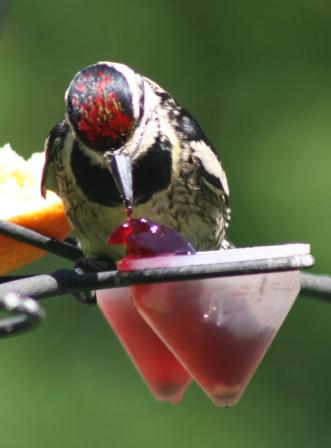
A young male Oriole has found the bonus of a spider in his jelly.
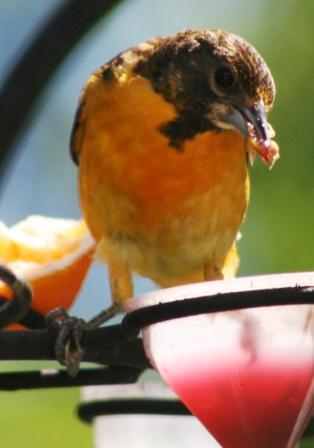
Young make Red-Breasted Grosbeak.

A not so young male Red-Breasted Grosbeak.

A seriously annoying young Hairy Woodpecker, begging relentlessly.

More of the annoying youth, chasing mom around.

There are lots of young birds coming right now. It is fun to see them change.
Thanks are also due to those of you who have lately used the donation button. They eat because of you.
Also, many thanks to those of you who have sent items from the Amazon wish list.
LW of WI sent a book by Scott Hahn, The Lamb’s Supper together with some oil for cooking, which I will very much enjoy. I have plans for the walnut oil, especially.
Also, I have started receiving copies of The Weekly Standard.
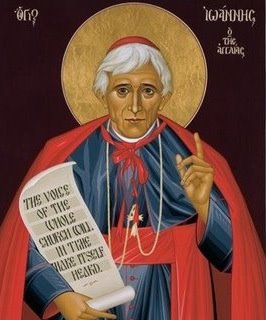 In this PODCAzT we will drill into the Collect designated for the Memorial of soon-to-be Blessed John Henry Newman (+1890).
I have as a surprise, a guest appearance by Fr. Timothy Finigan, who will read one of Newman’s famous works.
We drill into the phrase "kindly light" and also the epitaph for Newman’s grave.
Then we hear the excerpt from the Apologia Pro Vita Sua chosen for the Office of Readings for Newman’s Memorial.
Along the way, I comment.
https://wdtprs.com/wp-content/legacy/audio-archive/podcazt/10_06_25.mp3
Listen & subscribe: Apple Podcasts Overcast Pocket Casts RSS feed
SEND Fr. Z VOICEMAIL FEEDBACK.
And don’t forget:
105 10-06-24 Augustine on the Baptist; don Camillo (Part VIII)
104 10-05-28 A glimpse of heaven, “the Love that moves the sun and other stars”
103 10-05-24 The new translation of the 2nd Eucharist Prayer; Fr. Z digresses and rants
102 10-05-21 Exploring the new English translation of the Roman Canon; voicemail
LATIN:
Deus, qui beátum Ioánnem Henrícum, presbýterum,
lumen benígnum tuum sequéntem
pacem in Ecclésia tua inveníre contulísti,
concéde propítius,
ut, eius intercessióne et exémplo,
ex umbris et imagínibus
in plenitúdinem veritátis tuae perducámur.
WDTPRS LITERAL VERSION:
O God, who granted blessed John Henry,
a priest following Your kindly light,
to find peace in Your Church,
graciously vouchsafe,
by his intercession and example,
that we may be drawn from shadows and shades
into the fullness of Your truth.
Space Weather News for June 25, 2010
SPACE STATION IN CONSTANT SUNLIGHT: For the next few days, the International Space Station (ISS) will be orbiting Earth in constant sunlight. This sets the stage for a remarkable sky show. Because the ISS is constantly illuminated, it shines brightly in the night sky every single time it passes overhead. Some observers can see the space station 3, 4, even 5 times a night. More information and flybys predictions may be found at http://spaceweather.com
ANDROID FLYBYS: Spaceweather’s "Simple Flybys" app is now available for Android phones as well as the iPhone and iPad. Details at http://simpleflybys.com
WEEKEND LUNAR ECLIPSE: On Saturday, June 26th, the Moon will pass through Earth’s shadow, producing a 54% partial lunar eclipse. The event is visible from most of the Americas, Australia, Japan, east Asia and all of the Pacific Ocean. For readers in the USA, the best time to look is just before sunrise on Saturday morning. Visit http://spaceweather.com for more information.
Allow me please to direct your attention to a new blog of a friend of mine, Mr. Jeffrey Tucker, who is well-known as a Church musician. He is editor of the journal Sacred Music, which for many years had been edited by my late mentor, Msgr. Richard Schuler.
The new blog is called Chant Cafe.
There are several contributors, including some fine church musicians.
Please take a look at Mr. Tucker’s blog, bookmark him, and add him to your RSS feed reader. Give him some traffic.
And please follow me on Twitter: @fatherz More tweet followers! More!
From a reader:
I need immediate advice. This morning my son spilled the Precious Blood on his shirt when receiving this morning. There is no sacrarium in the Church. I brought him home and washed the shirt in cold water which I intend to pour into the ground near a tree. However, there is still a stain. Can I use soap? Is Jesus still present when there is a stain or are the accidents sufficiently gone?
I commend you for being so careful!
You don’t have to put the shirt in the tabernacle.
Wash the shirt.
In this case you don’t have to worry. The accidents of "wine" are no longer present. The Presence of Christ was probably broken at the moment the liquid was absorbed and dried a bit, that is, when it was no longer recognizable as "wine". You have to be able to recognize the accidents of wine, not the accidents of a wine stain.
It was always the tradition that stained altar linens were first washed by the priest himself in a first rinsing. The water poured down the sacrarium…. just in case. It was a very prudent practice, and one which stemmed from and fostered reverence and care for the Eucharistic species. There may have been particles of Hosts caught in the linens, etc.
But, in the situation you are describing, I think you did the right thing.
I think this also brings up other questions.
Is it prudent to have Communion under both kinds?
Is it prudent to have the very young receive in that way?
I think laundry tips will be forthcoming from readers.
Pope Benedict recently addressed priests of Rome brought together in the Basilica of St. John Lateran for an ecclesial convention on 15 June.
The Holy Father develops some themes that I have been working with and bashing you with over your heads for years.
The Holy Mass, celebrated in the respect of the liturgical norms and with a fitting appreciation of the richness of the signs and gestures, fosters and promotes the growth of Eucharistic faith. In the Eucharistic celebration we do not invent something, but we enter into a reality that precedes us, more than that, which embraces heaven and earth and, hence, also the past, the future and the present.
This universal openness, this encounter with all the sons and daughters of God is the grandeur of the Eucharist: we go to meet the reality of God present in the body and blood of the Risen One among us. Hence, the liturgical prescriptions dictated by the Church are not external things, but express concretely this reality of the revelation of the body and blood of Christ and thus the prayer reveals the faith according to the ancient principle "lex orandi – lex credendi."
And because of this we can say "the best catechesis on the Eucharist is the Eucharist itself well celebrated" (Benedict XVI, Post-Synodal Apostolic Exhortation "Sacramentum Caritatis," No. 64).It is necessary that in the liturgy the transcendent dimension emerge with clarity, that of the mystery, of the encounter with the Divine, which also illumines and elevates the "horizontal," that is the bond of communion and of solidarity that exists between all those who belong to the Church.
In fact, when the latter prevails, the beauty, profundity and importance of the mystery celebrated is fully understood. Dear brothers in the priesthood, to you the bishop has entrusted, on the day of your priestly Ordination, the task to preside over the Eucharist. Always have at heart the exercise of this mission: celebrate the divine mysteries with intense interior participation, so that the men and women of our City can be sanctified, put into contact with God, absolute truth and eternal love.
Full text in English.
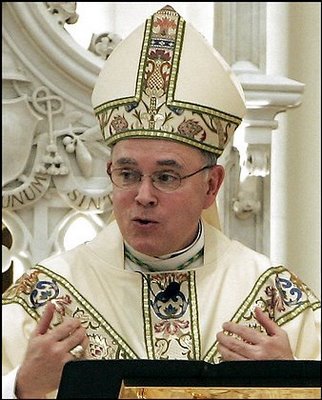
H.E. Most Rev. Charles J. Chaput, Archbishop of Denver has delivered a talk about evangelization and liturgical renewal.
You long-time readers by now have my liturgy speech down pat. You know what I have to say about Pope Benedict’s "Marshall Plan" and that liturgy is the tip of the spear. We must renew our Catholic identity, and our worship is our key component.
A strong Catholic identity is a key to affecting the world around us.
Here is the CNA recap.
Chicago, Ill., Jun 24, 2010 / 06:58 pm (CNA).- Christian witness is intended to prepare for and to live the “cosmic liturgy” in which all mankind adores God, Archbishop Charles J. Chaput declared in a lecture on Thursday evening. Noting the cultural obstacles to liturgical understanding, he said the renewed liturgy should create Christians who would die rather than not celebrate Mass.
Delivering the Hildebrand Distinguished Lecture at the Liturgical Institute of the University of St. Mary of the Lake in Illinois, the Archbishop of Denver praised Chicago’s “historic role” in the renewal of the liturgy and the evangelization of America. He said the 10th anniversary of the Liturgical Institute shows that this legacy continues.
He opened with a reflection on the respected liturgist and theologian Fr. Romano Guardini. Soon after the Second Vatican Council published its “groundbreaking” document on the liturgy, “Sacrosanctum Concilium,” the priest sent a letter to the Third German Liturgical Conference wondering whether man in an industrial and scientific age is “no longer capable of the liturgical act.”
“I think he put his finger on one of the key questions of mission in his time, and also in ours,” Archbishop Chaput remarked, explaining that the liturgical act is the transformation of personal prayer and piety into “genuine corporate worship” and “the public service that the Church offers to God.”
This act requires an inward awareness of the unity of the whole person, body and soul, with the spiritual body of the Church, present in heaven and on earth, he added.
“It also requires an appreciation that the sacred signs and actions of the Mass — standing, kneeling, singing and so forth — are themselves ‘prayer’.” [signs]
However, he warned, this awareness is obscured in a society organized around a “narrow” vision of technological progress in which truth is judged by what can be perceived and verified through research and experiment.
“In practice, almost nothing of what we believe as Catholics is affirmed by our culture,” commented the archbishop. “Even the meaning of the words ‘human’ and ‘person’ are subject to debate.” [Exactly.]
This has implications for Catholic worship in which we profess to be in contact with “spiritual realities” and to receive the true Body and Blood of the Lord.
“We preach the good news that this world has a Savior who can free us from the bondage of sin and death. What can our good news mean in a world where people don’t believe in sin or that there is anything they need to be saved from?” Archbishop Chaput asked. “What does the promise of victory over death mean to people who don’t believe in the existence of any reality beyond this visible world?”
The archbishop said Chicago priest Fr. Robert Barron is one of the few to have wrestled with such issues. For him, the liturgy is not to be shaped according to modern suppositions; rather, the liturgy should “question and shape the suppositions of any age.” While modern man is probably incapable of the liturgical act, this is no grounds for despair. Instead, we should “let the liturgy be itself,” the priest has said.
Archbishop Chaput agreed with Fr. Barron that in recent decades the “professional liturgical establishment” chose to shape the liturgy according to the world, which has proven to be “a dead end.” Seeking relevance through “a kind of relentless cult of novelty” has only resulted in confusion and division between the faithful and the true spirit of the liturgy, continued the archbishop.
He said liturgical renewal should build “an authentic Eucharistic culture” to instill “a new sacramental and liturgical sensibility that enables Catholics to face the idols and suppositions of our culture with the confidence of believers who draw life from the sacred mysteries …”
To this end, the Archbishop of Denver offered several suggestions: [1] the need to recover the “intrinsic and inseparable connection” between liturgy and evangelization; [2] the need to see the liturgy as a participation in the “liturgy of heaven” where Christians worship “in Spirit and truth” with the Church and the communion of the saints; [3] and the need to recover and live the early Christians’ “vibrant liturgical and evangelical spirituality.”
“Liturgy is both the source of the Church’s mission and its goal,” explained the prelate. “The reason we evangelize is in order to bring people into communion with the living God in the Eucharistic liturgy. And this experience of communion with God, in turn, impels us to evangelize.”
The “pedestrian” and self-focused nature of many contemporary liturgies results from the loss of the sense of this participation in the heavenly liturgy, he suggested.
“The Eucharist … is a cosmic liturgy that unites the worship of heaven with our own worship here on earth… Heaven and earth are filled with the glory of God,” he continued. Worship is a window through which “the reality and destiny of our lives is glimpsed.” [Does that sound familiar?]
This truth should “make us strive for liturgies that are reverent and beautiful, and that point our hearts and minds to things above.” The ultimate purpose of Christian witness is to “prepare the way for the cosmic liturgy in which all humanity will adore the Creator.”
The archbishop encouraged the faithful to look to the early Christians, who found their identity in the liturgy and said “we cannot live without the Mass.” ["Sine dominico non possumus" is what some North African martyrs explained before they died.]
“This is the kind of faith that should inspire our worship. And this is the kind of faith that our worship should inspire. Can we really say today that we’re ready to die rather than not celebrate the Mass?” [A question to be asked.]
Describing the liturgy as “a school of sacrificial love,” [charity] he said that all Christians should see themselves as a Eucharistic offering, “a perfect offering holy and acceptable to God.”
“The liturgical act becomes possible for modern man when you make your lives a liturgy, when you live your lives liturgically — as an offering to God in thanksgiving and praise for his gifts and salvation. You are the future of the liturgical renewal.”
Archbishop Chaput closed his lecture with the words of one of the dismissal prayers of the new Roman Missal: “Go in peace, glorifying the Lord by your life.”
To read Archbishop Chaput’s full lecture, click here.
Today we welcome St. Augustine of Hippo (+430) who speaks to us from a sermon about St. John the Baptist on his feast day, the Feast of the Nativity of St. John.
Along the way you will hear a couple versions of Ut queant laxis, the famous hymn for this feast day. The first is a baroque version by Juan de Araujo (+1712), which will give you a sense of the sacred music in the great cathedrals of S America. This has a pretty groovy ending, too. There is also a Gregorian chant version worked in.
And since a reader recently dropped me a line about having enjoyed the stories of The Little World, we have another installment about the fictional not-quite-saint don Camillo Tarocci, (+ A.D. … ?), tough guy and parish priest.
Listen & subscribe: Apple Podcasts Overcast Pocket Casts RSS feed
 Some time ago, I began a to read stories from The Little World of Don Camillo by Giovanni Guareschi. There is a Don Camillo tag you can use to find the others easily.
These delightful pieces are set in post-war Northern Italy.
They blend brilliant insight into the human condition with solid applied Catholic Faith.
Today we hear the story:
https://wdtprs.com/podcazt/10_06_24.mp3
SEND Fr. Z VOICEMAIL FEEDBACK.
105 10-06-24 Augustine on the Baptist; don Camillo (Part VIII)
104 10-05-28 A glimpse of heaven, “the Love that moves the sun and other stars”
103 10-05-24 The new translation of the 2nd Eucharist Prayer; Fr. Z digresses and rants
102 10-05-21 Exploring the new English translation of the Roman Canon; voicemail
101 10-05-15 Preface for Ascension
100 10-04-18 Benedict XVI, Pius XII, Justin Martyr and Fr. Z rants about liturgical abuse


Coat of Arms by D Burkart
 Fr. John Zuhlsdorf on Daily Rome Shot 1117 – A *POLL* about 2026-27: “Sorry… my bad. It is indeed SIX. 1. Rh8+! Kxh8 2. Qh2+ Kg8 3. Qh7+ Kf8 4. Qh8+ Ke7 5.…”
 on Encrypted Yeast? The Fathers on “What does the “leaven” really say?” (6th Sunday after Epiphany Resumed): “I especially like St. John Chrysostom’s insight, that when we are “hidden” in the normal places we live and work,…”
 on Daily Rome Shot 1117 – A *POLL* about 2026-27: “pestolover: For what it’s worth, your solution was the best I could do also.”
 on Daily Rome Shot 1117 – A *POLL* about 2026-27: “Fr Z thanks so much for 2 reminders. 1. Using your Amazon link! For heaven’s sake it costs us nothing…”
 on 10 November – St Andrew Avellino (Vetus Ordo). Wherein Fr. Z rants.: “So interesting that you bring this up, a couple weeks ago a priest at a neighboring parish died unexpectedly. They…”
 on Daily Rome Shot 1117 – A *POLL* about 2026-27: “All moves are forced for black. R-h8+, KxR Q-h2+, K-g8 Q-h7+, K-f8, Q-h8+, K-e7 QxP+, K-e6 Q-f7++ Ok, so 6…”
 on Daily Rome Shot 1117 – A *POLL* about 2026-27: “I couldn’t post on the ad orientem article. Here’s what I wanted to post: “Let the bishops restore ad orientem…”

A Daily Prayer for Priests








They find you a pro-life agent in your area who commits to giving a portion of the fee to a pro-life group!

PLEASE subscribe via PayPal if it is useful. Zelle and Wise are better, but PayPal is convenient.
A monthly subscription donation means I have steady income I can plan on. I put you my list of benefactors for whom I pray and for whom I often say Holy Mass.
In view of the rapidly changing challenges I now face, I would like to add more $10/month subscribers. Will you please help?
For a one time donation...



Help Monks in Wyoming (coffee – UPDATED LINK) and Norcia (beer) and the wonderful "Soap Sisters" of Summit, NJ!


Please follow me on Twitter!










Visits tracked by Statcounter
since Sat., 25 Nov. 2006:



 Archbishop Chaput: Liturgical renewal should create martyrs’ love for the Mass

