A miracle through Bishop Baraga?

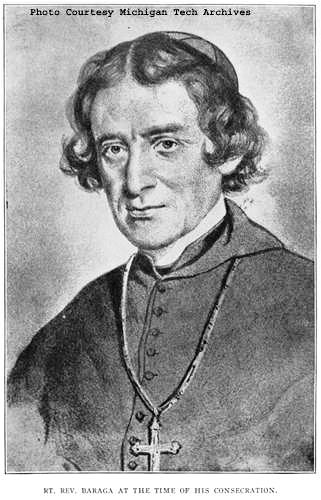
A miracle through Bishop Baraga?I believe my friend, now Bishop of Marquette, H.E. Most Rev. Alexander Sample was once the postulator for the cause of Bishop Baraga, but that would have been many years ago.  The cause has moved along.  I believe the positio super virtutibus was already dealt with at the Congregation, but Bp. of Baraga, Servant of God, is not yet "Venerable".

There is now news from Marquette about a possible miracle.

this is from CNA:

Michigan diocese investigates miracle attributed to former bishop

Marquette, Mich., Mar 11, 2010 / 08:26 am (CNA/EWTN News).- The Diocese of Marquette is investigating an possible miracle attributed to Servant of God, Bishop Frederic Baraga. The official inquiry will move the cause for Bishop Baraga’s canonization forward, which was opened for the prelate in 1952.

In press conference on Wednesday, the current Bishop of Marquette, Alexander K. Sample, announced the recent development, saying, “Since my first days as a seminarian studying for the priesthood, I have had great devotion to Bishop Baraga.”

“As his eleventh successor, I am thrilled at the prospect of a miracle that will advance his cause. With all the priests, deacons, religious and lay faithful of the diocese, I give thanks to God for his, holy, priestly, example,” he added. 

Father Ronald Browne, who has been appointed to lead the work of the canonical tribunal, explained the story behind the alleged miracle. “We have a case involving what was thought to be a tumor on a patient’s liver that showed up on various tests, including a CT scan and an ultrasound. However, when exploratory surgery was done, there was no tumor to be found,” Fr. Browne said.

The Diocese of Marquette reported that while in the Upper Peninsula, the patient and the patient’s family invoked the intercession of Bishop Baraga and placed his stole on the sick person’s abdomen. Following the prayers, the patient said that the pain in the abdominal area went away.

The diocese explained that in order for the event to be considered as a miracle, it needs to be affirmed as something that science cannot explain and be attributable to the intercession of the candidate for sainthood.

Once the tribunal has investigated the event – the process is scheduled to begin on March 12 – two physicians must testify regarding the physical condition of the patient before and after the event. After the allA miracle through Bishop Baraga?eged miracle has been verified, documentation will be sent to the Congregation for the Causes of Saints in the Vatican, who will then submit the cause to Pope Benedict XVI. The Holy Father will then determine whether or not Bishop Baraga will be beatified.

If the miracle is recognized as authentic, the diocese will need to verify one more miracle in order for the Michigan bishop to be declared a saint.

Bishop Baraga was born in 1797 in Slovenia, and come to the United States as a missionary to the upper Great Lakes region in 1830. Ministering to the Odawa and Ojibwa Native American tribes, the bishop is said to have traveled throughout the 80,000 square mile territory by means of boat, canoe, horse, dog sled and even snowshoe. Often called the “Snowshoe Priest,” he was consecrated a bishop in 1853 and served until his death in 1868. Bishop Baraga is credited with writing a Ojibwa/English dictionary which is still in use today. 

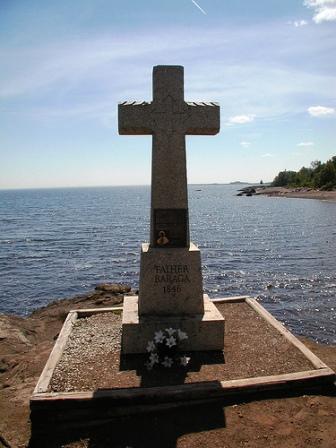
Bishop Baraga also has ties to my native Minnesota.  On the North Shore of Lake Superior you can visit "Baraga’s Cross".

Posted in Saints: Stories & Symbols, SESSIUNCULA | Tagged ,
9 Comments

URGENT POLL UPDATE on Denver priest attacked for being obedient

Look what you have done!

ORIGINAL ENTRY HERE.  Comment there.

 UPDATE 10 March 1813 GMT:

LOOK WHAT YOU HAVE DONE!

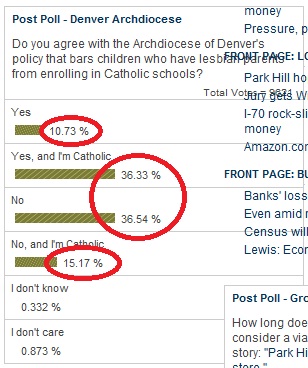
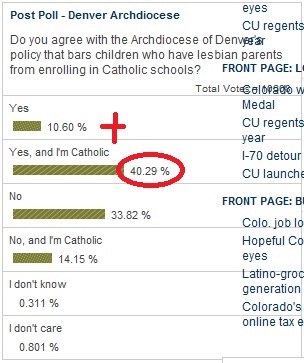
The poll graphic on the denverpost.com page is screwed up.

This is the best I could get.

Close… it is getting closer. 

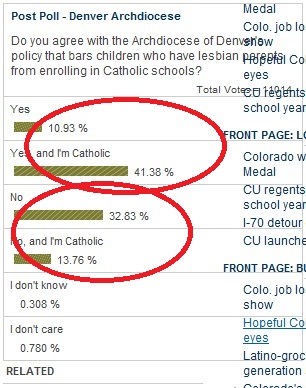
And those "Yes" and "No, and I’m Catholic" categories are getting closer too.

URGENT POLL UPDATE on Denver priest attacked for being obedient

UPDATE 10 March 1839 GMT:

I see that on Fr. Breslin’s blog, the comments have been deleted under all the posts.  Hard to blame him, poor guy.

UPDATE 10 March 2344 GMT:

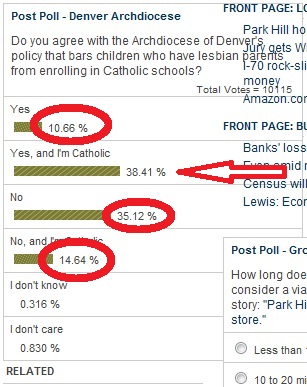
The Yes, I am Catholic category has pulled ahead!  

But the bad opinion is still head if you add their two categories together.

URGENT POLL UPDATE on Denver priest attacked for being obedient

UPDATE 11 March 1344 GMT:

The poll has been turned around!

Keep up the good work!

URGENT POLL UPDATE on Denver priest attacked for being obedient

UPDATE 11 March 2304 GMT:

The good guys are winning.

URGENT POLL UPDATE on Denver priest attacked for being obedient

Posted in POLLS | Tagged , ,
Comments Off on URGENT POLL UPDATE on Denver priest attacked for being obedient

Zmirak responds to Hoopes, Fr. Z does Liturgy Science Theatre 3000

There is a bloggy debate going on between Mr. Zmirak and Mr. Hoopes.  Rather, it turned into a debate.

Zmirak started the ball rolling it with a piece in Inside Catholic.  Hoopes responded on the National Catholic Register. 

I posted a fisk of Hoopes’ response.

It is only fair that I now fisk Zmirak’s loooooong retort to Hoopes’ response… with the oft imitated emphases and comments:

You May Kiss the Bridey
by John Zmirak  
3/10/10
Print This Page
 
My former editor at the National Catholic Register, Tom Hoopes, has done me a courtesy rarely afforded tradition-minded Catholics: He has stooped to address my arguments, instead of airily dismissing them as the sad obsessions of half-wits, bag ladies, and yellow-eyed anti-Semites with dirty fingernails. Sure, he did so in a blog post which referred to the traditional Mass — the one said by almost every priest who has ever been canonized — as a "freak flag." But as a true-blue Traddy, I will take what I can get. Give me a Mass at 6 a.m. at a chapel in a lunatic asylum . . . a muttered liturgy with a mandatory sign-in sheet at an abandoned Armenian parish . . . and I’ll show up, clutching a missal — despite the alarming (if not surprising) percentage of eccentrics. [That’s true, you know.]  Come to think of it, those of us who accept Humanae Vitae are already a vanishingly tiny segment of practicing Catholics, so it seems a bit rich for one sliver of this infinitesimal subculture to throw donut holes across the bingo hall at the other. (Okay, I’ll toss a few: At least we Trads aren’t scarfing down lame Catholic knock-offs of already-pitiful Christian "rock," or training our daughters to be altar servers for the next World Urban Youth Day . . . bless their hearts!)  [Okayyy… Zmirak has the flamethrower charged up.]
 
What makes responding to Hoopes such fun […and he left himself open, folks, for this…] — I’m almost moved to give up writing this article for Lent — is his resemblance to one of my favorite characters in the works of Evelyn Waugh, Sebastian Flyte’s brother Bridey. Like him, Hoopes is a fervent believer, who has worked hard and sacrificed much in the service of the Church, and he earnestly strives to explain and defend the Faith. Like Bridey’s, his arguments have a curious effect. As Charles Ryder says:
 
D’you know, Bridey. If ever I thought about becoming a Catholic, I’d only have to talk to you for five minutes to be cured. You manage to reduce what seem quite sensible propositions to stark nonsense.
 
To which Bridey responds, with admirable humility:
 
It’s odd you should say that. I’ve heard it before from other people. It’s one of the reasons why I don’t think I’d have made a good priest. It’s something in the way my mind works, I suppose.
 
The "Bridey Effect" is so evident in Hoopes’s response to my piece on the liturgy that I face an embarrassment of riches. And to avoid the rich embarrassment I fear might otherwise result, I will henceforth refer to the article’s author simply as "Bridey." [ROFL!]
 
Bridey begins by objecting to the suggestion that it was an imprudent act for Pope Paul VI to forbid the liturgy in its solemn, invariant, historic form and replace it with one open to dozens of options, subject to a decade of tinkering, at a time of deep theological uncertainty and radical social change. Did this radical, unsettling alteration in the form of the Church’s central mystery prepare the laity to accept the lies of dissenting Catholics who claimed that everything else — from faith to morals — was also up for grabs? Was it indeed like a new president coming into office and changing our country’s flag? [That was the point in Zmirak’s original article.]
 
Bridey doesn’t answer, but instead takes refuge in a theological evasion: "The Church doesn’t have or need a flag, because it isn’t a nation. Its members are tied to each other by bonds far deeper than political ones." Very nice, and very high-minded. The Church is indeed, in one sense, the Mystical Body of Christ. And in that sense, a Renaissance cardinal could have whispered to his mistress across the pillow that the Church of his day was not in any sense "corrupt." Indeed, the Bride of Christ is indefectible. So why even talk about it? Why have a newspaper devoted to reporting on the changeless, eternal union of Christ and His Church? My old colleagues at the Register can pack up their laptops and go home.  [NB: A flag is a "sign".  The point is that Bridey decides that because the Church is, ideally and considered from the point of view of Christ, spotless, it doesn’t need an outward sign such as a flag, or a Mass that doesn’t change, etc.]
 
What if, however, by "Church" we are referring to the changeable, human side of the Church Militant on earth [Which speaks to the point that while the Church is spotless, ideally, we are not.  Humans are, furthermore, not angels.  We need things like signs.] — you know, the aspect of the Church that indeed has human leaders and members, news, controversies, flaws, reforms, and renewals? It is that Church that had an abuse crisis culminating in the 1990s, and a liturgy crisis beginning in the 1970s. If we’re permitted to talk about the former, we must also address the latter. In that sense, the Church has an earthly governance, a legal code, an administrative structure, and more than one billion imperfect adherents. Thanks to the fall of the Chinese empire in 1912, it is the oldest continuous human institution on earth. Such an organization, which commands human loyalties and can lose them, [Indeed.] might indeed need something like a flag.  [Indeed.] It’s not for nothing that Catholics during the Counter-Reformation marched (heavily armed, to prevent sacrilegious attacks) in Corpus Christi processions through hostile Calvinist towns. The Eucharist itself was those brave Catholics’ banner, and I for one am not ashamed of them. Is Bridey?
 
My original article implied — no, it stated outright, and let me here reaffirm it — that the chaos in Catholic bedrooms began on Catholic altars. [The constant changes people experienced in liturgy led to confusion also about moral issues, especially in the lead up to and in the wake of Humanae vitae.  And vice versa.] The noodling, tinkering, profanation and vulgarization that afflicted the Catholic sanctuaries gave busy, weary, worldly Catholics (i.e., most of us) apparent permission to follow the lead of pastors and theologians who were tinkering and noodling with Catholic sexual morality. Humanae Vitae was treated as a dead letter when it was issued, as was Sacrosanctum Concilium, and then the norms that (once upon a time) forbade Communion in the hand and altar girls. [Well… that parallel isn’t quite right.  Liberals rejected Paul VI’s Humanae vitae but they enthusiastically instrumentalized Sacrosanctum Concilium to be able to do their own thing with impunity.  Subsequent corrective documents on liturgy however…] Documents trickled in from Rome from time to time on sexual morality and liturgical abuses, and they were duly ignored by the very bishops Rome had appointed. What exactly were ordinary Catholics, the kind who don’t read curial admonitions over breakfast, meant to think? If that’s good governance, I’d hate to witness anarchy.  [Do I hear an "Amen!"?]
 
Of course, much of this confusion — which has dragged on for a generation — could be resolved by a "reform of the reform," such as many suggest Pope Benedict XVI has in mind. Were the Novus Ordo pared back to something resembling the intentions of the Second Vatican Council — facing the altar, minus all the ambiguous Eucharistic Prayers (that is, all but the First), with congregants kneeling for Communion on the tongue received from a priest — most Traditionalists would shut up. No, we’d sing for joy. Most of us appreciate hearing the readings in the vernacular, and few would travel for miles and hours to find a Mass for the sake of the old Confiteor. [Indeed.]
 
[But let’s move along to the next section.] The next point Bridey makes is one intended to make the delicate reader squirm. He compares the reception of Holy Communion to the intimate marital act, and suggests there is something prurient in paying undue attention to the externals attending either sexuality or Mass. Here again, it is hard to know where to begin. I might start by noting that the sexual act is private and properly confined to the participation of two. The Mass is inherently public and communal, even when said by a solitary priest in a prison camp. It is the summit and locus of unity in the Church. To lump these mysteries together and ask that marital dignity and privacy be accorded, say, the public masses said by an archbishop . . . for once in my life, I am almost speechless. [i would add that if Bridey, as Zmirak calls Mr. Hoopes in this piece, thought – really – that people on the traditional side of things might be discomforted by a reference to Mass and sex, then he doesn’t know traditionalists.  Trads are not pruds, in the sense many liberals assume them to be.  As a matter of fact, the same sort of traditionalism and conservatism allows "trads" to have the sense of humor lacking in most liberals, as well as a healthier use of the good things of creation.]  I’ll leave my response to one of Bridey’s more acerbic commenters, who rightly replied:
 
[I]f that’s the analogy you REALLY want to use, current celebration of the Liturgy has become less like one of the parties insist[ing] on the same candles and Journey tape all the time, and more like one of the parties . . . insisting on constant novelty, obsessing on what she can do to make it "different" this time; as if it were . . . oh, I don’t know, the French maid’s outfit that made it all "meaningful."
 
Bridey says that the Eucharist, like sexual intercourse, is an "expression of a relationship of which it is a very small (but very important) part." Concerning the Eucharist, this statement is so wide of the mark I’m tempted to say, "It is not even wrong." Does the author really regard sexuality and all the ripples it spreads across the surface of life as a drop in the bucket? Is he saying, with so many randy bachelors over the centuries, "It’s just sex, sweetie"? Surely not. That’s just the "Bridey effect."  [Nor is Holy Mass just a "small" part of the Catholic experience.  I was rather surprised at that.]
 
The sexual act and the commitments (such as children) that follow from it are the only decisive difference between a marriage and a friendship. The first thing we singles wonder when we see two members of the opposite sex together is: Are they "together"? Are these people married, engaged, exclusively dating, or are they just "pals"? In answer to this honorable question, married people wear rings, women change their names, and healthy laws still distinguish marriage from "domestic partnerships." We do all sorts of very public things that declare which person we’re married to, and mark that relationship off from every other.
 
Indeed, in almost every culture, the two sexes engage in a wide variety of activities designed to reinforce and celebrate the distinctions between male and female — almost as if the most primitive men and women knew that the difference between them was profound and meaningful. In Jewish and Christian theology, as theologian Manfred Hauke demonstrated, the male represents transcendence and the female immanence; God is the Father or the Bridegroom, and humanity is the Bride. Desacralizing the liturgy, confusing the roles of priest and laity, is as confusing and misleading as pretending there is no difference between the sexes. But then we’re doing that too, nowadays. [Do I hear and "Amen!"?  That was good, Mr. Zmirak.]
 
An article I penned eight years ago on Paul VI’s collaborator in crafting the Novus Ordo, Archbishop Rembert Weakland [!], explains the implications here:
 
The priest acts in the person of Christ. Christ acts as high priest, and offers himself as victim to God the Father, in expiation for the sins of man. In the person of the priest, Christ weds himself to the congregation, which stands for the Church, Christ’s mystical Bride. Just as the priest’s sacrificial role in the New Testament theology is a direct outgrowth — down to many of the rituals and prayers used — of the High Priest’s Temple ritual in Judaism, so this matrimonial theology grows directly out of the Old Testament understanding of the Jewish people as wedded to Yahweh. (See the Song of Songs and Hosea for lovely, poetic meditations on this theme in the Hebrew Bible.) . . .
 
This marriage between the priest and the congregation, between Christ and the Church, is at the very heart of Catholic theology. It connects to the sacredness of the sexual act, and expresses the very reason why (as we believe) God became a man — in order to unite the mass of fallen, weak humanity to himself, in a mystical sacrament of love. In pagan religions and ancient Judaism, the role of a priest — one who offers sacrifice — was distinctly and utterly masculine. [My digression: This is a good reason why we priests should always use a chalice veil for Holy Mass.  End digression.] This is true in all the traditional liturgies of the Church, East and West, along with the papal mass in Rome, which dramatically depict Christ’s manhood along with his transcendent Godhood, in the imperfect but sanctified masculine person of the priest. A woman playing at priest is just as absurd as Nathan Lane playing a nun. It’s a drag act, proper to Saturday Night, but not to Sunday morning.
 
In a reverent liturgy, we engage in all sorts of symbolic behavior to distinguish the sacred elements from the profane, the unconsecrated bread from the Body of Christ, and the priest from the laity. Liturgies that cloud such distinctions are inherently confusing, as in some sense they were meant to be. [RIGHT] As Michael Davies [and Rembert Weakland in the same piece…] noted long-ago, the Anglican and Lutheran-inspired changes in the Novus Ordo Missae in the original Latin were intended by the committee that crafted them to fudge the differences among the churches — in the hope that an ecumenical liturgy would promote Christian unity. [How did that go?  Now that Pope Benedict is shifting the discussion with his liturgical view (inter alia) the Orthodox are entering a new phase of dialogue with the Catholic Church.] Later, secularizing abuses such as Communion in the hand were promoted precisely in order to cloud the exact Catholic theology about the Mass as a sacrifice performed by a priest in the Person of Christ, in favor of a nebulous, liberal Protestant spirituality of communal commemoration — one that could lead to the ordination of women. [Do I hear a HUGE "AMEN!"?] The Holy Spirit has prevented any changes that invalidated the Mass. That is all we were promised.
 
It is one thing to call for the proper celebration of the Novus Ordo, minus destructive options (ambiguous Eucharistic prayers, handing out Communion like a movie ticket, Mass said facing the people — something Benedict has regretted). Do that, and you settle the question. In that idealized vision of the Ordinary Form of the Roman Rite — such as I’ve seen good priests celebrate maybe five times in my life — there are no theological or catechetical problems. [Though… ehem… you could look at the way the orations were changed.  But let that pass.] Impose that liturgy throughout the Church, and every objection raised by Traditionalists fades into pedantry — though some of us will really miss those extra Kyries . . . [Not quite every, but nearly all.]
 
It is quite another thing to defend the Ordinary Form as ordinarily celebrated, [Something fewer and fewer reasonable people do, actually.  I think it is pretty well accepted even in some liberal circles that something has to be done.  We might differ a great deal about what, but something isn’t working.] in some 99.9 percent of parishes outside Vatican City, then scoff at those who object to its banality, vulgarity, and casual sacrilege as aesthetes or Pharisees. Bridey’s position reminds me of a wedding I heard about among some distant acquaintances. For reasons that remain opaque to me, the groom decided to take his bride’s last name, and have her female friend serve as his "best man." My charitable response was: "Which one of them wore the white dress?"
 
Imagine for a moment that the groom was indeed the one in the puffy gown, the bride in a tuxedo. Picture that whole wedding party done up in drag, with the bridesmaids wearing taped-on Freddie Mercury moustaches, the ushers in high heels and stockings. With his consistent disregard of "externals," I’d expect Bridey to answer that this marriage was sacramentally valid. As indeed it was. [Well… probably.] So is the Ordinary Form as ordinarily celebrated. That’s pretty much all we can say for it.  [Which is precisely which lies at the core of Pope Benedict’s real concern about liturgy: the "so long as it’s valid" – from a strain of Neo-Thomist reductionism to the bare basics for validity – spurred a generation and more to make the rest up as they pleased…. "so long as it was valid".]
 
John Zmirak is the author, most recently, of the graphic novel The Grand Inquisitor and is Writer-in-Residence at Thomas More College in New Hampshire. He writes weekly for InsideCatholic.com.

Posted in The Drill | Tagged ,
39 Comments

WDTPRS – Thursday 3rd Week of Lent – Prayer over the people (2002MR)

A great new feature of the 2002 Missale Romanum in Latin is that for Lent the "Prayer over the people" or Oratio super populum has been revived as an option.

Priests can use this prayer NOW at the end of Mass, but still only in the Latin.

Yah, I know.. I keep posting these as if they were, I dunno, interesting.

Let’s have a look at today’s:

ORATIO SUPER POPULUM (2002MR):
Clementiam tuam imploramus, Domine,
in misericordia tua confidentes,
ut, sicut nos ex te habemus esse quod sumus,
sic per gratiam tuam et bene velle sumamus,
et bonum posse quod volumus
.

This is based mostly on an ancient prayer which was in the Sacramentarium Veronense.  It was part of a Preface listed for Masses in the month of Semptember, but perhaps used for the anniversary of a bishop’s consecration.  It was originally: "[Vere dignum…] Maiestatem tuam devotis mentibus implorantes ut sicut ex te habemus esse quod sumus sic per gratiam tuam et bene velle sumamus et bonum posse quod volumus: per …".

Note that maiestas, typical more of a preface, is changed to clementia, which is often paired with a form of the very imploro in ancient Latin prayers.  That creates a rather awkward juxtaposition of misericordia and clementia, which means close to the same thing. 

Clementia is “calm, tranquil state of the elements, calmness, mildness, tranquility” as in describing weather or the ocean and is “indulgent, forbearing conduct towards the errors and faults of others, moderation, mildness, humanity, forbearance, benignity, clemency, mercy” in regard to interior dispositions.  Again, we often see clementia paired with a form of imploro.  Certain concepts expressed in specific vocabulary tend to be paired and repeated in liturgical prayers.

The original version, from that preface, is grammatically "incomplete", unless you are perhaps Preserved Killick.  You can why, in putting together this "shake and bake" prayer, they decided to change implorantes to imploramus.

SLAVISHLY LITERAL VERSION:

…

Want to have a go?

Posted in SESSIUNCULA |
12 Comments

“marriage is NOT for Adam and STEVE”

From The Telegraph in the UK:

My emphases and comments:

Priest apologises for joking that marriage is not for ‘Adam and Steve’

A Catholic priest [no, he is a deacon] has apologised for joking during a sermon that true marriage can only be between Adam and Eve – not ”Adam and Steve”.

Reverend Frank Wainwright, 48, a Deacon [deacon] at St Gregory’s Church in Cheltenham, Glos., made the controversial comment during a Sunday service. [It isn’t controversial to people who have their heads screwed on in the right direction.]

He was preaching on the theme of marriage when he claimed that same-sex civil partnerships are not considered as marriage by the Catholic church. ["claimed"?  ummmm…. they aren’t…. are they?  Did I miss a change?]

But his ”flippant joke” sparked five complaints from his congregation and has been branded as homophobic by gay and lesbian rights groups. [Just because he made this statement about marriage doesn’t mean that he hates or fears homosexuals, that he is homophobic.]

Rev Frank Wainwright, who lives in Cheltenham, Glos., apologised for causing any offence and claimed he is not ”homophobic”.

He said: ”The sermon was about marriage and I have no idea why all this has come up but someone has obviously complained.

”The comment is obviously not homophobic and it was just intended as a joke. [A joke, in the sense that it is a clever play on words.  But it was true.] My duty is to preach what the church preaches that marriage is between a man and a woman.

”I have plenty of gay friends [?!?] and I have no problem at all with them but as a Catholic minister I must preach that marriage is between a man and woman and nothing else. ["nothing" else… and therein lies the problem.  More on that below.]

”I’m sure there are gay members of my congregation and I imagine it’s one of them who complained but it certainly wasn’t the thrust of my sermon.

”I can see why people are upset by the comment because it was flippant. I totally accept that I have caused offence and I am apologising for that.” [sigh … they have a little nutty… and someone else has to apologize!  Or was it not a nutty at all… but rather another purposeful slash at the Church to silence her on a matter of morals….]

Rev Frank Wainwright delivered the 15-minute sermon on marriage at St Gregory’s Church on January 17 this year.

He told his 200-strong congregation: ”Sometimes in our families we have situations that either surprise us or are not ideal.

”For example if your 15-year-old daughter comes home and says ‘I’m pregnant’ even if it’s a shock and we disagree the first thing we should do to that person is hug them and let them know they are still family.

”Sometimes within the church we have to hold our heads above the parapet and say what we believe as Catholics and sometimes in saying that we will be marginalised and put down.  [Good for him.  And don’t apologize next time.]

”For example, in adoption a child has a right to want a mother and father.

”That marriage is between a man and a woman and it’s a life-long commitment and usually only ended by death, [And if it was a sacramental marriage, always ended only by death.] as it was in the beginning and ever shall be.

”Marriage is between Adam and Eve – not Adam and Steve.”

A spokesman for the Gloucestershire Gay and Lesbian Community group said Rev Frank Wainwright’s words were ”poorly chosen” but accepted his apology.

He said: ”I can understand why he has said it as there are canonic references.

”However, we are living in a different world and one would hope that anyone who is in a loving relationship would be accepted. [Go back and read that ridiculous statement and savor it.]

”In this country, it is legal for people of the same sex to enter into a civil partnership and that is not necessarily a religious relationship.  [It might be legal, but it is wrong in God’s eyes.]

”But we appreciate he has apologised for the remark and we would not want to stir anything up.”

His Hermeneuticalness commented here.

Note how this dovetails with what is going on in Boulder, CO, in the Archdiocese of Denver.

What I though was interesting was the statement: "I must preach that marriage is between a man and woman and nothing else."

"Nothing else".

That’s right. 

Once you legalize this sort of "marriage", then down the road people will want to marry minor children – for obvious reasons –  and then marry their dogs.

Sort of like an old-fashioned nylon stocking, isn’t it?  Once it gets a snag in it, there is no stopping the run.

Posted in Our Catholic Identity, SESSIUNCULA, Throwing a Nutty | Tagged , , ,
36 Comments

A little debate about the Extraordinary Form in the blogs

A while ago, I posted on John Zmirak’s get punchline at the end of an article:

And by changing back the flag, by taking back our Mass, we are saying: Go back to Hell. Our Church belongs to Christ.

Now a certain Tom Hoopes writing for National Catholic Register is trying to duke it out bloggishly wiht Zmirak over the issue of the Extraordinary Form.  And Zmirak responded.

Their entries are quite long.

You probably know who John Zmirak is, but who is Tom Hoopes? 

Tom Hoopes is writer in residence at Benedictine College in Atchison, Kan., where he teaches in the Journalism and Mass Communications department. Etc.

So, what does Mr. Hoopes have to say to Mr. Zmirak?  My emphases and comments:

Answering Zmirak on the Mass
Wave Your Freak Flag High?

by Tom Hoopes  Friday, March 05, 2010

My friend and former colleague, John Zmirak — the guy who friends of mine call their favorite writer, even now that I’m eligible for the honor — has written an an explosive article (at the excellent Inside Catholic) about the Mass.

He’s [Zmirak’s] an Extraordinary Form guy — a 1962 Missal guy, a Tridentine Mass guy. He sets out to address the question he has heard: “Why do you people care so much about externals?” His piece is hilarious, copiously linked to supporting material, clever, and wrong. [An echo of Archbp. Chaput’s speech in Houston.]

Well, ultimately wrong. Three things I know:

1. I know that the Extraordinary Form Mass has been a giant blessing for the Church before the Council and continues to be for many people afterwards.

2. One of my best friends is a new devotee; his wife, also a dear friend, said if she were to write about her experience (moving from turned off by to definitely a fan of the Extraordinary Form) she would call her article “Surprised by Beauty.”

3. My own exposure to the Extraordinary Form has been very limited, so I am not speaking from a personal preference point of view.

Zmirak goes through a list of possible reasons he might care about externals (aesthetics, love for Latin, nostalgia) and eliminates them. He scores by comparing the Catholic Church and the U.S. Navy: “It’s a machine built by geniuses so it can be operated safely by idiots.” I’d answer (with help from Benedictine College’s theology department) that it’s a machine built by God, not saints. In the end, though, John avoids the theological debate in order to pin his argument on an analogy instead. So will I.

So, why does he insist that the externals are important?

Because he says the Mass form is like a flag: An inessential, but vitally important thing. Imagine a new administration changed the flag. “If people accepted the change,” writes Zmirak, “what else would they be likely to accept?”

Um, not to put too fine a point on it, but the form of the Mass is not at all a flag.  [Ummm… Zmirak used that as an analogy.]

Furthermore, it seems to me that to think of the form of the Mass as a flag points to a, er, major problem. It in fact forces us, the Novus Ordo friends of John, to restate our question. “Okay, forget my question about why you care about externals. Let me ask you this: Why do you wave your Mass around and wear it like a badge?”  [Didn’t he give several reasons?]

Let’s think about this for a second. The Church doesn’t have or need a flag, because it isn’t a nation. Its members are tied to each other by bonds far deeper than political ones.  [But the Church does have markers for the identity of her members.  Mo?]

What is the Church? It’s a communio. It isn’t just like a family, it is a family (we share a Father and mother), but it’s more expansive than that. Christ calls himself the bridegroom and us the bride. Corporately, we’re the bride of Christ, we are so united to him that we are his body — just as “a man is united to his wife and they become not two but one flesh.”  [So, the writer has reduced what the Church is to this model.]

Where does this happen in the Church? At Mass. We receive his body and blood, as a community — in communion — and we are one. As the Council taught, the Eucharist is both the sign and the reality of the unity of the Church, a unity that starts in baptism.

Where does this happen in marriage? In the consummative act and in its conjugal reaffirmation. In other words, through marital intimacy: On night one and on subsequent nights. This conjugal act is the “source and summit” of the unitive and procreative dimensions of a couple’s marriage.

But of course spousal unity is about a lot more than sexual union. To have a proper relationship, a husband and wife have to, well, do stuff with their clothes on. In fact, their highest priorities will consist almost entirely of stuff that happens outside the bedroom.

As important as sex is as the “source and summit” of their marital relationship, their behavior and relationship will start to look warped if they make sex the “center and preoccupation” of their relationship. Their marital relationship will start to be tense and unhappy and the very unity the act is supposed to affirm will become tenuous and fragile.

It’s the same with the Mass.  [So far.. is his analogy that participating at Mass is like having sex?]

Now, don’t get me wrong: Not only do I know it’s possible to prefer the Extraordinary Form without obsessing about it, but the two most faithful devotees of the old Mass I know don’t obsess about it.

But I know some people do, and I know Zmirak in this piece comes perilously close. [What does "close" mean here.  Does he? Doesn’t he?  I guess he doesn’t.]

Mass is public; sex is private. [Well… not if you see what is going on in the world today.] But just as I wouldn’t wave my Mass like a flag, I wouldn’t go winking at my wife and pointing to the bed too much, either. Doing either, it seems, would tend to alienate and irritate.  [I wonder if this is anything like the liberal Catholic argument that our faith should be a private matter.]

To complete the analogy: the conjugal act ought to have a certain order of events and should be respectful and true to the nature of the relationship. If you’re going to play music, it ought to be appropriate to the occasion, and not disrespect or distract. And the same goes for Mass.  [But the various "rites" leading up to a couple having sex are going to vary.  But the issue at hand is a Rite of Mass, which is by nature ritual.  No… this isn’t working.]

But if a husband got too focused on the externals of the conjugal act, about the kind of scented candle and the lighting, and started insisting that the details should match Sept. 17, 1987’s details, and that only the one Journey tape was appropriate, and furthermore started talking about little else but the importance of the act, and the perfection of that 1987 experience …  [Then he would be an idiot.]

His good wife would probably want to reorder his priorities a little bit.

Ultimately, we want Mass to be our expression of a relationship of which it is a very small (but very important) part. [Can we accept this premise?  That Mass is a "very small part" of our "relationship" with… God/neighbor/Church/world? ] That’s why most of us — in both the Ordinary and the Extraordinary camps — know the externals should be right, but don’t obsess too too much about them.  [Perhaps he might reflect on the fact that we Catholics come into contact with mystery through signs.]

So, John, put down your flag, stop pointing to the bed, and let’s talk about us for a change.

UPDATE: Contra at least one blog’s inference, this post should in no way be taken to suggest that I have a predeliction for Journey at intimate moments or at any other time.

This didn’t convince.  So far, advantage Zmirak.

The writer’s analogy was, how to put this delicately… a little limp?

Posted in SESSIUNCULA |
66 Comments

St. Peter’s Basilica watch

I was going through some things and found an old watch I haven’t used for a while.

You might find it interesting.

St. Peter's Basilica watch

Closer.  Note the appropriate roman numerals.

St. Peter's Basilica watch

It wants a battery, but it remains amusing…. and exact twice a day!

UPDATE

I was out on errands and got a new battery put in.  It runs just fine!

Posted in Lighter fare, SESSIUNCULA | Tagged ,
17 Comments

Prayer requests and intentions

I have had a lot of email from people with prayer requests, some in pretty dire straights.

When I get these I stop and say at least a Hail Mary or some other appropriate prayer.

But I have a sense that, right now, a lot of readers have a concerns. 

As this Lent continues – and it has been an intense Lent for me, I don’t know about you – I have a sense that the Enemy of the Soul is working overtime right now… undermining… discouraging.

So… perhaps I could enlist the help of readers.

Here’s the deal.

Post your intentions.

And if you post, pray for the intentions other people post as well.

Perhaps with a chaplet rosary or something.

On that score, I have an entirely Latin Rosary (Sorrowful Mysteries) in the playlist of Radio Sabina right now.  I will add it again, so that it comes up more often.

Posted in SESSIUNCULA |
76 Comments

Good news, please?

Folks, I really need some good news.  I think others could use it as well.

I have gotten so many requests for prayers in these last few days.

I think that Old Scratch is stepping things up as Lent becomes more intense.

My good news:

Because of the goodness of many of you readers, some of you sending even very small donations, I have the new computer set up and have gotten the Z-CAM and RADIO SABINA going again.  Everything is better than before.  I am still tinkering with it, but it is working well.

That is good news not only because it takes away a head ache, but it is also a sign of support, which is always welcome.

So… let’s have your good news.

Posted in SESSIUNCULA |
67 Comments

WDTPRS – Wednesday 3rd Week of Lent – Prayer over the people (2002MR)

A great new feature of the 2002 Missale Romanum in Latin is that for Lent the "Prayer over the people" or Oratio super populum has been revived as an option.

Priests can use this prayer NOW at the end of Mass, but still only in the Latin.

Yah, I know.. I keep posting these as if they were, I dunno, interesting.

Let’s have a look at today’s:

ORATIO SUPER POPULUM (2002MR):
Tibi placitam, Deus noster, populo tuo tribue voluntatem,
quia tunc illi prospera cuncta praestabis
cum tuis aptum feceris institutis.

This prayer has ancient origins, being in the Sacramentarium Leonianum, the Liber sacramentorum Augustodunensis, etc.  I don’t think it was in the pre-Conciliar edition of the Missale Romanum.

I have been posting these each day, translating them and commenting.

How about you readers do that today?

Posted in LENT | Tagged
3 Comments