 Today’s first entry in the Martyrologium Romanum says:
1. Memoria sancti Ambrisii, episcopi Mediolanensis et Ecclesiae doctoris, qui pridie Nonas aprilis in Domino obdormivit, sed hac die potissimum colitur, qua celebrem sedem adhuc catechumenus gubernandam suscepit, cum civitatis praefecturae officio fungebatur. Verus pastor et doctor fidelium, maxime in omnes caritatem exercuit, libertatem Ecclesiae ac rectae fidei doctrinam adversus arianos strenue defendit et commentariis hymnisque concinendis populum pie catechizavit.
How about you readers providing your own flawless yet elegant rendering?
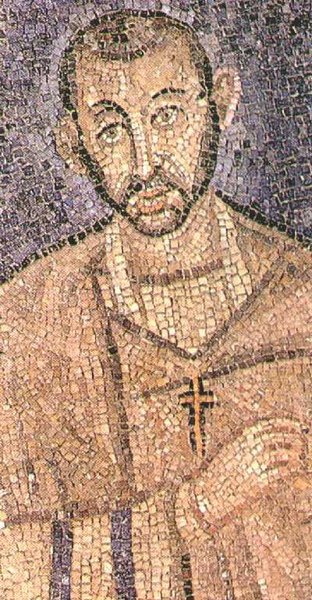
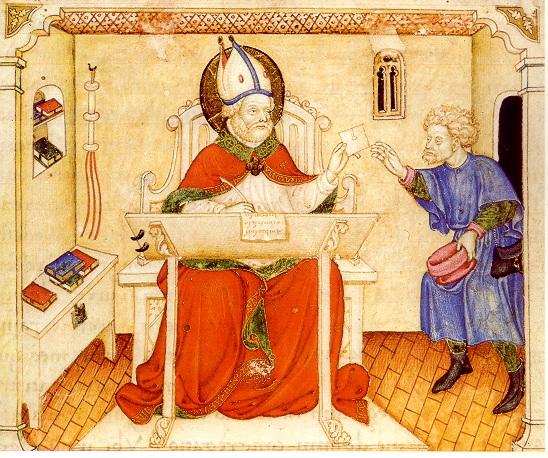
St. Ambrose of Milan (+4 April 397), a titanic figure of the late 4th century who changed the shape of Church and State relations for a thousand years, who brought much of the wisdom of Greek writings to the West, and who helped to bring St. Augustine of Hippo into the fold.
Would that we might see his like again in the great capitals of the world.
There are too many interesting things about Ambrose for them all to be shared here, but we have space for a couple.
There is a famous moment recounted by St. Augustine in his Confessions (Bk VI) about visiting St. Ambrose.
Augustine walked into the room where Ambrose was sitting and saw him staring at a book! Ambrose was reading and not even moving his lips!
Augustine was so impressed by this that slipped silently out of the room without saying anything to Ambrose, lest he disturb him.
Augustine was very impressed by Ambrose and had wanted to talk to him about various problems and doubts. Because of all the people pressing around Ambrose, who was tremendously important and sought after, Augustine was never able to get near him in public.
Let’s read the text and hear about it from Augustine himself!
Remember, at this point Augustine is a hot property in Milan and not yet Christian, though interiorly twisting on the spikes of difficult doubts and problems.
Augustine wasn’t really praying yet and he he still was considering things in very worldly terms.
6,3. Nor had I come yet to groan in my prayers that thou wouldst help me. My mind was wholly intent on knowledge and eager for disputation. Ambrose himself I esteemed a happy man, as the world counted happiness, because great personages held him in honor. Only his celibacy appeared to me a painful burden. [Augustine was not chaste at the time and he was angling for a politically favorable marriage.] But what hope he cherished, what struggles he had against the temptations that beset his high station, what solace in adversity, and what savory joys thy bread possessed for the hidden mouth of his heart when feeding on it, I could neither conjecture nor experience.
Nor did [Ambrose] know my own frustrations, nor the pit of my danger. For I could not request of him what I wanted as I wanted it, because I was debarred from hearing and speaking to him by crowds of busy people to whose infirmities he devoted himself. And when he was not engaged with them—which was never for long at a time—he was either refreshing his body with necessary food or his mind with reading.
Now, as he read, his eyes glanced over the pages and his heart searched out the sense, but his voice and tongue were silent. Often when we came to his room—for no one was forbidden to enter, nor was it his custom that the arrival of visitors should be announced to him—we would see him thus reading to himself. After we had sat for a long time in silence—for who would dare interrupt one so intent?—we would then depart, realizing that he was unwilling to be distracted in the little time he could gain for the recruiting of his mind, free from the clamor of other men’s business. Perhaps he was fearful lest, if the author he was studying should express himself vaguely, some doubtful and attentive hearer would ask him to expound it or discuss some of the more abstruse questions, so that he could not get over as much material as he wished, if his time was occupied with others. And even a truer reason for his reading to himself might have been the care for preserving his voice, which was very easily weakened. Whatever his motive was in so doing, it was doubtless, in such a man, a good one.
Amazing stuff there.
Keep in mind that, i the ancient world, books were rare. If you had a book, you were probably wealthy. If you got your hands on a book, you had to remember what you read because you might not ever see that particular book again. There would be public readings of books so that more people could hear them. People had to read aloud, actually, to help their memory. The more senses you could involve, the easier it was to remember the material. This holds true today! But, in the ancient world, everyone who read, read aloud.
Notice that Augustine, writing many years after the scene he recounts, and now a bishops himself, understands what it is to be entirely lacking in free time. He wonders if Ambrose read quietly so that the intellectually hungry people around him wouldn’t ask him to explain what he was reading, thus cutting short his own time for study. Also, Augustine himself later in life suffered from having a very weakened voice. In his sermons we acutally here him saying once in a while to the crowd that they had to stop making so much noice in their reactions to him, because his voice to too weak to shout over them! At any rate, Augustine puts a positive spin on what Ambrose did.
Busy tired clergymen understand each other.
If Augustine had a lot of admiration for Ambrose, the famously irascible Jerome did not.
My conjecture is that Jerome was jealous of Ambrose, who had "made it" in the Church in Italy, whereas Jerome always played second fiddle. But I digress.
What’s with Jerome and Ambrose? Well, to get at this we have to bring in a third character, Tyrannius Rufinus of Aquileia.
You are no doubt aware that Jerome and his old friend of his youth Rufinus (+410) had a titanic clash over the writings and teachings of the early Alexandrian exegete Origen. When they were young, they were very close, forming part of a group of dedicated Christians at Aquileia and then later at Jerusalem. They began to argue over the theology of Origen, but they patched things together before Rufinus left Palestine for Italy.
However, once in Italy Rufinus began to translate Origen Peri archon (De principiis). In his preface Rufinus made the mistake of assuming that just because Jerome had translated some of Origen’s work, therefore Jerome was a fan of Origen. People around Jerome also thought Rufinus purposely made Origen sound more orthodox than he was. These folks wrote to Jerome to let him know what they thought Rufinus was up to and asked Jerome to explain what was going on. In response Jerome translated Origen himself. In a letter he strongly denied being a partisan of Origen’s theology, even though he admired Origen’s skill. Jerome focused his laser on Origen’s statements about the resurrection and the preexistence of souls, and how the Persons of the Trinity related to each other which made him sound like a subordinationist. Jerome, in this second phase of translation, interpreted Origen in a very strict and harsh way.
When you look at the way Jerome spoke of Origen the first time around, 12 years before, and what he did to him in the second round, it is pretty clear that this was a reaction to Rufinus’s written assumption about Jerome. Jerome was afraid that his own reputation was going to be damaged by a positive association with ideas which seemed very strange to many people, especially in the West. In short, he turned savagely on both Origen and Rufinus in order to defend his reputation. In defending himself Jerome was a little less than sincere.
Rufinus responded, of course. He had too. Rufinus pointed out, for example, that in a commentary on Ephesians Jerome had referred without objection to ideas of Origen about the preexistence and fall of souls into bodies. There are other points as well. Jerome responded with vitrolic force saying that some people (e.g., Rufinus), "love me so well that they cannot be heretics without me."
Of course the ways of saints are strange and fraught with problems. The postal service, or lack of one, actually plays an importance role in all of this. Jerome wrote a friendly letter to Rufinus assuring him of his high esteem and speaking of their past friendship and the passing of his mother. He expressed his desire to avoid a public fight.
The letter never reached Rufinus. Jerome’s friend Pammachius kept it, and published instead a letter of Jerome which accompanied his translation of Origen’s De principiis. Not having seen Jerome’s irenic gesture, Rufinus published his Apology, in response to Jerome the attacker.
In Book II of his Apology, Rufinus points out how Jerome had attacked Ambrose. He mentions, as a matter of fact, Ambrose’ work De Spiritu Sancto. Thus, Rufinus about Jerome’s view of Ambrose. Rufinus relates more of Jerome’s disdain for his "rival" in Milan (Apology 2,23-25) as he digs into accusations of plagiarism which were being hurled around. Rufinus says in 2, 23 that Jerome referred to Ambrose as a raven, a bird of ill omen, croaking and ridiculing in an strange way the color of all the others birds on account of his own total blackness… "praesertim cum a sinistro oscinem corvum audiam croccientem et mirum in modum de cunctarum avium ridere coloribus, cum totus ipse tenebrosus sit."
Again, going on about Jerome’s accusation against Ambrose of plagiarism, in 2,25 Rufinus continues about Jerome’s treatment of Ambrose with his own counter charges:
25. You observe how (Jerome) treats Ambrose. First, he calls him a crow and says that he is black all over; then he calls him a jackdaw who decks himself in other birds’ showy feathers; and then he rends him with his foul abuse, and declares that there is nothing manly in a man whom God has singled out to be the glory of the churches of Christ, who has spoken of the testimonies of the Lord even in the sight of persecuting kings and has not been alarmed. The saintly Ambrose wrote his book on the Holy Spirit not in words only but with his own blood; for he offered his life-blood to his persecutors, and shed it within himself, although God preserved his life for future labours.
Suppose that (Ambrose) did follow some of the Greek writers belonging to our Catholic body, and borrowed something from their writings, it should hardly have been the first thought in your mind, (still less the object of such zealous efforts as to make you set to work to translate the work of Didymus on the Holy Spirit,) to blaze abroad what you call his plagiarisms, which were very possibly the result of a literary necessity when he had to reply at once to some ravings of the heretics. Is this the fairness of a Christian?
Is it thus that we are to observe the injunction of the Apostle, “Do nothing through faction or through vain glory”? But I might turn the tables on you and ask, Thou that sayest that a man should not steal, dost thou steal?
I might quote a fact I have already mentioned, namely, that, a little before you wrote your commentary on Micah, you had been accused of plagiarizing from Origen. And you did not deny it, but said: “What they bring against me in violent abuse I accept as the highest praise; for I wish to imitate the man whom we and all who are wise admire.” Your plagiarisms redound to your highest praise; those of others make them crows and jackdaws in your estimation. If you act rightly in imitating Origen whom you call second only to the Apostles, why do you sharply attack another for following Didymus, whom nevertheless you point to by name as a Prophet and an apostolic man?
For myself I must not complain, since you abuse us all alike. First you do not spare Ambrose, great and highly esteemed as he was; then the man of whom you write that he was second only to the Apostles, and that all the wise admire him, and whom you have praised up to the skies a thousand times over, not as you say in two, but in innumerable places, this man who was before an Apostle, you now turn round and make a heretic.
Thirdly, this very Didymus whom you designate the Seer-Prophet, who has the eye of the bride in the Song of Songs, and whom you call according to the meaning of his name an Apostolic man, you now on the other hand criminate as a perverse teacher, and separate him off with what you call your censor’s rod, into the communion of heretics. I do not know whence you received this rod. I know that Christ once gave the keys to Peter: but what spirit it is who now dispenses these censors’ rods, it is for you to say. However, if you condemn all those I have mentioned with the same mouth with which you once praised them, I who in comparison of them am but like a flea, must not complain, I repeat, if now you tear me to pieces, though once you praised me, and in your Chronicle equalled me to Florentius and Bonosus for the nobleness, as you said, of my life.
And from Jerome’s own pen we have this vicious attack on Ambrose (ep. 69,9). Jerome was writing in the year of Ambrose’ death, 397, to a Roman named Oceanus who wanted Jerome to help him fight against a bishop in Spain who had married a second time. Jerome tells Oceanus to drop it, since that bishops’ first marriage had been before baptism. However, Jerome uses the occasion to take a somewhat less than oblique swipe at Ambrose. Ambrose had been popularly proclaimed bishop in Milan in 374 even though he had not even been baptized and had no theological training. The emperor, who wanted peace, acceded and within a week Ambrose was baptized and consecrated bishop.
Jerome, who had probably been disappointed that he hadn’t been made bishop of Rome, surely felt the sting of this meteoric rise of Ambrose.
In any event, listen to Jerome:
One who was yesterday a catechumen is today a bishop; one who was yesterday in the amphitheater is today in the church; one who spent the evening in the circus stands in the morning at the altar: one who a little while ago was a patron of actors is now a dedicator of virgins. Was the apostle ignorant of our shifts and subterfuges? Did he know nothing of our foolish arguments? (Heri catechumenus, hodie pontifex; heri in amphitheatro, hodie in ecclesia; uespere in circo, mane in altari; dudum fautor strionum, nunc uirginum consecrator: num ignorabat apostolus tergiuersationes nostras et argumentorum ineptias nesciebat?)
Okaayyyy! That’s a big "NO!" vote from Jerome.
Regardless, today is the feast of St. Ambrose, who seemed to bring out both the worst and the best in people.
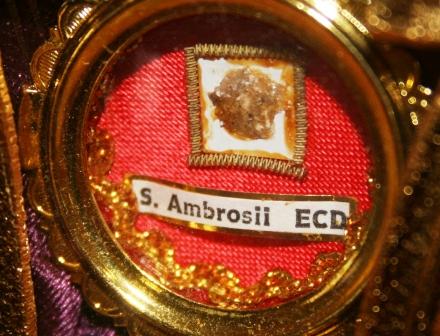
I am happy to have the company of Ambrose in a special way. I have a first class relic of the great saint and doctor in the chapel:


 bodiment of the local Church. That would have liturgical implications. What an idea. Har!]
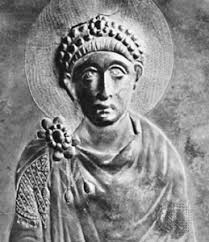 A spokesman for the administration said, "We were just attending the Mass in the local church as usual. This confrontation with the bishop has hurt the emperor deeply, I know. [Feelings count.] The emperor is a deeply committed Christian, [I think he did his CCD with Nancy Pelosi.] and does not believe that the bishop acted rightly in attempting to use his position as a Church leader to dictate public policy. The Emperor hopes that a more constructive dialogue can be entered in the near future."

 This one, from the
 You are no doubt aware that Jerome and his old friend of his youth Rufinus (+410) had a titanic clash over the writings and teachings of the early Alexandrian exegete Origen. When they were young, they were very close, forming part of a group of dedicated Christians at Aquileia and then later at Jerusalem. They began to argue over the theology of Origen, but they patched things together before Rufinus left Palestine for Italy.
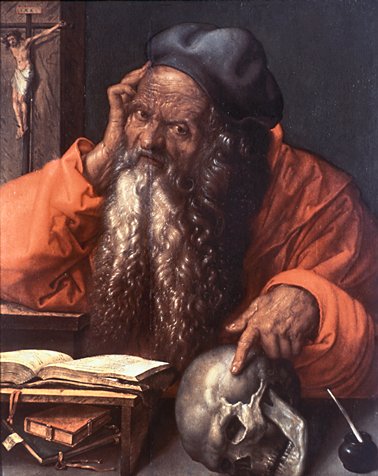 When you look at the way Jerome spoke of Origen the first time around, 12 years before, and what he did to him in the second round, it is pretty clear that this was a reaction to Rufinus’s written assumption about Jerome. Jerome was afraid that his own reputation was going to be damaged by a positive association with ideas which seemed very strange to many people, especially in the West. In short, he turned savagely on both Origen and Rufinus in order to defend his reputation. In defending himself Jerome was a little less than sincere.
 In Book II of his Apology, Rufinus points out how Jerome had attacked Ambrose. He mentions, as a matter of fact, Ambrose’ work De Spiritu Sancto. Thus,
 Is it thus that we are to observe the injunction of the Apostle, “Do nothing through faction or through vain glory”? But I might turn the tables on you and ask, Thou that sayest that a man should not steal, dost thou steal?


 fac on Daily Rome Shot 1118 – Paddywhack!: “Speaking of the disputatio back on October 31st between Archbishop Vesco and Bishop Barron (Vesco saying the Catholic Church was…”




























