Women religious in Asia/Oceania support “beleaguered” U.S. sisters

Here’s a funny one from the ulta-lefty over-the-top dissenting National Catholic Reporter.

My emphases and comments.

Asia, Oceania women religious offer support to beleaguered U.S. sisters
Statement represents a step in global women religious unity
Oct. 20, 2009
By Thomas C. Fox
 
SAMPHRAN, THAILAND

In a symbolic and bold move, 113 women religious leaders from 17 Asian and Oceania nations today issued a statement of solidarity with U.S. women religious who are facing two Vatican investigations. [So… if communities of women religious in the USA are being investigated, they are "beleaguered".   They are being ATTACKED!  They are UNDER SIEGE!  They are PERSECUTED!  What a bunch of horse hockey.]

The women began their nine-day conference Oct. 13, and as they conclude, they said they want to send a message to their sister sisters half a globe away that they are one with them in their time of difficulty. [Silly beyond imagining.] 

The meeting is being held under the auspices AMOR, [Soon, hopefully, to have greater attention from the Holy See….] which is holding is 15th gathering since the loose network of women religious was organized in the early 1970s. AMOR, which stands for Asia-Oceania Meeting of Religious has been holding its meeting with the theme “Jesus Encounters the Syro-Phoenician Woman: Called to Move Beyond.” The solidarity statement was viewed by many as one answer to the call.  [The Syrophoenician Woman! aka The Canaanite Woman!  LOL!  The best thing on this is the brilliant, must-read comment by "Diogenes"  HERE.  A quote: "The Emboldened Canaanite Woman Shtick is one of the oldest gags in the white suburban liberal homiletic repertory, already a cliché-benumbed yawner by the late 1960s. Their point was that, if Jesus was not above correction, neither is the Church he founded, whence we should all feel free to follow our own moral and theological intuitions." ]

If you have the stomach for it, you can read the rest at NCR, but I don’t recommend it.

When will the National "Catholic" Reporter be investigated?

Posted in SESSIUNCULA |
15 Comments

Point for consideration

While the Holy See is holding the towels and disinfectant on the banks of the Tiber, – imagine swimming that river! brrrrr – it remains to be seen just how many will swim.

There are lots of issues to consider.

For example, ownership of property, etc.

Posted in SESSIUNCULA |
18 Comments

NCR twits on Twitter over Anglican Ordinariates

I had to laugh at the spin the ultra-lefty dissenting National Catholic Reporter gave to the Anglican Ordinariate story via a "tweet" on Twitter

Pope okays new structures to absorb disgruntled Anglican conservatives

This isn’t a tweet, it’s a twit!

How conflicted the editors of the NCR must be!

After all, they think like liberal Anglicans.  

I can imagine another tweet some day in the future from, say, The Wanderer.

Archbp of Canterbury dissolves even more structures to absorb disgruntled Catholic liberals.

Hey, NCR!

I hear there are going to be even more empty pews ready for you in Anglican churches!

Posted in SESSIUNCULA |
15 Comments

The weight of this sad time we must obey

Some time ago I had to call my phone provider to find out international roaming rates for my phone when in Italy.

The person on the other end of the call explained to me that my phone would work (not my question) in Europe but not in Italy.  The list of countries included Europe, but not Italy.

I asked her if she was aware that Italy was a country included in the continent called Europe. 

This was real news!  News met with skepticism, I might add.

I have great sympathy for this note from Argent By The Tiber:

Not a good sign

…calling the local store of a national bookseller chain:

Argent: Do you have an individual copy of Shakespeare’s King Lear?
Bookseller: Who? How do you spell that?
Argent (trying hard not to laugh): King Lear. K-I-N-G L-E-A-R.
Bookseller: Hang on. (typing sounds) Ah, you’re in luck. We do have a copy.
Argent: Thank you. I’ll be right there.
Bookseller: No problem.

Okay, is Shakespeare not taught in schools anymore?


Along with many other things, I suspect very little Shakespeare is presented to students in many schools…. even in movie versions.

Posted in Global Killer Asteroid Questions, The future and our choices |
21 Comments

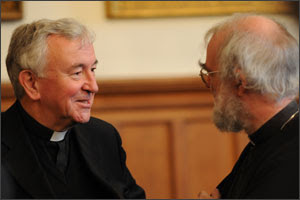
Joint Statement of Archbps. Nichols (Catholic) and Williams (Anglican)

Joint Statement of Archbps. Nichols (Catholic) and Williams (Anglican)The doors to the Church are always open to those wishing to enter.  Now there is not only a door open to Anglicans, but also a house full of furniture.

The Holy Father will establish ordinariates for Anglicans who wish to enter fuller manifest unity with the Catholic Church.

To that end, the Catholic Archbishop of Westminster and the Anglican Archbishop of Canterbury issued a joint statement.

Let’s have a look with my emphases and comments.

JOINT STATEMENT BY THE ARCHBISHOP OF WESTMINSTER AND THE ARCHBISHOP OF CANTERBURY

Today’s announcement of the Apostolic Constitution is a response by Pope Benedict XVI to a number of requests over the past few years to the Holy See from groups of Anglicans who wish to enter into full visible communion with the Roman Catholic Church, and are willing to declare that they share a common Catholic faith and accept the Petrine ministry as willed by Christ for his Church.  [Christ established His Church with certain necessary elements.  Among them are not only apostolic succession, or bishops (and Anglicans except some version of that) but also the ministry of Peter and his successor, the Bishop of Rome, the Pope.]

Pope Benedict XVI has approved, within the Apostolic Constitution, a canonical structure that provides for Personal Ordinariates, which will allow former Anglicans to enter full communion with the Catholic Church while preserving elements of distinctive Anglican spiritual patrimony.

The announcement of this Apostolic Constitution brings to an end a period of uncertainty for such groups who have nurtured hopes of new ways of embracing unity with the Catholic Church. It will now be up to those who have made requests to the Holy See to respond to the Apostolic Constitution.

The Apostolic Constitution is further recognition of the substantial overlap in faith, doctrine and spirituality between the Catholic Church and the Anglican tradition. Without the dialogues of the past forty years, this recognition would not have been possible, nor would hopes for full visible unity have been nurtured. In this sense, this Apostolic Constitution is one consequence of ecumenical dialogue between the Catholic Church and the Anglican Communion.  [This is a joint statement, remember?  This statement (i.e., by Williams) seems very positive about what is happening.]

The on-going official dialogue between the Catholic Church and the Anglican Communion provides the basis for our continuing cooperation. [The talks continue!] The Anglican Roman Catholic International Commission (ARCIC) and International Anglican Roman Catholic Commission for Unity and Mission (IARCCUM) agreements make clear the path we will follow together.  [Don’t hold your breath about an ordinariate for Anglicans who want homosexual marriage or women priests.  Just don’t.]

With God’s grace and prayer we are determined that our on-going mutual commitment and consultation on these and other matters should continue to be strengthened. Locally, in the spirit of IARCCUM, we look forward to building on the pattern of shared meetings between the Catholic Bishops Conference of England and Wales and the Church of England’s House of Bishops with a focus on our common mission. Joint days of reflection and prayer were begun in Leeds in 2006 and continued in Lambeth in 2008, and further meetings are in preparation. This close cooperation will continue as we grow together in unity and mission, in witness to the Gospel in our country, and in the Church at large.

London, 20 October 2009

 + Vincent Gerard Nichols
   
 + Rowan Williams

As I read this I had the sense that Archbp. Williams has leaned very much in favor of union with Rome.  It is a joint statement, after all. 

But really… what is the alternative for Anglicans who really believe in God as God and who accept that Scripture contains the truth not subject to man’s whims or fads?

Posted in SESSIUNCULA | Tagged , , , , , ,
31 Comments

Anglicans desiring unity will have “ordinariates”

Today the Prefect of the CDF, Card. Levada, and the Secretary of the CDW, Archbp. DiNoia, were available in a press briefing at the Holy See Press Office.

The Pope is issuing an Apostolic Constitution to create personal ordinariates for Anglicans who want to rejoin the Catholic Church.

Note the language…. PERSONAL ORDINARIATES.

Just yesterday I was speaking about the word "ordinary".   The usual sort of "ordinary" is a diocesan bishop.  But, as I explained, there are other sorts of ordinaries as well.

This could be important down the line also for SSPXers.

NB: Keep in mind that the Holy Father has from time to time expressed openness to discussing different ecclesial structures and even the role of Peter.  He has spoken of his role as primarily one of unity.  He also let go of the title Patriarch of the West.   Just a few reminders, before reading, that the Pope thinks deeply about these issues.

The following has been released with my emphases and comments:

NOTE OF THE CONGREGATION FOR THE DOCTRINE OF THE FAITH ABOUT PERSONAL ORDINARIATES FOR ANGLICANS ENTERING THE CATHOLIC CHURCH , 20.10.2009

NOTE OF THE CONGREGATION FOR THE DOCTRINE OF THE FAITH ABOUT PERSONAL ORDINARIATES FOR ANGLICANS ENTERING THE CATHOLIC CHURCH

With the preparation of an Apostolic Constitution,[the Church’s most authoritative type of document] the Catholic Church is responding [NB: responding… not initiating… responding…] to the many requests that have been submitted to the Holy See from groups of Anglican clergy and faithful in different parts of the world who wish to enter into full visible communion.

In this Apostolic Constitution the Holy Father has introduced a canonical structure that provides for such corporate reunion by establishing Personal Ordinariates, which will allow former Anglicans to enter full communion with the Catholic Church while preserving elements of the distinctive Anglican spiritual and liturgical patrimony. Under the terms of the Apostolic Constitution, pastoral oversight and guidance will be provided for groups of former Anglicans through a Personal Ordinariate, whose Ordinary will usually be appointed from among former Anglican clergy.  [Does this not sound like a possible structure also for the SSPX?  However, you know that the appointment would ultimately be by the Holy See.]

The forthcoming Apostolic Constitution provides a reasonable and even necessary response to a world-wide phenomenon, by offering a single canonical model for the universal Church which is adaptable to various local situations and equitable to former Anglicans in its universal application. [Not to mention the SSPX.]  It provides for the ordination as Catholic priests of married former Anglican clergy.  [Get that?  Married clergy.] Historical and ecumenical reasons preclude the ordination of married men as bishops in both the Catholic and Orthodox Churches. The Constitution therefore stipulates that the Ordinary can be either a priest or an unmarried bishop.  [A priest can be an ordinary.] The seminarians in the Ordinariate are to be prepared alongside other Catholic seminarians, though the Ordinariate may establish a house of formation to address the particular needs of formation in the Anglican patrimony. In this way, the Apostolic Constitution seeks to balance on the one hand the concern to preserve the worthy Anglican liturgical and spiritual patrimony and, on the other hand, the concern that these groups and their clergy will be integrated into the Catholic Church.

[Interesting.  Doesn’t this simply raise all of the Church’s boats by raising the water level?]

Cardinal William Levada, Prefect of the Congregation for the Doctrine of the Faith which has prepared this provision, said: "We have been trying to meet the requests for full communion that have come to us from Anglicans in different parts of the world in recent years in a uniform and equitable way. With this proposal the Church wants to respond to the legitimate aspirations of these Anglican groups for full and visible unity with the Bishop of Rome, successor of St. Peter."

These Personal Ordinariates will be formed, as needed, in consultation with local Conferences of Bishops, and their structure will be similar in some ways to that of the Military Ordinariates which have been established in most countries to provide pastoral care for the members of the armed forces and their dependents throughout the world.  [In other words, they have no geographical borders, but are aimed at groups of people who may be scattered around.  Thus, there could be an Ordinariate for, say, the USA or for Nigeria or for England, etc.] "Those Anglicans who have approached the Holy See have made clear their desire for full, visible unity in the one, holy, catholic and apostolic Church. At the same time, they have told us of the importance of their Anglican traditions of spirituality and worship for their faith journey," Cardinal Levada said.

The provision of this new structure is consistent with the commitment to ecumenical dialogue, which continues to be a priority for the Catholic Church, particularly through the efforts of the Pontifical Council for the Promotion of Christian Unity. "The initiative has come from a number of different groups of Anglicans," Cardinal Levada went on to say: "They have declared that they share the common Catholic faith as it is expressed in the Catechism of the Catholic Church and accept the Petrine ministry as something Christ willed for the Church. For them, the time has come to express this implicit unity in the visible form of full communion."  [Did anyone notice that folks such as Card. Kasper were not the presenters for this press conference?   Also, consider that the true aim of ecumenism must ultimately be for all people to become Catholic.  Along the way there are various stages of rapport… but there must be one goal: bring people to the fullest way of following their path to salvation, which – though we know God saves whom it pleases Him to save –  is always and only through Christ and mediated through the Catholic Church He founded.  And that Catholic Church has, as a necessary part of its structure, the Petrine Ministry.]

According to Levada: "It is the hope of the Holy Father, Pope Benedict XVI, that the Anglican clergy and faithful who desire union with the Catholic Church will find in this canonical structure the opportunity to preserve those Anglican traditions precious to them and consistent with the Catholic faith. Insofar as these traditions express in a distinctive way the faith that is held in common, they are a gift to be shared in the wider Church. The unity of the Church does not require a uniformity that ignores cultural diversity, as the history of Christianity shows. Moreover, the many diverse traditions present in the Catholic Church today are all rooted in the principle articulated by St. Paul in his letter to the Ephesians: ‘There is one Lord, one faith, one baptism’ (4:5). Our communion is therefore strengthened by such legitimate diversity, and so we are happy that these men and women bring with them their particular contributions to our common life of faith."

[In that statement, above, substitute the Anglican elements with SSPX/traditional Catholic elements.]

Background information

Since the sixteenth century, when King Henry VIII declared the Church in England independent of Papal Authority, the Church of England has created its own doctrinal confessions, liturgical books, and pastoral practices, often incorporating ideas from the Reformation on the European continent. The expansion of the British Empire, together with Anglican missionary work, eventually gave rise to a world-wide Anglican Communion.

Throughout the more than 450 years of its history the question of the reunification of Anglicans and Catholics has never been far from mind. In the mid-nineteenth century the Oxford Movement (in England) saw a rekindling of interest in the Catholic aspects of Anglicanism. In the early twentieth century Cardinal Mercier of Belgium entered into well publicized conversations with Anglicans to explore the possibility of union with the Catholic Church under the banner of an Anglicanism "reunited but not absorbed".

At the Second Vatican Council hope for union was further nourished when the Decree on Ecumenism (n. 13), referring to communions separated from the Catholic Church at the time of the Reformation, stated that: "Among those in which Catholic traditions and institutions in part continue to exist, the Anglican Communion occupies a special place."

Since the Council, Anglican-Roman Catholic relations have created a much improved climate of mutual understanding and cooperation. The Anglican-Roman Catholic International Commission (ARCIC) produced a series of doctrinal statements over the years in the hope of creating the basis for full and visible unity. For many in both communions, the ARCIC statements provided a vehicle in which a common expression of faith could be recognized. It is in this framework that this new provision should be seen.

In the years since the Council, some Anglicans have abandoned the tradition of conferring Holy Orders only on men by calling women to the priesthood and the episcopacy. [So, the ordination of women helped spark this…] More recently, some segments of the Anglican Communion have departed from the common biblical teaching on human sexuality—already clearly stated in the ARCIC document "Life in Christ"—by the ordination of openly homosexual clergy and the blessing of homosexual partnerships. [The blessing of sodomy has also sparked this…]  At the same time, as the Anglican Communion faces these new and difficult challenges, the Catholic Church remains fully committed to continuing ecumenical engagement with the Anglican Communion, particularly through the efforts of the Pontifical Council for the Promotion of Christian Unity.

In the meantime, many individual Anglicans have entered into full communion with the Catholic Church. Sometimes there have been groups of Anglicans who have entered while preserving some "corporate" structure. Examples of this include, the Anglican diocese of Amritsar in India, and some individual parishes in the United States which maintained an Anglican identity when entering the Catholic Church under a "pastoral provision" adopted by the Congregation for the Doctrine of the Faith and approved by Pope John Paul II in 1982. In these cases, the Catholic Church has frequently dispensed from the requirement of celibacy to allow those married Anglican clergy who desire to continue ministerial service as Catholic priests to be ordained in the Catholic Church.  [There is a progression from individuals, to parish groups, to larger groups under an "ordinary".]

In the light of these developments, the Personal Ordinariates established by the Apostolic Constitution can be seen as another step toward the realization the aspiration for full, visible union in the Church of Christ, one of the principal goals of the ecumenical movement.

Again, substitute some of the distinctively Anglican elements in this with elements having to do with traditional Catholics, members of the SSPX with their aspirations.
Posted in SESSIUNCULA |
47 Comments

“I think I can! I think I can!”

From Astronomy Pic of the Day comes a tale about The Little Mars Rover That Could!

Nereus Crater on Mars
Credit: Mars Exploration Rover Mission, JPL, NASA; Image Processing: Kenneth Kremer

Explanation: It was along the way. The robotic rover Opportunity currently rolling across the Meridiani Plain on Mars has a destination of Endeavour Crater, a large crater over 20 kilometers across which may yield additional clues about the cryptic past of ancient Mars. Besides passing open fields of dark soil and light rock, Opportunity has chanced upon several interesting features. One such feature, pictured above in a digitally stitched and horizontally compressed panorama, is Nereus Crater, a small crater about 10 meters across that is surrounded by jagged rock. Besides Nereus, Opportunity recently also happened upon another unusual rock — one that appears to be the third large meteorite found on Mars and the second for Opportunity during only this trip. Opportunity has been traveling toward Endeavour Crater for over a year now, and if it can avoid ridged rocks and soft sand along the way, it may reach Endeavour sometime next year.


See Explanation.  Clicking on the picture will download  the highest resolution version available.


Posted in Just Too Cool | Tagged , ,
2 Comments

Briefing tomorrow in Rome about Anglicans and the Church

This is from the Bolletino:

AVVISO DI BRIEFING

Si informano i giornalisti accreditati che domani, martedì 20 ottobre 2009, alle ore 11.00, nell’Aula Giovanni Paolo II della Sala Stampa della Santa Sede, si terrà un briefing su un tema attinente ai rapporti con gli Anglicani, cui parteciperanno l’Em.mo Card. William Joseph Levada, Prefetto della Congregazione per la Dottrina della Fede e S.E. Mons. Joseph Augustine Di Noia, O.P., Segretario della Congregazione per il Culto Divino e la Disciplina dei Sacramenti.

So… in sum…

There will be a briefing tomorrow.  Featured is the topic of relations of the Holy See with "Anglicans".

The main speakers will be the Prefect of the Congregation for Doctrine of the Faith, His Eminence Card. Levada and the fomer Sotto-Segretario of the same CDF, now Secretary of the Cong. for Divine Worship H.E. Augustine DiNoia, OP.

This all makes sense if…if… this is to announce that there will be a reunion of Traditional Anglicans with the Catholic Church.  This would be in the bailiwick of the CDF.   And Archbp. DiNoia would have been involved when he was at the CDF.

However, a group of Traditional Anglicans would also no doubt have the Anglican Use for their liturgy, and therefore having the English speaking Secretary who had been at the CDF, rather than the Spanish speaking Prefect of the CDW makes perfect sense.

So… I suspect this is about the reunion of the so-called Traditional Anglicans.

UPDATE 2158 GMT

Damian Thompson has this.

And this, from the Archbishop of Canterbury’s office:

PRESS CONFERENCE INVITATION

(not for publication)

You are invited to a press conference with Archbishop Vincent Nichols (Archbishop of Westminster) and Archbishop Rowan Williams (Archbishop of Canterbury) on Tuesday 20 October at 1000. The press conference will take place at 39 Eccleston Square, London SW1V 1BX.

(Yes, I know it says “not for publication”, but it wasn’t me [Damian, that is…] they invited, so tough.)

I cannot believe that the two press conferences are not directly related.

Neither can I.

Posted in SESSIUNCULA |
43 Comments

Some random musings on “ordinary” and “extraordinary”

Just a reminder:

Going back to what "Ordinary" and "Extraordinary" mean in liturgical or ecclesiastical terms.

Ordo in Latin, has to to with putting things or people in an order.  That is, organizing them according to a scheme.

Our trusty Lewis & Short Dictionary reminds us that the adjective ordinarius means "of or belonging to order, orderly; according to the usual order, usual, customary, regular, ordinary". 

If we apply ordinarius to a person in the Church you wind up with the an "ordinary", the usual example of which is the local diocesan bishop (though others also are "ordinaries" too).

In a religious order, people live according to a rule.

Men who are ordained are in Holy Orders, so that they can help to put order into God’s people and live in a certain way. 

When we get to the word "ordinary" in English but in Church terms, we shouldn’t automatically assume that something is of, for example, less quality or undeserving of attention.  It means essentially that something is in the proper scheme of things.  Consider "Ordinary Time" in the liturgical year.  These Sundays are not unusual in the way that, say, Easter is out of the ordinary.  In a sense, Easter is out of the ordinary because not every Sunday is Easter Sunday (yes, I know that some say every Sunday is a little Easter… but you get my point).  In fact, Easter does come along regularly each year in the proper order of things.  It is perfectly ordinary to find Easter at the conclusion of Lent and Holy Week.  It is not rare.

On the other hand, Latin extraordinarius means, as you might expect "out of the common order, extraordinary".  It is something that does not occur in the ordinary course.   That does not mean that extraordinarius is therefore assumed to mean "rare".  On the contrary, the idea of ordinarius seems to assume that there are regular interruptions because extraordinarie, the adverb, means in later Latin – for example in St. Jerome’s writing, "with excessive frequency".  So, ordinarie suggests that there are regular deviations from a pattern, and that extraordinarie can be either something special or unexpected or a more than usual interruption of the regular order.

I don’t think it is fair to cast extraordinarius as simply "rare".

And I think we must exclude also the common British use of "extraordinary" in a negative sense or in the American usage for something remarkably good.

Posted in SESSIUNCULA | Tagged ,
14 Comments

OLDIE PODCAzT: Augustine on Prayer; how to treat newcomers to Traditional Latin Masses

I am digging out of the archive an old PODCAzT.

These days in the Liturgy of the Hours we have had readings from St. Augustine’s Letter 130 to the wealthy widow Proba, who had fled to North Africa after Alaric the Visigoth sacked Rome.  Since I talked about Augustine and Proba in an old PODCAzT I thought I could just trot it out again.  There are some interesting things in that little project.

Also, I make some remarks about how to treat newcomers at celebrations of the older form of Mass.  Since Summorum Pontificum is now in force, people who haven’t been to the older Mass will be getting first impressions. 

Let’s make sure they are good impressions.

Posted in Classic Posts, Patristiblogging, SUMMORUM PONTIFICUM |
4 Comments