 Ed Pentin, surely Rome’s best English language commentator on Church matters these days, has an interview with Dr. John Rist, a professor at Cambridge and also in Rome at my school, the Patristic Instititute Augustinianum. I had several courses from him.
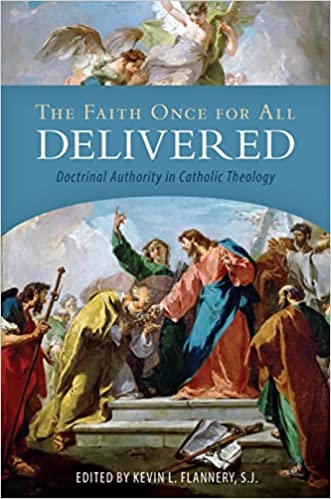
Rist has a piece in the recently published The Faith Once For All Delivered: Doctrinal Authority in Catholic Theology,a set of important essays by world class scholars with forward and afterword by Cardinals Burke and Sarah. It is about sensus fidelium. VERY IMPORTANT. US HERE – UK HERE
I’ve written about Rist’s brilliant, hard, books over the years. HERE You can read about how he was cancelled in 2019 by the Vatican after he signed a letter critical of Francis. He was banned from all pontifical institutions. CUA even cancelled his Festschrift.
Rist was interviewed by Pentin now probably because Rist has a new book which is to be released 27 June 2023 (tomorrow, as I write):
Infallibility, Integrity and Obedience: The Papacy and the Roman Catholic Church, 1848-2023 US HERE – UK HERE
BTW… go to amazon and take a look at the titles that John M Rist as authored or written for. Amazing.
The interview deals throughout also with treatment of an Italian priest Fr Tullio Rotondo who was suspended a divinis by his bishop because he wrote a book critical of Francis and his collaborators.
Here’s a taste:
PENTIN It’s also one thing for a bishop to shut down heresy and heterodoxy, but if it’s orthodoxy, or trying to emphasize orthodox arguments, that’s very odd, isn’t it?
As I say, because Don Tullio has got a position which he’s trying to advocate, and he’s done so by producing material on either side, and has then tried to evaluate it — what the French would call a catalogue raisonné. That, of course, is how things should be sorted out. It’s exactly what people should be doing. Don Tullio has a doctorate in theology. It’s his job to think about these kind of things. And because some bishop doesn’t like his conclusions… Put it this way: this book couldn’t have been written in the time of John Paul II or Benedict XVI, but had it been, he would not have been banned by his bishop. Let’s forget about Amoris Laetitia, if he’d discussed the subject matter of an encyclical, and related matters in the times of Benedict and John Paul, or let alone John XXIII, or Paul VI, for that matter, people would have said, “Yeah, it’s a bit pedantic, long-winded and so on, but of course very useful.” It would not have led to him being suspended by his bishop. Undoubtedly, it would not.
PENTIN What does it tell us about this time in the Church?
Well, Don Tullio cites me, and others, in the interview which he gave to Maike Hickson, as well as, for example, John Finnis, who was a professor of law at Oxford, saying that the present crisis is probably the worst the Church has had for centuries, perhaps from its beginning, in some way or another. It’s more dangerous to the existence of the Church. You can compare the Reformation, but I think it’s even more serious than that. You’ve got to go back to the Arian controversy to find something comparable. But I think that, in terms of the damage that it now might cause, what might happen to the Church in the future, this is going to cause more trouble, more than anything else we’ve seen before.















 Ed Pentin, surely Rome’s best English language commentator on Church matters these days, has



 July 24th, 2023


 ProfessorCover on Is the needle moving?: “Saint110676 writes: “But theology, it seems, is not so different from economics: bad ideas have a remarkable capacity to resurface,…”



























