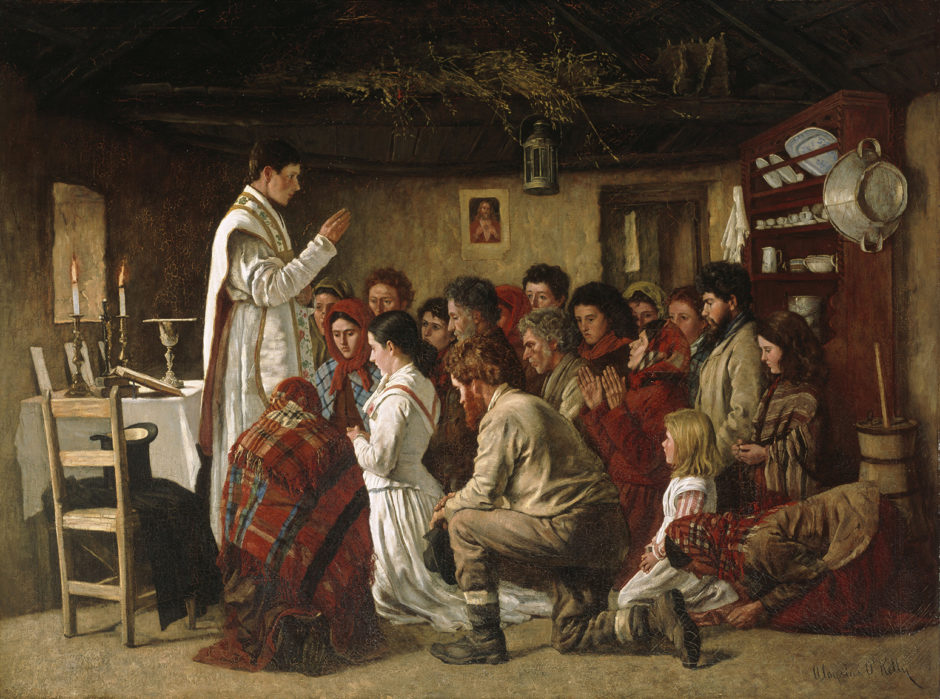
 I read a story at CNA about a diocese in the Netherlands where the wonderous springtime of Vatican II has revolutionized all of Catholic life.
So successful has the Vatican II reform been, that the Diocese of Roermond has said that, due to a shortage of priests and to save on energy costs, they are was abandoning offering at least one Sunday Mass in every parish. They are shifting to Masses every other week. There are 3.7 million Catholics in the Netherlands, but only 4% regularly attend Mass. The Diocese of Roermond is one of two dioceses with a majority of Catholics.
Recently Peter Kwasniewski gave a talk in Charlotte, NC which was reproduced at Rorate also with the video. The title of the talk, “The Primacy of Tradition and Obedience to the Truth”.
You can seek that out and read and/or view it via those links, above. However, here is an excerpt for thought. Keep in mind my catch-phrase: We Are Our Rites.
[…]
The liturgical reform was “sold,” so to speak, on a mighty promise of the countless wonderful blessings it could not fail to bring to the Church. The Second Vatican Council’s Constitution on the Sacred Liturgy, Sacrosanctum Concilium, begins with a statement of what the Council hoped to achieve, with the liturgical reform as its poster-child:
This sacred Council…desires to impart an ever increasing vigor to the Christian life of the faithful; to adapt more suitably to the needs of our own times those institutions which are subject to change; to foster whatever can promote union among all who believe in Christ; to strengthen whatever can help to call the whole of mankind into the household of the Church.
As my colleague Gregory DiPippo, esteemed editor of New Liturgical Movement, has pointed out on more than one occasion: “None of this has happened. The Christian life of the faithful has not become more vigorous; its institutions have not become more suitably adapted to the needs of our times; union has not been fostered among all who believe in Christ; the call of the whole of mankind into the household of the Church has not been strengthened.”[30]
As I have said, the traditionalists objected to a massive reform as a matter of principle, on the twin basis of reason and faith, because they could not see how it would be right to sacrifice the tradition already certainly known and loved for a future possibility uncertainly known and impossible to love because it had yet no existence. As Joseph Shaw says, in 1971, at the time of the first (so-called Agatha Christie) indult, no one had the freedom to base an argument for keeping the old liturgy on the grounds that it would be “pastoral” to do so, or because of its venerable theology, since “the whole point of the reform was the [promised] pastoral effectiveness, as yet of course untried, of the Novus Ordo Missae, and [the hoped-for assimilation of] the theological insights of Vatican II.”[31] The only defense that might work with the authorities back in 1971 was an artistic and cultural defense.
Today, we are in a vastly different position. We have not only the same principles of faith and reason as our forefathers, we also have behind us a half-century of desolation, desecration, and dramatic decline in church life as a monumental witness of unarguable fact against the prophesied success of the liturgical reform. We know now that the prophets of renewal—even if they wore the mitre of a bishop or the fisherman’s ring—were false prophets who said “peace, peace, when there was no peace” (Jer 6:14, 8:11), who promised plenty but brought down famine. To defend the superiority of Catholic tradition today, we don’t need to have even half the insightfulness of the original traditionalists, because we can see that every one of their predictions has been proved true to the last degree. They predicted that sudden and massive change would have catastrophic effects, and that the particular changes pushed through would undermine Catholic faith and practice. They predicted that where tradition was treasured, the Church would weather the storm and produce good fruits. They have been abundantly vindicated in the event, for it is the very success of the traditionalist renewal against all possible odds that has roused the dragon’s ire.
For us to be traditionalists today requires no great wisdom, for the good and bad fruits have reached full maturity. We still have the same power of reason and the same sensus fidei fidelium that tells us when something is irrational or when it refuses to harmonize with what a sound catechism teaches us. The one thing we need more of, much more of, is courage, fortitude, boldness. The traditionalist movement both benefited from and suffered from the fifteen-year “pax Benedictina,” the peaceful space of coexistence put into place by Benedict XVI. We benefited because many more priests learned the old rite and many more faithful grew to love it. So our movement has grown tremendously in numbers. But we suffered, too, because in a lot of places things became easier for us, and perhaps we grew soft, as soldiers may do in peace time; suddenly we had friendly (or at least not openly hostile) bishops, we had parishes springing up here and there; it seemed like a gently rising and irresistible tide.
And then came the unexpected Traditionis Custodes—whose title can be translated “prison-guards of treachery”—which threw us suddenly back into a state of open conflict that many of us, especially, I would say, the “baby traditionalists,” were quite unprepared for. This is where we really need to step up our game. Everyone who has drifted to the TLM because they love the Eucharistic reverence, the silence, the music, the community of young families, the orthodox preaching, whatever it might be, or even just because they hated masks and hand sanitizer and the branch covidian religion—all of them need to pick up some good books and educate themselves![32] They need to find out what happened in the 60s and why traditionalism as a movement began.[33] They need, in short, to move from being tourists of tradition to apostles of it, from nomads to homesteaders, from admirers to defenders. We were sold a kind of half-truth, that we could have the tradition if we “preferred” it; and that was a false compromise, because tradition is not something we “prefer,” it is something we know and understand, believe and live—it is a treasure without which we cannot live and without which the Church cannot thrive. It is not a preference but a vital necessity, a fundamental identity.
[…]
[30] Gregory DiPippo, “The Revolution Is Over,” New Liturgical Movement, August 1, 2022.
[31] “The 1971 Petition,” Mass of the Ages 210 (Winter 2021), 8.
[32] Start with these two: my Reclaiming Our Roman Catholic Birthright (Brooklyn: Angelico Press, 2020) and Michael Fiedrowicz’s The Traditional Mass: History, Form, and Theology of the Classical Roman Rite (Brooklyn: Angelico Press, 2020).
[33] For this, Stuart Chessman’s book Faith of Our Fathers: A Brief History of Catholic Traditionalism in the United States, from Triumph to Traditionis Custodes (Brooklyn: Angelico Press, 2022) will be indispensable.


 From a reader…







 Sue in soCal on ROME 26/10– Day 09: very cool and a rare restaurant review: “You are in my daily prayer list, Fr. Z. Get well!”