
 I need seminarians and young (especially) priests to pay attention to this.
Chad Pecknold, contributing editor at the Catholic Herald (where I have a weekly column), is articulate, bring and right. He manifests these attributes much to the dismay of New ‘c‘atholic Guard wannabees like Comrade Defarge, the Fishwrap‘s Tricoteuse, who wants Pecknold fired from his teaching position because he doesn’t like Pecknold’s positions.
Which is sure to endear Chad to the readership. You can tell a lot about someone from their antagonists.
With that in mind, check out Pecknold’s piece at the aforementioned CH on confusion and ignorance about the Eucharist. He locates the problem, in the sense of locus, a word that will be used a lot in the near future.
Why do so few US Catholics believe in the Real Presence? Look at the liturgy
The latest Pew study shockingly states that only 31 per cent of Catholics in the United States believe that “during Catholic Mass, the bread and wine actually become the body and blood of Jesus.” Out of the 69 per cent of Catholics surveyed who believe that the bread and wine are mere “symbols,” only 22 per cent of those understand that they are dissenting from the Church’s actual teaching. The rest are accidental Zwinglians. [Who held that the Eucharist is a sign of grace already given. Hmm… sounds like Rahner.]
It sometimes surprises students how little dispute over the Eucharist there was in the early Church. Certainly one could see how Donatism or Pelagianism or Nestorianism might touch upon Eucharistic understanding, but there were no serious disputes until the ninth century — when the aptly named Ratramnus taught Charles the Bald that the elements of bread and wine should not be regarded as “verily” Christ’s body and blood, but as “figures” which spiritually communicated the reality to us. Yet this never rose to the level of a grand ecclesial dispute.
[… Hereafter follows a compact theological history about Eucharistic doctrine…]
Yet even in the sixteenth century, as historians such as Eamon Duffy have shown, it took time for the people’s understanding of the Eucharist to catch up with the theological and liturgical reforms of the theologians. But [… wait for it…] eventually, the people began to learn through the liturgical changes. They learned by hearing how the theologians and pastors spoke about the Eucharist, and they learned from the kind of reverence, or lack of it, given to sacrament of sacraments. [Change the way we pray and we will per force change what people believe. And vice versa. Prayer reflects and shapes belief and belief shapes how we pray. 50 years of, for example, hearing “for all” and seeing white vestments and panegyrics at funerals – rather than prayer for the deceased, certainly has lead to a severely diminished understanding of the fact that, one day, we will have to render a personal account to God, as Judge, that will have eternal consequences.]
What the Pew study shows is something like an echo of this protestant history, yet very much downstream from another set of reforms: a series of unnecessary and para-conciliar liturgical reforms that were implemented by Catholic priests in the United States to better accord with their view of what it meant to be “open to the modern world.” [The Council Fathers required that Latin remain. They did not mandate that churches be stripped and altars destroyed and rendered into ironing-boards. There is nothing about versus populum worship in the documents. The mandated that nothing be done that was a) not truly consistent with previous practice and b) that it was truly for the good of the people. That’s NOT what we got. We have been reaping the weeds ever since.]
Many have said that the Pew study reflects a catechetical failure. I fear the opposite: it reflects a certain kind of catechetical success. [!!! Yes! As a matter of fact, I think what we see today was the intended objective of those who had their hands on the controls of information about the Council, etc., such as the infamous IDOC. It has been as effective as Gramsci’s patient advice about the Italian DC.] It is the result of an unwritten catechesis that American Catholics have been slowly learning. Through a deracinated, spiritualistic, and emotivistic treatment of the Eucharist, many Catholics have learned their faith from a generation of pastors who stripped the altars, razed the bastions of reverence around the Lord in the sacrament, and who generally treated the Most Holy Eucharist itself as something to be passed out like a leaflet rather than received in awe, as people prostrate before the fire of divinity. Far too many have received this kind of unwritten catechesis. [Unwritten.. BUT… more eloquent than words. If, from the beginning, they had frequently articulated bad or inadequate or misleading teaching about the Eucharist, they would have, at first, been howled down. But, slowly but surely, through their ars celebrandi, they warped their flocks into what could be argued to be a different religion. It is no wonder that the clear-sighted Ratzinger/Benedict wrote in Sacramentum caritatis about the importance of the priest’s ars celebrandi. This ars celebrandi… “art” of celebranting… with all that is packed into the super-charged technical word “ars” is as important a factor in the Church as gravity is in the cosmos. The “knock on effect” of a priest’s liturgical choices and manner must never be under estimated.]
It’s past time that our pastors preach what St. Cyril of Alexandria taught. Namely that the Eucharist is divine fire. Mistreat it, and it will burn you. The whole “razing of the bastions” theme has played itself out to disastrous effect in the Church. The bastions turned out to be things like altar rails, and liturgical actions which conform us to the reality of the Eucharist. The Pew study proves that it’s time to put the bastions back.
Put the bastions back!
Hereunder I shall rant.
 A dear nonagenarian priest friend describes the older, traditional form of the Roman Rite as “a suit of armor”. “It stands”, says he, “on its own.” We need bastions. We need armor. We always will, for this world has its “prince”.
There was a gruesome and gory vivisection of the Faith during the 60s and 70s when an artificial form of liturgical worship was imposed on the Church with nary a cogent explanation. The “knock on effect” was devastation for our Catholic identity. Lex orandi – lex credendi.
 Ratzinger/Benedict understood that only slow and organic development of liturgical worship will effect holistic and positive effects. Hence, it was his vision that the Novus Ordo and the Traditional Roman Rite ought to be side-by-side, so as to “jump start”, as it were, the organic process which that artificial imposition snuffed out. As Pope, Benedict released the hitherto enslaved traditional forms through his “emancipation proclamation”, Summorum Pontificum. What he calls a process of “mutual enrichment” I call a “gravitational pull”. Each form will exert a pull on the other. This is happening, this is inexorable, and this is positive.
In my early conversations with Card. Ratzinger, late 80s and early 90s, I had the sense that he thought that the Novus Ordo would have logical priority and that the older forms would serve as a corrective to abuses such that, later, a tertium quid would emerge which favored the Novus Ordo. Later, I think he came to see that the older form must retain its priority.
Using my gravity analogy, two bodies in space will “pull” at each other. However, your planet Earth’s pull on the Moon is greater than the pull of the Moon on the Earth. Perhaps a better analogy would be that the Sun’s pull on all the planets is greater than their pull on the Sun. The traditional form is that much more dense and vast in scope and importance in the Church’s history and lived life. The traditional form has a far greater impact. After a renewed organic process, it could be that a tertium quid will emerge, but it is bound greatly to favor the traditional forms and not the modernistic forms artificially imposed. If nothing else, demographics and the Biological Solution will see to that.
In the meantime, we need patience, without tinkering with the Traditional Roman Rite, as some well-meaning but impatient people have suggested.
Let’s take Pecknold’s image of “putting back the bastion” another way.
First, “putting back” then “bastion”
 Putting back. In geometry, when two lines diverge from the same point, the farther they extend, the farther apart they get. In a journey, if you take a road leading the opposite direction of your destination, the farther you go from it. You have to turn around and find the correct road. If you are smart. Or … if you are not perverse. I think that a false road was purposely created for our naive feet by the City of Man’s diabolical civil engineers and we were lead astray. But we’ve now had time to study the map.
Now for Pecknold’s “bastion”.
When Summorum Pontificum was issued, I often described it as part of Benedict’s vision in terms of what I called his “Marshall Plan” for the Church.
After the devastation of WWII these USA helped to rebuild Europe in order to foster trade and to create a bulwark (or bastion) against Communism.
In the wake of the devastation caused by a hermeneutic of discontinuity after the VaticanII, Benedict tried to revitalize our Catholic identity as a bulwark (or bastion) against the dictatorship of relativism. Summorum Pontificum is a key to his vision.
The renewal of our Catholic identity absolutely requires a realigning of the Roman Rite.
We must renew our liturgical worship in order to be who we are within Holy Church, so that we can have an impact, as Catholic disciples of the Lord, on the world around us.
This realigning requires the Extraordinary Form. There is no way around it.
If we don’t worship rightly, we can’t know who we are. Heck, we don’t even know what the Eucharist is anymore, in large part. If we don’t know that… then who are we? If we don’t know who we are, no one will pay attention to us or what we might have to offer.
Why should the world listen to us if we don’t have a clue about our own identity. But the Lord said, “Go forth and teach all nations!” How, pray tell, do we do that when we haven’t the foggiest idea of who we are? If we have no clear identity as Catholics?
That identity includes our patrimony whole and entire, especially our worship.
Think of the implications of not knowing who we are for, say, inculturation. This is an ongoing process of gravitational pulls and mutual enrichments between the Church and the world. It does and will happen, period. However, we can guide this unavoidable exchange by giving logical priority to what the Church has to give to the world, rather than giving priority to the world’s contribution. That reversal, giving priority to the world, results in the disasters we see around us today.
The key to everything is our sacred liturgical worship. Worship is doctrine and identity. It must be rightly ordered.
If justice is the virtue by which we give to men what is due to them, then religion is the virtue by which we give to God what is due to God. They are similar, but God is wholly other than man, so a different virtue describes what we owe Him: religion.
The principle way in which we fulfill giving what is due to God is through worship. We worship as individuals, as small groups and as larger bodies, like the Church. The hierarchy of our loves and things that require our attention is unquestionably topped off by God, who alone has the rightful place on the throne of our hearts and minds. If we have a disordered relationship with God, then all of our other relations and goals and activities and accomplishments are going to be skewed, out of sync, off.
We have to get sacred liturgical worship of God right before everything else can be right. This goes for individuals, small groups, the whole Church.
God has always indicated what pleasing worship is. He did this under the old covenant through His revelation. He does this in His new covenant through the authority of the Church He established as the means for our salvation. We fulfill the worship due to God as individuals, groups and a Church by properly carrying out our sacred liturgical actions with full, conscious and actual participation, with fidelity, care and reverence. Our baptism enables all of us to participate in the priest/victim action of Christ, the true actor in the actions, the true speaker in the prayers. The ordained priest, through Holy Orders, alter Christus in worship, in Christi persona in moving and singing, therefore, must cultivate (and there is a relationship of that word with cultus, worship) and order the Church’s sacred liturgical action properly, especially by their ars celebrandi.
PROPONITUR: Think of what a widespread renewal of worship through the conscious efforts of priests, fully integrated with Tradition and mindful of the lessons learned in the last half century, would do to enkindle the vocations of the faithful in the world.
Pecknold cited Cyril who said that the Eucharist is divine fire. Mistreat it, and it will burn you. If that is true, then guarding, protecting and worshiping rightly the Eucharist will transform us from within like the burning bush inflamed with God’s presence.
Think about how, when the cloud of God’s presence was upon the tent of meeting, and Moses came forth, his face shone so brightly that people couldn’t look at him. He had to wear a veil after his meetings with God. So much more do we have in Holy Communion.
Yes, we have to put the bulwarks and the bastions back. We have to do this now.
Thus endeth the rant.
 Today is the feast of St. Edith Stein, co-patroness of Europe. Ethnically Jewish, she converted and entered Carmel as Sr. Teresa Benedicta of the Cross. In 1942 she was rounded up by the Nazis and sent to Auschwitz, where she was killed in a gas chamber on this day.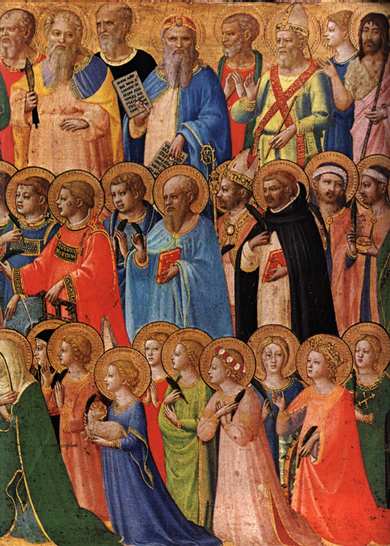

 The other day, in reference to the conference I attended at the Shrine of Our Lady of Guadalupe near La Crosse, WI, I mentioned that it would be very cool indeed to hold a “special event” at the Shrine, perhaps for some feast of anniversary.
 May I suggest to the readership your participation in a Spiritual Bouquet for the new Bishop of Madison, Most Rev. Donald Hying?
 From a reader…
 As I write, I am watching my recording of the public TV series American Experience – “
 Do you all remember my repeated descriptions of libs of a certain age? They’re worldview was crystallized in the halycon days of revolt against authority, and in these USA, the anti-war movement, Vietnam protests, civil rights demonstrations, pot and acid, anti-authority rebellion, all tied into the “spirit” of Vatican II. This slurry of forces coalesced into an iconic moment that, for them, is as indelible as baptism.
 A bill has been introduced by Wisconsin Dems which would seek to force priests to violate the Seal of Confession under penalty of civil in case of abuse of minors.


 Was there a




























