ASK FATHER: Obligation to attend the local parish instead of going somewhere else

From a reader…

QUAERITUR:

Someone told me that I am bound to attend mass at my territorial parish, even though it is a rule that is not followed by many people. I was told this as reason for why I should not be attending the TLM at a church about 30 minutes away from my house. Is this true? Am I required to attend mass only at my territorial parish church?

In the 1983 Code of Canon Law we find that on Sundays and other holy days of obligation, the faithful are obliged to participate in the Mass (can. 1247).  We also find that, “a person who assists at a Mass celebrated anywhere in a Catholic rite either on the feast day itself or in the evening of the preceding day satisfies the obligation of participating in the Mass.(can. 1248 §1).

Hence, you can go to Mass anywhere, so long as it is a Catholic Mass.

In the older Code, now superseded by the 1983 Code, there was a stronger obligation to attend one’s local parish.

Keep in mind also that there are different kinds of parishes.  Some are territorial and some are personal.   An example of a personal parish is my home parish in St. Paul, St. Agnes, which founded within the boundaries of a territorial parish but for immigrants from the Austro-Hungarian Empire and German speakers.  Some parishes today are for certain ethnic or immigrant groups or even TLM parishes for those who want tradition.

But it you don’t belong to one of these personal parishes, then you are probably under the jurisdiction of the pastor of the local territorial parish.  You are not obliged to attend Mass there, but the local pastor can still have a say in your life, when it comes to sacraments.  Say, for example, you live in one territorial parish, but you are attend Mass in a different territorial parish.  You get involved, find a gal, and want to get married.  Your true, local territorial pastor must give permission to the other territorial pastor.

Many people find a parish across town which they prefer.  They “register” in the parish.  That doesn’t make you a member (unless, for example, there are “personal parish” issues).  Registration helps for when you need some service, but you are not thereby a member.

Keep in mind that, out of justice, if you are receiving services from a parish, you should be supporting the parish financially (or an equivalent) as well.

Ironically, were pastors of parishes to follow the prescripts of law that outlines what their duties are, fewer people would want to escape to another place.   If pastors insist on their prerogatives outlined by law, then lay people should do the same.

Posted in "How To..." - Practical Notes, ASK FATHER Question Box, Canon Law | Tagged , ,
9 Comments

Online Shopping Reminder and BIRETTA PROJECT

Folks, when you shop using Amazon, please consider entering Amazon through the links on this blog.  That way I get a small percentage of each sale.  The percentage depends on the product.  It’s very helpful.

Amazon didn’t like that I had a link to search box with their logo and the made me remove it: why, I can’t grasp.   However, I have a couple things on the right side bar which you can click to go into Amazon.  Use any of those links and, for that session, my code will be associated with anything you get.

It might take an extra 5 seconds to come back here and to go into Amazon through my link.  I can assure you that it is significant for me when you do.

One reader here does ordering for his business through my link.  That’s really helpful.

Thanks!

Meanwhile, here’s a link right away.  I’ll even make it easy for you Brits!

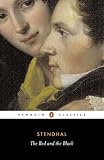
I’m reading, after many many years, Stendahl’s The Red and The Black.  I’m reading a hardback copy I picked up second hand for a couple bucks.  YOU on the other hand, can get it through Amazon in a couple clicks, even for your Kindle with nearly immediate effect!

US HERE – UK HERE

Every seminarian and every young priest should read this book.  As a matter of fact, I think I will include it among books for seminarians which we’ve been doing for several years now.   For example, in 2017 and 2014.

Also, remember the BIRETTAS FOR SEMINARIANS PROJECT.

HERE

I am told by John at Leaflet Missal that, so far, we’ve managed to send out about 200 birettas to seminarians.

Biretta by biretta.


Posted in ACTION ITEM! |
Comments Off on Online Shopping Reminder and BIRETTA PROJECT

Blistering NRO piece flames the recent USCCB meeting

Beware.  This piece from NRO might provoke thoughts that require confession.  I’m not kidding.

That said, this blistering entry by Declan Leary jabs a serious bruise.    Themes: passing v. lasting – passivity and reaction v. activity v. proaction. Let’s see some of this with my emphases and comments.

Assembly of U.S. Catholics Bishops Reveals an Ugly, Incompetent Bureaucracy

More than 200 men in black suits sit in a conference hall in a Baltimore hotel. On folding tables in front of them hundreds of pieces of paper are scattered and pitchers of water are placed at regular intervals. Two tables raised in the front are lined with people apparently in charge, each with a microphone. Everyone has a name tag, hung around his neck on a green lanyard. At a glance, you might think it’s a regional gathering of some professional association of paper salesmen, hotel managers, maybe even low-caliber lawyers. Only a careful look at their collars will show that these men are the apostolic shepherds, more or less, of the Catholic Church in the United States.

One steps up to a portable podium and offers a brief opening prayer. There is a pull-down projector screen behind him lit up with an image of the crucified Christ; one can’t help but think that a better setting might have some permanent reminders of why these men are here — or permanent anything, for that matter. Folding tables, a moving podium, a temporary stage (though why a stage is necessary at all in a gathering of bishops is beyond me), all in a neutral (not to mention, thoroughly secular) location, every exit neatly marked by red-lit signs — the bishops look ready to pick up and run at the first hint of trouble. Call it a sign of the times.

A woman begins to bang out a hymn on one of those plug-in electric keyboards. Another impermanence tic. It’s turning into a compulsion, a reflex against that hideous horror, tradition — or, worse, aesthetics. As the keyboard jumps and jolts along and the bishops sing (each out of tune in his own way), you can’t help but feel nostalgic for the grand organs that once made music worthy of the Church and for the simple, ancient chant that even Blase Cupich could sing without sounding like a character out of VeggieTales.

When morning prayer is ended, though not before one more grating hymn is scraped out, Cardinal Daniel DiNardo, president of the the United States Conference of Catholic Bishops, reminds them of the reason for this assembly: “To further the sacred work of rooting the evil of sexual abuse from our Church.”

That would be great. But it quickly becomes clear that combating evil is not their primary concern — or that, if it is, they have no idea how to do it. Forty-five minutes into the proceedings, the first substantial mention of the issue finally appears, as a chargé d’affaires from the office of the Holy See’s nuncio to the United States, reading a message from the nuncio himself, tells the bishops that “there can be no hesitation in responding vigorously as a matter of justice.” And therein lies the problem: for the bishops, everything is about responding.

[…]

It gets harsher.

Think about that paragraph:

A woman begins to bang out a hymn on one of those plug-in electric keyboards. Another impermanence tic. It’s turning into a compulsion, a reflex against that hideous horror, tradition — or, worse, aesthetics.

That writer has nailed it.

Posted in "How To..." - Practical Notes, Pò sì jiù, The Drill, The future and our choices | Tagged , ,
15 Comments

ASK FATHER: Trying to translate prayers into Latin, but I don’t trust Google

From a reader…

QUAERITUR:

I’m trying to translate a few prayers into Latin, but I don’t
trust Google Translate’s accuracy. Is there anything I can do?

Let me get this straight…

You don’t trust Google?

Shhhhhh.  C’mon!  Why are you dragging me into this?   Don’t you know that every word you type is being monitored?   Sheesh.

Look, friend.  The only thing you can do, is….

study Latin.

Meanwhile, I have no idea who this guy is and I publicly profess my undying gratitude and extreme loyalty to our benevolent Google overlord.

Posted in "How To..." - Practical Notes, ASK FATHER Question Box, Latin, Lighter fare | Tagged
8 Comments

Lib ‘c’atholic outcry in … 3… 2… 1

Lib catholics often fall into the camp of those for whom every utterance of Francis is like to an oracle of the 5th apparition of Vishnu.   They insist that everything he says and does is of the Magisterium.  Anyone who dares to question even those comments barely related to some doctrine must be “enemies”, “detractors”, “divisive”, and against the Holy Spirit.

“You must AGREE … OR ELSE!”

Hence, I’m await lib catholic outrage soon to be poured down upon Sr. Maria Luisa Berzosa, who, according to LifeSite, was among the first four female consultors to the General Secretariat of the Synod of Bishops appointed by Francis.

Sr. Luisa wants women to be ordained as priests and she thinks that it could happen through small steps (aka “creeping incrementalism”).

Oh, the humanity!

Apparently Sr. Luisa has not accepted what Francis has said about the ordination of women to the priesthood.   Hint: NO!

Sister has committed a public ThoughtCrime in going against what Francis has said.  She is obviously “divisive” and she deserves all the Wrath of the Whatever from high atop the Thing.

For daring to defy the Pope, lib catholic outrage will flood down on her in…

… 3 … 2 … 1 …

Hmmm… nothing yet.

Maybe I got the timing of this wrong.  The Fishwrap and other organs must be gearing up and coordinating their venomous vituperation against this renegade pro-women’s ordination nun and their stalwart defense of their Leader.

In…

… 3 … 2 … 1 …

Hmmm.

Posted in Liberals | Tagged
4 Comments

15-18 July 2019: East Coast Priest Conference in Wheeling, WV – looks good!

I have heard great things from a couple priests about the St. Paul Center’s East Coast Priest Conference.   This year, 2019, it is to be held at Oglebay Resort and Conference Center in Wheeling, WV, which looks like a really beautiful place.   The speakers will be Scott Hahn, John Bergsma and Ralph Martin.

HERE

I wrote to them about being TLM friendly and right away got a couple of notes back from their Director of Events about what we could do!  Very friendly.

I think I’ll go to this.   Fathers, click, above and check it out!

The organizers have – as an incentive – provided you priestly readers with a special CODE you can use if you sign up, which will give you a $100 discount.

frzblog

The image they put on the webpage for the conference is a detail from a painting in – if memory serves – the Louvre in Paris, Carreno de Miranda’s Mass of the Foundation of the Trinitarian Order.   This is hardcore in a couple ways.  First, note the liturgical style.  Second, the Trinitarians were seriously bad ass when they were founded.  They were dedicated to the ransoming of captives from Muslims.


Posted in Priests and Priesthood, The Campus Telephone Pole | Tagged
21 Comments

Fr Rosica, amazing papal claims, and resignations

Let’s be clear. There is an element among Francis’ most dedicated promoters, channel their inner Rex Mottram and declare nearly every syllable that he utters to be oracular and under the inspiration of the Spirit.   Some of them form an inner core, like a New catholic Red Guards, a la the Cultural Revolution, ready to pounce on any deviation from their received message and according to their orders from their cadres.

One of best/worst examples of this came almost a year ago from NcRG member Fr Thomas Rosica of Salt and Light.  Recently, Rosica has been embroiled in a plagiarism scandal, which has revealed quite a few examples.

Anyway, Rosica, in July 2018, wrote… and meant it… that Pope Francis

“breaks Catholic traditions whenever he wants because he is ‘free from disordered attachments.’ Our Church has indeed entered a new phase: with the advent of this first Jesuit pope, it is openly ruled by an individual rather than by the authority of Scripture alone or even its own dictates of tradition plus Scripture.”

Apart from it being highly weird, that was one of best/worst examples of sycophantic crawling you will find from that end of the spectrum.  Truly exemplary.

And… it was plagiarized.

As a story at CNA notes, …

In April, it was discovered that one of Rosica’s most controversial publications, a July 2018 blog post, had been plagiarized from a 2014 blog post by by Richard Bennett, a former member of Dominican Order and an apparently laicized priest, who is now active in a fundamentalist Protestant organization which says it “places particular emphasis on the evangelization and conversion of Roman Catholics.”

What a source.

That same CNA story says that Rosica has resigned from Salt and Light.

I’ll turn on the comment moderation queue for this one.

Posted in The Drill | Tagged ,
9 Comments

Priest apologizes to traditional Catholics: “The future of the Church is in her past.”

From a priest… (my emphases)

Dear Fr Z:

I’ve just returned from France where, among other things, I took part in the Chartres Pilgrimage.

After registering for the Pilgrimage, I discovered that the usus antiquor would be required of all participating priests, I decided it was high time to learn how to celebrate the Extraordinary Form, thanks to a very kind and patient FSSP priest in the neighborhood.

At first, I was taken back by the demand to stick to the Extraordinary Form, then I realized that a far worse injustice was inflicted when it was ripped away from the faithful shortly after the Council.

Several months beforehand, however, I took it upon myself to celebrate the older Breviary–I bought the Baronius edition– […].  I was therefore exposed to a greater number of the Psalms and, since I was using an edition based upon the Septuagint, I found these Psalms to be more Christologically obvious.  Not only that, but the prayers, I discovered, were more even more “manly.”

The great boon in celebrating the Extraordinary Form, for me, was mainly twofold.  First, there is something very liberating about incessantly asking the Lord for forgiveness as we do, in not only the Confiteor but also the many private prayers of the priest.  The Scripture became very true for me:  “Humiliamini in conspectu Domini, et exaltabit vos.”  Second–and I understand that some of your readership may differ from me here–as a Charismatic Catholic, I deeply, deeply appreciated the celebration of the Pentecost Octave, with the sevenfold Veni, Sancte Spiritus and the focus on the outpouring of the Holy Spirit in the Epistle.  I’ll come right out and say it:  The “mutual enrichment” envisioned by Pope Benedict has come true in my own priesthood by the exchange between Traditionalism and the Catholic Charismatic Renewal.

Without abandoning the Ordinary Form, I confess that the older Missal and Breviary has enriched my priesthood in ways I had never imagined.  In fact, I found myself becoming more robustly priestly and fatherly.

[ NB] I also want to take a moment for public repentance.  Long ago, at a certain liberal seminary far, far away, I was indoctrinated with a disdain for, and even a mockery of, Traditional Catholics.  I jumped on the bandwagon for their supposed liturgical naivete and sanctimony.  I was convinced that they were backwards, habitually uncharitable, and elitist.  After being around 14,000 other Traditional Catholics and priests of more traditional religious congregations, I found them to be astonishingly affable, joyous, and genuine.  I was especially surprised to not have heard a single murmur against Pope Francis during the Chartres Pilgrimage.  So, to all of those Traditional Catholics I mocked in the past:  I am truly sorry.  I was wrong.  You are doing tremendous good for Christ and His Church.

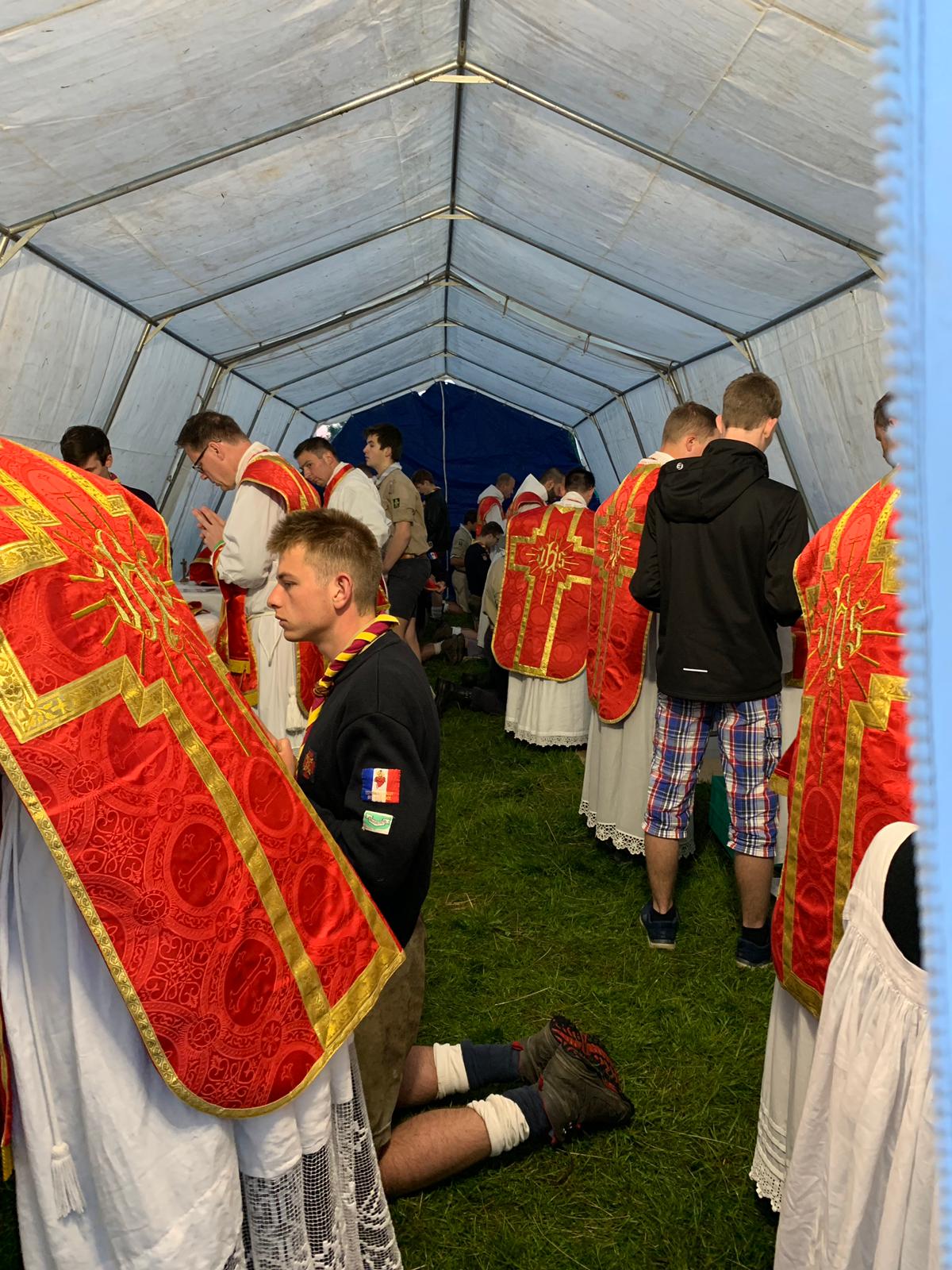
And you, Traditional Catholics, you are so young!  Attached is a picture I snapped as I was walking, of a young boy and a tonsured monk in long, deep conversation–as I took it, a word came to me:  “The future of the Church is in her past.”

I have also become convinced that Summorum Pontificum was in fact a prophetic  document, as it made possible a place of refuge and safe harbor in the face of the Church’s current crisis.

If you decide to reproduce this, kindly withhold my name.

Do keep up the good work.

Fraternally in Christ….


Posted in ¡Hagan lío!, Mail from priests, Priests and Priesthood | Tagged
35 Comments

ASK FATHER: Is a concelebrated Mass just one Mass or several Masses?

From a reader…

QUAERITUR:

Your recent post and “rant” regarding concelebration made me realize…I don’t actually know what happens at a concelebrated Mass. Is it technically two Masses (if there are two concelebrating priests)? How does that actually work?

At first glance, yes, this can be confusing.  It seems as if there are as many Masses as their are priests concelebrating.  This is especially so because priests are able to accept a stipend even when they concelebrate.  Hence, it seems that there are more than one Mass.

However, it’s a philosophical principle that there can be various instrumental causes united under an agent cause.  That is, there can be a main celebrant and various concelebrants with their own intentions to apply the merits of the Mass (which are infinite) to this or to that purpose (thus the stipend) but, in fact, at the time of the consecration they all have (we hope) the same intention to consecrate the Eucharist.

Sometimes an analogy of baptism is used.  If several priests were to pour water and say the formula of baptism simultaneously over the head of a child, there would be one baptism occurring in the child, not many baptisms.

At a concelebration there is ONE Mass with more than one celebrant,

That said, I think that, as far as the Novus Ordo is concerned, concelebration ought to be safe, legal and rare.

I will concelebrate for, say, an ordination to the priesthood, but not to the diaconate.  I won’t concelebrate at weddings and funerals.  I am happy to attend in choir.   Having clerics in choir also adds to the decorum of the moment.

Concelebration has its place.  In the traditional Roman Rite, newly ordained priests each have their own missal and they consecrate with the ordaining bishop.   That seems fitting.  The rest of the priests present don’t, however.  They manifest their unity of priesthood by imposing hands during the rites.

At gatherings of priests, say that a bunch of guys get away at someone’s lake place “up north”, it is tempting to have one concelebrated Mass.    It’s “brotherly”, quick, and over.  It seems to me better that priests should serve Mass for each other, even if multiple altars must be set up so that it doesn’t take all day (thus, cutting into golf time).   It’s good for a priest to serve Mass occasionally.

Frankly… more, reverently offered,  Masses are better.   How could it not be so?

See my remarks on Save The Liturgy – Save The World.

Posted in "How To..." - Practical Notes, ASK FATHER Question Box, Liturgy Science Theatre 3000, Our Catholic Identity, Priests and Priesthood | Tagged ,
15 Comments

A Solemn Mass in Albany in the presence of the bishop. Wherein Fr. Z rants.

The esteemed Deacon Kandra posted – picking up on some Facebook page or other (I don’t like Facebook) – that a Solemn Mass was celebrated on Trinity Sunday in the Roman Church’s traditional form at the St. Mary’s in Albany, NY. From Rev. Mr. K (my emphases and comment):

This popped up on the Facebook page for the Diocese of Albany, and it’s worth noting:

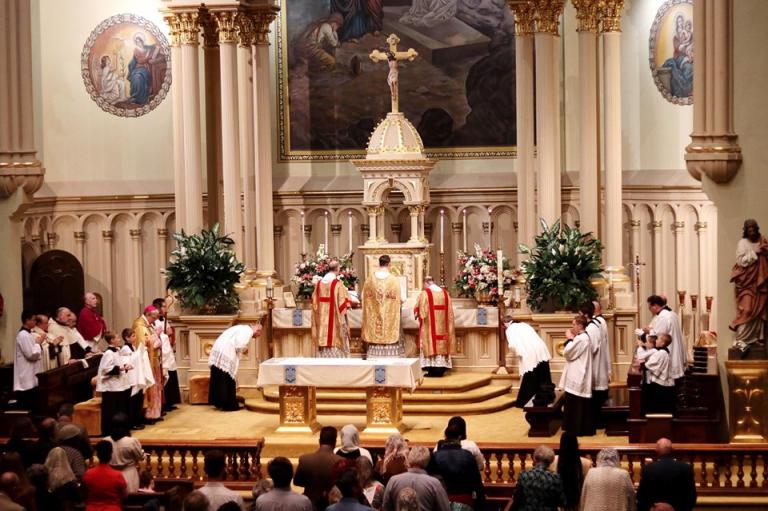
Solemn High Mass in the Presence of the Ordinary to commemorate the 20th Anniversary of The Extraordinary Form in the Albany Diocese. Both Bishop Edward B. Scharfenberger and Bishop Emeritus Howard Hubbard concelebrated[Ummm… no.  They didn’t.]

The Mass took place at St. Mary’s Church in Albany.

A few people have noted that there is no “concelebration” in the Extraordinary Form. It appears, however, that Bishop Scharfenberger and Bishop Emeritus Hubbard both took part.

[…]

Yes, they “took part”, but they did not concelebrate.

Let me rant about this for a little bit.  And, believe me, I am not slinging arrows at Deacon Kandra.  Moreover, I renew an invitation to him anytime he is in WI to come to learn to act as deacon in the Roman Rite.  I’m sure he would like to learn to do that.

However, allow me to riff a little on the “concelebration” thing for a moment.

What Deacon Kandra get a little wrong here is that, there was NOT concelebration in the modern, common usage of the word. What happened was Solemn Mass in the presence of the Diocesan Bishop.  A priest said the Mass and bishops were present.  In this case the variant was that the bishop, the diocesan ordinary, participated in cope and miter. There are also provisions for the bishop to be in cappa magna.

Here’s a shot of the late Extraordinary Ordinary at the First Mass of a priest.  The bishop is in cappa.

As for the presence of the bishop emeritus (Hubbard…not exactly a friend of tradition, he), he was simply in choir dress and in choro. In a generic sense of “concelebrating” they were “concelebrating”, but there was only one celebrant, the priest saying the Mass.  Bp. Scharfenberger “presided” so to speak, but not as celebrant.  Bp. Hubbard was in choir and he helped with Communion.  There’s another term that get’s mixed up.  In NovusOrdoese “preside” often is applied to the priest celebrating the Mass, “Good morning everyone!  Today’s presider is Fr. Jasmine of the Society of Jesus… open your worship aids to page….”

Here’s where you can see the Great Divide made manifest.

Again, I’m not trying to beat up Rev. Mr. Kandra.  Nemo dat quod non habet.  If you have not learned all this technical stuff from the older rite, then you pull out terms from the Novus Ordo and your own experience to fill in the blank.  But the older, traditional form has levels of celebration that the extremely flattened Novus Ordo eliminated.

Here’s where I want to rant a little.

In just a few decades, even clerics aren’t really sure about what is going on in our Church’s Roman Rite.

Remember: I maintain that a Roman Catholic cleric who doesn’t know also the Extraordinary Form, doesn’t really know his own Rite.  It’s one thing when men ordained before the Emancipation Proclamation was issued (aka Summorum Pontificum), but it is entirely another afterwards.  This is because at ordination someone has to stand up and attest that the ordinands are well trained.  But if they don’t know their Rite, they are not well-trained.   However, now that Summorum is out, and at least juridically there are two forms of the one Roman Rite, then ever cleric who does not know the traditional form is obliged to learn it and learn it NOW.

This is for the sake of their own professional integrity and identity, if nothing else.

Consider, for example, the graduation of a medical doctor who perhaps studied pathology, pharmacology, and maybe specialized in endocrinology, but didn’t get into all that anatomy and biochemisty stuff. Image a lawyer being passed to the bar without having studied civil procedure, constitutional law, or contracts. How about a doctorate in French literature without knowing French?

I suggest that a physician, lawyer, or professor worth their salt would, upon discovering a big gap in their tool box, move heaven and earth to get those tools!

Professionals are expected to know the tools of their trade, basic and advanced. Priests are to know the Rites of their Church. The Roman Rite is more than the Novus Ordo, in English, “facing the people” with a four-(Protestant) hymn sandwich to the accompaniment of a piano.   It’s a great deal more than that.   Just because “that’s what we do every weekend done at St. Idealia” in the Diocese of Libville under Fr Bruce Hugalot , and the actual Roman Rite doesn’t seem to be very useful there, that doesn’t exonerate clerics from learning their Rite!   There is also the issue of identity and integrity.

WE ARE OUR RITES.

That goes for Catholics in the pews and clerics at the altar.  We are our rites.  And if you don’t know and never experience half your Rite – nay, rather far more than a mere half – the… who the heck are you?

C’mon, men!  Learn your Roman Rite!

If I wanted to by B-Ritual, say, Ukrainian, I’d have to work hard to learn the liturgy!  I’d have to learn Ukrainian, too, though some of their worship is in the vernacular.  It would be hard.  But if I respect it and the people… I’d do the work.

The late Bishop Morlino, above, told his seminarians that he wanted them to know, before ordination, the traditional Roman Rite.   He didn’t impose it (“Learn it or else!”).  He wasn’t expecting that they had to use it all the time.  But he wanted them to know it.  And, I can say for sure, that has had a real impact on the ars celebrandi of the men who were thereafter ordained.

Let me approach this another way, from the affective side rather than the intellectual side.

When you love someone, you want to know all about that person, all their little foibles.  And, learning those little foibles, even some of the annoying ones, you love them more deeply.  You engage your will and you reach out with your mind and heart to embrace the person as he or she is.  You delight in making your loved one more comfortable or more beautiful or better educated or… whatever is the true good for that person.  You’ll take care of the house and keep it clean and beneficial.  Food preparation will reflect your esteem.  Etc.

If a priest loves his Church and the Rite he belongs to, then he wants to know all about the Church and her Rite.   He want’s the whole scoop, all the reality of her history, all the ins and outs.  And because the most important thing that his Church does is worship God with sacred liturgical rites, then he should want to know all the ins and outs of those rites.  No?  If you love, you want to know and you want to do the very best you can, and not some slip-shod job, or something half way.   You want it all.  You’ll make God’s house lovely.  Worship will be greatly adorned with the best you can manage.  Etc.

Does that sound right?

I am very encouraged by the growing number of occasions for the use the traditional Roman Rite and the questions that arise and the issues that pop up as a result.  This is a time of mutual enrichment, as Benedict XVI wanted.   This occasion in Albany was an opportunity for mutual enrichment: it raised questions and issues for those who aren’t that familiar with it.  Armed with more knowledge, they will probably – from love of the Church – desire to flesh out than knowledge and learn more and then apply it where they serve!

Part of the problem is that subtlty has been lost.  The Novus Ordo shoves everything straight at you.  Talk talk talk… sound sound sound.  And there is a tendency to flatten it all out, so that it is “generic” and without variation.  There”s little difference from day to day even for big occasions.

On the other hand, the traditional Roman Rite had many layers of celebration from extreme simplicity up to supreme complexity.  If memory serves there are four ways for a Solemn Mass to be said in the presence of a bishop, depending also on that bishop’s office.  It was worked out.  And it worked.   And those workings-out provided great freedom…. and subtlety.

Again, when you love, you allow for complexity.  Subtlety is delightful.  You enjoy texture and contour rather than flatness and sameness.  The genius of the Roman Thing, Romanitas, in liturgy is that there can be multiple things going on at the same time.  There are concise, even terse prayers, and then elaborate gestures.  There are layers and subtlety.

Having layers and subtlety in WORSHIP means layers and subtlety in the mind of the cleric and and the hearts of the faithful.

We are our rite.
 

Posted in "How To..." - Practical Notes, Liturgy Science Theatre 3000, Mail from priests, My View, Wherein Fr. Z Rants | Tagged , ,
6 Comments