“You just want the 1950’s back!”

One of the things that the goulish faculty of my hellish US seminary hissed at me in my re-education sessions during my second awful year when I was under super double-top secret probation, was “You just want the 1950’s back!”

Stupid.

Not only was I born in 1959 and didn’t know the 50’s, I strongly want Jesus Christ to come back in the parousia.   The only way that is going to happen is for the Church to be crucified, made smaller.  I understood that even in seminary.

However, while we are waiting, why shouldn’t we do the best we can?   Why shouldn’t we strive for full schools, full seminaries, full convents, full Sunday Masses, full confessionals?

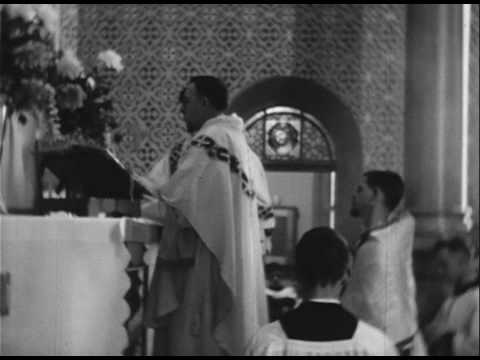
A reader sent a couple of videos of 1st Communion Masses from 1949 and 1951 at a church in Kansas.

Do I want this back. Sure! I’m a realist about the end times and the nature of the Church, which must, like her Lord, be oppressed and beaten down. But… sure!

There are lots of interesting details in these videos. How about you readers dig some of them out and comment.

YouTube thumbnailYouTube icon

YouTube thumbnailYouTube icon

Posted in Four Last Things, Hard-Identity Catholicism, The Coming Storm, The future and our choices |
32 Comments

ASK FATHER: How can eating desserts during Lent be fasting? Would Jesus eat desserts?

From a reader…

QUAERITUR:

Dear Father Z in the tradition of the Church could one have two small meals and for your full meal have a full meal including dessert?

Should we not have a spirit of penance? How can fasting include dessert.? My husband talked to a lay Franciscan and read the Catechism and insists desser for example a bowl of chocolate ice cream topped with strawberries is still fasting! How can this be? Don’t we try to model ourselves after Jesus? The way He fasted? [Other than the time that He ate nothing for 40 days, and other than the time that He delayed drinking the final cup of wine until He was on the Cross, do you know how He fasted?  Moreover, in Matthew 12:1 He and the disciples were hungry, so they ate grain plucked from wheat fields as they walked along… on the sabbath, yet!] Aren’t we supposed to have penance an mortification as part if the fast? Isn’t full just refering to size not number of courses? I feel confused and disappointed. My husband says if I can find in writing that as part of tradition of the church or somewhere in the Catechism it says than fasting does not include dessert that he will stop doing it and teaching our children this way. I looked and hve not found anything! How can this be? Can you teach me and / ir help me!! Please I NEED THIS

One thing that people can surely give up for Lent, and this will be a major sacrifice for some, is looking down their noses at what others choose to do.

I am not convinced that you “need” this from me: common sense does the heavy lifting here.

Let us all stipulate that Lent should be taken seriously.   Can we do that?

Fathers of the Church were convinced that the discipline of a season of fasting was of apostolic origin.  Hence, we cannot ignore Lent.   For example, Caesarius of Arles (+542) teaches:

Aliis diebus ieiunare aut remedium aut premium est, in quadragesima non ieiunare peccatum est. Alio tempore qui ieiunat accipiet indulgentiam, in his diebus qui potest, et non ieiunat, sentiet poenam…. On other days fasting is a remedy or a distinction, but in Lent not to fast is a sin. In another season one who fasts receives an indulgence, but in these days, whoever can fast but doesn’t, will experience punishment. (s. 199)

The reference here is, of course, to fasting.

Fasting means the reduction of food.

Fasting does not mean the reduction of the goodness of the food.

Fasting could include eating simpler food.

Fasting certainly means eating less food.

Fasting doesn’t mean that we must eat bad food, insipid food, or revolting food.

NB:  While”fasting” is a technical term, it is also used loosely.  Some people say “fasting” and they mean all manner of mortifications, as if they “fast” from, say, watching TV.   That’s a penance or a mortification, but it is not, technically, fasting.  Fasting really concerns the quantity of food.   Don’t confuse fasting with mortifications.   Just as a square is a rectangle, not all rectangles are squares.   Fasting is a mortification, but not all mortifications are fasts.  So, we want to know how we are using our words.

Food can taste good during Lent.  Just eat less of it.  It could be a help for someone to cut back on the quantity of the food he eats (= fast) if the food he has is a) good and, at the end of a meal, he can b) have something that pleases (= dessert).

Lent doesn’t automatically mean rejection of desserts, or other foods that taste good, or foods that are sweet.  Someone might freely choose to give up desserts.  That’s fine.

What is it with some people and their war on good food?   I post something about cooking and I get hate mail.   All I have to do is make something extremely simple and inexpensive look good and the hate mail comes.   Put a chive across something and it must be extravagant.  Frankly, I find those notes equally pathetic and amusing.  If anyone doubts that there are Jansenists around….  But I digress.

Not everyone is a slave to sweets.   GOOD GRIEF!  How many people for Lent choose to give up chocolate (and that’s it)?   It’s a bit trivial.  However, we also must recognize that some people in this modern materialistic age of comforts and instant gratifications are spiritually behind the curve: chocolate is about all they can handle.  It’s a start. As Paul describes the conflicted Corinthians, some people are spiritual adults and some are still spiritual infants: “I fed you with milk, not solid food; for you were not ready for it; and even yet you are not ready, for you are still of the flesh.” We all understand that some people are at different stages of their development. However, if people choose to remain spiritual infants rather than grow up… that’s a problem. I also think this applies to the form of the Roman Rite that they attend by choice… but I must close that rabbit hole now.

Giving up certain foods can be a good mortification, a good chosen penance.  It is praiseworthy when mortifications offered for the right reasons.  Cutting back on the quantity of food during Lent is certainly in the spirit of Lent, especially in places of abundance and for those who are able to do so.   Taking on other mortifications during Lent (avoiding certain foods, activities, adding hours of prayer, even performance of works of mercy which involve unpleasantness) are praiseworthy.

On an amusing note, back in the day when I was living with quite a few priests, one guy who didn’t especially like sweets and never ate desserts started eating them during Lent to help everyone else do more penance.  A final digression just to sweeten the sharper edge of this response.

Let us all take Lent seriously.  It could be a good thing for some of the readers here to start slowly in Lent and then add some mortifications along the way, perhaps week by week.

Now, since it is Sunday, I think I’ll have some raspberries after I eat whatever it is that I’m going to eat for supper.  Maybe I’ll put some cream on them.

Posted in "How To..." - Practical Notes, ASK FATHER Question Box, Our Catholic Identity |
19 Comments

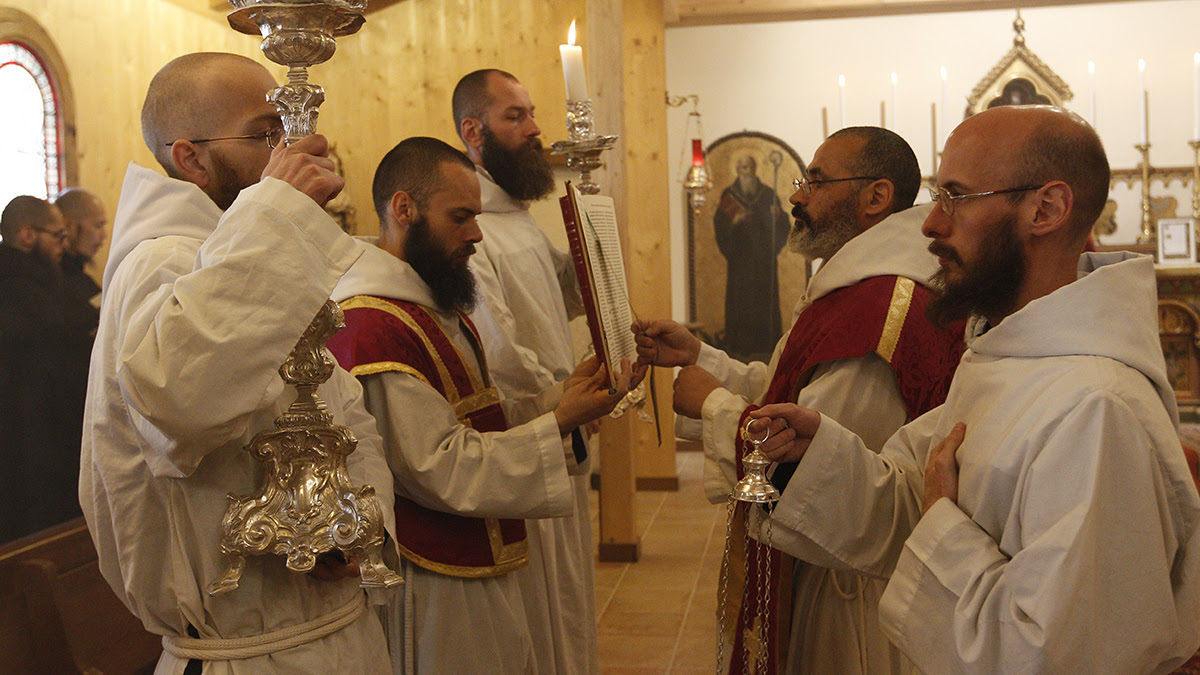
News from the great Benedictines at Norcia: building, dogs, liturgy, beer

In my email I found something from the great Benedictines at Norcia.

I’ll “Rosica” it by cutting and pasting… but no, I told you where it is from.  Darn.    Anyway, the formatting remains messy.

Remember: BEER!   Buy Beer – Boost Benedictines

Dear friends and family,

Construction has started on the new monastery, but on the most unlikely of sections: the laundry room! While washing our monastic habits and linens is indeed important, the reason that the building work is starting here is nearly 500 years old. When the Capuchin monastery was first built, the laundry room was constructed in a retaining wall which also channeled fresh mountain water to the monastery. We are trying to rebuild the monastery as faithfully as possible according to the ancient plan. That means that we too are building the laundry room in conjunction with the retaining wall.

Laundry is a fitting theme to start this update since during Lent the monks try in a particular way to clean up, not our outer clothing but our inner souls. They can become dirty and tired through our negligence throughout the year. The monk’s life, St. Benedict teaches, is a continuous Lent, but we grow weak and tired and need a season dedicated to penance. Aware of the continual stream of bad news about the scandals in the Church, we use this time to do penance for our personal sins as well as to pray for those affected by things happening in the wider Church and world.
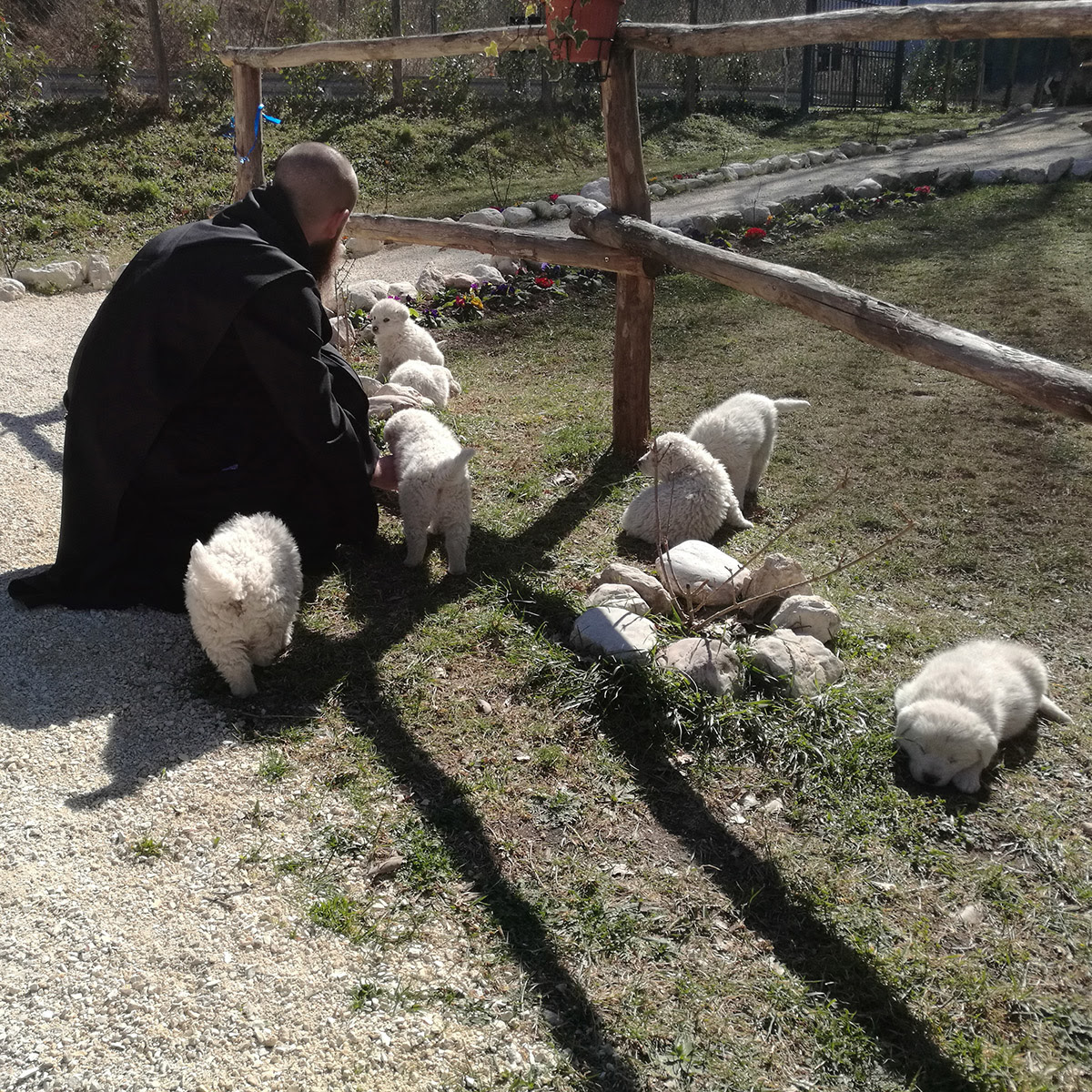
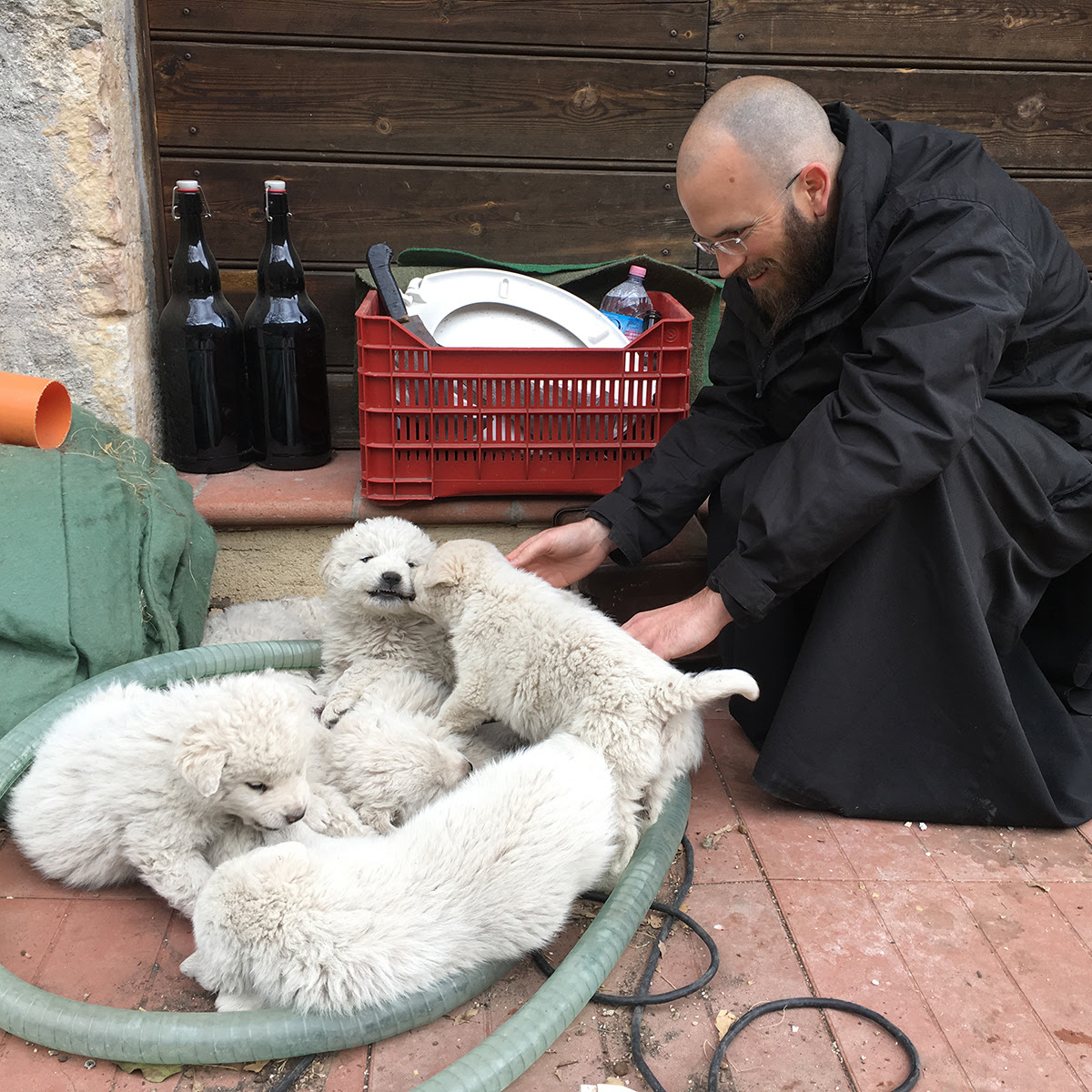
With the coming of Spring, we see the hope of new life both in nature and for ourselves. We are happy to share that our monastery farm is growing. Shortly after we built the chicken coop last year for our chickens, we realized we needed help to protect them from the wild boar, wolves and foxes that roam our woods. Help is now on the way in the form of Umbrian sheep dogs, born last month on a nearby farm. Their names will follow an ancient Roman custom: Primus, Secundus, Tertius and Quartus.
The arrival of this breed of protective sheep dogs means that we’ll soon be able to acquire a few goats. We need their help to clean the underbrush in the vast forest we have inherited from our Capuchin forefathers. As we grow, other animals will join the farm. A monastery, says our holy Patron, should have everything inside of it so that the monks don’t need to leave unnecessarily. This takes time to build and set in order, but with your help, our fundraising will advance successfully and we will be able to complete the construction.
And yet, as we plan for new life and growth, we must also plan for death. In the past two months, three monks lost a parent. The close proximity of these passings was difficult but nevertheless a powerful reminder to keep death before our eyes daily, as the Rule says. All of this present suffering, as well as the chaos and confusion in the world and in the Church will pass away and we must be ready for our own judgement. Along with our slow construction of the farm, we are also laying the ground for a monastic cemetery, a traditional place to pray for the souls not only of monks who will leave us (as of yet we have had no deaths) but for all our loved ones, family, friends and benefactors.
In Christ,
Prior Benedict Nivakoff, O.S.B.

Birra Nursia purchases help us rebuild.

Posted in Just Too Cool | Tagged ,
6 Comments

ASK FATHER: A question about a marriage situation (not mine)

From a reader…

QUAERITUR:

I have a question about a marriage situation (not mine). If a marriage was valid, is it enough to resolve the state of sin of the re-“married” party(s) to simply abstain from sex without leaving the “second spouse?” Especially if each party of the original marriage is responsible for the care of an old/sick “spouse?” The proposition seems dicey to me, but the element of the care of the second “spouse “ seems to be a wrinkle perhaps.

GUEST PRIEST RESPONSE: Fr. T. Ferguson

Difficult to say – I’m not sure the question is worded accurately, so I’m going to respond to what I think the interlocutor is trying to ask.

Second point first: I think the question is about a couple in a second marriage where the first marriage of one (or both) parties is presumed to be valid. Can the couple then simply abstain from sexual relations and then re-approach the sacraments? Answer – no, at least not on their own without consulting with a priest. A priest might deem that the conditions of the second, invalid marriage are such that requiring a separation would be an injustice to someone, e.g., if the second spouse requires care, or if there are children born in the second marriage whose rights to parenting would be unduly compromised by mandating that their parents separate. The priest might then employ what’s come to be known as the “brother-sister solution,” whereby the couple agrees to retain common life, but avoid sexual intimacy, until the situation is resolved (either the former spouse dies, the children are raised, or the care the other spouse needs has been sufficiently met).

First point second: be VERY, very careful about posing questions regarding someone else’s marital situation. To a large extent, even if you’re closely related or bound by affection, it’s none of your business. Also, there is a good chance that you don’t know the entirety of the story.

If you’re aware of, or suspect some irregularity in the marital situation of your good buddy Jiff, or your dear sister Edna, the thing to do is, over tea in the latter situation or scotch in the first, say, “Have you ever sat down and had a chat with Father Entwhistle about your situation?”
If he or she answers, “No,” you respond, “You really should consider doing that someday.” Then promptly change the topic.
If he or she answers, “Not yet,” you respond, “Let me know when you want to do it, we can watch the kids (feed the dog, water the houseplants, scrub the baseboards) some evening for you so you have time.” Then promptly change the topic.
If he or she answers, “Yes,” you respond, “How lovely! I hope it went well.” Then promptly change the topic.

Posted in "How To..." - Practical Notes, ASK FATHER Question Box, Canon Law, One Man & One Woman | Tagged
7 Comments

How to spot a good preacher

I picked this up from a tweet by a classicist.  It applies well to preaching.   Since it’s Sunday and you all had to sit and listen … and some of you had to stand and preach…

[200] itaque intellegens dicendi existumator non adsidens et adtente audiens sed uno aspectu et praeteriens de oratore saepe iudicat. videt oscitantem iudicem, loquentem cum altero, non numquam etiam circulantem, mittentem ad horas, quaesitorem ut dimittat rogantem: intellegit oratorem in ea causa non adesse qui possit animis iudicum admovere orationem tamquam fidibus manum. idem si praeteriens aspexerit erectos intuentis iudices, ut aut doceri de re idque etiam voltu probare videantur, aut ut avem cantu aliquo sic illos viderit oratione quasi suspensos teneri aut, id quod maxume opus est, misericordia odio motu animi aliquo perturbatos esse vehementius: ea si praeteriens, ut dixi, aspexerit, si nihil audiverit, tamen oratorem versari in illo iudicio et opus oratorium fieri aut perfectum iam esse profecto intelleget.

[200] A man, therefore, who is a real connoisseur in the art, can sometimes by a single glance as he passes by, and without stopping to listen attentively to what is said, form a tolerable judgment of the ability of the speaker. When he observes any of the jurors either yawning, or speaking to the person who is next to him, or looking carelessly about him, or sending to enquire the time of day, or pressing the quaestor to dismiss the court; he concludes very naturally that the cause upon trial is not pleaded by an orator who understands how to apply the powers of language to the passions of the judges, as a skilful musician applies his fingers to the harp. On the other hand, if, as he passes by, he beholds the judges looking attentively before them, as if they were either receiving some material information, or visibly approved what they had already heard- if he sees them listening to the voice of the pleader with a kind of ecstasy like a fond bird to some melodious tune;- and, above all, if he discovers in their looks any strong indications of pity, abhorrence, or any other emotion of the mind;- though he should not be near enough to hear a single word, he immediately discovers that the cause is managed by a real orator, who is either performing, or has already played his part to good purpose.”  [Translated by E.Jones (1776)]

Posted in The Drill | Tagged , ,
Comments Off on How to spot a good preacher

CNA Exposé: Archbp. Francis Chullikatt, Holy See’s former Observer at the UN

A long and disappointing read is available at CNA about Archbishop Francis Chullikatt the Holy See’s unfortunate former permanent observer to the UN , apparently a “nasty little man”.   It’s hard to imagine – or maybe it isn’t – how he has kept his head.

There is one curious thing, however, that caught my eye in the piece.

[…]

Terrence McKeegan, a former legal advisor to the Holy See’s mission to the U.N., told CNA that after he signed a one-year contract to work for the mission, Chullikatt arbitrarily cut his wages.

“On or about December 10 of 2013, I myself was informed by the nuncio that starting in 2014, he would only pay me half of the salary we had contractually agreed upon,” McKeegan told CNA.

McKeegan also noted that, beyond his contracted position, he was expected to serve, unpaid, as legal advisor to the non-profit Path to Peace Foundation, a legally distinct U.S.-based private foundation affiliated with the U.N. mission. McKeegan said he was not given access to records for the foundation, or invited to attend meetings.

The foundation, he said, helps fund mission operations and staff salaries. It also, according to its tax filings, has funded scholarships, seminars, and a U.N. internship program founded by Fr. Thomas Rosica.

[…]

Fr. Thomas “Ctrl+C” Rosica?


Posted in The Drill | Tagged ,
7 Comments

When We are elected Pope…

We have often opined that when We are elected Pope, We shall disappear into the Apostolic Palace for lengths of time so protracted that the world will suggest that We have died.  Our Encyclicals will be brief and our Briefs will be terse.   Our decisions will come rarely, since much of the running of all the other stuff will be handled adroitly by our Vicar For Everything.   Furthermore, the newly renewed Noble Guard – with license beyond that of 007 – will ferret out the problem makers and the revised Swiss Guards – mutually enriched with retired Marines, Rangers, SEALs, SAS, etc., will maintain order on Our perimeter.   But, mainly, We shall not be “out there”.

I now direct the readership to

  • a recent post by Fr. John Hunwicke, at his excellent blog.  HERE.  After a few observations about the present holder of the See of Peter, he considers the prudence of the next Successor of Peter (if not Us then who?).
  • Moreover, Taylor Marshall and his sidekick have in a podcast dreamed a dream of what they would as Pope.  Silly usurpers.  We shall thwart them.  HERE

There is an old adage that the grass is always greener on the other side of the whatever.

The ancient poet Horace – We were told as an undergrad that, as We aged We would appreciate him more and more, and We do – creatively explained this nearly ubiquitous phenomenon in his Satires, when he recounted the exchanges of the farmer and the soldier, the town-mouse and the country-mouse, the cart-horse and the race-horse.  Each pines for a situation which isn’t real … for him.  They learn that their lot is the lot they’ve been allotted.

Of all the possible universes God could have created, He created this one, not another.  He knew each one of us before the creation of the cosmos.  He called us into existence at exactly the place and time of His choosing according to His plan.   This is where he wants Us to be.

These are our times.  These are the problems which we, uniquely, are called to face.

Let Us, each of us, review the duties and responsibilities of our state in life as it is in the here and now, the hic et nunc, and then carry them out with true devotion.  If we do that, God will give us every actually grace that we need, because we are carrying out the role He gave us in the economy of salvation.


Posted in ¡Hagan lío!, Our Catholic Identity, Si vis pacem para bellum!, The future and our choices | Tagged ,
28 Comments

AUDIO: Damian Thompson on boring bishops – @HolySmoke

Are you tired of torpor-inducing cliches from the pulpit?  Do you grind your teeth and then yawn at the cringe-worthy pabulum dribbled by high clerics in interviews?

I guide the readership to the latest and superb podcast from Damian Thompson.  He and Harry Mount, editor of The Oldie, discuss, inter alia, how boring bishops are.

Brutal. Refreshing.  My only complaint is that it wasn’t long enough.

Be careful if you are drinking your mug of coffee…. tea.

They touch on the dreary state of liturgical worship and market forces… and then they end the podcast!  GRRRR.

Posted in Fr. Z KUDOS, The Drill | Tagged
8 Comments

Dems push to save cats after abandoning babies to death

From LifeSite:

Democrats fight for kittens’ right to life after voting to kill born-alive babies

March 14, 2019 (Family Research Council) — What do cats have that newborn babies don’t? Democrats’ support. In one of the sickest ironies no one is talking about, Senate liberals picked this moment — 17 days after they voted to kill America’s perfectly healthy infants — to fight for the humane treatment of kittens. Maybe the DNC’s strategists are out to lunch, or maybe the Left really is this shameless, but I can’t wait to see some of these politicians standing on debate platforms next year telling the American people that when it comes to protecting living things: We chose cats over kids.

For sponsors like Senator Jeff Merkley (D-Ore.), the optics are nauseating. Here he is, arguing that America “must stop killing kittens,” when, three weeks ago, he stood in the U.S. Capitol and agreed with 43 Democrats that human beings should be put down. “The USDA’s decision to slaughter kittens after they are used in research is an archaic practice and horrific treatment, and we need to end it,” Merkley said with a passion that he and his colleagues couldn’t muster for a generation of perfectly healthy newborns. His Kittens in Traumatic Testing Ends Now — or KITTEN — Act wouldn’t stop the research, but it would keep the animals from being destroyed.

[…]

You can’t make this stuff up.

Democrats. The Party of Death.

Posted in Emanations from Penumbras, You must be joking! | Tagged ,
4 Comments

A “binding” German synod… What could possibly go wrong?

The German Church continues its imitation of the Body of Christ’s theological and disciplinary Necrotizing fascitis, more commonly known as “flesh-eating disease”.

From the Catholic Herald comes news about a synod which the Germans want to hold.

What could possibly go wrong?

German bishops announce ‘synodal process’ on celibacy, sexual morality

The German bishops will discuss priestly celibacy and sexual morality, leading to an as yet undetermined ‘binding’ outcome

Cardinal Reinhard Marx of Munich and Freising has announced that the Catholic Church in Germany is embarking on a “binding synodal process” to tackle what he says are the three key issues arising from the clerical abuse crisis: priestly celibacy, the Church’s teaching on sexual morality, and a reduction of clerical power.

Speaking at the conclusion of the plenary session of the German bishops’ conference on Thursday, Marx told reporters that the bishops had unanimously decided these three topics would be subject to a process of “synodal progression” that could lead to a binding, but as yet undetermined, outcome.

“The Church needs synodal progress,” the president of the German bishops’ conference asserted. “Pope Francis encourages this.”  [Right.  Put it on him.  Maybe he does, but these guys don’t need any encouraging.  They do whatever they want anyway.]

The German bishops held their plenary session in the German town of Lingen from March 11 to 14.

[NB] Addressing journalists on the final day, Marx said the Church’s teaching on sexual morality has yet to account for significant recent discoveries from theology and the humanities. Also, he said, the significance of sexuality to personhood has not yet received sufficient attention from the Church.  [Get that?  They’ll drag in all sorts of B as in B S as in S from “experts” in various pseudo-sciences and obtain a pre-determined conclusion.]

Bishops “feel we often are unable to speak on questions of present-day sexual behavior,” Marx said. [That’s because you are COWARDS who don’t want to give up your Church-Tax money.]

The cardinal also said that the German bishops appreciate priestly celibacy as an “expression of the religious bond to God” and do not simply want to give up on it. [Here it comes.] But to what extent celibacy should always be an element of priestly witness is a question “we will determine” through the “synodal process,” Marx told the press.  [It’s always nuance this and nuance that.  They sound so smart!]

Furthermore, Marx said clerical abuse of power constitutes a betrayal of the trust of people in need of stability and religious orientation. Therefore, the “synodal process” would be charged with identifying what measures must be taken to achieve “the necessary reduction of [clerical] power.”  [Anything to avoid the real problem: queer bishops and priests and seminaries dominated by their vile influence.]

The establishment of ecclesiastical administrative courts is one such step for which the bishops will in the near future draft a proposal.

As a first step on the proposed synodal path, Marx announced that the German bishops have decided to set up three preparatory working groups. The working group on “clerical power” is headed by Bishop Karl-Heinz Wiesemann of Speyer, the working group on “sexual morality” will be headed by Bishop Franz-Josef Bode of Osnabrück. [THAT guy!] The working group on “the priest’s way of life,” which will focus on celibacy, will be moderated by Bishop Felix Genn of Münster.

Interim reports are expected from all three by September 13.

Referring to the German bishops’ four year “Würzburg Synod” from 1971 to 1975, which was charged with an implementation of the decisions of the Second Vatican Council, Marx affirmed that the Church in Germany is “not starting at zero” in a synodal process, given the Würzburg experience, and various consultation processes undertaken by the German bishops in recent years.

The “synodal process” will involve consultations with the “Central Committee of German Catholics,” a lay organization that closely cooperates with the bishops’ conference, and will draw on outside experts.

As I said.  What could possibly go wrong?

Pray for the poor Catholics of Germany.

Posted in Liberals, Pò sì jiù, The Coming Storm, The future and our choices | Tagged ,
13 Comments