At First Things, Charlotte Allen deftly explains the spectacularly bad move to change the official wording of the Lord’s Prayer in Italian.
In effect, she points out that this tinkeritis (my word) is yet another abysmally obtuse reaction by bishops and so-called experts to the decades ongoing erosion of Catholic identity that they caused in the first place. Okay, that last part was mine.
Here’s a sample, though I recommend that you read the whole thing. She starts out with an explanation of how the wording – in Italian – of the Lord’s Prayer will change and why (hint: it’s called a ‘bad translation’). Then she gets into the meat of it: dumbing things down doesn’t help. My emphases:
[…]
It is always irritating when professional liturgists, theologians, and prelates deem ordinary Catholic laypeople mentally incapable of looking beyond the surface meaning of “lead us not into temptation” and understanding that the words might actually imply a subtle and nuanced understanding of God the Father’s providential concern for sinful humanity. It is especially irritating for English-speaking Catholics to face—possibly—the prospect of changing, on a whim of bishops or pressure from the pope, the deliberately archaic language of their own beloved Christian prayer that has included the words “lead into” as a translation of inducas since Anglo-Saxon times. Proposals to “modernize” the English Our Father have surfaced from time to time, but so far both clergy and faithful have rejected them.
The problem is deeper than just the unwarranted dumbing down of an ancient phrase. Updating the ne nos inducas is another knot in a long string of failed efforts to reverse the catastrophic decline of practiced Catholicism (especially European Catholicism) in the wake of Vatican II by piling on more of the accommodations with secular modernity that Vatican II supposedly mandated. To most of the theologians—nearly all hailing from Europe—who engineered the supposed liturgical and disciplinary “reforms” of the Church in the wake of the Council, many traditional rules and practices were simply too arcane and rigid for the secularized modern mind to deal with.
[…]
In this context, fiddling with translations of ne nos inducas in tentationem isn’t just rearranging deck chairs on the Titanic. It’s doubling down on a strategy of post-Vatican II accommodation with secular culture that has so far failed miserably. Even worse, it’s playing fast and loose with the Gospels and Christ’s own words.
Brava. Fr. Z kudos.
The answer: Tradition.
If only we had a common language of prayer in the Latin Rite of the Roman Catholic Church.
Somewhere in my stacks and stacks of books I have a reprint of an old Italian catechism. It lays out everything that the children were to learn for 1st Communion, etc. Included are lots of prayers in Latin.
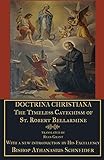
Also, I have a new edition of the classic catechism of St. Robert Bellarmine, translated into English with an introduction by Athanasius Schneider. Doctrina Christiana: The Timeless Catechism of St. Robert Bellarmine (US HERE – UK HERE). This is terrific. Remember that St. Robert Bellarmine wrote in a time before we moderns got all grown up an too sophisticated to do things like… you know… think, make distinctions, remember stuff. His catechism breaks down all the articles of the Creed and of the Our Father. He provides a crystal clear explanation of “ne nos inducas“. This catechism is written as a dialogue. It was intended for catechists and it was written at the express bidding of Pope Clement VIII and was approved in 1598.
S. Enlighten me about the sixth petition: “and lead us not into temptation.”
T. In this petition, we ask for help against future evils, clearly against temptations, through which we fall into sin. Therefore, you would know that here we especially pray to God, lest he would permit us to be conquered by temptation. To be sure, because temptations are very dangerous, and victory over them is uncertain, therefore, we ask God, lest he would permit us to be tried, especially when he sees the devil will be the victor. For that reason, we gather a characteristic proof that it is beyond doubt the devil not only cannot conquer us, but cannot even tempt us, unless God should permit it.
S. I do not sufficiently understand this matter of speaking, “and lead us not into temptation.” It seems this phrase means that God usually leads us into temptation, and we ask him lest we would do that.
T. To lead into temptation, or to send into temptation, or to send one into temptation or to urge one to sin is proper to the devil, but by no means is it proper to God, who pursues sin with the utmost hatred. Just the same, by speaking, according to this phrase of Sacred Scripture, where it is repeatedly attributed to God, to lead into temptation is nothing other than for God to permit someone to be tempted, or to be conquered by temptation. This is why the sense of this petition is what we have said, namely, that since we recognize on the one hand, the weakness of our nature, and on the other, the deceit and power of the devil, we pray to God that he would not simply prevent us from being conquered by temptation, but also by being beaten by temptation when he sees that we are not going to be victorious.
In Bellarmine’s Short Catechism of 1614, for children, he explains.
Student: Declare the sixth (petition of the Our Father).
Teacher: We demand (ask) in the sixth that God deliver us from temptations which are evils to come, or not permitting us to be content, or giving us grace that we will not be overcome.
Heck… even Lutherans get this. In Luther’s Small Catechism he wrote:
The Sixth Petition
And lead us not into temptation.
What does this mean? God tempts no one. We pray in this petition that God would guard and keep us so that the devil, the world, and our sinful nature may not deceive us or mislead us into false belief, despair, and other great shame and vice. Although we are attacked by these things, we pray that we may finally overcome them and win the victory.
It is the task of bishops and priests to explain all these articles of the Creed, the petitions of the Our Father, the meaning of the Decalogue, and the basics, to their people. That’s why after Trent, the Roman Catechism was produced: so that parish priests had a sure reference to the content of the Faith, the fides quae creditur, so that they could preach and teach it to their people. The fact is, back in the day, the Fathers of Trent realized that catechism was in appalling shape. That’s why they did what they did.
Can we say that things are a whole lot better now? Sure, we have greater resources than even before. However, today we have to fight also the debilitating effect of horrible sentimentlist education and the accumulative brain-melting effect of screens.
Priests and bishops are included.
When I was in major seminary in these USA, one day we were walking out of a Christology class. I heard one guy say to another, “That whole two natures in Christ thing is pretty interesting.”
PRETTY INTERESTING? He had never heard of this before and he was in 2nd year of major seminary.
Okay… end of rant.

 At Epiphany – once upon a time far more important than Christmas – we Latins have the custom of singing a solemn proclamation of the key liturgical dates – movable feasts – for the new year of salvation, just begun. This underscores how these dates and seasons are all interconnected.

 Today I was greeted with the excellent new that my old friend Greg Burke, the director of the Holy See Press Office and papal spokesman, has resigned. I am delighted for him.
 Somewhere in my stacks and stacks of books I have a reprint of an old Italian catechism. It lays out everything that the children were to learn for 1st Communion, etc. Included are lots of prayers in Latin.