 From a priest…
QUAERITUR:
I am a parish priest in a Midwestern diocese. Our bishop is allowing us to celebrate the Mass publicly again soon. One of the stipulations is that communion can only be given in the hand. Do you have any words of comfort or wisdom for members of my congregation who only receive on the tongue?
Since I have not seen the wording, the text, of what the bishop sent out, I can’t say much. Past experience suggests that these documents really express the preference of the bishop (or rather the one who wrote it for the bishop) but expressed in such a highfalutin way that people who read it thing that it is a legitimate law, even when it contradicts the Church’s universal laws.
On that last point, the 2004 document Redemptionis Sacramentum from the Congregation for Divine Worship and Discipline of the Sacraments still has force today for the whole Latin Church. Bishops cannot override it. They – or rather their ghost writers – can try to get people to think they can, but they can’t.
Redemptionis Sacramentum …
[91.] In distributing Holy Communion it is to be remembered that “sacred ministers may not deny the sacraments to those who seek them in a reasonable manner, are rightly disposed, and are not prohibited by law from receiving them”.[Code of Canon Law, can. 843 § 1; cf. can. 915.] Hence any baptized Catholic who is not prevented by law must be admitted to Holy Communion. Therefore, it is not licit to deny Holy Communion to any of Christ’s faithful solely on the grounds, for example, that the person wishes to receive the Eucharist kneeling or standing.
[92.] Although each of the faithful always has the right to receive Holy Communion on the tongue, at his choice, [Cf. Missale Romanum, Institutio Generalis, n. 161.] if any communicant should wish to receive the Sacrament in the hand, in areas where the Bishops’ Conference with the recognitio of the Apostolic See has given permission, the sacred host is to be administered to him or her. However, special care should be taken to ensure that the host is consumed by the communicant in the presence of the minister, so that no one goes away carrying the Eucharistic species in his hand. If there is a risk of profanation, then Holy Communion should not be given in the hand to the faithful. [Congregation for Divine Worship and the Discipline of the Sacraments, Dubium: Notitiae 35 (1999) pp. 160-161.]
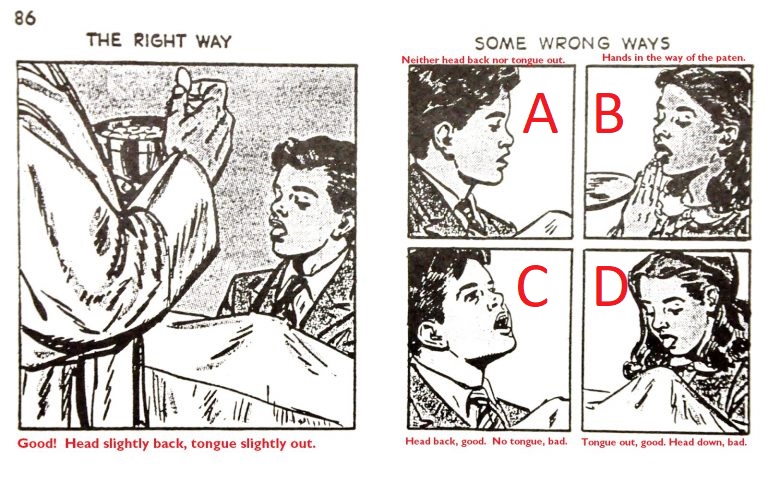
91 says that, seeking to receive Communion via reception on the tongue is “a reasonable manner”, even in this time.
92 says, “each of the faithful always has the right to receive Holy Communion on the tongue, at his choice”. Those are words of comfort.
Then, 92 warns about the risk of profanation via Communion on the hand. It says nothing of risk of profanation via Communion on the tongue. Why? Because Communion on the tongue is really the normative way to receive. This is why permissions were give to depart from the norm.
Bishops cannot override this.
When the coronavirus thing was revving up, the Archdiocese of Portland quite properly cited Redemptionis Sacramentum in this matter. Archbp. Sample is a superb canonist and has a strong liturgical sense. I can’t think of a more reliable and knowledgeable bishop on liturgical law in these USA.
Not rarely, decrees that emanate from chanceries about traditional liturgical practices sound rather official, but a careful reading will often reveal that they convey preferences.
Finally, I’ll repeat what I have written before. There is far greater risk of hand to hand contact when Communion is distributed on the hand than there is risk of hand to tongue contact when the communicant receives properly. Think about what hands have been touching before Communion.
His dictis, obedience to the universal law in the face of the local bishop’s contrary preferences can earn the priest a really hard path. It is unfair for a bishop to put a priest in a hard spot: obey the Church’s legitimate law or knuckle under to the bishop’s personal preferences.
If the bishop is a bully, he can harass a priest in a thousand ways. If a priest gives in, do not blame or pick on him. And if people, because of an unjust imposition, are denied their right in this regard, then offer it up – an act of persecution – in reparation for offenses against the Eucharistic Lord via Communion in the hand and receptions in the state of mortal sin.
Also, there are times when the bishop is with his powers to issue decrees about his preferences and he issues a document that actually cites law accurately. In that case, priests don’t have much of a choice but to tug the forelock and obey, no matter how odious.







 Ave Maria on Summorum Pontificum Pilgrimage 2026… *sigh*… Vatican Bars Annual TLM Pilgrimage from ENTERING St. Peter’s Basilica: “Every Catholic who loves the patrimony of the Roman Catholic Church is not really wanted in the new ‘synodal direction’.…”




























