New Dean of the Roman Rota appointed

16_12_12_LOssRom_01UPDATE:

Note that Msgr. Maurice Monier was appointed PRO-Dean. That means that Pinto is not necessarily retired. As a matter of fact it looks like Pinto is staying in place, according to a well-placed friend. So, BOTH Pinto and Monier will be wheeling in that chair at the circular table.

On the other hand, Catholic Hierarchy lists him as Dean Emeritus.

16_12_12_CathHier_01

____ Originally Published on: Dec 12, 2016 @ 11:32

A while back Msgr. Vito Pinto – then-Dean of the Roman Rota – made disparaging remarks about the Four Cardinals of the Five Dubia on Amoris laetitia.  At the time I observed that Pinto was 75 (aka retirement age).

Today I observe at L’Osservatore Romano that a new pro-Dean of the Rota has been appointed: Msgr. Maurice Monier of the Diocese of Le Puy-en-Velay.

It is tempting to conclude that the timing of the appointment has something to do with Pinto’s explosive gaffe in his talk. However, I’m pretty sure that that is not what happened. It was time for Pinto to be retired anyway. Pintos exploded after all.

Posted in Lighter fare | Tagged
9 Comments

Pope Francis pummels traditional priests, seminarians, laity … again. What can we learn from that?

UPDATE 14 Dec 2016:

Jan Bentz of LifeSite has a follow up piece.

___  Originally Published on: Dec 12, 2016 ___

Over the last few years, Our Holy Father Pope Francis has said some pretty awful things about priests.  He doesn’t limit himself to priests.  Remember how he pummeled the Cardinals and Bishops of the Roman Curia as a Christmas gift a couple years ago?  HERE  Everyone is a target: women religious, theologians, canonists, you name ’em.

The other day, during his daily Mass fervorino he recounted an anecdote – actually, a bit of gossip – in a rather – well, there isn’t any other way to take it – insulting manner about a seminarian getting some clerical gear.  He heaped ridicule on this seminarian and on pretty much anyone who respects and uses outward traditional garb or, I suppose, anything else that is traditional.  I am reminded of his mocking of an altar boy who was standing with his hands folded together carefully… as altar boys ought.  I am reminded of his scoffing at a spiritual bouquet which people presented to him.

I honestly don’t know what His Holiness is trying to accomplish with these harsh gestures and words.  It could be that – while they deal with things that are not his cup of tea – he says them before their possible impact is considered.

BUT … Don’t we all do that?  I know that I do, sometimes.  And I regret it afterward.  I suspect that Pope Francis does too.

Let’s see his words posted at the site of Vatican Radio:

“About rigidity and worldliness, it was some time ago that an elderly monsignor of the curia came to me, who works, a normal man, a good man, in love with Jesus – and he told me that he had gone to buy a couple of shirts at Euroclero [the clerical clothing store] and saw a young fellow – he thinks he had not more than 25 years, or a young priest or about to become a priest – before the mirror, with a cape, large, wide, velvet, with a silver chain. He then took the Saturno [wide-brimmed clerical headgear], he put it on and looked himself over. A rigid and worldly one. And that priest – he is wise, that monsignor, very wise – was able to overcome the pain, with a line of healthy humor and added: ‘And it is said that the Church does not allow women priests!’. Thus, does the work that the priest does when he becomes a functionary ends in the ridiculous, always.”

It’s sort of an inversion of the parable of the publican and the pharisee, no?  “Thank God I’m not like him!”, only the fancy and the lowly are reversed.

I must ask: How many times has Pope Francis inveighed against the perils of gossip in the Church?  Gossip in “the terrorism of words” according to Vatican Radio.  “Gossip is rotten,” he told a crowd gathered in St. Peter’s Square back in 2014. “At the beginning, it seems to be something enjoyable and fun, like a piece of candy.  But at the end, it fills the heart with bitterness and also poisons us.”  You can find other examples.

Also, a subtle point, this is probably not going to be appreciated by women who think that they can be, or want to be, priests.  THIS is what the Pope thinks of you: You just want to play dress up – hah! hah! – aren’t you ridiculous?

A couple comments and explanations about this are in order.  First, the cape described is called a cappa.  It is not the cappa magna of the bishop.  It is a black, ankle or slightly higher length, cloak. It sometimes has a velvet collar (mine does not), that fastens at the throat with clasps and a chain.  Sometimes they have fabric “frogs” as a closure.

The use of these accouterments means, in itself, precisely nothing.

It is superficial to judge the heart and mind of a person by these fleeting glimpses.  After all, who even knows if that seminarian or priest actually bought what he tried on?  And who knows why he might have bought it?  Any priest who lives in a cold climate – as I do – and who has to go to the cemetery for burials or who goes from the rectory to the church when it’s -10° and blowing knows how useful this cloak is.  Moreover, the flat hat, or as the Roman’s call them, “saturno” (after the planet – also called “frying pans”), is quite practical.  It keeps the rain and snow from going down your neck and it will shade over a book as well.

However puzzling and, frankly, derogatory the public recitation of that anecdote was to a large number of people, my main concern reaches beyond the itsy bitsy, teensy weensy feelings of traditional Roman Catholics, who by now are thoroughly inured by decades of abuse and neglect  from the priests and bishops who should be giving them pastoral care.

Let’s consider for a moment… this:

QUAERITUR: Would we Latins be out of line in mocking our Eastern Catholic or Orthodox brothers?

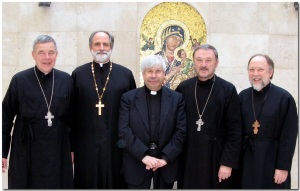
An Orthodox married priest explains why he wears his attire to Walmart.

eastern priest walmart

Just look at the strange hat, will you?  Maybe it’s a bad thing?

Lots of Eastern priests wear silver and gold chains with cross and icons.  Are they doing something bad? Look at these guys, with their black robes and their silver chains.

Some of these have three things.  And these hats are even stranger!

Heck… Eastern Catholics and Orthodox don’t just wear hats, they wear crowns!

Look at all that fancy finery!  Are they just functionaries?  Are they ridiculous?  Perhaps it should be sold and the money given to the poor.

As for the saturno…

Benedict XVI saturno

Why did THE POPE wear it?  Why, to be ridiculous, of course.

(The real answer is that the sun was really hot.)

St. John Paul used a saturno when it was hot.

John Paul II saturno

John Paul II saturno May 1980 Ouagadougou

Let’s get serious for the last part of this post.

I’ve known clerics who are really into the outward trappings of traditional Catholicism.  Really into them.  Some – few – of them are, well, a bit vain.  Others, however, are perfectly normal, sane, hard working men who pour themselves out like rivers to their flocks.  They find the garb good and useful and they put it to good use.  In time people see what priests are all about even if they wear – gasp – a cappa when they go out into the cold.  And… lots… dare I say… most?  the vast majority?… want their priests to look like priests.  No?  Am I wrong about that?

So.  What’s the take away from this for me, for the priests and the seminarians who are reading this.  What can I learn from this beating that the Vicar of Christ doled out to every cleric who owns a cloak and a hat, who does not despise traditional things enough?

  • First, be careful how you talk about people based solely on appearances or glances of something that you can’t possibly grasp from a distance.  Check your tongues!  How often would we – would I – have avoided sinning had we – had I – simply kept our mouths shut.
  • Next, remember that the Church has two lungs, West and East.   The Holy Father would never in a million years mock Easterners for their traditional style of dress and for their high liturgical style.  But he regularly mocks Westerners.  What of it?  We Latins also have our traditional style of dress and our own high liturgical style that matches the East step for step.  We have nothing to apologize for in wanting it and using it with good intentions.
  • Also, too much of a good thing is too much.  If you are a young priest or a seminarian, and you are really into these things, examine your motives and consciences.  I’m not saying give them up.  On the contrary!  I’m saying that if you are too attached to them, to the exclusion of prudence, etc., make some changes.

action-item-buttonMoreover, remember that we have going here at this blog a long-term project to get birettas for seminarians.  HERE

John Hastreiter at Leaflet Missal in St. Paul is collecting names and hat sizes of seminarians who don’t have a biretta and putting them on a “biretta wanted list”.  Then you, dear readers, can contact John, buy a biretta, and he will send it to a man on the list!

Contact John in church goods at Leaflet Missal in St. Paul – 651-209-1951 Ext-331.  If he is away, leave a voicemail with your phone number and he will call you back ASAP.

Let’s encourage these men!  Call John and buy a biretta for a seminarian.  It’s as easy as that.

Lastly, we priests – most of us anyway – are not precious tender snowflakes who need affirmation and hugs and puppies and coloring books.  I won’t say that we need a drubbing all the time, but we can take it when its handed out.


Posted in ¡Hagan lío!, ACTION ITEM!, Hard-Identity Catholicism, Liturgy Science Theatre 3000, Mail from priests, Our Catholic Identity, Priests and Priesthood, Seminarians and Seminaries | Tagged , , ,
68 Comments

Knights of Columbus bankroll Crux. Do @KofC also hold @Crux editorial positions?

I saw a piece at Crux today which left me disappointed.  The piece in question is an opinion hit-job by Austen Ivereigh against anyone who dares to suggest that there are problems with Chapter 8 of Amoris laetitia.

Ivereigh is a “contributing editor” at Crux.  His position is de facto an editorial position.

On Crux’s webpage we read:

We’re an independent Catholic news site, operated in partnership with the Knights of Columbus….

They are partners.

Is this the sort of product that the Knights of Columbus want?

If this is the sort of thing that the Knights of Columbus aim for as partners, then I must review my hitherto positive view of the Knights of Columbus.

Posted in Green Inkers, I'm just askin'..., Liberals | Tagged ,
25 Comments

Just for fun

Wisdom from the Book of Wayne

YouTube thumbnailYouTube icon

No tender snowflakes allowed.

Posted in Lighter fare | Tagged
22 Comments

ASK FATHER: Of different shades of rose, madder, and debauchery


“Real priests wear rosacea!”

QUAERITUR:

Elsewhere someone asked if there are proper shades of rose, rosacea, for Roman vestments just as there are different shades of violet or purple for Advent and for Lent.  Some say that a bluer purple should be used for Advent and a redder purple should be used for Lent.

So, are there different roses for Advent and for Lent?

That’s a pretty good question.

There is, of course, a huge variety in what we see as “rose”, ranging from baby-rattle pink to a reddish hue.

Some say that the proper Roman rose, which is sort of salmon (with that orange touch) is what is generally called rose madder, from dyer’s madder root, rubia tinctorum.  

Here some shades that one might see in rose (other than bubble-gum pink) which are variations of rose madder:

rosacea rose madder #e32636

A friend sent this shot of a vestment he had made.

RomanBee2.JPG

It’s very fine.

My home parish has a set not unlike this, with blue trim.

rosacea rose madder #e74250

gaudete mass at st agnes in st paul

My new set for Sung Masses is like this in moire acetate.

rosacea rose madder #ed6c77

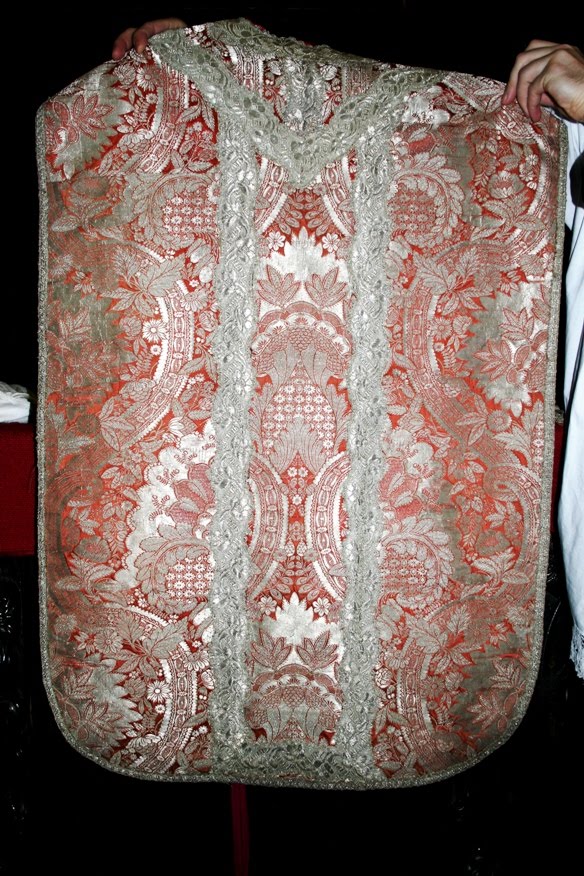
Here is that salmon shade.  I have an antique silk Roman vestment like this.

rosacea rose madder #e37a70

As it is silk, however, you also get some of the shades above.

Along with the salmony shade…

I suppose that if a parish were able to do so, they could differentiate the attitudes of Advent and Lent through the use of different roses.    Perhaps the redder madder rosacea for Lent and the lighter or more salmon-like for Advent?

Speaking of madder, I am reminded of the scene in the Aubrey/Maturin novel by Patrick O’Brian‘s HMS Surprise.  (UK HERE) The ship’s surgeon, an eminent naturalist, Dr. Stephen Maturin was conducting an experiment on some rats.  He had been feeding them madder.  He intended eventually to dissect them to see if the red stuff had colored their bones and penetrated to the marrow.  It was not to be.  Hungry midshipmen ate his fat, madder saturated rats whilst he was marooned on St. Paul’s Rock.  Note the spiffing partitive genitive in the first sentence of the following:

In time it appeared that Babbington had eaten of the Doctor’s rats; and that he was sorry now.

‘Why, no, Babbington,’ said [Capt.] Jack. ‘No. That was an infernal shabby thing to do; mean and very like a scrub. The Doctor has been a good friend to you – none better. Who patched up your arm, when they all swore it must come off? Who put you into his cot and sat by you all night, holding the wound? Who – ‘

Babbington could not bear it; he burst into tears. Though an acting-lieutenant he wiped his eyes on his sleeve, and through his sobs he gave Jack to understand that unknown hands had wafted these prime millers [aka rats] into the larboard midshipmen’s berth; that although he had had no hand in their cutting-out – indeed, would have prevented it, having the greatest love for the Doctor, so much so that he had fought Braithwaite over a chest for calling the Doctor ‘a Dutch-built quizz’ – yet, the rats being already dead, and dressed with onion-sauce, and he so hungry after rattling down the shrouds, he had thought it a pity to let the others scoff the lot. Had lived with a troubled conscience ever since: had in fact expected a summons to the cabin.

‘You would have been living with a troubled stomach if you had known what was in ‘em; the Doctor had -’

‘I tell you what it is, Jack,’ said Stephen, walking quickly in. ‘Oh, I beg your pardon.’

‘No, stay, Doctor. Stay, if you please,’ cried Jack.

Babbington looked wretchedly from one to the other, licked his lips and said, ‘I ate your rat, sir. I am very sorry, and I ask your pardon.’

‘Did you so?’ said Stephen mildly. ‘Well, I hope you enjoyed it.

Listen, Jack, will you look at my list, now?’

‘He only ate it when it was dead,’ said Jack.

‘It would have been a strangely hasty, agitated meal, had he ate it before,’ said Stephen, looking attentively at his list. ‘Tell me, sir, did you happen to keep any of the bones?’

‘No, sir. I am very sorry, but we usually crunch ‘em up, like larks. Some of the chaps said they looked uncommon dark, however.’

‘Poor fellows, poor fellows,’ said Stephen in a low, inward voice.

‘Do you wish me to take notice of this theft, Dr Maturin?’ asked Jack.

‘No, my dear, none at all. Nature will take care of that, I am afraid.’

Stephen is eventually revenged in a creative way – involving laxatives – which also kept him true to his Hippocratic Oath.

Later in that same book, by the by, Jack will debauch Stephen’s pet sloth with grog and turn it into an alcoholic.

Which it’s tough going for the Doctor on the high seas, as Preserved would put it.

But I digress.

Have a rosy Sunday.

UPDATE:

The shades of vestments have a lot to do with the history of trade and of dyes. Once upon a time in the West, there was a lot of rose material, which you see in the movies of the late great John Wayne!

john wayne rosacea

Posted in "How To..." - Practical Notes, ASK FATHER Question Box, Liturgy Science Theatre 3000, O'Brian Tags, Preserved Killick | Tagged , , ,
8 Comments

POLL: Did you see Rose vestments on “Gaudete” Sunday 2016?

Here is a little poll for your 3rd Sunday of Advent, Gaudete.

Please choose an answer and add a comment in the combox.

Anyone can vote, but only registered members can comment.

For my Roman Rite 2016 'Gaudete' Sunday Mass of Obligation I saw vestments of

  • Rose/Pink (78%, 1,792 Votes)
  • Purple/Violet (19%, 429 Votes)
  • Blue (1%, 32 Votes)
  • Other (1%, 24 Votes)
  • White (1%, 21 Votes)

Total Voters: 2,298

UPDATE:

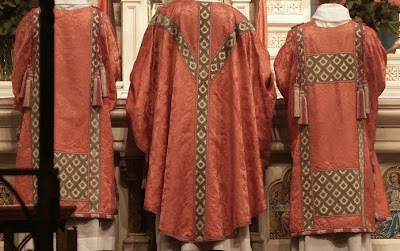
Here are the new rose vestments in action. The cope is used for the Asperges.  Lots of people were late today because of the simply dreadful weather, winter storm. The Asperges was a little thin, but more arrived along the way.

16_12_11_rose_vestments_01 16_12_11_rose_vestments_02

16_12_11_rose_vestments_03

Posted in Liturgy Science Theatre 3000, POLLS | Tagged , , ,
51 Comments

WDTPRS – 3rd Sunday of Advent: The childlike dash towards the long-desired thing

Our new rose set for Sung Masses on Gaudete and Laetare when we have an Asperges.  DONATE

We are coming to the 3rd Sunday of Advent, also nicknamed Gaudete…. the plural imperative of gaudeo, “Rejoice!”, the first word of the Introit chant.  This Sunday there is a relaxation of the penitential aspect of Advent, just Laetare Sunday does during Lent.

Yes, Advent is a penitential time, though not so much as Lent.  Advent is a time for joyful penance or penitential joy.

Remember: Real priests wear rosacea.

In the first week of Advent we begged God for the grace of the proper approach and will for our preparation.

In the second week, we ask God for help and protection in facing the obstacles the world raises against us. This Sunday we have a glimpse of the joy that is coming in our rose colored (rosacea) vestments, some use of the organ, flowers. Christmas is ever nearer at hand.

COLLECT – (2002MR)

Deus, qui conspicis populum tuum nativitatis dominicae festivitatem fideliter exspectare, praesta, quaesumus, ut valeamus ad tantae salutis gaudia pervenire, et ea votis sollemnibus alacri laetitia celebrare.

The infinitives in our Collect (expectare… pervenire… celebrare) give it a grand sound and also sum up what we are doing in Advent. L&S informs us that conspicio means, “to look at attentively, to get sight of, to descry, perceive, observe.” Alacer is, “lively, brisk, quick, eager, active; glad, happy, cheerful” and it is put in an unlikely combination with laetitia, “joy, especially unrestrained joyfulness”.

At the same time we also have votis sollemnibus. Votum signifies first of all, “a solemn promise made to some deity” (we have all made baptismal vows!) and also “wish, desire, longing, prayer”.

There is a powerful sentiment of longing in this prayer, God’s as well as ours.

Don’t fall into the trap of thinking that expecto is from ex- + pecto (pecto, “to comb”). Exspecto is “look forward to, await, long for, dread” in your L&S.  You can also comb through your copy of the etymological dictionary of Latin by Ernout and Meillet which says it is from ex– + *specio, spexi, spectum or ex- + spicio. Therefore, it is a cousin of conspicio: God “watches” over us and we “look” back at… er um… forward to Him. This word play is clever.

Furthermore, sollemnis, related to sollus, i.e. “totus-annus“, points to something that takes place every year.  So, it basically means “yearly, annual”.  Thus, by extension it means something that takes place at appointed times, such as rites of a religious character and that which is does by custom.

LITERAL TRANSLATION:

O God, who attentively watch Your people look forward faithfully to the feast of the Lord’s birth, grant, we entreat, that we may be able to attain the to joys of so great a salvation and celebrate them with eager jubilation in solemn annual festive rites.

OBSOLETE ICEL (1973):

Lord God, may we, your people, who look forward to the birthday of Christ experience the joy of salvation and celebrate that feast with love and thanksgiving.

You decide.

Rose vestments from the days of Fr. Finigan in Blackfen. Then came the regime change….

With the last two week’s of “rushing” in our prayers and doing good works, we have now the added image of eager and unrestrained joy, an almost childlike dash towards a long-desired thing.

Have earthly fathers watched this scene all of a Christmas morning?

Even so should we be in our eager joy to perform good works under the gaze of a Father who watches us, a Father with a plan.

The obsolete ICEL version captures little of the impact of the Latin prayer, that is, God the Father is patiently watching his people as we go about the Advent business of doing penance and just works in joyful anticipation Christ’s coming.

NEW CORRECTED ICEL (2011):
O God, who see how your people faithfully await the feast of the Lord’s Nativity, enable us, we pray, to attain the joys of so great a salvation, land to celebrate them always with solemn worship and glad rejoicing.

Posted in ADVENT, Liturgy Science Theatre 3000 | Tagged , , ,
2 Comments

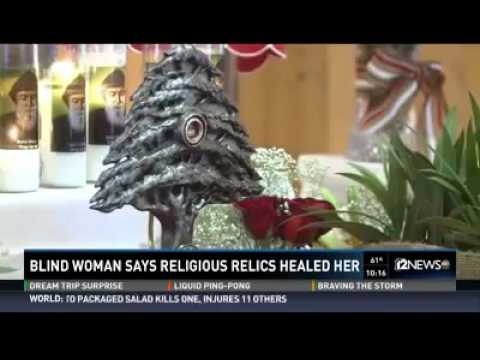
Blind woman healed by contact with relics and priestly prayers

This is a great story.

YouTube thumbnailYouTube icon

When I wrote about St. Gianna, I offered some points about miracles.

I hereby put to you several points to consider, any of which might serve as a starting point for comments below:

  1. Saints are presented to us by Holy Mother Church for “the two I’s”: imitation and intercession.
  2. As all Christians are called to imitate Christ, we also must experience self-emptying and the Cross, abandonment to providence and self-donation. We must be willing to lose everything.
  3. We are not alone: the Church Militant and the Church Triumphant are closely knit, interwoven in charity. We on earth must intercede for each other and believe and ask for the intercession of the saints.
  4. God makes use of the weak to demonstrate His might and love.
  5. If we do not believe in miracles, we do not ask for them. If we do not ask for them, they will not be granted.
  6. Our life of faith is noticed by non-believers and they are not unaffected.
  7. What a difference a bishop (and a priest) can make!
  8. How often do you invoke the help of the saints and holy angels?
  9. God’s ways are not our ways.
  10. No one is too small to be an occasion of grace for others.
Posted in Just Too Cool, Saints: Stories & Symbols | Tagged ,
8 Comments

Hail, thou holy Throne of God

15_11_30_rubens_immaculate-conception_200From the 3rd Nocturn of Matins:

V. Grant, Lord, a blessing.
Benediction. May the Gospel’s holy lection be our safety and protection. Amen.

Reading 7
From the Holy Gospel according to Luke
Luke 1:26-28
In that time, the angel Gabriel was sent from God into a city of Galilee, called Nazareth, to a virgin espoused to a man whose name was Joseph, of the house of David; and the virgin’s name was Mary. And so on.

Homily by St. Germain, Patriarch of Constantinople.
On the Presentation of the Blessed Virgin.
Hail, Mary, full of grace, holier than the Saints, higher than the heavens, more glorious than the Cherubim, more honourable than the Seraphim, and the most worshipful thing that the hands of God have made. Hail, O dove, bearing in thy beak the olive-branch of peace that telleth us of salvation from the spiritual flood, Gen. viii. 10, n, dove, blessed omen of a safe harbour, whose wings are of silver, and thy feathers of gold, shining in the bright beams of the Most Holy and Light-giving Spirit. Ps. lxvii. 14. Hail, thou living garden of Eden, planted towards the East by the right hand of the Most Merciful and Mighty God, wherein do grow to His glory rich lilies and unfading roses, for the healing of them that have drunk in death from the blighting and pestilential breezes of the bitter West, Gen. ii. 8, 9; Eden, wherein hath sprung that Tree of life, Whereof if any man eat he shall live for ever. Gen. ii. 9; iii. 22. John vi. 52. Hail, stately Palace of the King, most holy, stainless, purest, House of the Most High God, adorned with His Royal splendour, open to all, filled with Kingly dainties; Palace wherein is that spiritual bridal chamber, not made with hands, nor hung with divers colours, in the which the Eternal Word, when He would raise up fallen man, wedded flesh unto Himself, that He might reconcile unto the Father them who had cast themselves away.
V. But thou, O Lord, have mercy upon us.
R. Thanks be to God.

R. A garden enclosed is my sister, my spouse, a garden enclosed, a fountain sealed.
* O Mary, thy perfumes are a garden of delights.
V. Open to me, my sister, my love, my dove, my undefiled.
R. O Mary, thy perfumes are a garden of delights.

V. Grant, Lord, a blessing.
Benediction. She whose feast-day we are keeping, Mary, blessed Maid of Maidens, be our Advocate with God. Amen.

immaculate-conception ZurbaranReading 8
Hail, O rich and shady Mountain of God, whereon pastured the True Lamb, Who hath taken away our sins and infirmities, Hab. iii. 3; Isa. liii. 4; John i. 29, mountain, whereout hath been cut without hands that Stone which hath smitten the altars of the idols, and become the head-stone of the corner, marvellous in our eyes. Dan. ii. 34; Ps. cxvii. 22, 23. Hail, thou holy Throne of God, thou divinest store-house, thou temple of glory, thou bright crown, thou chosen treasure, thou mercy-seat for the whole world, thou heaven declaring the glory of God. Ps. xviii. 2. Hail, thou vessel of pure gold, made to hold the manna that came down from heaven, the sweet food of our souls, even Christ. Ex. xvi.33; Heb. ix. 4; John vi. 49-51. Hail, O purest Virgin, most praiseworthy and most worshipful, hallowed treasury for the wants of all creatures; thou art the untitled earth, the unploughed field; thou art the vine full of flowers, the well overflowing with waters, Maiden and Mother; thou art the Mother that knew not a man, the hidden treasure of guilelessness, and the clear, bright star of holiness; by thy most acceptable prayers, strong from thy motherly mouth, obtain for all estates of men in the Church that they may continually tend unto Him Who is the Lord, and God, and Maker of thee, and of them, and of all, but of thee the Son also, conceived without man’s intervention; obtain this, O Mother, pilot them to the harbour of peace.
V. But thou, O Lord, have mercy upon us.
R. Thanks be to God.

R. My soul doth magnify the Lord;
* For He That is mighty hath done to me great things, and holy is His name.
V. For, behold, from henceforth all generations shall call me blessed.
R. For He That is mighty hath done to me great things, and holy is His name.
V. Glory be to the Father, and to the Son, * and to the Holy Ghost.
R. For He That is mighty hath done to me great things, and holy is His name.

V. Grant, Lord, a blessing.
Benediction. May He that is the Angels’ King to that high realm His people bring. Amen.

tiepolo prado immaculate conceptionReading 9
Be it thine to clothe God’s priests with righteousness, and to make them shout aloud for joy Ps. cxxxi. 9, 16, in approved and stainless, and upright and glorious faith. thine be it to guide in peace the sceptres of orthodox princes, even of princes who put their trust in thee to be the crown of their Majesty, and the Royal Robe of their greatness, and the firm foundation of their dominion, more than in purple, or fine gold, or pearls, or precious stones; thine be it to put under their feet the unfaithful nations, nations that blaspheme thee, and the God That was born of thee; thine be it to keep in meek obedience the people that are under them, according to the commandment of God. Behold, this is thine own city, which hath thee for her towers and her foundations, crown her with victory, gird the house of God with strength, keep undefiled the loveliness of His tabernacles, as for them that praise thy name, be thou their deliverer from strife and bitterness of spirit. Free thou the prisoner, protect the wanderer, and if there be any that hath no refuge, be thou to him a consolation. Stretch forth thine hand and help the whole earth so shall we year by year keep this and all thy feasts, and at last be found with thee in Christ Jesus, Who is Lord of all, and verily our God. To Him, with the Holy Father, Who is the Fountain of Life, and the coeternal Spirit, Three Persons and One Substance, even as there is one Kingdom, be glory and strength, now and for ever. Amen.
V. But thou, O Lord, have mercy upon us.
R. Thanks be to God.

Te Deum
We praise thee, O God, * we acknowledge thee to be the Lord.
All the earth doth worship thee, * the Father everlasting.
To thee all Angels cry aloud, * the Heavens, and all the Powers therein.
To thee Cherubim and Seraphim * continually do cry.

(bow head) Holy, Holy, Holy * Lord God of Sabaoth;

Heaven and earth are full * of the Majesty of thy glory.
The glorious company of the Apostles * praise thee.
The goodly fellowship of the Prophets * praise thee.
The noble army of Martyrs * praise thee.
The holy Church throughout all the world * doth acknowledge thee;
The Father, * of an infinite Majesty.
Thine honourable, true, * and only Son;
Also the Holy Ghost, * the Comforter.
Thou art the King of Glory, * O Christ.
Thou art the everlasting * Son of the Father.

Immaculate Conception Francisco Ignacio Ruiz de la IglesiaDuring the following verse all make a profound bow:
When thou tookest upon thee to deliver man, * thou didst not abhor the Virgin’s womb.

When thou hadst overcome the sharpness of death, * thou didst open the Kingdom of Heaven to all believers.
Thou sittest at the right hand of God, * in the glory of the Father.
We believe that thou shalt come * to be our Judge.

Kneel for the following verse
We therefore pray thee, help thy servants, * whom thou hast redeemed with thy precious Blood.

Make them to be numbered with thy Saints, * in glory everlasting.
O Lord, save thy people, * and bless thine heritage.
Govern them, * and lift them up for ever.
Day by day * we magnify thee;

During the following verse, by local custom, all make a profound bow.
And we worship thy Name * ever, world without end.

Vouchsafe, O Lord, to keep us * this day without sin.
O Lord, have mercy upon us, * have mercy upon us.
O Lord, let thy mercy lighten upon us, * as our trust is in thee.
O Lord, in thee have I trusted, * let me never be confounded.
Posted in Our Solitary Boast, Patristiblogging | Tagged
1 Comment

Happy Birthday Blog!

On 8 December 2005, I posted this photo.  This blog project began.

Today is the 11th anniversary of this blog.

16_12_08_screenshot_visits_01This photo was a shot from my apartment window in Rome on the evening of the day Pope Benedict was elected.


I started it with the original intention of it being an archive for articles I was writing for The Wanderer about liturgical translations.  Thus, it’s original name.  That column, by the way, began before the release of Liturgiam authenticam.

That was the intention, but the blog rapidly took on a life of its own.

Since I started keeping stats, on 23 November 2006, I have had about 78.6 million page views and 50.7 million unique visits.  People come from all over the world, as you can see from the screen shot of the live visit feed just before I posted this.

Dear readers, please accept my thanks for everything, your comments and feedback, your prayers and your patience with me.

Tomorrow I will say Mass for the intention of my benefactors and donors.

This is what the blog looked like back then.  A screen shot from about a month after its inception.

16_12_08_wdtprs_2006

Posted in Lighter fare | Tagged
45 Comments