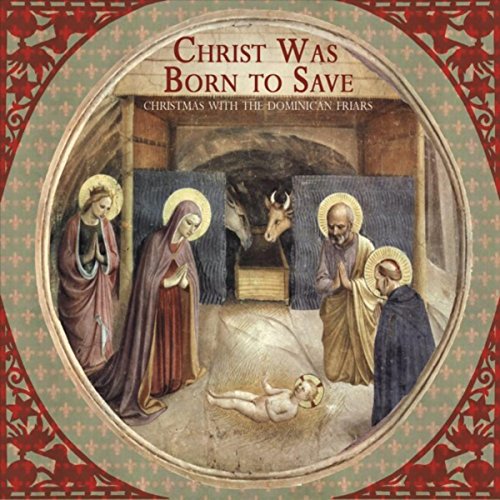
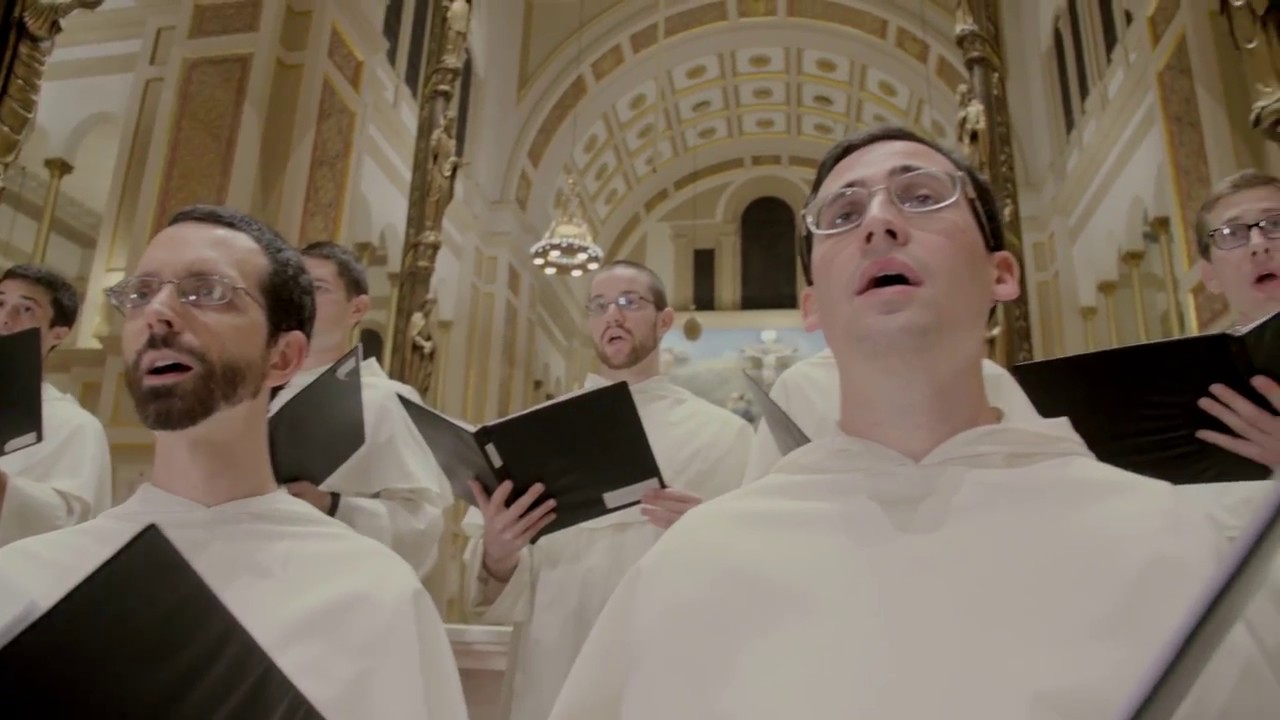
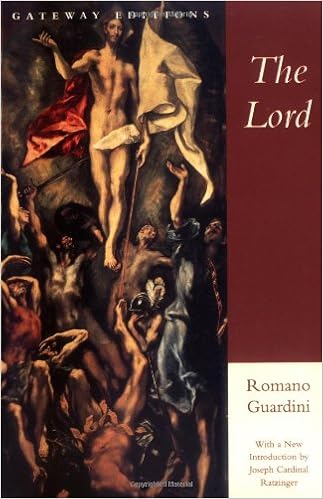
NEW CHRISTMAS CD from the Friars of the Dominican House of Studies

This is a GREAT new offering from the Dominican Friars at the Dominican House of Studies in Washington DC, right now probably the best school of theology in these USA.

US HERE – UK HERE

YouTube thumbnailYouTube icon

Pretty good, no?

They have some examples of Dominican Chant, which differs a bit from Gregorian Chant.

Posted in The Campus Telephone Pole | Tagged ,
6 Comments

Bp. Schneider: attacks on Four Cardinals, Five Dubia like time of Soviet Union

At LifeSite we read interesting remarks by Bp. Athanasius Schneider of Kazakhstan. Bp. Schneider made an interesting comparison.  about a conference held in Rome. Present were the two of the Four Cardinals (Burke, Brandmüller) who submitted the Five Dubia and Bp. Athanasius Schneider of Kazakhstan. Bp. Schneider made an interesting comparison.

Bishop Schneider likens treatment of four Cardinals to Soviet regime: ‘We live in a climate of threats’

Regarding the dubia [The Five Dubia] published by the four Cardinals, [The Four Cardinals] he told LifeSiteNews in an exclusive interview today that the Church should always foster a “culture of dialogue.”

“The formulation of dubia, as the Cardinals here have expressed in their own terms, has been a common practice in the Church,” he explained. “We need to be able to ask questions openly without being afraid of repressions.”

Bishop Schneider referred to the numerous attacks that the four Princes of the Church have suffered after their dubia was published. The questions still remain unanswered by Pope Francis.

“The reaction to the dubia is a proof of the climate in which we actually live in the Church right now,” Bishop Schneider said. “We live in a climate of threats and of denial of dialogue towards a specific group.”

Schneider went to say that “dialogue seems to be accepted only if you think like everyone else – that is practically like a regime.”

Schneider brought up his experience in Russia, where he was born in the time of the Soviet Union. His parents were sent by Stalin to work camps, or “Gulags,” after the Second World War. “If you didn’t follow the line of the party, or you questioned it, you couldn’t even ask. That is for me a very clear parallel to what is happening now in the reactions to the dubia — questions — of the Cardinals.”

“This is a very sad experience especially since everybody is speaking about a ‘dialogue of culture’ after the Second Vatican Council. While bishops openly teach heresies and nothing happens to them, that is truly a grave injustice and very sad,” Bishop Schneider added.

“If the Pope does not answer, the next step will be recourse to prayer, to supernatural means,” Schneider said, “to pray for the enlightenment of the Pope and that he will gain courage.”

[…]


Moderation queue is ON.

Posted in Our Catholic Identity, The Coming Storm, The Drill, The future and our choices | Tagged , , , ,
22 Comments

6 Dec – St Nicholas: SNOWFLAKE ALERT! NOT A “SAFE SPACE”!

soumela_nicaea_nicholas slaps ariusWARNING SNOWFLAKES!

This blog is NOT a Safe Space for you!  This post, especially, is NOT a Safe Space for you.

You know which sites you can go to to be affirmed and unchallenged by anything truly Catholic.  Please go to one of them NOW.

The Management

_____

There arrived in my email today an interesting study in contrasts, which I gave a bit more attention and detail.

Missale Romanum 1962:

Deus, qui beatum Nicolaum Pontificem innumeris decorasti miraculis: tribue, quaesumus; ut, eius meritis et precibus, a gehennae incendiis liberemur.

O God, Who didst adorn blessed Nicholas, the bishop, with miracles unnumbered, grant, we beseech Thee, that by his merits and prayer we may be delivered from the fire of hell.

What’s this prayers pedigree?

16_12_06_Nicholas

Meanwhile, the experts of the Consilium, dedicated to turning every Mass – sorry… “liturgy” – into a Safe Space to make Catholics into Tender Snowflakes…

Missale Romanum 2002 (new composition for the Novus Ordo):

Misericordiam tuam, Domine, supplices imploramus, et, beati Nicholai episcopi interveniente suffragio, nos in omnibus custodi periculis, ut via salutis nobis pateat expedita.

We humbly implore your mercy, Lord: protect us in all dangers through the prayers of the Bishop Saint Nicholas that the way of salvation may lie open before us.

Interesting choice, no?   Let’s water down the Four Last Things.

Our brothers in the Anglican Use surely took the following from the Book of Common Prayer, which in turn mined the Roman Missal

New “Anglican Use” Missal  

“O God, who didst adorn thy blessed Bishop Saint Nicholas with power to work many and great miracles: grant, we beseech thee; that by his prayers and merits, we may be delivered from the fires of everlasting torment.”

They got it right.

nicholas arius deck the hallsToday we are facing something rather like the Arian crisis in the 4th century.

Think about it this way.  There are a lot of people – more and more – going over to the position that Christ simply got it wrong about indissolubility of marriage (Kasperites).  That means that He wasn’t divine, right?  Moreover, these same people are reducing Holy Communion to a token of affirmation in the comfortable club we all more or less belong to.  What does that say for their belief in the divinity of the Lord?

The questions which are being hotly debated today go waaaaay beyond mere considerations of Communion for one group of sinners in hard cases (the divorced and civilly remarried).  The questions go ultimately to:  Who is Jesus Christ?

In the early centuries of the Church this question had to be settled by the Council of Nicea.  There were those who, following the heretical proposition of the priest Arius, believed that Christ was not divine as the Father is divine, that Christ was the greatest of creatures.

According to some accounts, during the heated debate of the Council the bishop of Myra, St. Nicholas, struck Arius across the face. Apocryphal or not, an exaggeration over time of a lesser micro-aggression or not, you have to admire the bishop’s zeal. After all, Arianism was not a small deal. They weren’t having a disagreement over the translation of a liturgical Collect. They were debating an issue which had torn apart the Church to the point the the Emperor Constantine had to intervene for the sake of civic unity.

The apocryphal story of Nicholas belting Arius in the chops continued. Nicholas, for his infraction, was taken to Constantine, divested of his episcopal garb and locked up. This is why Nicholas is sometimes in art not depicted with a miter, etc. During the night, the Blessed Virgin appeared to him and gave him an omophorion, the Eastern style of today’s pallium. When in the morning he was thus found clothed as a bishop, he was reinstated.

Nicholas-Icon-Meme-heretics

Posted in ADVENT, Four Last Things, WDTPRS | Tagged ,
18 Comments

What makes a parish “great”?

My good friend Fr. Gerald Murray (of all the priests who regularly appears on network TV clearly the best prepared), wrote for First Things a review of a recently published book by William E. Simon, Jr., Great Catholic Parishes: How Four Essential Practices Make Them Thrive.

Simon, apparently, identified in order four characteristics of a thriving (successful) parish, namely: Great parishes share leadership; they foster spiritual maturity and plan for discipleship; they excel on Sundays; and they evangelize.

Fr. Murray remarked precisely about the point that occurred to me when I read Simon’s list. None of you regular readers will be surprised at my gentle dissent. Thus, Fr. Murray:

I would have preferred that the third characteristic of thriving parishes (“they excel on Sundays”) be the interpretative key that guides the discussion of the other three. Simon rightly emphasizes the importance of good preaching and sacred music at Mass. People are more motivated to attend Mass regularly at a parish where the homilies and the music are good. This has always been true, but it is perhaps more important today than in the past. Why? Because of the breakdown in our day of the previous discipline of Sunday attendance at one’s geographical parish.

I maintain that everything starts from and flows back to and then flows forth more and flows back again to… sacred liturgical worship of God, which we owe to God’s Divine Majesty by the virtue of religion and common sense. Without solid and vital liturgical worship of God, to initiate, fuel, carry forward and frame all our activities as a Church, we will not achieve our goals except in a superficial way.

Fr. Murray also touches on two other controversial points which can stifle the life of a parish. The changing demographics of parishes, most of which are territorial or at least somewhat territorial and/or ethnic, etc., and the widespread practice in these USA, of moving pastors every six or twelve years. Both of these issues serve to inject a could of unknowing – and not in a good way – into the identity of the parish.

Ease of transportation and the breakdown of doctrine, liturgy and good taste in many parishes, with the resulting vast diversity between parishes, has resulted in large numbers of people who still bother to go to church to hunt down places where they are comfortable rather than go to the local territorial parish.

Constant change of pastors results in the sense that he and his role are not that important.  Stability rests with the volunteers and some staff.  Also, the priest doesn’t have long enough really to get to know families (also a problem from the mobility issue, above).  This will certain have a negative impact on, for example, vocations.

Be sure to read Father’s review.  Just to track back to the book Fr. Murray reviewed, it is only fair to post also his final observation:

In Great Catholic Parishes, Simon has gathered a useful set of facts and analyses. His conclusions should prompt all Mass-goers, including pastors, to ask themselves whether they are doing their share to make their parishes thrive.

Make Parishes GREAT Again!

Posted in "How To..." - Practical Notes, Mail from priests, Our Catholic Identity | Tagged , ,
18 Comments

CRUX: An exercise in contrasts concerning ‘Amoris laetitia’

amoris vaticanAt Crux there were a pair of pieces which were in sharp contrast.

First, take note of Austen Ivereigh’s lengthy (and rather whiny) interview with Jesuit Fr. Antonio Spadaro.  HERE   He’s sooooo misunderstood!  And he tells us about that at jesuitical length.  They start out with unlikely though entertaining explanations about his recent hijinx with Twitter and then he goes into a defense of the controversial parts of Amoris laetitia.   He goes and goes and goes!

Next, check out the latest comments from the once-nearly-ubiquitous John Allen.  No, no… not the story entitled, “How a clown could help the pope engage today’s populist tide”.  (I didn’t make that up.) Rather, look for…

No matter what anyone says, clarity on ‘Amoris’ remains elusive

Despite the insistence of papal allies that everything is clear about ‘Amoris Laetitia’, there’s an important segment of the Church that doesn’t believe that’s true. Whether they’re a minority doesn’t matter – they can’t simply be dismissed, because they include senior figures in the hierarchy.

[…]

What are we to take away from all this? For now, two conclusions seem clear.
First, despite the insistence of papal allies that everything is perfectly clear about what the deal is with regard to access to Communion, there’s an important segment of the Church that just doesn’t believe that’s true. Whether they’re a minority or a majority doesn’t matter for the moment – they can’t simply be dismissed, because they include senior figures in the hierarchy. [Even were they relative unknowns, their written dubia deserve respect for what they ask.]
By the way, Spadaro’s willingness to engage in an exchange with Ivereigh represents something that hadn’t been done so far, which is to respond directly to the four cardinals. In itself, that’s arguably an acknowledgment there are questions that still need to be answered.
Second, unless and until Pope Francis delivers a binding magisterial response, the forecast is for local control. We’ve already seen various bishops deliver clearly divergent responses about what the implications of Amoris will be in their dioceses, and there’s nothing to suggest that won’t continue in the absence of a clear and indisputable papal declaration.

[…]

There are a lot of really smart people in the Church who want clarity about a great many things in orbit around Amoris laetitia, ch. 8.

I have conversed with a lot of really smart people about this.  They, as I am, are convinced that nothing short of another papal document from Francis will suffice. At the very least the CDF could issue responses to dubia, which Pope Francis would have to order published.

If Amoris laetitia is a magisterial document, then a penned note to a committee of bishops in a conference in Argentina means, effectively, nothing. If an Austrian cardinal gives opinions about the nature of the teaching and its coherence with previous papal magisterial documents, we can shrug and continue to wait for a response that matters. I think it will take a papal document to bring clarity to another papal document.

Is it possible that the Holy Father wants the sort of confusion and division that is going on right now?  If so, I am mystified as to his motive.  Cui bono?  It this an example of the principle cunctando regitur mundus?  Just wait everyone out until, finally, you have your way.  However, the written word is pesky.  It has a way of sticking around.  Just to keep the Latin adages going, scripta manent.  And it’s corollary is verba volant.  That’s why we need a papal document to clarify the papal document that, by a reasonable reading, seems directly to contradict other papal documents of the recent past.   Or else, is this a kind of … experiment?   “Let’s let the two sides clash and bang and see what come out!”  That doesn’t seem very wise to me, and, so, it is unlikely.   When this started to rev up, I and others observed that those who tend to be faithful to the Church’s cult, code and creed will continue to be faithful. On the other hand, those who have a less then easily identifiable relationship with cult, code and creed and who have tended to do exactly as they please hitherto, will probably continue to do exactly as they please in the future.  Except: now they will claim approval – not clearly enunciated in law or doctrine, but by creeping antinomial, anti-intellectual, faux-pastoral incrementalism.  After all, if it isn’t written down and issued in the right way, but just sort of happens until people stop asking questions about it, then … what is it?

Why is it reasonable to want a clarification?  Because this controversy involves more than just who can receive (can. 916), and who can be given (can. 915), Communion.  And it is more than about adultery.  It’s about all manner of grave sins.

The issue of Communion for the divorced and civilly remarried (and all manner of sinners with no firm purpose of amendment) cannot be divorced from key questions.  What… who… is the Eucharist?  What does Communion mean?  Who is Christ, who taught us about indissolubility, about the Eucharist, about Himself?  Was Christ wrong?  If you think so, then you must not believe in Christ’s divinity.  If that’s the case…if Christ isn’t the Eternal Word, consubstantial with the Father, God made man… then what the hell are we doing?

Remember: hard cases make bad law.  When you read the wifty offerings of those who think that Amoris laetitia is clear as a bell, and if you can’t understand that then you must be lacking in “mercy” or “knowledge of Christ” or “intellect” or … pick some other stone to throw… keep your eyes peeled: they will appeal to sad, hard cases.

The moderation queue is ON.

Posted in ¡Hagan lío!, The Coming Storm, The Drill, The future and our choices | Tagged , , , , , ,
34 Comments

Fidel’s Ignoble Exit and A Drink Suggestion

The jeep carrying Fidel Castro’s ashed today – wait for it – broke down and had to be pushed. HERE

In case you didn’t know…

cuba libreHOW TO MAKE A CUBA LIBRE (or How to Make Cuba Free)

Equipment

  • Tall glass
  • Long spoon or stir stick

Ingredients

  • Ice cubes
  • 2 wedges of lime
  • 1 part Rum
  • 2 part dark cola (e.g., Coca Cola, etc.)
  • optional mint leaves

Instructions

  1. Fill glass with ice cubes
  2. Squeeze and then drop 2 lime wedges into the glass – coat the ice with the lime juice
  3. (Add optional mint leaves)
  4. Pour in the Rum
  5. Top up with chilled cola
  6. Stir gently, briefly
Posted in "How To..." - Practical Notes, Fr. Z's Kitchen, Lighter fare | Tagged ,
11 Comments

ASK FATHER: Book recommendations for young men discerning priesthood

From a reader…

QUAERITUR:

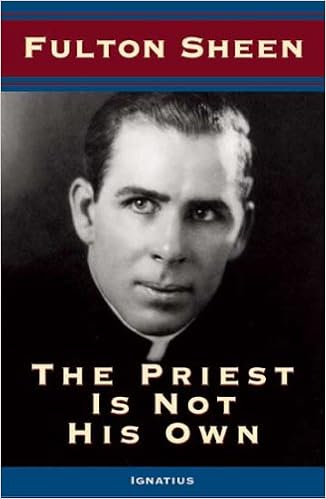
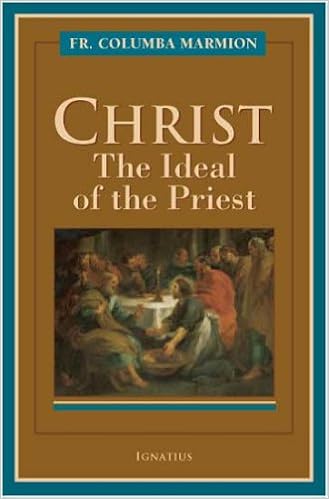
In reference to one of your latest posts, do you have any solid book recommendations for young men discerning priesthood. A lot of the stuff usually recommended is emotionally based and does little in the way of sacerdotal theology.

This is interesting.  I had this same question this morning in the sacristy after Mass!   I can’t tell you what a pleasure it is to receive such a question.

Immediately there comes to mind…

(This book is good for a range of ages.)

US HERE – UK HERE

For someone maybe a little older…

US HERE – UK HERE

US HERE – UK HERE

I would be delighted to receive – FROM PRIESTS – other suggestions.  Please, Fathers, send them in.

The moderation queue is on.

Posted in "How To..." - Practical Notes, ASK FATHER Question Box | Tagged , ,
13 Comments

Veneral Sky Show

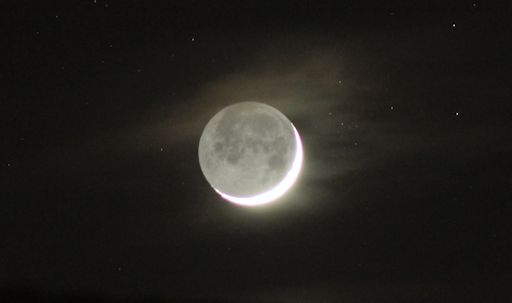
The Moon and Venus are at it again in the early evening sky. They are just a few degrees apart. However, given your Moon’s crescent state, you may be able to see some great Earth Shine.  It is also called “Da Vinci Glow” after the guy who figured out what it was.

See SpaceWeather:


Posted in Just Too Cool, Look! Up in the sky! |
2 Comments

WDTPRS – 2nd Sunday of Advent: LIONS!

“We escape neither the Enemy lion nor the glorious Lion of Judah”!

Our Collect (once called the “Opening Prayer”) for the 2nd Sunday of Advent was not in the pre-Conciliar Missale Romanum but it was in the so-called Rotulus (“scroll”) of Ravenna, dated perhaps as early as the 5th century.

Omnipotens et misericors Deus,
in tui occursum Filii festinantes
nulla opera terreni actus impediant,
sed sapientiae caelestis eruditio
nos faciat eius esse consortes
.

Impedio (built from the word pes, pedis, “foot”), at the core of this prayer, is “to snare or tangle the feet”.   A consors is someone with (con-) whom you share your lot (sors).   The phrase “faciat eius esse consortes” recalls both the Collect for Christmas Day and the priest’s preparation of the chalice during the offertory.  Deus, “God”, is declined irregularly. In solemn discourse the nominative is used as the vocative form (e.g. cf. Livy 1, 24, 7).  Sapientia (“wisdom”) and eruditio (“learning”) are packed, technical terms from ancient rhetoric and philosophy.

BRUTAL LITERAL RENDERING:
Almighty and merciful God,
let no works of worldly impulse impede
those hurrying to the meeting of Your Son,
but rather let the learning of heavenly wisdom
make us to be His co-heirs.

OBSOLETE ICEL (1973):
God of power and mercy,
open our hearts in welcome.
Remove the things that hinder us
from receiving Christ with joy,
so that we may share his wisdom
and become one with him
when he comes in glory,…

NEW CORRECTED ICEL (2011):
Almighty and merciful God,
may no earthly undertaking hinder those
who set out in haste to meet your Son,
but may our learning of heavenly wisdom
gain us admittance to his company.

Last week in our Collect we rushed to meet the Coming Lord while striving for our reward through works made meritorious by Him alone.

During Advent, as the Baptist warns us, we are to make ready the path for the coming of the Lord.  This week we are still rushing but perhaps we are wiser after the first rush of excitement.

This week we are wary of obstacles which could impede us, snare our feet.  These impediments are merely worldly ways and works, not meritorious for salvation since they are not performed in Christ.

Worldly ways entangles us.  St. Paul contrasts the wisdom of this world with the Wisdom of God (cf. 1 Cor 1:20;  3:19; 2 Cor 3:19).  In Romans 12:2 Paul admonishes,

“Do not be conformed to this world but be transformed by the renewal of your mind, that you may prove what is the will of God, what is good and acceptable and perfect.”

This is not just a Pauline concept.  Compare today’s Collect with 2 Peter 1:3-4: “His divine power has granted to us all things that pertain to life and godliness, through the knowledge (cognitio: cf. eruditio) of him who called us to his own glory and excellence, by which he has granted to us his precious and very great promises, that through these you may escape from the corruption that is in the world because of passion, and become partakers of the divine nature (efficiamini divinae consortes).”

St. Augustine of Hippo (+430) dismantled Donatist arguments that all clerics ordained by a sinful bishop would automatically be stained by the same guilt. He used imagery reminiscent of today’s prayer:

“The mire (lutum) their feet are stuck in is so thick and dense that, trying in vain to tear themselves out of it, they get their hands and head stuck in it too, and lingering in that muck they get more tightly enveloped” (c. Don. 25).

The Donatist argument was based on worldly, not heavenly, wisdom.  Sticky lutum is a metaphor for a worldly, sinful life. Augustine contrasts being lutum with being children of God. “Noli esse lutum …Don’t be muck, but become (efficere) a child of God through His mercy!” (diu. qu. 68.3).

If we neglect God, we weak sinners can eventually convince ourselves of anything: down becomes up, back becomes front, black is white, wrong is right, and muddy is clean.  We excuse away our sins.  Once self-justification becomes a habit, it is a vice in more than one sense of that word.  Our consciences may occasionally struggle against the vice of self-deception, but the proverbial “Struggle” supplies permission:

“I really ‘struggled’ with this, … before I did it.”

If we go off the true path into the sticky mire of error, we escape neither the Enemy lion seeking whom he might devour (1 Peter 5:8), nor the glorious Lion of Judah who will open the seals and read the Book of Life (Rev 5:5).

This all, it seems to me, is pertinent to our present debates surrounding Amoris laetitia.

During Advent, let us make straight Christ’s path and watch our step.  Nevertheless, no matter how sticky may be the mess we have gotten ourselves into, Christ’s loving mercy washes its stain away in a good, complete confession before Christmas.

GO TO CONFESSION!
Posted in ADVENT, GO TO CONFESSION, Liturgy Science Theatre 3000, WDTPRS | Tagged , , ,
1 Comment

What marriage is and what it isn’t

I have turned back the clock to June 2016 to find a post at the blog of canonist Ed Peters, who also – to our benefit – comments on these electronic pages.

Peters breaks it down Barney style so that even the most obtuse of libs can follow.

Papal comments on cohabitation and civil marriage suggest a direction
[…]

Let’s be clear: marriage is marriage but cohabitation (as that word is nearly universally understood in social discourse) is only cohabitation. Where to begin?

Everybody starts off single. One stays single unless one goes through a ceremony called a wedding, at which point, one is (presumptively, at least) married. People who are married get to do certain things that people who are not married don’t get to do, like, say, submit a married-filing-jointly tax return with a certain someone and have sex with that same certain someone if they both so choose. In addition, though, married couples who are baptized get something else at their wedding, they receive a sacrament called Matrimony, and with that sacrament come very powerful graces put there by Jesus to help Christian couples living the difficult and wonderful thing called marriage.

But, if one is not married, one does not get to submit a married-filing-jointly tax return with anyone and one does not get to have sex with a certain no-one or with anyone else. Moreover, even if one is baptized (and regardless of what other sacramental or actual graces might be wonderfully at work in one’s life) a single person does not get the specific graces of Matrimony. Why? Because cohabitation is NOT marriage, let alone is it “true marriage”, and cohabiting couples do NOT share in the graces of Matrimony.

[…]

Read the rest of this brilliant entry over there.

Posted in One Man & One Woman | Tagged , , , ,
55 Comments