Michael D. O’Brien’s new book: The Fool of New York City

Speaking of Michael D. O’Brien, I just finished reading his newest offering…

The Fool of New York City

US HERE – UK HERE

This could be a good Christmas gift.

No, you tender lib snowflakes out there.  It’s not about Donald Trump.

It is quite touching.  I don’t like spoilers, so I won’t say much about it.  What I can say is that it is about identity and rediscovery.  There is a wounded soul and an unlikely redemptive figure.  It has all the usual poetry and mystic touches for which O’Brien’s books are known.

Another great thing about this new book: It’s only 280 pages long!  For O’Brien that’s like a haiku.  Many of his books could serve as cornerstones of buildings.  Did he listen to his editor?  Is he experimenting with the genre of (Relatively) Short Story?  Whatever the reason, he moves along at a good pace in this one.

Posted in The Campus Telephone Pole | Tagged
22 Comments

It is as if the Church simply caved in before the world and its Prince.

Around the time of the Second Vatican Council some of our sound practices were simply dropped, as if they were no longer needed.  For example, the Leonine Prayers after Low Mass which included the Prayer to St. Michael the Archangel.

QUAERITUR: Does anyone believe that the Devil stopped attacking in the 60’s?

My recollection of the 60’s suggests that the attacks redoubled and with great effect.

Consider how the reformers of the rite of Baptism, approved by Paul VI, dropped the exorcisms despite the teaching of the Church about the Enemy and  the effects of Original Sin.  Consider how the orations of Holy Mass in the Roman Rite were stripped of their clear references to sin, expiation, propitiation, judgment.

It is as if the Church simply caved in before the world and its Prince.

“But Father! But Father!”, you snivelers yammer from behind your Fishwrap, “The Council was lead by the spirit!  The spirit of the Council!  Everything is so much better now! It’s undeniable.  But yoooooou… you and your … your… GAH!  Vatican II didn’t go nearly FAR ENOUGH!   Küng says so!  But yooooou… you can’t see that because you don’t have the spirit of the Council?  And she doesn’t like you at all!  Why?  WHY?!?  Because YOU HATE VATICAN II!”

I love Vatican II so much that I won’t lie about it.

Today at the ever-more-useful Crisis there is a great piece which urges the return to the use of exorcism prayers and other devotions to fight the evil of the Enemy of our souls.

Here is the front part, but be sure to go there to read the whole thing. My emphases and comments.

A Call to Restore Prayers of Exorcism
R. JARED STAUDT

In 1886, Pope Leo XIII added the Prayer to St. Michael the Archangel to the prayers he had already ordered to be said after the Low Mass in 1884. The origin of the prayer is subject to much speculation, particularly about whether or not Leo received a locution with the voices of Jesus and the devil. Regardless of the exact details of this alleged event, which some deny for being unsubstantiated, there are some historical testimonies to the fact that a mystical experience moved the Pope to compose the prayer and to have it said daily throughout the world.  [I believe the accounts about Leo and the locution.]

On June 29, 1972, Pope Bl. Paul VI, who stopped the recitation of the prayer, seemed to confirm an element’s of Leo’s prophecy, stating in his homily in St. Peter’s Basilica that “from some fissure the smoke of Satan has entered the temple of God.” [One source close to Paul VI thought that by the phrase the Pope mean liturgical abuses.  HERE] This built upon Leo’s sense that the devil would have extraordinary influence in the twentieth century, including within the Church. [Which is clearly the state of affairs now.] Paul continued his reflection on the influence of the devil on November 15 of that same year in a general audience entitled “Deliver Us from Evil,” arguing that “one of the major needs [of the Church] is defense from that evil we call the Devil.” Pope Paul, referencing Ephesians 6:11-12, argued that we need to withstand the evil one with the armor of God.

Was a large part of the smoke of Satan entering the Church our denial of his influence and a laying down of our spiritual arms to confront him? [Was it Pius XII who said that the Devil’s greatest victory was getting us to deny his existence?] For too long we have denied or overlooked the influence of the devil on our lives and the Church. Therefore, we have grown lax in seeking the Lord’s power to overcome his opposition. Praying for this deliverance is central to Christian prayer, as we see even at the end of the Our Father, which has been translated, “deliver us from the evil one.” After being tempted, Christ commanded the devil, “away with you Satan!” and cast out many demons in his ministry. Our Lord took spiritual warfare seriously and recognized our need for deliverance, as he brought “freedom to captives.” He also gave power and authority to his disciples to exorcise: “And these signs will accompany those who believe: by using my name they will cast out demons” (Mk 16:17; see Luke 9:1). This power has been overlooked of late, as belief in the influence of the evil one now appears superstitious to many.

Take the example of exorcism prayer in the Rite of Baptism as part of the liturgical reforms following the Second Vatican Council, promulgated in 1969 by Paul VI. It is fascinating that the Associated Press quoted Bl. Paul as questioning the revised prayer in the audience I referenced above (though these lines have been removed from the official text). The AP article reads: “In his speech. Pope Paul appeared to regret that in the new rite of baptism, which he approved three years ago, less emphasis is given to exorcism. This is the part in which the priest orders Satan to get out of the new Christian. ‘I don’t know whether this is realistic,’ he said of the revised exorcism.” In the audience, Paul recognized both the increased influence on the devil and that the Church had softened her response.  [Paul also seemed to lament the loss of Latin in our liturgical worship even as he allowed it to be expunged.  Incredible.]

[…]

This world has its Prince.

We are in a constant state of spiritual warfare.  The Enemy neither lays down arms nor ceases the attack just because we idiots stop defending ourselves.  How stupid is that, anyway?

For the umpteenth time, no initiative we undertake in the Church will succeed without a revitalization of our sacred liturgical worship.  We must reclaim what has been lost and reintegrate it into our regular practices and daily lives.  We need what was won for us and handed down through the centuries of our forebears’ experience.  We need a wide-spread renewal of the older, traditional Roman Rite.

Fathers!  Use the older Rituale Romanum.  Learn the older, traditional Mass.  Say it often.  Turn those altars back towards the Lord.  Don’t be afraid.  Reinstate devotions such as novenas and Exposition with Benediction.  Bring the Church’s language Latin back into your liturgical lives.  Reclaim your patrimony, your identity.

Posted in ¡Hagan lío!, "But Father! But Father!", Be The Maquis, Hard-Identity Catholicism, Our Catholic Identity, Si vis pacem para bellum!, The Coming Storm, The Drill, Vatican II | Tagged , , , ,
29 Comments

Our Rich Traditions of Ember Wednesday of Advent

Do you remember the little mnemonic poems?  “Lenty, Penty, Crucy, Lucy”, or else

Fasting days and Emberings be
Lent, Whitsun, Holyrood, and Lucie.

The Wednesday, Friday and Saturday after St. Lucy are the Advent Ember Days.

In the old Julian calendar before the Gregorian reform, 13 December was the darkest day of the year.  Hence, St. Lucy, whose name is from the Latin lux… “light”, reminds us who dwell in the still darkening Northern Hemisphere that our days will soon be getting longer again. Lucy is depicted in art with a lantern, or with a crown of candles, or with her own eyes on a platter. Some accounts have Lucy slain by having her throat thrust through with sword.  Other accounts say that, to protect her virginity, she disfigured herself by cutting her own eyes out and sending them to her suitor, a plot which most likely discouraged him.  St. Lucy is therefore the patroness of sight.

St. Lucy shows up in important moments in Dante’s great Divine Comedy.  She is first in the Inferno.  It is Lucy who asks Beatrice to help Dante.  In Purgatory the eagle that bears Dante upward in a dream is actually Lucy who is bearing him to the gate of Purgatory.  Eagles, of course, are “eagle-eyed”.  In the Paradiso she is placed directly across from Adam in the Heaven of the Rose.  Lucy can gaze directly at God.  She was something of a patroness for Dante.  He was devoted to her probably because, as we glean from various works, he may have had a problem not just with his eyes but also struggling with sins of the eyes.

The so-called “Golden Mass”, the Missa Aurea, is celebrated today.  The illuminated missals and sacramentaries of centuries past presented the Gospel, or at least its initial capital letters, in gold, whence our nickname Missa Aurea.  There is a strong Marian overtone to today’s Mass formulary.  The Roman Station today is St. Mary Major.  The Gospel is the Annunciation.  The Gospel pericope begins Missus est angelus Gabriel.  It was once celebrated with a solemnity nearly approaching a feast day.  Thus, Missa Aurea also refers to little dramas in medieval times in which the Annunciation was acted out.  It is thus not just “golden Mass” but “the golden sending“, which refers to the moment in which Our Lord becomes incarnate in the womb of the Virgin.  Missa Aurea is used in the terminology of art history for paintings of the Annunciation, which often contain dramatic elements associated with the tableaux struck in the dramatic presentations of the mystery.  Doves would be lowered and an old man would be placed in a loft wearing an alb and cope.  Angels would be vested in dalmatics.  Giotto’s frescoes in the 13th c. Arena or Scrovegni Chapel in Padua echo this tradition as do many paintings of the Annunciation.

Scrovegni Chapel Giotto Annunciation

And, since today is an Ember Day, we who recite the Office according to the Roman Breviary must during Lauds also say the Weekday Intercessions, which don’t come up on all weekdays.

Weekday Intercessions
Lord, have mercy upon us. Christ, have mercy upon us. Lord, have mercy upon us.
Our Father, who art in heaven, Hallowed be thy name. Thy kingdom come. Thy will be done on earth as it is in heaven. Give us this day our daily bread. And forgive us our trespasses, as we forgive those who trespass against us.
. And lead us not into temptation:
. But deliver us from evil.
. I said: Lord, be merciful unto me:
. Heal my soul, for I have sinned against thee.
. Turn thee again, O Lord; how long will it be?
. And be gracious unto thy servants.
. Let thy mercy, O Lord, be upon us.
. As we have hoped in thee.
. Let thy priests be clothed with justice:
. And may thy saints rejoice.
. Let us pray for our most blessed Pope N.
. The Lord preserve him and give him life, and make him blessed upon the earth: and deliver him not up to the will of his enemies.
. Let us pray for our bishop N.
. May he stand firm and care for us in the strength of the Lord, in the might of thy name.
In Rome, the preceding Versicle and its Response are omitted. Elsewhere, the name of the local Ordinary is inserted at the letter N. If the Holy See or the See of the local Bishop is vacant, the appropriate . and ., either or both as the case may be, is omitted.
. O Lord, save our leaders.
. And mercifully hear us when we call upon thee.
. O Lord, save thy people, and bless thine inheritance:
. Govern them and lift them up for eve.
. Remember thy congregation,
. Which thou hast possessed from the beginning.
. Let peace be in thy strength.
. And abundance in thy towers.
. Let us pray for our benefactors.
. O Lord, for thy name’s sake, deign to reward with eternal life all who do us good. Amen.
. Let us pray for the faithful departed.
. Eternal rest grant unto them, O Lord, and let perpetual light shine upon them.
. May they rest in peace.
. Amen.
. Let us pray for our absent brothers.
. Save thy servants, O God, who put their trust in thee.
. Let us pray for the afflicted and imprisoned.
. Deliver them, God of Israel, from all their tribulations.
. O Lord, send them help from thy sanctuary.
. And defend them out of Sion.
. Turn us again, O Lord, God of Hosts.
. Show us thy face, and we shall be whole.
. Arise, O Christ, and help us.
. And redeem us for thy name’s sake.
. O Lord, hear my praye.
. And let my cry come unto thee.
Prayer {from the Proper of the season}
skip second ‘O Lord, hear my prayer’
Let us pray.
Grant, we beseech thee, Almighty God, that the solemn Feast of our redemption, which is now at hand, may both help us in the life which now is, and further us toward the attaining of thine eternal joy in that which is to come.
Through Jesus Christ, thy Son our Lord, Who liveth and reigneth with thee, in the unity of the Holy Ghost, ever one God, world without end.
. Amen.

Where is all this in the Novus Ordo?

(Trick question.)
Posted in Hard-Identity Catholicism, Liturgy Science Theatre 3000, Saints: Stories & Symbols | Tagged , , , , , ,
14 Comments

Hell’s Bible (aka NY Times) Editor: “We don’t get religion. We don’t get the role of religion in people’s lives.”

Via Ave Maria Radio:

TOP NYT EDITOR CONFESSES: WE DON’T UNDERSTAND RELIGION AT ALL  [Well knock me down with a feather!]

In an interview with WNYC’s “Fresh Air” The New York Times executive editor Dean Baquet admits his newspaper knows nothing about religion or the role it plays in people’s lives.

I want to make sure that we are much more creative about beats out in the country so that we understand that anger and disconnectedness that people feel. And I think I use religion as an example because I was raised Catholic in New Orleans. I think that the New York-based and Washington-based too probably, media powerhouses don’t quite get religion. We have a fabulous religion writer, but she’s all alone. We don’t get religion. We don’t get the role of religion in people’s lives. And I think we can do much, much better. And I think there are things that we can be more creative about to understand the country.

This admission will come as no surprise to anyone who’s ever attended a church service once in his or her life and read basically anything the NYT has published about religion. The newspaper has a long-running history of really bad screw-ups. For example, the newspaper of record apparently thought Christians think Christ’s body is still buried.

Read more at TheFederalist.com…

Posted in Biased Media Coverage, Liberals, The Last Acceptable Prejudice | Tagged ,
22 Comments

ACTION ITEM! NEW PROJECT – SATURNOS FOR CLERICS!

action-item-buttonBy now most of you know about the Biretta for Seminarians Project.
You – seminarians and lay people – contact John Hastreiter in church goods at Leaflet Missal in St. Paul – 651-209-1951 Ext-331.  Seminarians: give name, address, HAT SIZE and John will put you on the list. Lay people or clergy: Contact John and pay for one or more birettas and John takes care of the shipping, etc.

In light of recent events, and in consultation with Mr. Hastreiter, here is a new project for your consideration.

saturno 02

SATURNOS FOR CLERICS PROJECT

The Project will work along the same lines as the Biretta Project.

Clerics (priests and deacons – bishops buy your own!), contact Mr. Hastreiter with your information – check your hat size before you call.

Here is a video about how to measure for your HAT SIZE: HERE.  It is important to double-check especially if you have gained or lost a lot of weight or hair.

“Saturno” is, of course, an Italian nickname for the broad-rimmed Roman clerical hat.  Romans also call the hat a “padella… frying pan”.  Otherwise it is a “cappello Romano”.  “Saturno” is fun and pretty much everyone knows it.

Mr. Hastreiter informs me that there are a couple options for your saturno.  There are different kinds of Roman hats: woven straw for hot weather (they come in white for when you wear your white cassock), felt (like most normal hats, and pressed fur (often rabbit – warmer – rather shiny as in the photo, above).

My initial thought about this is that the Project should be mainly for deacons and priests rather than for seminarians.  I don’t think that seminarians should be excluded.  That said, it could be that getting a saturno and having it around at the sem is NOT going to do you a lot of good… depending on the faculty and what you do with it.  Be prudent, men, and deny yourself some good things for the sake of the greater goal: ordination.  That said, seminarians aren’t excluded.

¡Hagan lío!  Let the New Evangelization Thrive!

PS: We also need a Spanish Biretta and a Jijin For Fr. Z Project.

Posted in ¡Hagan lío!, ACTION ITEM!, Lighter fare, Mail from priests, New Evangelization, Priests and Priesthood, Seminarians and Seminaries | Tagged , , , ,
13 Comments

Liturgical challenge: “If we say, ‘I shall attend this Mass because it will be good for me,’ it will be of no avail.”

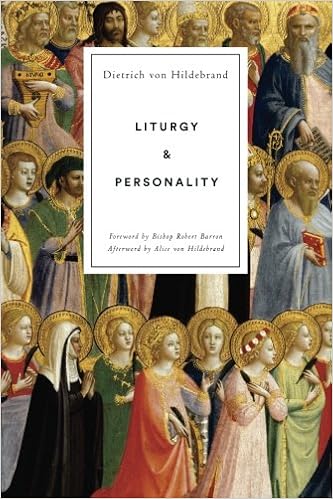
Today at the ever helpful Crisis there is a piece by Anthony Esolen (who is being persecuted by Providence College – HERE) with thoughts on disposition and sacred worship stemming from the thought of Dietrich von Hildebrand in his work Liturgy and Personality, which is out in a new edition.

I warmly recommend both… Esolen and von Hildebrand.

If you have never read anything by Dietrich von Hildebrand… whew… are you in for a treat.  It is a hard treat, mind you.

US HERE – UK HERE

Under immediately discussion is disposition for participation in sacred liturgical worship.  This could be helpful – and a real challenge – for a lot of readers.

Sample:

In other words, the liturgy sweeps us out of ourselves. We do not set about this transformation directly, says Hildebrand. That would be a contradiction. We cannot forget ourselves while assiduously gauging the measure of our spiritual progress. We do not participate in the liturgy for the experience: the ravishment comes “in an entirely gratuitous manner.” The proper attitude of the man being transformed by the liturgy “is like that of love which is entirely directed towards its object, a love which in its very essence is a pure response-to-value, which comes into existence only as a response to the value of the beloved.” Had Dante said, “I think I shall fall in love with this girl Beatrice, because she will enable me to write great poetry,” he would have been but one of the great crowd of poetic poseurs, and could never have written his Commedia. Hildebrand insists upon the necessity of love. If we say, “I shall attend this Mass because it will be good for me,” it will be of no avail. It would be like trying to win the love of a woman by gazing into a mirror.

I am determined now to reread Liturgy and Personality.

Mind you, the title of this blog post is meant to provoke.  There are many levels of benefits that flow from different levels of participation on our sacred liturgical worship.  Should we be satisfied with the lesser, when the greater is possible?

Hence, there is also a great challenge on the table for PRIESTS AND BISHOPS.  Consider ars celebrandi and the knock on effect it MUST have for the congregation.  Consider the rite itself!   What choices about liturgical worship are going to foster the greater rather than the mere lowest common denominator?  The easy path.  The utilitarian.

Fathers… read and ponder.  It’s on us.

Posted in "How To..." - Practical Notes, Hard-Identity Catholicism, Liturgy Science Theatre 3000 | Tagged , ,
12 Comments

ASK FATHER: Baptizing with the name “Lucifer”.

UPDATE:  Reading comments, I was suddenly minded of the moment in Michael O’Brien’s book Voyage to Alpha Centauri (UK LINK HERE) when the dupes perform the Satanic dance.

Have you read it?

infant baptism

“You named me WHAT?!?”

From a priest…

QUAERITUR:

I recently encountered a situation in ministry that previously was the stuff of theory or anecdote only.

A parent has given his still unbaptized toddler the middle name “Lucifer.” The parent claims that even though Lucifer fell, he was still “God’s favorite” angel and that the name was chosen for that and no sinister occult reason. Based on a previous priest’s alleged refusal to approve the child’s baptism the parent had the impression he must legally change the middle name in order to baptize (something he is not willing to do). I told the parent that I would consider baptism but (a) I would not baptize using the name Lucifer; (b) that he would need to choose a saint’s name in place of Lucifer; and (c) I can only strongly encourage him to cease using the middle name with the child if he is seriously making a decision for Christ and Christ’s reign on behalf of his child.

A further testament to the poverty of modern catechesis and, more importantly, modern Catholic culture! Can anyone imagine our great-grandparents reaction to  a name so deeply associated with Satan?

Lucifer means, simply and plainly, the bearer of light. Today, the Church celebrates the martyrdom of the great St. Lucy, Lúcia in Latin, and the root of her name is the Latin lux, lucis, “light”.  There’s nothing wrong with that.  In some ancient texts, Christ Himself is referred to as “lucifer… bringer of light”, that is, the one who brings us the illumination which is truth and wisdom, guiding us to the way to eternal life.  There is a hymn of St. Hilary, Lucis largitor splendide, which calls Christ, “tu verus mundi lucifer,” and St. Ambrose’s Aeterne rerum conditor speaks of the morning start as “lucifer“.

There was even a St. Lucifer, bishop of Cagliari, during the Arian controversies.  The founding bishop of Siena was also named Lucifer.

Of course the most prominent contemporary use of lucifer describes the paschal candle, and by analogy Christ, during the Easter Proclamation, in the Latin Exsultet.

Yet, by the time of Dante, Lucifer had begun to be understood as a sort of proper name for Satan, because of his former status as a light-bearing angel.

If someone were to ask to have a child named Lucifer because of a strong devotion to St. Lucifer of Cagliari, or out of interest in the Lord Jesus Christ’s status as the Morning Star who never sets, a prudent pastor would gently urge an alteration of the name, because of the sensibilities of the community and the common association of that name with evil.

Here, however, we have something even worse. The parents know that Lucifer is generally seen as a name of the devil, and they still want to give it to their son.

Let us not have any misplaced sentimentality towards the Evil One.  His pride and unchangeable decision to reject God eternally taints his person and reputation to a degree that all good Christians should shudder in horror at the mention of his name.

Can. 855 of the Code of Canon Law requires that a baptismal name be chosen not be “foreign to Christian sentiment.”

Life is not, thanks be to God, a Rolling Stones song.  Having sympathy for the devil is foreign to Christian sentiment.  Hence, to choose a name out in that sympathy is likewise foreign to Christian sentiment.  It is prudent, reasonable and smart in our present cultural context – especially since we are not in either Cagliari or Siena of yesteryear – to decline to use the name “Lucifer” for a child’s baptism.

And, take note, the Extraordinary Form rite of baptism retains all those powerful exorcisms precisely to unchain the domination of the very enemy under discussion.  That’s even smarter.

Posted in "How To..." - Practical Notes, ASK FATHER Question Box, Our Catholic Identity | Tagged ,
28 Comments

ASK FATHER: Rose vestment on weekdays after Gaudete Sunday?

IMG_8372From a reader…

QUAERITUR:

Can rose Vestments be worn on the Féria days of the 3rd week of Advent in both Extraordinary Form and Novus Ordo?

I haven’t seen an indication of that for the Novus Ordo in the Novus Ordo Ordo.

For the Extraordinary Form, the Usus Antiquior, I direct your attention to the Ordo put out by the great men at St. John Cantius in Chicago.

During the weekdays following Gaudete we find Lucy (red) and Ember Days (violet).  However, on Monday (which has the option of O.L. of Guadalupe) and Thursday (Advent Feria) I see an indication for rose or violet, rose listed first.

So, this Ordo says “yes”.  Angelus Press didn’t send me one this year.

As far as the Novus Ordo is concerned, perhaps the principle of “mutual enrichment” might apply.  Also, given that rubrics were always considered withing the realm of moral theology, there is also the new interpretive principle developing in an ongoing walking together of mercy these days: struggle with it for a while and then just go ahead and do it.


Posted in ¡Hagan lío!, "How To..." - Practical Notes, ASK FATHER Question Box, Liturgy Science Theatre 3000 | Tagged , ,
6 Comments

What are your Advent and Christmas customs?

First, I’ll remind you, please, when shopping via Amazon, use my search box on the sidebar.  I’ll get a small percentage of each item you get.  I have no way of seeing who buys what, by the way.  Get your shopping done now so you don’t have to fret as Christmas draws nearer.  Keep those last spiritually and liturgically heavy days unburdened by that stuff.

However, there are other things to prepare as well.   Do you have certain personal or family customs for Christmas time?

Perhaps you readers could use this entry to share some ideas about how to make Advent and Christmas a fruitful time for yourselves and families.

Do you have an Advent calendar?

Are there any other things you do, or don’t do, for Advent?  Remember, it is a time of penance, too.

Do you listen to Christmas music before Christmas or wait until after?

When do you put up your tree and when do you decorate it?

Do you eat fish on Christmas Eve?  Pork hocks and lentils after Christmas?  Goose?

Do you bake cookies?

Do you have stockings at the mantle or a creche?

Does the youngest child put the star or angel on the tree?

What happens in your parishes?  Are there food and clothing and toy drives?

Maybe some discussion here can help other people think, in advance, about Christmas, which is fast approaching.

I’m just askin’.


Posted in I'm just askin'..., Our Catholic Identity | Tagged ,
50 Comments

ASK FATHER: Holy ICE! Holy Water freezing in the stoop.

IMG_0422From a reader…

QUAERITUR:

I have included some pictures as a visual aid for my question.

Today I went to confession at a church well over 100 years old. As such, the entrance ways are quite cold in the winter, especially right now since we’re in an Arctic Polar Vortex. As you can see below, the holy water in the stoup is a holy Popsicle. I had some blessed salt in my purse so I added a few granules to melt a small amount to bless myself with (also pictured below). It worked quite well.

This is not an uncommon problem. We had a funeral when the temperatures were reaching the -40°C mark (without the wind chill) and the holy water kept freezing outside.

This got me thinking; what are the requirements for holy water? Since salt naturally helps to prevent (or at least slow down) the freezing of water, and since exercised salt is already added to holy water that’s made according to the Roman Ritual, is there anything that prohibits adding a substantial amount of exorcised salt to holy water or using salt water to prevent freezing?

Interesting question.

I only have ever use and only will ever use the older, traditional blessing for Holy Water in the Rituale Romanum. Period.

In the traditional blessing, salt is exorcised and blessed. After the water is also given the same treatment, the salt is added to the water with the invocation of the Trinity in a three-fold pouring in crosses.

There is no specified amount for the salt.

There have been times when I have added quite a bit of salt to retard any algae growth if I knew it was going to sit for a while or be stored. There have been times that I have had to clean a salty crust from stoops, left as the water evaporated. No harm no foul.

Perhaps you might suggest to Father to use the older rite and add quite a bit of salt.

Holy water brings actual graces to those who are disposed to receive them.

There can be both spiritual and corporal effects from the use of Holy Water.  Use of Holy Water in making the sign of the Cross effects the forgiveness of venial sins.  One should use it consciously, perhaps also saying an act of contrition.  Holy Water helps us resist temptations that can come from the Devil, the Enemy of the soul.  Demons hate Holy Water.  The blessing of Holy Water refers to how it puts devils to flight.  Holy Water can aid our intellect and will.

We use Holy Water in the Asperges and Vidi Aquam at Mass.  We use it in blessing objects. We use it at funerals.  We use it, in fact, all the time… or we should.

There are various kinds of waters which we bless and use as Catholics.   Today I was chatting with a priest about my coming on the Vigil of Epiphay to bless a large quantity of “Epiphany Water” which will then be distributed to the large men’s group which will be in attendance.

Let’s use these spiritual aids.  It is so easy to incorporate their use in our daily lives.  Why not?


Posted in "How To..." - Practical Notes, ASK FATHER Question Box | Tagged
14 Comments