CQ CQ CQ #HamRadio Monday: kicking myself

I could kick myself.

I am heading to La Crosse today for the annual Speculum Iustitiae canon law conference.  I might have thought to get my act together ahead of time so that I could operate from there.  I’ve gotta get out and do it.

Which gives me an idea.  Perhaps a special call sign and an event could be in order.  If there are a few Catholic hams in the area, we could do something and coordinate with the Shrine.   Perhaps a Marian feast or one of Card. Burke’s anniversaries.  I’ll talk to “the guy” there when I see him tomorrow.

Thoughts?

The Shrine is in a splendid location on a hill, though there is a higher slope behind it (to the south, I believe).

In any event, I will haul my little bag of DMR gear with me and, during a break, see if anyone is on ZedNet.  Also, I’ll bring my laptop and try some remote operation if I can get wifi or I manage to tether my phone (the coverage up there is really spotty).  Keep an eye on the blog.

More on ZedNet HERE.   But quickly… ZedNet is Brandmeister DMR worldwide talkgroup 31429.  It was developed by a highly skilled ham who is a longtime reader here, WB0YLE.   It was intended to get ham-readers here talking to each other.

WB0YLE gave me a Bill of Materials (everything you need to get involved).

HERE

Of course, you also need a license and you need to obtain a number from Brandmeister, which is easy. For you who are into this digital stuff, ZedNet still exists on the Yaesu System Fusion (Wires-X) “room” 28598, which is cross-linked to Brandmeister (BM) DMR worldwide talkgroup 31429.  This gives world-wide multi-mode access to a common ham radio network.

Finally, I had a note from a ham reader in Eastern Kansas who is looking for an Elmer to help him out.  I don’t want to put his name and email in a post.  If there is someone in Eastern Kansas who could reach out to me, I’ll try to connect you.

UPDATE:

Before I forget, the latest QST has an article on the sort of hotspot I use for Zednet.  There is also a spiffy piece about ham-monks on Mount Athos!  Apparently, it’s a hot call sign.  Recently SV2ASP passed away but there is still a ham-monk up there trying to get a good shack going.

Speaking of going up a hill and operating at a religious site….


Posted in Ham Radio | Tagged , ,
7 Comments

Your Good News

Do you have good news to share with the readership? Let us know.

For my part, I will today drive to La Crosse, WI for the annual canon law conference organized under the aegis of Card. Burke and held at the beautiful Shrine of Our Lady of Guadalupe. I look forward to this every year.

Speaking of Our Lady, in connected good news, on this the feast of of the Dedication of the Basilica of St. Mary Major, Bp. Hying’s brief daily video touches on that Roman Basilica and on Mary. Check it out.

YouTube thumbnailYouTube icon

Posted in SESSIUNCULA |
12 Comments

Your Sunday Sermon Notes and ASK FATHER: sermons and birettas

Was there a good point made in the sermon during your Mass of Sunday obligation?

Let us know.

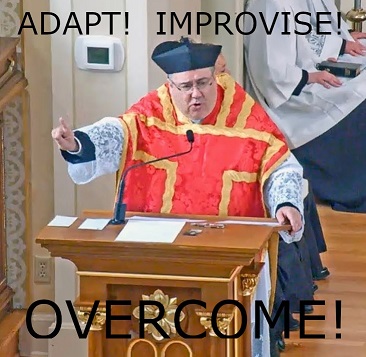
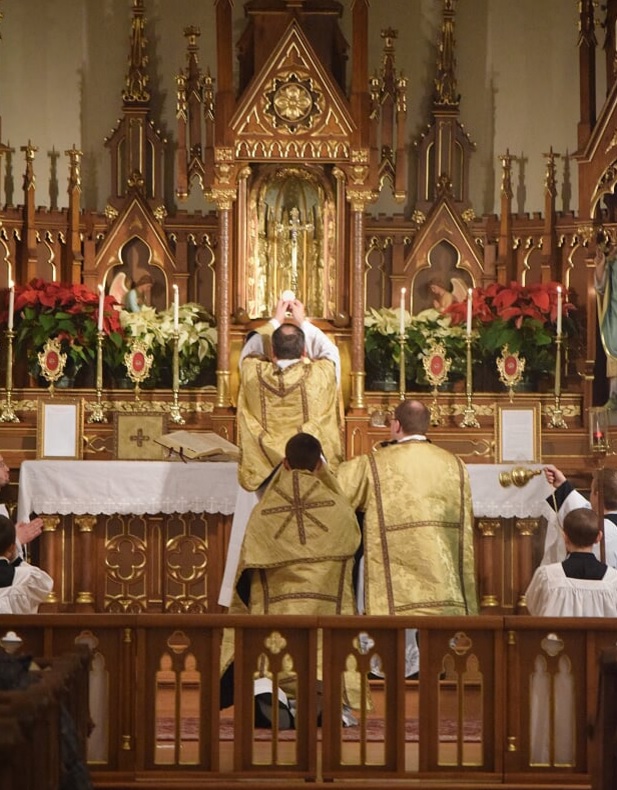
Today I had the pleasure of being deacon for this morning’s Solemn Mass.  One of the local priests had, at the last moment, the services of a mission priest, so he asked to be able to offer the Traditional Mass.  Hence, Solemn Mass and I am preaching in my diaconal dalmatic.   It seems I left my maniple on.  Do we have to do the whole thing over again?

Before the sermon, I mentioned to our visitor, that the last time I preached in a dalmatic was during a Pontifical Mass with the Extraordinary Ordinary. During that Mass, Bp. Morlino felt his voice going and, to save it, asked me to preach when we got to the moment.  Surprise!  I mentioned to Father Visitor today not to let this got his head.

So, today, I have a few points about the Lord’s highly curious parable of the wicked servant who defrauded his master and then figured out how to save his backside once he was found out.  It seems as if Christ is holding up lying, fraud and leading others into sin.  It could be that sometime else is going on.

BTW… one of you readers wrote a couple weeks back to ask me if priests must wear the biretta to preach.

Here’s the deal.  If the MC brings me the biretta when I come down the steps, I put it on.  If he doesn’t, I just go preach all the same.

Liturgical manualists seem to be consistently in favor of the biretta being worn by the preacher, whether it is the celebrant or another.  Trimeloni gave a footnote to a decree, but I didn’t dig it up. Of course if the Blessed Sacrament is exposed, no head covering!   Quod Deus avertat.  Proper birettaquette should be observed (NB: Distinguish from berettaquette, please).

So, the weight is heavy on the side of wearing the biretta.

The rubrics for the biretta for the sacred ministers prescribe that they wear it processing in and out (hence, outside of Mass) and when seated at the sedilia (hence, when they’ve stepped out of the action, as it were).  This is also why the maniple and even chasuble are both removed in some places before sermons and the biretta is worn.

Auctores scinduntur … commentators are divided on the removal of the chasuble.   Some are really against it.   It seems to me that environmental circumstances as well as the needs of the preacher should matter a great deal.

So, the weight is more against than for, but I think flexibility is prudent, for reasons that should be obvious: a) how hot it is and b) how long does Father plan to carry on?

Another point is that a biretta on a cleric is also a symbol of his teaching office, as a professor’s cap would be.  They developed from the same origin.  Yes, the sermon has a strong didactic dimension, but that’s not its only dimension.    Some say that the biretta is a symbol of authority, especially worn by the pastor because he has authority in the parish.  Okay.  Others recognize that it is also just a hat customarily worn by priests.  Thus, in Italy priests use “er tripizzi” – there’s a good Roman word – the biretta when going about while wearing the cassock.  They might also wear the flat Roman clerical hat, or saturno or even padella.  It’s better in the rain and hot sun.

Moreover, I’ve been using a biretta without the pom, as one does in Rome, and in the Neri style, from my devotion to that great saint.  I have more common gizmo, too, collapsible.  I use that when travelling.

One of the things we must establish for the Ritus Madisonensis™ (aka How We Solve Issues Here – for example, in Pontifical Masses the MC takes the book to the altar instead of the AP) is whether the non-celebrant preacher should ask a blessing.  Rubrics require this in the presence of a bishop, but not in his absence.  However, custom in this matter can prevail.

It’s a good thing.  I have been in places where it is done.  Why not maintain decorum?  Yes, I think that’s what we shall do.

Posted in "How To..." - Practical Notes, ASK FATHER Question Box, Liturgy Science Theatre 3000 | Tagged , , ,
11 Comments

St. John Vianney’s things

The Novus Ordo calendar has St. John Vianney – confessor, the other kind of confessor too, draft dodger, Legion of Honor recipient, patron of priests, for the Feast today, 4 August.  In the traditional calendar, he is celebrated on 8 August.   This is one of those movings of saints’ days that I don’t fret about much.  Originally St. John was observed on 9 August and John XXIII moved him to 8 August and Paul VI moved him to his death date or “birthday” into heaven, dies natalis, 4 August.

Over the years, thanks to a friend, I’ve been able to celebrate, even solemnly, using objects owned by St. John Vianney.  For example, an amice…

20111005-100832.jpg

20111005-100910.jpg

And a ciborium.

17_08_20_KC_MO_06


Posted in Saints: Stories & Symbols | Tagged
9 Comments

Letter of Francis to priests

Today, Sunday 4 August, in the Novus Ordo calendar Feast of St. John Vianney, Patron of Priests, a Letter of Francis to priests was released. Perhaps it was released in anticipation of the Feast of St. John Vianney celebrated on 8 August in the traditional Roman calendar?

The Letter addresses some aspects of The Present Crisis™.

HERE

Posted in Francis, Mail from priests, Priests and Priesthood, The Coming Storm | Tagged , ,
15 Comments

ASK FATHER: Priests who bless with their fingers in the Greek icon “ICXC” style

From priest…

QUAERITUR:

At the moment I’m at a presbyteral retreat. When you get a bunch of priests together, you’re bound to see the whole range of liturgical “sensibilities,” leaving aside entirely the dinner table conversation… [For sure.  I look forward… no… I anticipate most gatherings of priests with a measure of dread.  An exception would now be that great retreat/conference held by the St. Paul Center, which I just attended.]

Anyhow, when they give blessings, I notice that some priests attempt to contort their hand in the form of the Greek “ICXC,” or at least the form seen in many icons, where the first and middle finger are straight up, and the rest of the fingers down (and not to mention the “bear paw,” the “eagle claw,” etc.)  [Good descriptors.]

It’s my understanding that the way for Latin Rite priests to bless is with all 5 fingers straight up, and the palm turned to port. I remember even reading a dubium, or a rubric, or something something saying as much, but my search hasn’t returned anything.

What do you think?

I think that priests of the Latin Church should behave like priests of the Latin Church.  Let the West be Western and the East be Eastern.  We have our ways of doing things which are entirely proper and good.

And worse than the Greek icon thing is the palm turned outward sweep, and also the “claw” as you say, which look less like a liturgical gesture and more like the rubbing of a steamed up mirror in which the self-admiring priest can see himself being profound and simply wonderful.

In the matter of the actualization of hands for blessings, let us turn to old manuals of liturgy, books of ceremonies.  We are, after all, delighted to be Unreconstructed Ossified Manualists in doctrine and liturgy is doctrine in its most sublime manifestation, whence and back to flow all good things.  These old tomes are consistent about hands.

Isn’t it interesting that the books have paragraphs on what to do with your hands?  The Roman liturgy congregation even specified these things.  How wise is Holy Mother Church!  After all, our hands are one of our most important means of interpersonal communication.  We have happy gestures and angry gestures, some famous and pretty much universal across borders and centuries.  And don’t get me started about Italians.  One thing we note, however, is that when people don’t know what to do, their hands reveal their lack of ease.  This is especially the case with children.  And since priests who are liturgically ignorant are as childish (or womanish) as men can be, the Church told us exactly what to do with our hands.

So, here’s how Latin, the Roman priest blesses, making the sign of the Cross on himself or over others or over objects, liturgically, which is never wrong.

Caveat: Don’t be robotic.

First, the little crosses at the Gospel.  Nearly everyone gets this wrong.  The priest or deacon’s palm of the left hand is put upon the book, straight fingers and thumb pressed together.  With the right hand, straight fingers pressed together and thumb extended out at an angle but on the same plane as the fingers, he makes a small cross in two distinct strokes, lifting the hand for each, with the end or near end of his thumb at the beginning of the Gospel text.  The whole arm with hand moves, not just the thumb, making twitchy jerks. Then, he puts his left palm, still with thumb and fingers together on his chest, and, with his right hand, still straight and with thumb out a little, he traces small crosses on his forehead, lips, and breast below his left hand.  The downward stroke is first and, lifting up and resetting, the transverse follows from left to right.  The whole arm with hand moves, not just the thumb, making twitchy jerks.  The motions should be distinct and not wavy.  Mutatis mutandis this is also for the altar at, for example, at the Last Gospel.  Bottom line: open hand, not balled-fist.

Next, blessings over people, objects, places.  The dimensions of the Sign of the Cross is proportioned to the size of the object.  For example, blessing the oblata on the altar: just stick to the oblata on the altar, not a foot on either side of the corporal.  For a rosary, you don’t have to throw your shoulder out of joint.  For places and people, the Sign would be larger, much as the same size as when the priest makes the Sign upon himself.

Sticking to liturgy, and this is always right for blessing people outside of a liturgical setting, again, unless the left hand is instructed to be on the altar, etc., the left goes upon the chest.  The right hand, with straight fingers and thumb pressed together and pointing heavenward, is held with little finger toward whomever is to receive the blessing. NOT PALM OUT.   He traces the Sign of the Cross with distinct strokes.  Did I mention, NOT PALM OUT?  Raising his hand, as described, to about the height of his own forehead, as if crossing himself, he begins the downward stroke, again to the point where he would sign himself, while saying, “Pater et Filius or Patris et Filii“. At the nadir he might pause almost imperceptibly to make the stroke more distinct.  Then he raises his hand back up on the same vector as the downward stroke to the point where he will make the transverse stroke.  Moving his hand – parallel to the floor or footpace – towards his own left to about the point where he would sign himself he again pauses almost imperceptibly.  From thence he moves arm and hand, fingers always pointing up and little finger always toward the people, all the way to the right in a straight line to to where he would make the Sign on his own right shoulder while saying, “et Spiritus Sanctus or Spiritus Sancti“.  After that imperceptible pause, he then should put his hands together, palms together, before his chest and go on to the next privileged task of his priesthood.

Blessing with an object like a relic or a monstrance would be different, of course.  Giving blessings when you are Pope would be different, too.

One might object that we see Popes and saints depicted or in photos with hands raised in blessing with their two small fingers tucked down, not quite like the Greek icon thing, but probably symbolizing the three Persons and two Natures.

Sure.  Why not.  Keep in mind that Popes traditionally bless a little differently.

Who am I to judge?

YouTube thumbnailYouTube icon

There’s a little more to this, by the way.

There is a theory that Peter himself gave the blessing this way, so that’s why Popes and others do it now.  For example, legend has it that the Spanish of Castile has a coronal fricative, an lisped “s”, perhaps because a king had a lisp and the court then took it on also. It’s probably not true, se non è vero, è ben trovato as the rather charred Giordano might have said without receiving the papal blessing.  That said, there is a theory that the papal blessing developed because Peter had – I’m not making this up, this is really someone’s theory – Peter had ulnar or median nerve (running shoulder to pinky) damage which caused his two small fingers to curl in. Evidence for this is supposedly in a fresco in the Catacombs of Domatilla.  Peter is depicted with shorter ring and pinky fingers.  The idea is that Peter would never willingly have blessed with a hand like a claw or fist, but rather with a more peaceful open hand.  The Bishop of Rome has been imitating Peter’s never damage ever since.  Buy it?  We could also get into the difficulties of making the Vulcan greeting sign, but that might get us off track.  Meanwhile, the two tucked fingers from that nerve damage really is described  in old medical books as “Pope’s Hand” or some such.  That’s when people knew something, even when they weren’t Catholic.

As for blessing with the Greek icon fingers, no. Just, no.

Alas, with the systematic demolition of Catholic identity in the Latin Church over the last few decades, some (priests) have gotten it into their heads that to recover reverence we have to import Eastern art, architecture, music, etc.  NO.  Make it STOP!  We have our own heritage.  In some cases we assimilated some elements from the East (as in Venice, etc.), but organically and harmoniously.

We need our Western patrimony returned in its full splendor.  In that way we can appreciate the Eastern even more.

Another with Pius – who turns out smiled years before Francis was elected.  Lots of pictures with Pius with fingers bent, or slightly bent even with straight hand.  Damage?

YouTube thumbnailYouTube icon

St John Paul II of happy memory, straight handed.

YouTube thumbnailYouTube icon

But then there’s this official portrait.

Benedict at his last audience… sigh.

YouTube thumbnailYouTube icon

Sometimes, you play things fast and loose, as when Benedict once forgot to give the blessing and, laughing, came back to the window!  Still new at the Pope thing.

YouTube thumbnailYouTube icon

Don’t any of YOU priests put your hand on the lectern!  Unless you are the Pope.

We could multiply examples of variations of blessings of people by Popes in photos and films.  Cui bono?

But, liturgically, learn the RIGHT ROMAN WAY FOR PRIESTS and stick to it. And, as my old pastor used to say, “When you’re right, you can’t be wrong.”

Bl. Pius IX adds:

“The Book of Blessings… just say NO!”

Heh.

Posted in "How To..." - Practical Notes, ASK FATHER Question Box, Liturgy Science Theatre 3000 | Tagged
10 Comments

JUST TOO COOL: Ancient Roman Tchotchke

This is so amazingly cool that I have to share it.  A friend alerted me to this story.  I would very much like to see this exhibit at the Ashmolean.  Perhaps Fr. H might take it in and discuss it with Pope B14.

From MOLA:

‘I went to Rome and all I got you was this stylus!’ Rare inscribed Roman writing implement discovered beneath Bloomberg’s European HQ goes on display
A unique Roman stylus, with the most elaborate and expressive inscription of its kind is set to go on display for the first time in a new exhibition at the Ashmolean: Last Supper in Pompeii.
It was discovered by MOLA archaeologists during excavations for financial technology and information company Bloomberg’s European headquarters in London, on the bank of the river Walbrook – a now lost tributary of the Thames. The iron stylus – used to write on wax-filled wooden writing tablets – dates to around AD 70, just a few decades after Roman London was founded. [When the Temple in Jerusalem was destroyed.]
The Bloomberg dig uncovered more than 14,000 artefacts revealing what life was like for the first Londoners, including the first written reference to the name of the city. 600 of the finds are now on display at London Mithraeum Bloomberg SPACE.
Of over 200 styluses recovered from the site, only one was found to have an inscription. Inscribed styluses are exceptionally rare: archaeologists have found only a handful of examples from across the whole Roman Empire to date, and the Bloomberg inscription is the finest, unparalleled in the length, poetry and humour of its inscription.

A unique inscribed Roman stylus uncovered by MOLA archaeologists during excavations for Bloomberg's European headquarters in London. The inscription has been highlighted in yellow (c) MOLA
The inscription has been painstakingly examined and translated by classicist and epigrapher Dr Roger Tomlin. It reads:
‘ab urbe v[e]n[i] munus tibi gratum adf(e)ro
acul[eat]um ut habe[a]s memor[ia]m nostra(m)
rogo si fortuna dar[e]t quo possem
largius ut longa via ceu sacculus est (v)acuus’

‘I have come from the City. I bring you a welcome gift
with a sharp point that you may remember me.
I ask, if fortune allowed, that I might be able (to give)
as generously as the way is long (and) as my purse is empty.’

In other words: the stylus is a gift to remind the recipient of its sender; the sender acknowledges that it is a cheap gift and wishes that they could have given more. Its tongue-in-cheek sentiment is reminiscent of the kinds of novelty souvenirs we still give today. It is the Roman equivalent of ‘I went to Rome and all I got you was this pen’, providing a touching personal insight into the humour of someone who lived nearly 2000 years ago.
The letters of the inscription are tiny and exceptionally difficult to read, and their survival reflects both the excellent preservation of the Roman artefacts from Bloomberg and the careful work of MOLA’s conservators. It is possible that similar inscriptions on other Roman styluses have simply not survived or been identified.
The inscription even contains spelling errors from which it is possible to get a sense of the scribe’s train of thought. The final –m in nostram, for instance, has been missed off where they appear to have run out of space. [Or… perhaps the final vowel was nasalized and pronounced with lip rounding rather than a bilabial stop? That’s weak, since other final m’s appear.]
As ‘the City’ referred to is very likely Rome, the stylus suggests a direct link between Roman Italy and the province of Britannia. At this time Londinium lay near the edge of the Empire but, far from a being a provincial backwater, it had grown into an important centre for commerce and governance, interconnected with the wider Roman world. The stylus and its inscription highlights the crucial role that writing and literacy played in allowing traders, soldiers and officials to keep in contact with peers, friends and family, some of whom lived over a thousand miles away.

It is easy to lose track of the fact that people in those times had much the same concerns and habits that we have. Also, though their tech was lower than ours, they did have an amazing postal system. When Christianity was finally legitimized by law, bishops so taxed the system with their missives that it put a serious strain on the imperial postal system.

A lesson to learn is that leaders of the Church today should make better use of the tech that we have to communicate the messages they want to get out. I had a post on this issue the other day. HERE

And speaking of Pompeii…. this is amazing and a bit horrifying…

YouTube thumbnailYouTube icon

Posted in Just Too Cool | Tagged , , ,
3 Comments

What does @JamesMartinSJ say about the “gay” desecration of the Montréal church? – UPDATED

UPDATE 3 August 2019:

Still nothing from James Martin on this.  We know he has seen it by now.

Is this important?

Someone sent me a link to an article at the detestable New Ways Ministry about the event. The creators of the event described what they were up t.  You need a strong stomach.

“Its a queer love story produced by Matthew Richardson–and the church leaders were happy to host it.”

“They welcomed me, my message, and our creation with open arms,” said Richardson,the show’s creator and a former Cirque Du Soleil performer. Hallelujah is one of five dances he will direct as part of his CircusQueer Project. The video is deeply intimate in a deeply Catholic setting. In a review by the San Diego Gay and Lesbian News (SDGLN), dancers Guillaume Paquin and Arthur Morel Van Hyfte are described as “only [the] heart” of the video, while, “the church [is] its body, taking on perhaps the most important role in the video: an example of inclusivity through servanthood.” The entire 5 minutes and 33 seconds performance can be seen at the end of this post.”

Yes.  This is important.  It truly was a desecration.

___ Originally published 2 August 2019

This is upsetting.  It is better that some of you do not click on the link.  No, really!  I won’t post images.

I want to know what Jesuit Fr. James Martin has to say about this.

The issue, reported with video at Gloria.TV.  (WARNING)

Homosexual Orgasm Celebrated in Montreal Church (Video)

Two homosexuals performed an erotic dance inside Saint Peter Apostle in Montreal on May 1, 2019, for a film shoot.

It used Jeff Buckley’s sexualized adaptation of the song Hallelujah by Leonard Cohen.

Buckley explained to the Dutch magazine OOR: “The hallelujah is not a homage to a worshipped person, idol or god, but the hallelujah of the orgasm.”

This took place in a church of the Archd. of Montréal, under the aegis of Archbp. Christian Lépine. It seems that this is the at least tacitly approved “gay” parish run by the Oblates of Mary Immaculate (O.M.I.) HERE

Hence, it is exactly the sort of place that the Jesuit homosexualist Martin promotes.  Consider that he has publicly stated that “gays” (I hate that word) should freely kiss in churches.  This desecration in Montréal is on the logical trajectory of such statements.

Fr Martin should make a public statement about what happened in that church.

For my part, I consider it a desecration of that church and the celebration of something demonic. That church needs to be ritually purified.

Fr. Martin… what say you?

It may be that he already has said something about this.  Perhaps you readers know.  It that is the case, please let us know.

Comment moderation is ON.

UPDATE

As I read this disgusting account, my memory made a strong connection to a scene in the most recent book by Michael O’Brien: Voyage To Alpha Centuari.

US HERE – UK HERE

As I have written before, I suspect that O’Brien is a bit of a mystic.  His books have been useful to me in deciphering the signs of the times.

In the book, on the new planet they find a temple in which they find also documents about the satanic rites celebrated there.  Some of the travelers decide to reenact them.  O’Brien’s description is lurid.

Day 369: Green Day again. A year has passed since the previous exercise in elevating our cosmic sensitivities, or “interplanetary bio-consciousness” as it is called officially. There are few people onboard the Kosmos at present, so the green banners, scarves, and neckties were scarce here. Down on the planet, however, festivities were in full swing. On the panorama screen, I watched a few celebrations at various stations, dominated by an incompatible mixture of ecological cant and jargon and an any-excuse-for-a-party attitude, seasoned with mystical music. One particularly nauseating performance occurred in the temple itself. There, accompanied by the piped-in music of flutes and drums, a bevy of maidens danced around the black altar cube. They were dressed in diaphanous green gowns that left nothing to the imagination. Somewhat frenzied, nearly erotic, and definitely euphoric, the ten young women twirled and pranced and sang in praise of a cosmic “lord” who held fire in one hand and arrows in the other. Their choreography resembled a coil, winding and unwinding hypnotically as they chanted. At the head of the dance, leading it all, was the old Russian psychiatrist lady who had been so offended by me looking at her scar years ago. She was now without doubt far into her eighties, which was unfortunate, since her gown was the flimsiest of all, nearly transparent. With flailing arms, she repeatedly let fly full-throated cries rising from her arching abdomen, a crone-nymph on hallucinogens. As the event progressed, a soft, male voice-over informed the viewers of our need to reconnect to primitive “spirituality”, which entailed, apparently, a “rediscovery of the phallic” (thankfully not acted upon, at least not on screen, as far as I know, which isn’t saying much) and a “reintegration of light side and shadow side” for the sake of universal harmony. (Ay, caramba! I turned it off and went for a long walk.)

O’Brien, Michael D.. Voyage to Alpha Centauri: A Novel (Kindle Locations 8050-8065). . Kindle Edition.

The downfall of Numenor also comes to mind.  I just reread The Silmarillion with its tale of how Sauron, disguised in fair form, falsely humbled himself and ingratiated himself in the counsels of the kings to the point that he instituted worship of Morgoth/Melkor involving human sacrifice of those who resisted.

The fruit of the Forbidden Tree, the Golden Calf, queer dances, earth worship.  It’s all the same.

Posted in Jesuits, Sin That Cries To Heaven, The Coming Storm | Tagged , , , ,
24 Comments

Fishwrap’s latest spittle-flecked nutty about Card. Burke

The Biological Solution keeps rolling up stats and the Demographic Deluge soon to hit the Church will empty pews in the burbs.   What will be left?   Hard to say.  However, I think it will involve the steadily growing traditional communities, with their greater knowledge of and commitment to their Faith and their large, young families.

Meanwhile, at that perennial promoter of all things corrosive to the Faith, Fishwrap (aka National Sodomitic Reporter), there is an op-ed about something the aging hippies and their younger dupes truly fear:

Editorial: Cardinal Burke is a living symbol of a failed version of church

Pretty funny, really. If anyone embodies failure, it’s Fishwrap.

Fishwrap says with open anti-nomian, “non serviam” hubris, that this is in the print issue – still “fishwrap”! – with the title “Burke’s church is statute-bound, static .”

What set them off? Card. Burke participated in the annual Napa Institute confab, whom they have gnostically labelled “far right”.  Believe me.  Napa isn’t “far right”.  But when you are that far off the edge of the Left, everything looks right and far.

What are Burke’s faults?   He thinks that non-Christians should convert and accept Christ.  He thinks that the Church has a history of teaching about capital punishment that can’t be ignored.  He doesn’t think married men should be ordained.  Etc.

Let’s not waste more time on this.   We can sum up the analytical powers and insights of the Fishwrap by how they captioned the photo at the top of their green-inked whine.

Can you read the small type at the bottom? If not: “U.S. Cardinal Raymond Burke waves to the congregation after celebrating Mass at Sts. Peter and Paul Church in Cork City, Ireland, July 7. (CNS/Cillian Kelly)”

Fishwrap‘s writers don’t recognize that the Cardinal is blessing not waving.

That is hardly a surprise.  This op-ed is the sort of dreck you produce when your whole vision is the reduction of the supernatural to the natural.

Posted in Green Inkers, Liberals | Tagged ,
13 Comments

ASK FATHER: Repeat a wedding ceremony with a friend presiding?

From a reader…

QUAERITUR:

Long time reader, first time questioner.
I have a friend that will soon be getting married. On Saturday he will have a traditional Catholic Church wedding. However, on Sunday he is having a reception in which a friend of his is “presiding” at a ceremony. It is my understanding that at the reception he and his wife will exchange consent a second time. I thought this was forbidden.

What is Church teaching on this subject? I can only find one thing in Canon Law that seems to suggest a person should only exchange consent once.

Thanks for any help you can offer. I love reading your blog!

GUEST PRIEST RESPONSE: Fr. T. Ferguson

The presumption of the Church (and of common sense) is that there is and should be one wedding, at which two parties, capable of doing so, exchange consent that perdures until the death of one of the spouses. To hold multiple “weddings” would undermine the unicity of the exchange of consent.

However, the Church recognizes that there are some civil jurisdictions which do not recognize the right of parties to marry except before a civil official, and so (in France and Mexico, for example) there is usually a civil ceremony before the ecclesiastical wedding. Canon law states, in canon 1127 § 3:

“It is forbidden to have, either before or after the canonical celebration … another religious celebration of the same marriage for the purpose of giving or renewing matrimonial consent. Likewise, there is not to be a religious celebration in which the Catholic assistant and a non-Catholic minister, each performing his own rite, ask for the consent of the parties.”

The situation presented does not appear to be an additional religious ceremony, so it would not fall under that prohibition of canon 1127, but at the same time, it would not seem to be fulfilling any sort of civil requirement.

In short, it sounds like the couple will just be “play acting” their wedding after the fact, presumably for those who chose not to (or were unable to) attend the wedding the day before.

Odd, from a Catholic perspective, but probably not rising to the level of deserving some sort of censure.

I’d tell your friend that you’ll come to the wedding, and you’ll show up the next day at the reception after the play-acting is done, and no matter how many times the couple says “I do,” you’re only bringing one gift.

Fr. Z adds:

This play acting with a friend “presiding” is a bad idea.  It could appear to some that this is the real deal.  It would be even worse if the friend is some kind of mail-order minister.

There are blessings for marriages on certain anniversaries.  However, if there is some kind of “renewal” rite, it should be distinct from the actual wedding vows already exchanged.    The couple can renew their commitment to what they have already vowed to God and each other.   There are different rites for this in different countries, but they avoid simply repeating ceremony of matrimony.

Posted in "How To..." - Practical Notes, 1983 CIC can. 915, ASK FATHER Question Box, HONORED GUESTS, One Man & One Woman | Tagged , ,
7 Comments