Vera Lynn is 100 years old!

Vera Lynn is 100 years old!

What a voice!  She was an important figure for the West’s greatest trial which produced the greatest generation.

You young’uns pay attention!  There was once music which moved nations to more than… I don’t want to say.

When you see older people who lived this music in their own youth… ask them what it was like.  Their living memories are precious.

Vera Lynn is 100 years old!

US HERE – UK HERE

I said UK HERE!

YouTube thumbnailYouTube icon

YouTube thumbnailYouTube icon

Posted in Just Too Cool, Linking Back | Tagged ,
13 Comments

A Deacon’s First Holy Mass ‘ad orientem’ – Wherein Fr. Z issues an invitation

Here is something interesting from blogger Deacon Greg Kandra. He has had his first experience as a sacred minister for Holy Mass ad orientem.

Rev. Mr. Kandra was visiting a parish where Mass is said towards the liturgical East. Let’s see something of what he has to say.  My emphases:

Deacon, look East: serving my first Mass ad orientem

[The pastor] told me Saturday he had started doing one of the Masses ad orientem—giving his flock plenty of notice—and said the response had been positive for both himself and the people in the pews. “When you pray the Mass that way,” he told me Saturday night over dinner, “it brings people together in a way that is almost indescribable. You have all these people from different backgrounds and different ways of being Catholic, and suddenly it’s all focused in one direction, for one purpose.”

And I found that out myself Sunday morning.

“Is there anything special I need to know?,” I asked Fr. Aron. “I’ve never done Mass this way before.”

“It’s exactly the same,” he said, “just turned around.”

And it was.

And I have to say: there was also something profoundly humbling about it. Just as Fr. Aron described it, all the energy in the church seems to go toward that moment, that action on the altar.  And all the action on the altar was directed there, in that time and space. There were no distractions, nothing to draw the eye away from the chalice and that sliver of bread. It was at once transcendent, but also intensely private.

There’s no other way to put this: it was beautiful.

For a more objective take, I asked my traveling companion and CNEWA colleague Phil Eubanks what he thought of it. Phil is a young Methodist from Tennessee and has seen his fair share of Catholic Masses over the years.  How did this strike him?, I wondered.

I actually like it better,” he said after Mass. “That moment when the priest raises the host and the chalice is suddenly so much more powerful.

It’s made all the more so, I think, because the bread and wine been more or less obscured from view during the Eucharistic Prayer. At the moment of consecration, suddenly the sacred species are revealed for what they are: Christ physically present before us.

It’s enough to bring us to our knees.

[…]

Do I hear an “Amen!”?

I have often written about how learning to say the older, traditional form of the Roman Rite changes priests forever.  I haven’t thought about the effect on deacons.  I know that altar boys prefer it, in general.  In this case, Rev. Mr. Kandra has had a taste of something which is part and parcel of the older, traditional Roman Rite, but which is also entirely appropriate and even rubrically preferred for the Novus Ordo.

I hereby extend an invitation to Deacon Kandra to come to Madison where we would be pleased to have him act as Deacon for a Traditional Solemn Mass or even as Deacon for a Pontifical Mass.  He would be able to have the “full nine yards” of what it is to be a deacon at the altar in the Roman Rite.  If he would be pleased to contact me, I would be pleased to chat about it.

We would be very pleased to have him visit.  Perhaps we could also organize a mini-conference for his visit with a couple speakers and make it an event.

ORIENTEM CAR 01

Click

Posted in "How To..." - Practical Notes, Brick by Brick, Fr. Z KUDOS, Liturgy Science Theatre 3000, Our Catholic Identity | Tagged ,
11 Comments

My View For Awhile: Lovely Nightmare Edition

It’s a beautiful day, nicest in a while.  Of course that means that after a great Chinese meal with friends…


… I’m going somewhere else!

Going into the airport, a tour bus got stuck under a bridge and the delay was a nightmare.  I wound up getting out of the car at a different terminal and taking a shuttle.

I have a fast check in process (so that helped) and I got to my gate as the boarding was underway. 

Meanwhile my friend The Great Roman™ has been sending photos from the great St Joseph celebrations including a procession and, of course, la cuccagna!

Off we go.

UPDATE:

Or maybe not.  This is, after all, Delta!

They can’t get the door of the aircraft to close.  I believe that’s a useful option when flying.

Delta…Not Quite Ready When You Are!

UPDATE:

Apparently the problem lies with the electric assist for the door.   They have decided to – wait for it – close it manually. Such creative thinking.

Delta! We solve our problems!

Posted in On the road, What Fr. Z is up to |
12 Comments

OLDIE PODCAzT: St. Joseph’s hymn dissected & a hard sermon from St Bernardine of Siena

12_11_13_stjosephBack in 2009 I made a PODCAzT about the hymn sung in the Liturgy of Hours in honor of St. Joseph.

____

In this rapid PODCAzT, we will drill into a beautiful Gregorian chant hymn to St. Joseph in the Liturgia Horarum, the Liturgy of the Hours.

The hymn is Te, Ioseph celebrent and it is in the Liber Hymnarius for 1st and 2nd Vespers for the Feast of St. Joseph.

Also we listen to an indulgenced prayer written by Pope Leo XIII, Ad Te Ioseph.

Finally, we hear St. Bernardine of Siena (+1444) preach on our Patron of the Universal Church who is Patron of the dying.

082 09-03-19 St. Joseph: a hymn dissected & sermon of Bernardine of Siena

Also, Happy Name Day Holy Father Pope Emeritus Benedict!

Posted in Linking Back, Liturgy Science Theatre 3000, Saints: Stories & Symbols | Tagged , ,
3 Comments

“If you don’t commit adultery, I’ll kill myself!” – “Well, okay.”

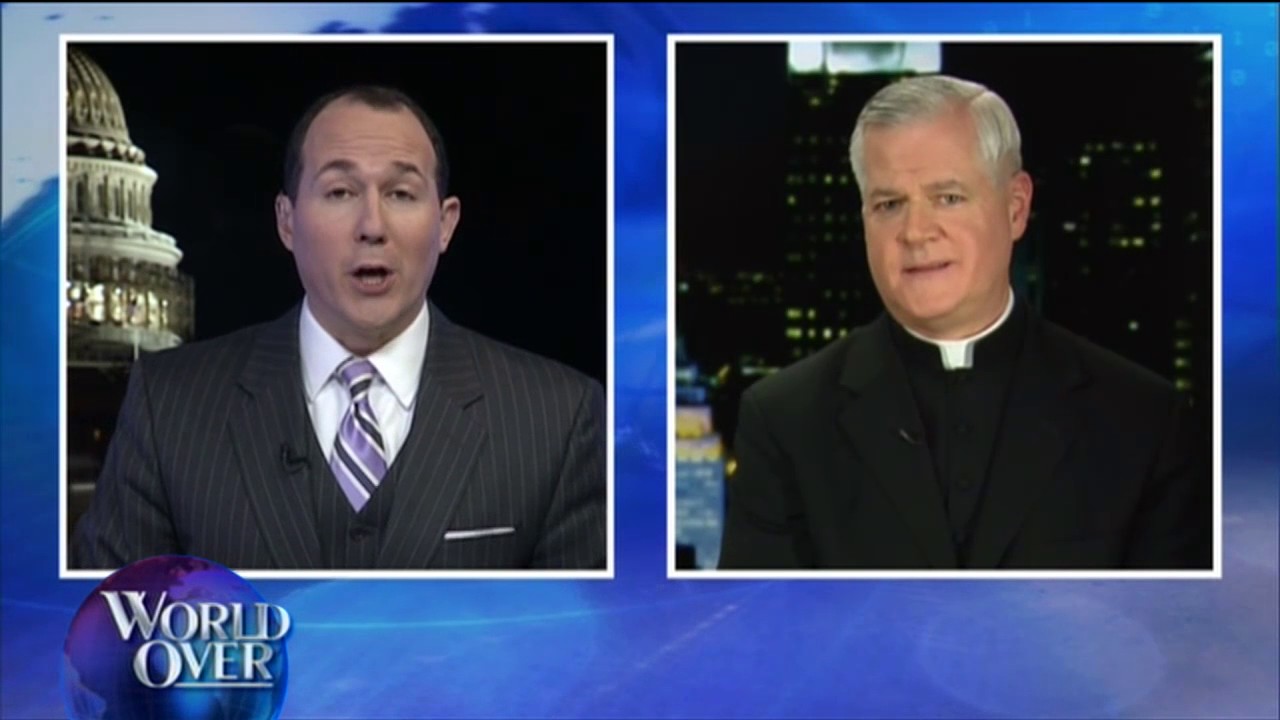
Francesco-CoccopalmerioMy friend Fr. Gerald Murray has again offered some insights over at The Catholic Thing about…

The False and Dangerous Coccopalmerio Gambit

Ready for some casuistry? [which is the use of clever but unsound reasoning, especially in relation to moral questions; sophistry. synonyms: sophistry, specious reasoning, speciousness, sophism, equivocation
… ]
Should the Catholic Church allow a man and a woman to receive the sacraments in the following case? A woman living with a married but divorced man tells him that she no longer wants to live in sin; the man threatens to kill himself, and she, following her confessor’s advice, stays with him?

In an interview with Edward Pentin, Cardinal Francesco Coccopalmerio offers this example and says: yes. He refers to his recent book on Chapter 8 of Amoris Laetitia in which he speaks of this case:

Think of a woman who lives with a married man. She has three little children. She has already been with this man for ten years. Now the children think of her as a mother. He, the partner, is very much anchored to this woman, as a lover, as a woman. If this woman were to say: “I am leaving this mistaken union because I want to correct my life, but if I did this, I would harm the children and the partner,” then she might say: “I would like to, but I cannot.” In precisely these cases, based on one’s intention to change and the impossibility of changing, [See the fatal flaw?] I can give that person the sacraments, in the expectation that the situation is definitively clarified.  [Fail.]

What’s the harm to the partner in her departure? “But how can she leave the union? He [her civilly married spouse] will kill himself. The children, who will take care of them? They will be without a mother. Therefore, she has to stay there.” 

He even states that the woman who desires to end the adulterous relationship would be guilty of killing her partner by leaving: “But if someone says: ‘I want to change, but in this moment I cannot, because if I do it, I will kill people,’ I can say to them, ‘Stop there. When you can, I will give you absolution and Communion.’”

The argument posed here is a quintessential “hard case” being used to establish a premise in favor of treating publicly known adultery as no longer an obstacle to the lawful reception of Holy Communion. But this premise sanctions emotionally manipulative coercion [Right!] and victimizes the woman further by treating her desire to live a virtuous life as the cause of harm to another.

How can that be? Obedience to God’s law is the cause of good in the life of the woman in question and that good radiates out to those around her. Her departure might shock the man into realizing how abusive his behavior has been toward her. His children are his responsibility, along with their mother, assuming she is still alive and involved in their lives. Her decision to follow God’s law will bring the children sadness, but more importantly gives a living witness of the Christian duty always to obey God’s law.  [One of the things that continues to shock me and other sensible people is the assumption that any sticky situation people get themselves into can be “fixed”.  Sometimes people get themselves into jams that can’t be fixed with some solution masked as “compassion” or “mercy”.  True mercy usually means helping the person through the suffering their self-created situation has gotten them into and then finding God in the redemptive suffering.  Happiness in this short life is not the ultimate goal.  Happiness in the next life, for eternity, is the goal.]

The man in question uses the threat of suicide to coerce this woman, not simply to remain in his household to raise his children, as would be the case if he agreed to live in a chaste, brother and sister relationship for the sake of the children; he is coercing her into committing acts of adultery. He is sinning gravely on two counts. She is conscious of her objectively sinful behavior and wants to conform her life to the demands of the Gospel.

Her culpability is mitigated by the force and fear imposed upon her by this man’s threat. [Yes.] Nonetheless, [NB] when grace moves a person to reject sin, the Church must never tell that believer that she need not worry about her sinful situation because the man she is civilly married to is somehow entitled to adulterous relations, lest he kill himself.  [That’s it, isn’t it?  Think about what the promoters of the Kasperite position claim: the matrimonial state is an ideal that some people can’t attain… people who get themselves into sticky situations shouldn’t have to reach for an ideal that they can’t attain.   Isn’t this a denial of God’s grace?  Isn’t it a denial of something that Church teaches definitively?  cf an anathema of the Council of Trent.  Keeping God’s law in particular situations can be difficult, extremely difficult, but it is never impossibleHERE]

Is it an authentically Christian pastoral approach to allow a deadly threat by the man to go unchallenged? Could the threat of suicide likewise be invoked to allow other gravely sinful situations to continue? [“If you don’t let me get that dress for the party at Danny’s place I’LL KILL MYSELF!”] If he were sexually abusing his children, and threatened to kill himself if they were removed from the house, would anyone think they should be left there? Why should his demand to continue in adulterous acts with a reluctant woman be treated differently?

An underlying assumption here may be that once the woman agreed to live with this man more uxorio, she somehow lost her right to refuse pseudo-conjugal rights, and that such a refusal would harm him, if not kill him. This is a backwards way of looking at the plight of a woman who, moved by God’s grace, wants to live faithful to the Sixth Commandment.

[Watch this…] By allowing this “suicide exception,” the Church would be tolerating the woman’s exploitation and reinforcing the man’s mistaken notion that he can, without any consequences, manipulate another person, until such time “that the situation is definitively clarified” (whatever that means).

The role of the priest confessor in this case is to help this man and woman to live virtuous lives, which means abandoning threats to commit suicide and giving good example to the children by living a chaste life together. If that is not possible, the priest should advise the repentant woman to live in accordance with her upright conscience by departing.  [HEY WAIT!  Surely the role of the confessor is to affirm people just as they are!!?!]

Sad to say, Cardinal Coccopalmerio believes it is impossible (emphasis added) for some Christians to change their situation: “I say in the book, it’s necessary to instruct the faithful that when they see two divorced and remarried that go to the Eucharist, they ought not to say the Church now says that condition is good, therefore marriage is no longer indissoluble. They ought to say these people will have reasons examined by the ecclesial authorities on account of which they cannot change their condition, and in the expectation that they change, the Church has placed importance on their desire, their intention to change with the impossibility of doing so.”  [impossibility]

Sed contra: “With God all things are possible.” Mt 19:26

Right.  Fr. Z kudos.

And now…

A reading from the the Council of Trent.

Mind you, the what the Council of Trent is still true.  Right?  Even though it was a few centuries ago, it is still true what that Council taught and we Catholics are obliged to accept what that Council taught.

ON JUSTIFICATION
FIRST DECREE
Celebrated on the thirteenth day of the month of January, 1547.

CHAPTER XI.

On keeping the Commandments, and on the necessity and possibility thereof.

But no one, how much soever justified, ought to think himself exempt from the observance of the commandments; no one ought to make use of that rash saying, one prohibited by the Fathers under an anathema,- that the observance of the commandments of God is impossible for one that is justified. For God commands not impossibilities, but, by commanding, both admonishes thee to do what thou are able, and to pray for what thou art not able (to do), and aids thee that thou mayest be able; whose commandments are not heavy; whose yoke is sweet and whose burthen light[That, dear readers, is true compassion.] For, whoso are the sons of God, love Christ; but they who love him, keep his commandments, as Himself testifies; which, assuredly, with the divine help, they can do. For, although, during this mortal life, men, how holy and just soever, at times fall into at least light and daily sins, which are also called venial, not therefore do they cease to be just. For that cry of the just, Forgive us our trespasses, is both humble and true. And for this cause, the just themselves ought to feel themselves the more obligated to walk in the way of justice, in that, being already freed from sins, but made servants of God, they are able, living soberly, justly, and godly, to proceed onwards through Jesus Christ, by whom they have had access unto this grace.

[…]

CANON XVIII.-If any one saith, that the commandments of God are, even for one that is justified and constituted in grace, impossible to keep; let him be anathema.

Posted in Mail from priests, One Man & One Woman, Our Catholic Identity, The Coming Storm, The Drill, The future and our choices | Tagged , , ,
69 Comments

Pope Francis GOES TO CONFESSION!

I see at Vatican Insider that there was a penitential service at St. Peter’s Basilica.  We have once again the image of a Pope making his confession, not hearing confessions.

confession-Francis

Meanwhile, Francis addressed a gathering of the extremely-helpful annual workshop for confessors held by the Sacra Penitenzieria Apostolica.

Among his remarks, the Pope said:

In fact, the confessor is called daily to go to the “peripheries of evil and of sin” – this is an awful periphery! And his work represents a genuine pastoral priority. To hear confessions is a pastoral priority. Please, let there not be those notices: “Confessions are heard only on Mondays and Wednesdays from this hour to that hour.” You hear confessions every time they are requested. And if you are there [in the Confessional] praying, keep the Confessional open, which is God’s open heart.

I would add to that, expand your times for confession and, Fathers…

GO TO CONFESSION!

Posted in GO TO CONFESSION, Liturgy Science Theatre 3000, Priests and Priesthood |
16 Comments

WDTPRS 3rd Sunday of Lent (1962MR): “When the priest’s hand extends over you, you are sheltered from the attacks of Hell.”

In ancient Rome on this 3rd Sunday, catechumens who desired to enter Holy Church and be baptized at Easter would be lead in a great procession to the Basilica of St. Lawrence “outside-the-walls” where they had been on Septuagesima Sunday.  They would be “scrutinized”, tested.

They were tested during Lent about their faith seven times, usually on Wednesdays and Saturdays, the climax of which came during the fourth week.

This Sunday the catechumens were exorcised of the evil enemy of the soul.  Today’s Gospel, in fact, presents the story of Jesus expelling a demon from a man who could not speak.

COLLECT (1962 Missale Romanum):

Quaesumus, omnipotens Deus, vota humilium respice: atque ad defensionem nostram, dexteram tuae maiestatis extende.

A prayer very similar to this is used in the Novus Ordo on the Saturday after Ash Wednesday.  It is ancient, from the Veronese and Gelasian Sacramentaries, and so it represents the best of the liturgical tradition of the early Church in Rome, formed out of the cultural, intellectual, spiritual milieu of the era.

The dictionary we call Blaise/Dumas reveals that a votum can be a “prayer” but it signals also “praise”, something due.  The mighty Lewis & Short Dictionary will show you that respicio is Respicio here means “to look at with solicitude, i. e. to have a care for, regard, be mindful of, consider, respect”.  Keep in mind that maiestas can be used like a title, as in “Your Majesty”, but it is also a divine characteristic, much like gloria, in the presence of which we will be transformed for all eternity.

LITERAL VERSION: 

We beseech You, God Almighty, regard with solicitude the prayers of the humble: and extend the right hand of Your majesty unto our defense.

As I hear of the mighty “right hand of God’s majesty”, I remember that soon, during Good Friday, both Christ’s hands will be pierced with nails for my sins.  He who is God became humbler than the humble creatures He fashioned in His likeness and, leaving Himself no defense, gave us His eternal freedom from the Enemy.

This majestic right hand is a way of talking about God’s power and authority.  In ancient times for example, a solider might commit an error or a crime for which he could be put to death by being flogged with the horrible scourge.  The imperator, the commander in chief, could remit the punishment of the legionary by extending his right hand over him in a sign of forgiveness.  Extending a hand over a slave was also the sign of manumission, a formal symbol of setting a slave free: extending the right hand had juridical effect.

Christ gave His own right hand of power and authority to the Catholic Church He founded and entrusted to Peter and the Apostles in union with him.  Until the end of time the Catholic Church will wield Christ’s own authority to teach, govern and sanctify.  We who are weak and humble benefit from this sheltering, liberating attribute of the Church.

In this prayer, I therefore reflect on how I, as a priest, extend my right hand of power and authority, Christ’s own right hand, over a penitent in the confessional.

When the hand of the priest is extended over you, you are sheltered from the attacks of hell.  You are freed from the unending flame that would consume you, liberated from the eternal bondage to the enemy which would for ever separate your from God’s sight.

Take that thought and now read through the other two major orations of Sunday’s ancient Mass.  The formulary is one of the most ancient we have.

SECRET: 

Haec hostia, Domine, quaesumus, emundet nostra delicta: et ad sacrificum celebrandum, subditorum tibi corpora, mentesque sanctificet.

Daily Liturgical Missal (Baronius Press):

May this Victim, O Lord, we beseech Thee, cleanse away our sins: and by sanctifying Thy servant in body and mind, make them fit to celebrate this Sacrifice.

POSTCOMMUNIO: 

A cunctis nos, quaesumus, Domine, reatibus et periculis propitius absolve: quos tanti mysterii tribus esse participes.

Daily Liturgical Missal (Baronius Press):

In Thy mercy, we beseech Thee, O Lord, do Thou from all guilt and peril absolve us, whom Thou grantest to be sharers in so great a Mystery.

QUAERITUR: When was the last time you sought out “the right hand of God” in the confessional? 

How long has it been since, after confession all your mortal sins in both number and kind, you have heard the words of absolution?

Deus Pater misericordiarum… God the Father of mercies…” or in the older form:

Dominus noster Jesus Christus te absolvat; et ego auctoritate ipsius te absolvo ab omni vinculo excommunicationis (suspensionis) et interdicti in quantum possum et tu indiges. Deinde, ego te absolvo a peccatis tuis in nomine Patris, et Filii, et Spiritus Sancti. Amen.  

May our Lord Jesus Christ absolve you; and by His authority I absolve you from every bond of excommunication (of suspension) and interdict, so far as I am able and you require. Thereupon, I absolve you of your sins in the name of the Father, and the Son, and the Holy Spirit. Amen.

How long has it been?

GO TO CONFESSION!

Posted in GO TO CONFESSION, LENT, Liturgy Science Theatre 3000, WDTPRS | Tagged , ,
1 Comment

CQ CQ CQ – #HamRadio Saturday: ZedNet possibility and June Field Day potential

ham radio badassOne of our frequent commentators here, WB0YLE, who is my online Elmer, has been lavishly generous with technical knowledge and skills.   He is the one who set up the Echolink node for our use.

WB0YLE is taking our networking possibilities to a new level, with the possibility of creating what he calls “ZedNet”, which might be activated on a regular basis.  It would be a net that connects, say, at 8 PM EST (or perhaps a bit earlier for those of you in different parts of the world).

ZedNet will be available on Wires-X room 28598, if any of you ham readers are near a Wires-X repeater.  It will also be available on DMR Talkgroup 31429 for those near a Brandmeister multimode repeater.  I am also pretty sure that you can join through Echolink, which he has patched in.  That means that even if you are out and about, you could access the net through your smart phone if it has an Echolink app.

I guess that that would make participants ZedHams rather than ZedHeads.

He is working on all the mechanics.  However, people can monitor the network now:

http://hose.brandmeister.network/31429/

There is pretty cool stuff going on with the digital side of things.

Also, we had a discussion about the upcoming warm weather Field Day at the end June.   Something needs to be done.  It would be quite the thing were priest hams (and lay hams) to descend on Madison, and on St. Mary’s in particular, for a combination of Field Day, potential ultra-blognik, Solemn Masses in the Extraordinary Form for the participants (and maybe even coaching in how to say the traditional Mass) along with good cheer and lots of real life and radio QSOs.  Just thinking out loud.

So, on my slate of things to do are 1) finally get those QSL cards made (along with my challenge coins), and 2) figure out Field Day, which will coincide with the Vigil of St. John the Baptist with its blessing of fire and perhaps even the joy of the old tradition of burning (in effigy of course) a witch, 3) form the club/society and 4) sort the new shack. Yes, Morse is in there too.

To refresh:

For those of you who are digitally active, WB0YLE set up the Echolink node available to us (554286 – WB0YLE-R  – Thanks! – Remember: You must be licensed to use Echolink.

I created a page for the List of YOUR callsigns.  HERE  Chime in or drop me a note if your call doesn’t appear in the list.

73!

W9FRZ


Posted in "How To..." - Practical Notes, Ham Radio | Tagged , , ,
Comments Off on CQ CQ CQ – #HamRadio Saturday: ZedNet possibility and June Field Day potential

20 March – MADISON, WI – Pontifical Mass for St. Joseph

st-joseph-patron-of-the-churchOn Monday, 20 March 2017, at 7 PM His Excellency Most Reverend Robert C. Morlino will celebrate a Pontifical Mass at the Throne (Extraordinary Form) in the Chapel of the Holy Name Heights in Madison (Bishop O’Conner Pastoral Center – 702 S. High Point Road).

Holy Mass is to be celebrated in honor of the Feast of St. Joseph, Foster Father of the Lord, Husband of Mary, Patron of the Church, of the Dying, of Fathers, and of Immigrants.

The music will be Gregorian Chant and polyphonic motets.  We will sing the beautiful Litany of St. Joseph.

The rites are in the Church’s ancient, Traditional Form of the Roman Rite in Latin.

This year St. Joseph is celebrated on 20 March, instead of Sunday 19 March, because the Sunday of Lent “outweighs” the Feast.  Please come to honor in this mighty intercessor and example of fatherhood and fidelity.  Bring to him your petitions for your family, nation and Church. All are welcome.

Also, please mark your calendars for the evening of Wednesday, 31 May, the Queenship of Mary (Extraordinary Form).  Bishop Morlino will celebrate a Pontifical Mass at Immaculate Heart of Mary Church in Monona.

Posted in SESSIUNCULA | Tagged , , ,
2 Comments

An argument and call for ‘ad orientem’ worship

ad orientem direction drawingFrom the increasingly valuable Crisis Magazine with my emphases and comments:

Re-turning to the Lord: A Call for Ad Orientem Worship
FR. JACOB S. CONNER, V.F. [a priest of the Diocese of Lake Charles]

Lent is a season of conversion. During this time, it’s common to encounter readings, orations, and teachings from the saints in the Mass and the Breviary that direct us to “turn away” from sin and error and “turn to” God. An example is Joel 2:12-14, which happens to be the First Reading of the Mass on Ash Wednesday:

Now, therefore, saith the Lord. Be convertedto Me with all your heart, in fasting, and in weeping, and mourning. And rend your hearts, and not your garments and turnto the Lord your God: for He is gracious and merciful, patient and rich in mercy, and ready to repent of the evil. Who knoweth but He will return, and forgive, and leave a blessing behind Him, sacrifice and libation to the Lord your God?

Another example comes from the (Ordinary Form of the) Mass  [I like how he makes the distinction…] from Wednesday of the First Week of Lent. In the Book of Jonah (3:8), the King of Nineveh, hoping to be spared from God’s impending wrath, makes this decree to all the citizens of his city:

Let every one turn from his evil way and from the violence which is in his hands.

Invariably, texts such as these affirm and respect the relationship of the outward, physical posture of the body and the inward, spiritual disposition of the soul (or heart). The purpose of this physical or bodily turning is to demonstrate the interior conversion (also presumably) happening within the soul. “Be converted to Me with all your heart.” I was pleased to find these same sentiments in the 2017 Lenten Pastoral Letter of the Most Reverend Glen John Provost, Bishop of Lake Charles, read at each Mass in the
Diocese on the First Sunday of Lent.

In a few of the observations from his Pastoral Letter, Bishop Provost teaches his flock about the relationship between this external physical turning of the body and the internal, spiritual turning of the heart to God in prayer. Let me now highlight a few of these:

  1. Ad-Orientem-Cartoon-Meme-640x578“When we worship [God], we turntowards the object of our adoration—God.  This turningtowards God is both a spiritual and physical.
  1. “Sacred Scripture permeates our Catholic worship.  Not long ago (i.e. Wednesday of the Third Week of Advent) the first reading for Mass was taken from Isaiah 45.  The
    passage struck me profoundly.  The verse read, ‘Turn to Me and be safe’ (Isaiah 45:22).  The reading continued, ‘To Me every knee shall bend; by Me everytongue shall swear’ (Isaiah 45:23).  Clearly a physicalorientation was implied.”
  1. “Literally Isaiah meant, ‘Face Me and be safe,’ a fitting admonition for not only Advent but any moment we enter the Lord’s presence.”

The bishop mentioned at the conclusion of his Pastoral Letter that this teaching was not new. When speaking about physically turning to God in prayer, he wasn’t proposing some unheard of novelty. Today, many Catholics know nothing (or very little) of ad orientem [liturgical worship]. Yet, the Catholic Church has consistently taught of its importance through the centuries and likewise practiced it in her prayer (both liturgically and devotionally). The reasons for this are manifold, but one of them is that ad orientem [liturgical worship] respects the integrity of the human person; that is, that man’s nature is both physical and spiritual. Both of these natures, moreover, are involved in conversion.

An example of this teaching is that of St. Augustine. The practice at Mass during his time was for the Deacon to announce to all present just after the homily: Conversi ad Dominum. (“Turn towards the Lord.”) Being the dutiful shepherd of souls that he was, St. Augustine explained the meaning of this admonition and gesture in a homily:

Does not God say, ‘Be converted to Me’? The scriptures are full of it: ‘Be converted to Me, be converted to Me.’ For what does this mean: “Be converted to Me”? It does not just mean that you, who were looking toward the west, should now look toward the east—that is easily done. If only you did it inwardly, because that is not easily done. You turn your body around from one cardinal point to another; turn your heart around from one love to another. (Sermo Dolbeau 19.)

As the body turns from one direction to another, so should the heart turn from sin and error to the true and living God. “Turn to Me and be safe,” says the Lord. Agreed. Conversion and ad orientem are the kinds of “safe spaces” our world and the Church really need.

In my own life, I have tried to put these teachings into practice. Beginning with the First Sunday of Advent, I expanded ad orientem from the principal Sunday Mass to every Mass at our parish. It is now firmly established here at St. Joan of Arc Catholic Church. I sincerely thank God for this blessing. Having several uninterrupted months of “turning to the Lord” at holy Mass has been one of the great blessings of my life. Though my own imperfections remain, ad orientem is deepening my union with God and helping me to pray the Mass with more recollection and devotion. In this way, it is also a blessing to the parishioners here and to all Catholics, because the sanctity of the priest and the people are interrelated.  [As I have been saying for years, there is a knock on effect.  When the priest’s ars celebrandi changes, so too does the congregation’s attitude of prayer. ]

Experiencing the positive effects of ad orientem has convinced me more than ever that there is something profoundly good and altogether reasonable about turning both the body and the soul to God when praying. Based on this experience and reflecting on the seasonal texts, I have come to question how anyone could doubt that the ad orientem celebration of Mass possesses an integrity that cannot be found when the priest offers Mass versus populum. [It is precisely for the reasons that Father gives that some priests and bishops will fight ad orientem worship: they insist that they be in control, at the center, the focal point of the enclosed circle.  They are uncomfortable with the truth that priests are for sacrifice and that what they are doing at the altar is renewing the Sacrifice of Calvary, rather than merely presiding at a pleasant collective meal.] Granted, a statement such as this could be taken as incendiary. Such is not my intention, and I would hope to allay any concern with an explanation.

In the early days of the Church there was a heresy known as Gnosticism. While more expansive, at its foundation Gnosticism denied the goodness of the physical order. It posited that all physical realities were either evil or not important. While of ancient origin, this error continues in our day under many a subtle guise. With respect to ad orientem, it is not unusual to hear someone say that the physical direction of the priest is of no relevance. [Wrong.] What matters is his spiritual orientation. While spiritual orientation is indeed important, so too is the physical. But when the latter is diminished and said to be “not important,” can we not see Gnostic tendencies at work?

In writing this, my hope is that our appreciation for the integrity of the body and soul, a relationship ordained by God himself, will be strengthened and better appreciated. I am not in any way accusing priests who offer Mass versus populum as being neo-heretics. At the same time, I unhesitatingly affirm that offering Mass ad orientem is superior to versus populum, given that the former more fully respects the hylomorphic nature of the human person, whereas the latter can easily (perhaps even naturally) give the impression that the physical realm is of no consequence. [Do I hear an “Amen!”?]

Drawing on the divine inspiration of Sacred Scripture; rooting ourselves in the truths enshrined in the Sacred Liturgy; and taking to heart the wisdom of the saints, my hope is that we—all of us—will aspire to observe practices at holy Mass which are consistent with our beliefs. [Lex orandi – Lex credendi!  There is a reciprocal relationship between what we believe and how we pray.  Change one and you change the other.] Such a conversionto the Lordneeds to happen. As Bishop Provost stated in his Lenten Pastoral Letter: “He [God] expects more of us.” While not a direct exhortation to his priests to employ ad orientem, I was happy to see His Excellency speak so favorably about turning to God in prayer. It is a welcome encouragement.

Click

We need to be serious, more serious than we have been in recent years about divine worship. [Do I hear an “Amen!”?] We also need to be rationally consistent. As Catholics, we believe in the integrity of the human person. The time has come that we align this truth of the faith with our practice at the altar. Lest we too are to fall into “old” errors, we should stop pretending (by our current practice) that the direction of liturgical prayer has little or no bearing on belief. The bodily postures we employ at Mass matter, and a universal re-turning to the Lord would be a tremendous blessing for the entire Catholic Church. As a priest, I pray that all bishops and priests would turn to the Lord at Mass, not just for Lent, but for life! Such an orientation would be for our own good as priests, [Definitely.] and, in the words of the Suscipiat, “for the good of all His holy Church.”

Fr. Z kudos.  I think this fellow deserves some Z-Swag.

Click!

Posted in "How To..." - Practical Notes, Fr. Z KUDOS, Hard-Identity Catholicism, Liturgy Science Theatre 3000, Our Catholic Identity, Priests and Priesthood, Turn Towards The Lord | Tagged , ,
9 Comments