
His Hermeneuticalness, the mighty P.P of Blackfen, the Dean of Bexley, the indominable Fr. Timothy Finigan opines on the situation the Franciscan Friars of the Immaculate are faced with.
The Commissar appointed by the Prefect of the Congregation for Religious, João Card. Braz de Aviz, has imposed seemingly draconian restrictions and changes on the Friars.
I can’t say I know the inner dynamics of this controversy. My sense is that the Friars had some serious internal problems. By the time this all escalated to the point of intervention by the Holy See, I suspect an intervention was needed: they couldn’t handle it on their own, which is not unsurprising for young institute.
That said, having read a little about the interventions made by the Holy See’s Commissar, Fr. Volpi, I must say I find them disturbing.
Fr. Finigan has made some good comments. He has his own blog but he has closed his combox. My emphases and comments™:
The Franciscans of the Immaculate have been going through a trying time recently. This seems to be getting worse. Rorate Caeli posted yesterday several documents relating the Franciscans of the Immaculate, including correspondence from Fr Volpi, the appointed Commissioner for the Institute. [I don’t see that “Commissar” is too far off the mark.]
[NB] We could all think of Orders, Congregations and Institutes where members have written against magisterial teaching. [Ohhhh, yes.] Occasionally [read: rarely] there has been some intervention from the Congregation for the Doctrine of the Faith and in rare cases an individual has been suspended from teaching in the name of the Church. We all remember the furore over the polite and carefully worded report on the Leadership Conference of Women Religious. The negotiations with the SSPX broke down over the nuance of an expression concerning the level of acceptance of Vatican II.
CLICK TO BUY
In the case of the Franciscans of the Immaculate (who have not contradicted magisterial teaching on faith or morals) [Unlike countless weirdos of one religious order after another who have plagued the Church with their heresy and destroyed the faith and vocations of who know how many…] their superior has been removed, their seminary has been closed, and their members [get this…] are now to be asked to take an oath agreeing that the modern Roman rite is an “authentic expression of the liturgical tradition of the Church.” [The first thing that popped into my mind as I read this was “Oath of Supremacy”.] I hope that I am not being intemperate in describing this as rather harsh. [as opposed to … draconian, cruel, drastic, oppressive, severe, brutal, extreme?] I certainly don’t recall others, whether liberal or traditionalist [Oh, Father! Never a liberal!] being asked to swear to such a specific question of fact. [Let’s imagine the Congregation imposing an oath on the Jesuits not to challenge the legitimacy of the Extraordinary Form or the legitimacy of what Bl. John Paul II called the “legitimate aspirations” of the faithful.] There are after all library shelves full of books by liturgical radicals arguing precisely the opposite: that the Novus Ordo was a a liberation from the encrusted barnacles of tradition and the opening of a bright new future for creative liturgy. Will they be administered an oath in which they must swear that it is an authentic expression of the liturgical tradition? [Rem acu.]It would be reasonable to require those in communion with the Church to accept that the modern rite is, in itself, a valid rite for the celebration of the Eucharist. (Otherwise you would have to say that the Masses of Blessed John Paul, Pope Benedict and Pope Francis were all invalid.) [Pay attention…] The question of whether it is an authentic expression of the liturgical tradition of the Church is surely a legitimate matter for debate within the wider discussion of the hermeneutic of continuity or rupture. Famously, Cardinal Ratzinger described it as a “banal on the spot product”: are we not allowed any longer to agree with him? [Oh, dear Father. You are now veering close to official bad-think. You are making… and I can barely bring myself to say it… distinctions. There! See what you’ve done?]
Actually, I think that the oath could be taken in good conscience anyway – the expression is capable of a range of interpretations without even the need for any mental reservation. Certainly the modern rite has many elements that have always been in the Roman liturgy, and has, broadly speaking, a traditional Roman structure with readings, offertory, canon, and communion in the traditional order. It is authentic in being valid for the celebration of the Eucharist, in being promulgated by a Pope and in being legitimate to use. [A person could still say that the Novus Ordo is valid, and even a legitimate expression of the Roman Rite, without ceding that it is as expressive as the older form.]
Please pray for the Franciscans of the Immaculate at this time of trial. Pray especially to Our Lady, Mediatrix, Auxiliatrix, Advocatrix and Co-redemptrix. Pray also to St Maximilian Kolbe.

I will say what I have said before. Some of you won’t like this.
Right now liberals think they have the big mo. They will – even in an antinomian way – work to oppress those who simply want to make use of the lawful, universal legislation in Summorum Pontificum. They will seek to forbid anyone from making reference to the vision Benedict XVI provided and then established with provisions that have juridical force. They will try to build a wall between Francis and Benedict, as repress those who want the older forms in the name of some new “spirit of Francis”.
Therefore, I urge you to three things.
First, tread carefully. When you seek the implementation of, or continuation of, or expansion of the use the provisions of Summorum Pontificum, put your most cheerful and happiest foot forward. You can lose what you have gained.
Second, do not give up. This is the time to press forward. Keep working for your legitimate aspirations. What Benedict set down is not any less needed today than it was a year ago. It is even more needed.
Third, when there is an opportunity in the parish to get involved with some project involving corporal works of mercy, be the first to volunteer and get involved.
Be exemplary in your joyful mien, your determination, and your charity.



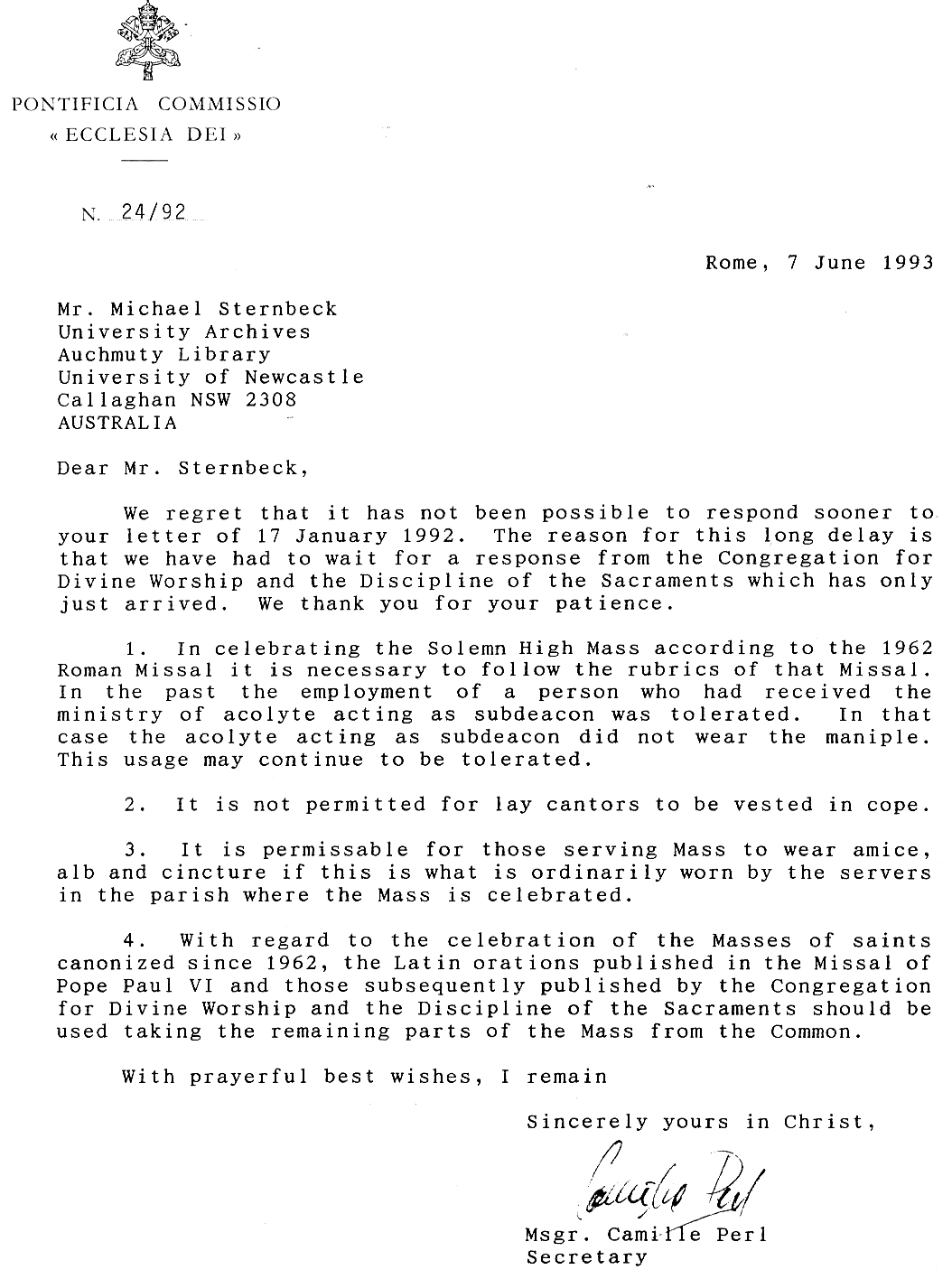 There is, however, a letter – signed by the then-Secretary Msgr. Perl but not addressed to an ecclesiastical authority – from Pontifical Commission “Ecclesia Dei” in 1993 said that straw-subdeacons may continue to be tolerated. That means that there can be straw-subdeacons. Perl’s 1993 letter also describes that, back when, the straw-subdeacon didn’t wear the maniple, but he doesn’t say it can’t be used now. He doesn’t cite any documents in this letter.


 I saw on




























