Do you have good news to share with the readership?
If your life is like mine, you need some!
Let us know.

Do you have good news to share with the readership?
If your life is like mine, you need some!
Let us know.
 Was there a good point made in the sermon you heard during your Mass for your Sunday obligation?
Let us know.
For my part – on this 19th Sunday after Pentecost -taking my cue from the Epistle and from the Lord’s parable about the king’s wedding banquet I spoke about the gift garment. Paul tells us to put on the “new man”. Our Lord describes how the king who gives the banquet has the man without the wedding garment bound hand and foot and then has him thrown outside to weep and grind his teeth in the darkness of night.
A bit of an over reaction on the king’s part, no? Why the stern punishment?
As per ancient Eastern custom, kings clothed guests in beautiful gift garments as they entered in order to honor them and to make the occasion more beautiful and decorous. The man without the garment had no excuse: he was given a garment and he refused to put on the king’s gift, thus insulting the king, the other guests, and the occasion itself. That’s what we do when we sin and are “bad Catholics”, we dishonor God and other members of the Church.
We are in the banquet on the KING’s terms, not on our terms. We are in the Church on the Church’s terms, not on our terms.
The Lord puts the new man on us in baptism and the other sacraments. He gives us the garment. We must keep it in good order. But the garment is invisible and inward as well as visible and outward. We have our baptismal character which is invisible, but outwardly our words and deeds reveal that we are clothed in the gift. Our behavior can honor God and others. Our behavior can harm others. Our behavior can make it easier for others to sin or to be holy. When we dishonor our gift garment in sin, we are bound and blind, frightened and angry in sin. That state is only a prelude to the paralyzing terror and fury of the eternal outside which is Hell. We can choose instead to keep the gift garment in good order and be filled with the light of the feast, in the company of the saints and angels, in the good pleasure of the King who wants to honor us and make us more like Him in splendor.
We can lose what has been given to us. We can lose the banquet of heaven by neglect of our gift garment, which insults the Giver. Remember: The king put the man out of the banquet and into Hell. The Lord wants us inside but He won’t force us. We are called, but we might not be chosen. Many are not.
Concretely, I also told the altar boys about how the first line of the Epistle, about putting on the new man, is the prayer we say when we put on our surplice to serve at the altar. We have to keep it in good order. We have to be squared away at the altar, where we give honor to the King’s table in the sight of all the other guests.
Also, concretely, I underscored for the congregation Paul’s admonition not to let the sun set on anger, to make amends, not to provoke to anger, which is a foretaste of being bound in the outer darkness.
In any event, for those of who who serve Holy Mass or who train altar boys, it is fitting to be recollected when putting on vestments. Use these prayers:
Washing hands:
Da, Domine, virtutem manibus meis ad abstergendam omnem maculam ut sine pollutione mentis et corporis valeam tibi servire.
Give virtue to my hands, O Lord, that being cleansed from all stain I might serve you with purity of mind and body.’
For the Cassock:
Dominus, pars haereditatis meae, et calicis mei: tu es, qui restitues hereditatem meam mihi.
O Lord, the portion of my inheritance, and my chalice: You are He who will restore my inheritance to me.
For the Surplice:
Indue me, Domine, novum hominem, qui secundum Deum creatus est in iustitia et sanctitate veritatis. Amen.
Invest me, O Lord, as a new man, who was created by God in justice and the holiness of truth. Amen.
From a reader…
QUAERITUR:
Is there a reasonable hope that all souls will be saved since it is a part of our liturgy?
No. That is not reasonable. It is wishful thinking.
Many will be lost.
The feel good of translations and other aspects in our sacred -or not so sacred – worship have given many more than a rosy prospect.
There is no part of our authentic liturgy as Catholics which suggests that “all” will be saved.
It is time to sober up.
We can lose the gift of membership in the Kingdom of God which Christ opened for us.
We can and we do… when we sin.
GO TO CONFESSION!
As baptized Catholics we have a role and work to do in the world, each according to our vocations. We must affect change… as Catholics. How can we imagine that we can do that if we don’t have a clear idea of who we are? If our Catholic identity is shaky, foggy, vague, superficial, nebulous, ill-defined, why should anyone listen to us? If we are hesitant, equivocal or hazy in what we know and believe about our Catholic Faith, can we bring about change within the Church and in the public square? Ad intra and ad extra?
Our identity depends in a fundamental way on our sacred liturgical worship of God. The first thing we owe to God by the virtue of Religion is worship. God must be at the summit of the hierarchy of our relationships. If as individuals and as small groups like parishes, or larger groups like dioceses, and as the greater Church, we have amorphous, lax, ambiguous, muddy, and even puzzling liturgical worship, we will be amorphous, lax, ambiguous, muddy, and even puzzling. When we speak – or rather squeak like tremulous little gerbils – we will be discounted in the public square, held in contempt and walked on.
We must get back to basics.
I think that two things in our worship will make a huge difference to our Catholic identity.
First, let’s get our altars turned back toward the Lord again. We need ad orientem worship. This will require lots of catechesis and guts.
Next, we need more and more priests of the Latin Church to put aside their fear of making mistakes or being criticized, to put aside their nervousness about Latin, put on their big boy pants and learn the Extraordinary Form.
Remember, Fathers, our Latin Rite has two forms. If you don’t know the Extraordinary Form yet… you don’t know your Rite yet.
We need you now.
Fathers… Bishops… we need you now.
Via LifeSite:
Priest: ‘You might not have a church to go to if you don’t vote the right way in November’
NAPLES, Florida, September 23, 2016 (LifeSiteNews)—We are at a “precarious moment in our history” when churches must speak truth to power or risk the loss of a lot more than their tax statuses, former Ave Maria Law School chaplain Father Michael Orsi said in a blistering speech at a National Day of Remembrance for Aborted Children event on September 10.
Orsi, now on the pastoral team of St. Agnes Church in Naples, Fl said, “For too long, pastors and churches have been bullied into believing that they can say nothing political from the pulpit,” said Orsi. The regulation that is used to silence them “was a piece of spite work” against non-profits that had opposed President Lyndon Johnson, he said.
“Let me remind you: the Bible is a political document,” the priest said. “The prophets, including John the Baptist, and Jesus, lost their lives because they spoke the truth to power.” [I recently wrote THIS.]
“The Constitution is quickly being destroyed,” warned Orsi, and “unless the right choice is made in November, we may not have a court that is fair and balanced in its interpretation of the Constitution.” [There is it, friends. SCOTUS. This is a huge dimension of the election. Also, I noticed today that the GOP candidate added a few names to the list of potential nominees to the SCOTUS. He has said that his picks will come from this list. HERE]
“Too many of the pastors—too many, practically all—in Germany refused to speak against national socialism,” continued Orsi. “And look [at] the result: millions of Jews, pastors, priests, homosexuals, gypsies all lost their lives because everyone was afraid. What are you afraid of, a couple of bucks? Your tax-exempt status? What’s that going to do to you? [NB]Your churches may be closed anyway, because if a certain party gets elected, this certain party said, if the churches do not agree with our interpretation of women’s reproductive rights, they’ll just have to change their doctrine.” [Hillary Clinton said last April that Christians must be forced to change their religious views to accommodate abortions. HERE]
“If a certain party gets elected, I can assure you what kind of judges are going to be on those appeals courts,” he said. And those judges will be charged with deciding whether the government may force churches and religious institutions to pay for abortion, contraception, and abortifacient drugs, he noted.
Furthermore, “I’m not going to vote for a candidate who decides that we can redefine the meaning of marriage,” proclaimed Orsi. “Our opponents believe once they destroy the family, once they destroy the churches, they can re-create society in their own image and their own likeness. That, my friends, is not just political. That is diabolical. Get it straight, for crying out loud! The devil is in this!”
“We are in a battle for the soul of America,” he said.
“Somehow, [Christians] have come to buy the story that you cannot be political in church,” said Orsi. “Let me tell you right now, oh yes, you can, and oh, yes, you better be. Because you might not have a church to go to if you don’t vote the right way in November.”
¡Hagan lío!
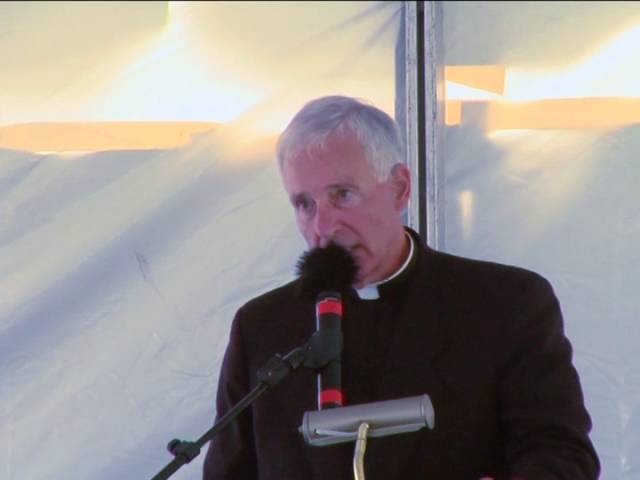

You might read THIS.
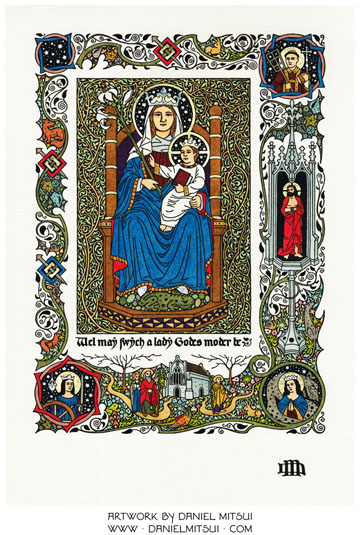
Happy Feast of Our Lady of Walsingham to members of the Ordinariate across the Pond.
I’ll take this occasion to remind you of the image of Our Lady by the Catholic sacred artist Daniel Mitsui. The 7″ x 10″ print is ready for ordering HERE.

Those saints in the corners are Catherine of Alexandria, Margaret of Antioch and Lawrence of Rome.
From his website:
The print was made on a Heidelberg Windmill press at Rohner Letterpress (Chicago, IL). The printing method involves pressing a piece of paper against a hard plate whose raised surfaces are inked; this is essentially the method invented by Gutenberg that remained dominant until the 20th century. Graphic Chemical & Ink (Villa Park, IL) supplied a traditional printing ink made from linseed oil & furnace black. The paper was handmade from cotton rag pulp at Twinrocker Handmade Papers (Brookston, IN). It is a laid paper, which means that it has a slight ribbed texture, from the wires in the papermaking mould. Laid paper was the only type of paper manufactured in Europe until the mid-18th century.
A few details.

A squirrel! I hate squirrels, but there it is.

A nice reminder that her shrine is a pilgrimage place.

The Middle English at the bottom is from a 15th c. poem in honor of Our Lady. You have to go to his site to read that…. yes… just go there.
I have an earlier version of this, on vellum, but he has a reworked it. The printing is crisp. It jumps out at you. Very nice.
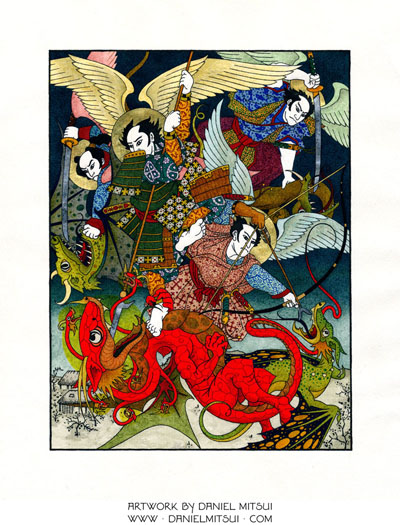
Lot’s of stuff to consider… go have a look!
One piece I saw when rummaging around was a fascinating version of the Battle of Heaven with the archangels as Japanese samurai opening a can of whoopass on Ol’ Scratch. Very cool. Feasts of angels are upon us at the end of September and the beginning of October.
For decades we Latin Church Catholics in the English speaking world suffered from hideous liturgical translations, prepared by ICEL.
Remember what they were like? Here is the quintessential, typical, emblematic, prototypical, illustrative, archetypal, representative Obsolete ICEL prayer:
O God,
you are so big.
Help us to be big like you.
Thank be to God, the Obsolete ICEL prayers were replaced, according to new principles of translation laid down in Liturgiam authenticam. While the current translations are not perfect, they at least resemble the Latin originals.
Today a friend sent me this.
Looks like the Maronites have discovered dynamic equivalence! The “reformed” version is apparently in their new Missal (2013 in US).
Attached to the email was this:

I don’t know Syriac, so I can’t compare these to the original, but… dang, this wouldn’t be good at all.
If this is accurate, and if this is representative of how Maronites might be praying if they use English, and if they stick to this, then their identity will be devastated.
“Enriched” Reform Version? REALLY?!?
Devastated.
I hope this a) isn’t true and b) is only one (little used) option.
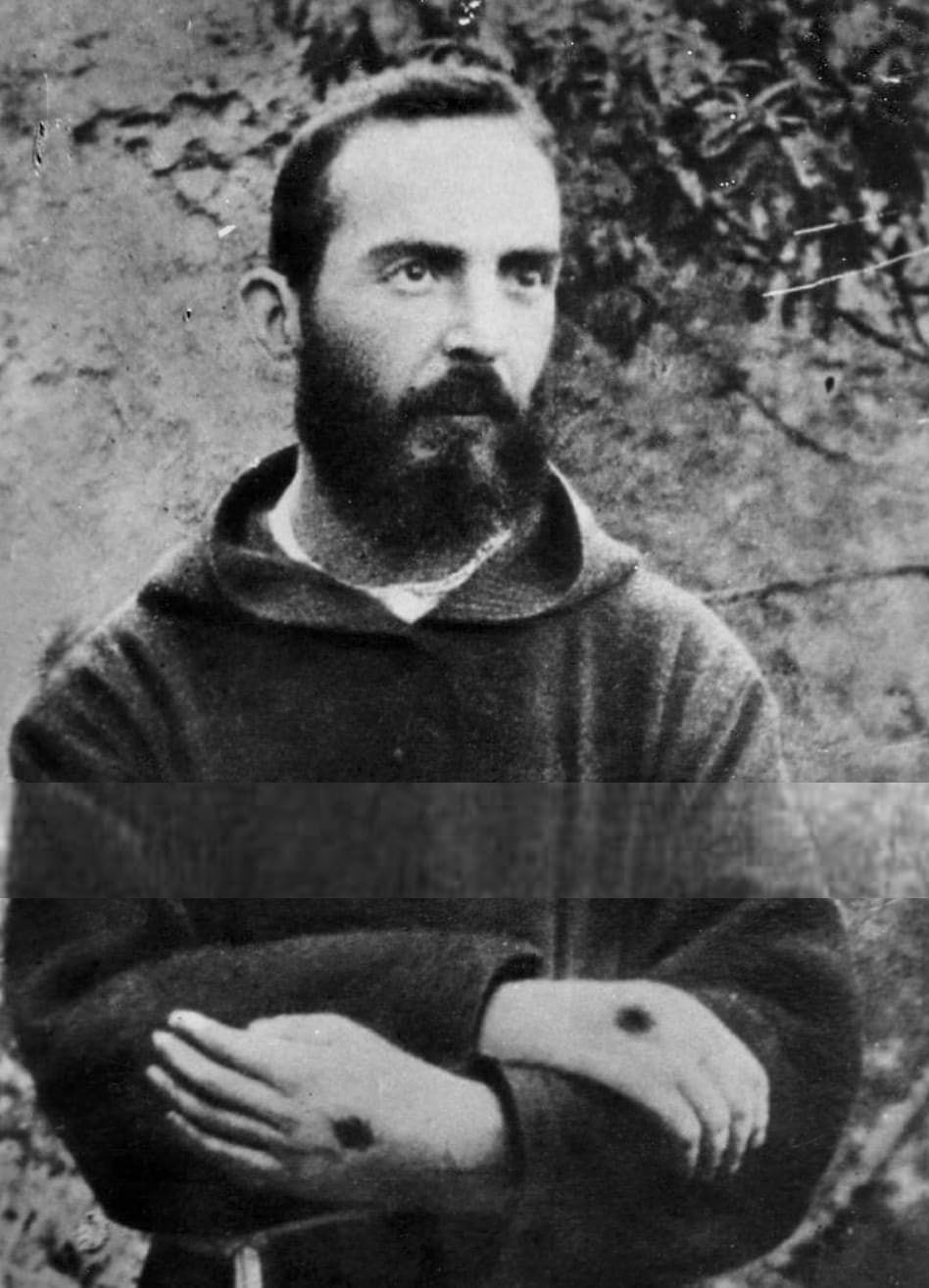 Today is the Feast of St. Pio, aka Padre Pio of Pietralcina, who died in 1968 and was canonized in 2002. He was an amazing saint.
I have an affection for Padre Pio. My bishop, who recently passed away – RIP, when he was a member of the Congregation for Causes of Saints was the “Ponente” of the cause of St. Pio . I got a good look at the many volumes of the positio for the cause and heard some great anecdotes.
Here is something that you may not be aware of.
I am sure you have heard of the great (living) composer of both secular and sacred music James MacMillan. Among the fine music has has written is, just as an example, the Tu Es Petrus we heard when Benedict XVI entered Westminster Cathedral during his state visit to England.
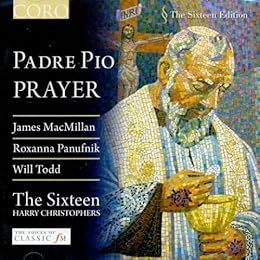
MacMillan wrote music in honor of St. “Padre” Pio! It is sung by no less than The Sixteen.
It is a setting of his “Prayer” HERE.
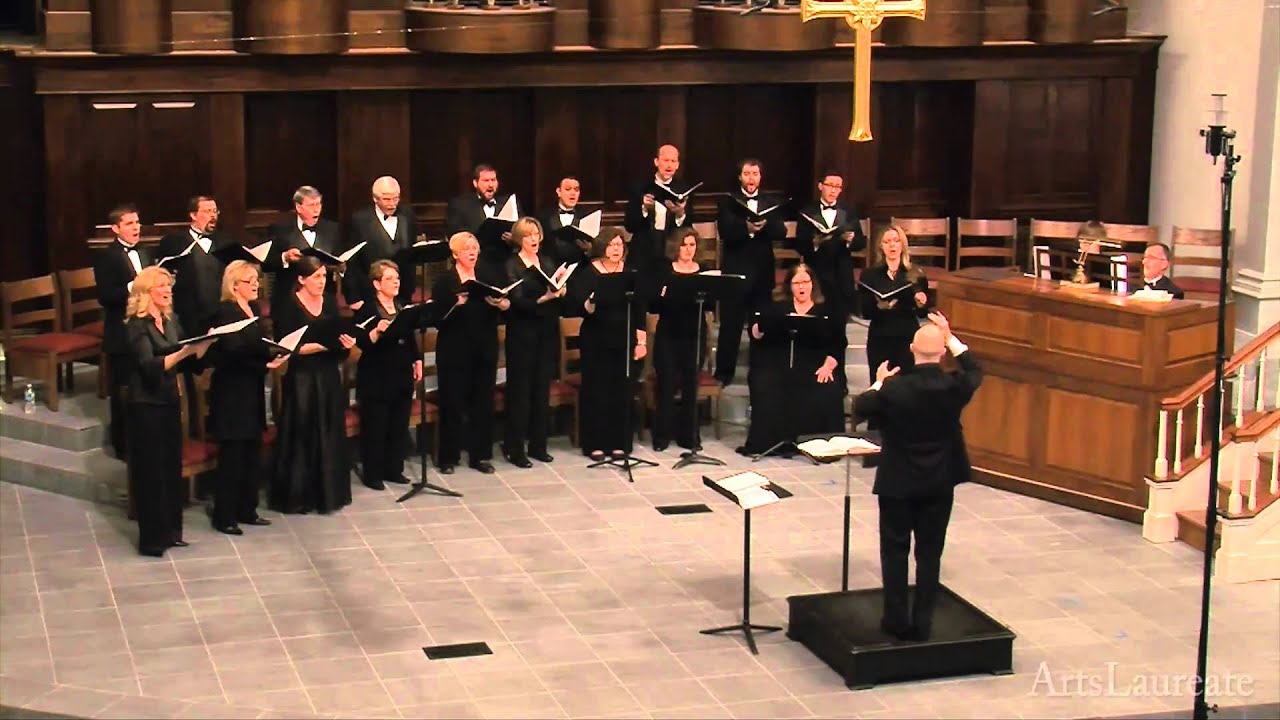
HERE, however, is a choir singing the Prayer:
Meanwhile,
A reader steered me to videos of a talk given in August in New Zealand by SSPX Superior, Bp. Bernard Fellay. It is broken into 6 parts on YouTube and is, frankly, dull to watch. But you might want to listen to it. Therefore, I stripped out the audio, cleaned it up a little, and pumped up the volume a tad.
Bp. Fellay speaks about the state of the question with the Holy See. The last half might be of greater interest. Perhaps you readers can point to minute marks long the way.
I left brief breaks where one video ended and another began.
Podcast: Play in new window | Download
Subscribe: RSS
I, for one, hope for a swift reconciliation.
The first of the videos …
 A friend sent an email with a reminder about Ember Days. These days were penitential in spirit. They were also traditional times for ordinations. The short mnemonic “Lenty, Penty, Crucy, Lucy” can help you remember when they fall.
Today in the traditional Roman calendar is Feria Sexta Quattuor Temporum Septembris (II. classis), Ember Friday of September.
From my friend’s email:
Ember Days (from Latin Quatuor Tempora, four times) are the days at the beginning of the seasons ordered by the Church as days of prayer, fast, abstinence, mortification, and almsgiving. Although these days were definitely arranged and prescribed for the entire Church by Pope Gregory VII (1073-1085), their real origin goes back to the early days of the Church at Rome. The Ember Days are specific to the West; the East does not know them.
In addition to prayer and fasting, another reason for the Ember Days is to thank God for the gifts of nature, to teach men to make use of them in moderation, and to assist the needy.
The immediate occasion (for their origin) was the practice of the heathens of Rome who worked in agriculture. In the months June, September, and December, the Romans invoked their false deities for protection upon their fruits of the earth: in June for a bountiful harvest, in September for a rich vintage, and in December for the seeding.
The Church, when converting heathen nations, has always tried to sanctify any practices that could be utilized for a good purpose. At first, the Church in Rome had fasts in June, September, and December, but the exact days were not fixed. The Church, on these days, taught Christians to consecrate the seasons by means of fasting, abstinence, prayer, mortification, and almsgiving in order to invoke the blessing of the One and True God upon their crops by means of sun and rain in due season.
Additionally, following the example of Our Lady, who fasted for 40 days and 40 nights, [while I imagine Our Lady also to have done that, perhaps he meant Our Lord] the Church always prepared for special feasts and festivals by fasting (Saturdays were days of fast and abstinence in preparation for Mass on the Lord’s Day – Sunday). This helped Christians to prepare spiritually and to increase their life of virtue by subduing the flesh to the spirit: “Fasting has always been the nourishment of virtues. By voluntary mortifications, the flesh dies to its concupiscence and the spirit is renewed in virtue” (Pope St. Leo).
Taken from Catholic Encyclopedia and A Pulpit Commentary on Catholic Teaching: The Liturgy of the Ecclesiastical Year.
If you want more, I wrote about Ember Days HERE.
However, pace Johnny Mercer, is you is or is you ain’t Ember Friday? There are some people who want to schedule the September Ember Days a week earlier, to follow Exaltation of the Cross when it falls early in a week. For example, HERE. But that is not the calendar we follow for the Extraordinary Form. Moreover, the Ordo sent by both the FSSP and the SSPX have today as Ember Friday.
As far as the Novus Ordo is concerned, Ember Days are discussed in the General Norms for the Liturgical Year (GIRM). Tucked into one of the very last paragraphs, as if it were really important, we find:
394. Each diocese should have its own Calendar and Proper of Masses. For its part, the of Bishops’ Conference should draw up a proper calendar for the nation or, together with other Conferences, a calendar for a wider territory, to be approved by the Apostolic See.153
In carrying this out, to the greatest extent possible the Lord’s Day is to be preserved and safeguarded, as the primordial holy day, and hence other celebrations, unless they be truly of the greatest importance, should not have precedence over it. Care should likewise be taken that the liturgical year as revised by decree of the Second Vatican Council not be obscured by secondary elements.
In the drawing up of the calendar of a nation, the Rogation and Ember Days should be indicated (cf. above, no. 373), as well as the forms and texts for their celebration,155 and other special measures should also be taken into consideration.
The U.S. Bishops’ Committee on the Liturgy did this in the 2007 edition of Catholic Household Blessings & Prayers (Rogation Days, pp. 142 ff.; Ember Days, pp. 164 ff.).
That doesn’t impress me very much, I’m afraid.
This is one of those instances in which the newer, post-Conciliar calendar reveals the myopia of the “experts” who cobbled together the liturgical reform.
By moving saints’ feast days around, they caused disruption with celebrations of name days, patronal feasts, etc. By changing the liturgical seasons – especially by eliminating the pre-Lenten Sundays – they diminished preparation for Lent. By eliminating Rogation Days and Ember Days, they removed crucial moments of petition from our schedule.
In sum, they didn’t consider that people’s lives were tied or could be tied to the rhythm of the Church’s year of grace.
If there were ever a way in which the older, Extraordinary Form could provide “enrichment” for the newer, Ordinary Form, this would be one way: reconsideration of the structure of the newer and the older calendar and how they fit together or don’t fit together. I advocate the addition of new feasts in the older calendar and the reintegration of elements of the older calendar into the newer.
Don’t make some of these things mere suggestions. Put them back into the calendar.
Recently two priests in Mexico were kidnapped and killed.
Now I read that another priest in Mexico is missing.
Via Crux:
Another Catholic priest in Mexico kidnapped, remains missing
Coming on the heels of the kidnapping and murder of two Catholic priests in Mexico over the weekend, a third one was reportedly taken from his church on Monday and remains missing.
Father José Alfredo López Guillen of the state of Michoacán, one of the most violent zones in the country, reportedly was taken on Monday by people who remain unknown. Items from the parochial house and his car are also missing.
The news about the kidnapping was shared by Cardinal Alberto Suárez Inda of the diocese of Morelia, the capital of Michoacán. His diocese published a video through YouTube and Twitter, where the cardinal says: “We ask God that his integrity, his life, are respected, so that he can soon go back to his ministry.”
Suárez Inda, created cardinal by Pope Francis in 2015, also prayed for peace, respect for life and the conversion of those who spend their lives doing wrong to others.
“This barbarity is in no way justified,” he said.
Michoacán has long suffered the consequences of organized crime and drug trade, and the disappearance of López Guillen is far from being an isolated case.
Fathers Alejo Nabor Jimenez Juarez and Jose Alfredo Suarez de la Cruz had been kidnapped last week in Veracruz, a region also marred by drug trade and organized crime, and found murdered on Monday, the same day the priest from Michoacán went missing.
[…]
The CMC also said in 2015 there was a decrease in the number of priests killed, from six in the year before to two. [Gosh! A decrease!] However, it also said that some 520 priests had been victims of extortion during the year. The fate of Father Carlos Ornelos Puga, who disappeared in November 2013 from La Victoria, Tamaulipas, and Father Santiago Alvarez Figueroa, who disappeared in December 2012 in Zamora, Michoacan, remained unknown.
But priests are not the only targets. Last June three nuns were tied up, gagged, and assaulted by unknown attackers in their parish home in the state of Oaxaca.
Pray for the priests who died. Pray for the priest who is missing.

Coat of Arms by D Burkart









A Daily Prayer for Priests


They find you a pro-life agent in your area who commits to giving a portion of the fee to a pro-life group!

PLEASE subscribe via PayPal if it is useful. Zelle and Wise are better, but PayPal is convenient.
A monthly subscription donation means I have steady income I can plan on. I put you my list of benefactors for whom I pray and for whom I often say Holy Mass.
In view of the rapidly changing challenges I now face, I would like to add more $10/month subscribers. Will you please help?
For a one time donation...



Help Monks in Wyoming (coffee – UPDATED LINK) and Norcia (beer) and the wonderful "Soap Sisters" of Summit, NJ!


Please follow me on Twitter!










Visits tracked by Statcounter
since Sat., 25 Nov. 2006:

