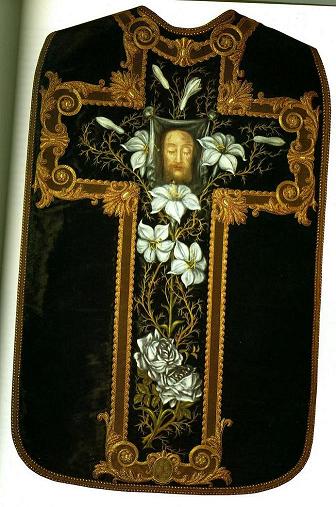
A special saintly chasuble

I picked this up from the blog Gem of the Ocean.

Did you know that the Little Flower, St. Therese of Lisieux, made a chasuble?  I didn’t.

The abovementioned blog says:

The chasuble garment itself was made from an old dress of Madame Martins. It appears to be a heavy brocade type fabric. It is dark green in color. St. Therese painted the Holy Face and the vines and roses. The book, Therese and Lisieux, didn’t say who sewed the garment. You can see an enlarged version of the photo here.

You can read more there!

Posted in Just Too Cool | Tagged , ,
12 Comments

QUAERITUR: Translation of “benedixt” in the Roman Canon

From a reader:

Would you consider doing a blog entry on the translation of “benedixit” as “said the blessing” in the new translation of the Roman Canon? I find this rendering a bit distracting as I can’t, with my basic knowledge of Latin, see how they got that translation. A good explanation of why it is okay would be really helpful (assuming there is one). Thank you.

Some context:

Qui, pridie quam pateretur, accepit panem in sanctas ac venerabiles manus suas, et elevatis oculis in caelum ad te Deum Patrem suum omnipotentem, tibi gratias agens benedixit, fregit, deditque discipulis suis dicens: …


The question focuses on the translation of Latin benedico, a compound of bene + dico, which obviously means in the first place, “to speak well of any one, to commend, praise”. By extension it also used in later, eclessiastical Latin, as “to bless, praise, or adore” God. Sometimes the object, God, is in the accusative (benedico Deum) and sometimes the “object” is in the dative, as in “to speak well to God”, “to adore God” (benedico Deo). By even more extension, it means when in reference to created things (people, objects) “to bless, consecrate, hallow”.

So, “to speak the blessing” is not at all outside the pale when rendering benedico.  But why not just say “bless”?

Perhaps the translators and those who approved it thought that they had to spin out the fact that the word is a compound, bene+dico.   For my part, I think it should be simpler.


Posted in ASK FATHER Question Box, Liturgy Science Theatre 3000 | Tagged , ,
9 Comments

What is going on in Brazil with Masons and Catholics?

Rorate has this, but I want to bring it to the attention of as many people as possible… lest nothing be done about it.

Keep in mind that Catholics cannot be Masons.  Period.  Masonry and Christianity are not compatible.  As a matter of fact, they are antithetical.  The CDF has made it clear that Catholics cannot be Masons.  The 1983 CIC does not specifically mention Masons but says that membership in organizations that “plot against the Church”, is prohibited and can be punished with a censure:

Can. 1374. A person who joins an association which plots against the Church is to be punished with a just penalty; one who promotes or takes office in such an association is to be punished with an interdict.

That said, how to interpret this?

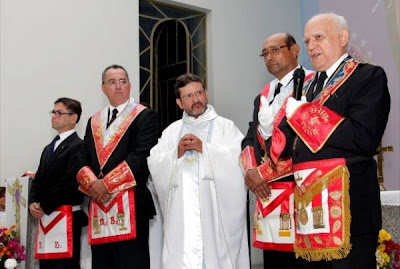
In the Diocese of Pesqueira (state of Pernambuco, Brazil), on 20 August 2012 Father Geraldo de Magela Silva, celebrated a “Day of the Freemason” Mass.  Photos were  posted on the Facebook page of a Masonic organization.  Rorate has a  few.  Here is one.

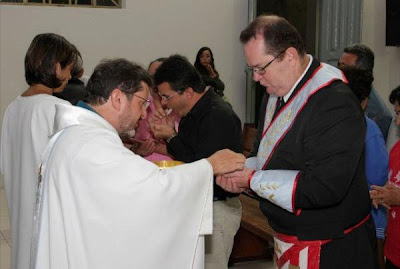
I am not 100% certain, but in the following photo it looks as if the priest is giving Communion to a man dressed in Masonic gear.

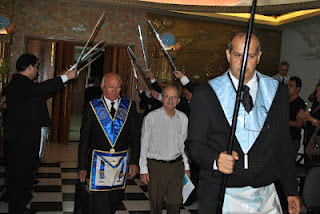
What is going on in Brazil?   Rorate, in another post, looked at what a Brazilian bishop did some time back. Luiz Demétrio Valentini, Bishop of the Diocese of Jales (Brazil) on 10 April went to a Masonic Lodge in Jales in honor of its 53rd anniversary. He was received with honor.  A photo:

The bishop is, I believe, the one not dressed in Masonic gear, though the Masons are certainly dressed with greater class.

I’m just sayin’.

If you are a Catholic involved in some Masonic group… GET OUT NOW.

Posted in Dogs and Fleas, I'm just askin'..., Liberals, Our Catholic Identity | Tagged , , , ,
47 Comments

US drought and crop losses will raise the price of altar breads

Being from the upper midwest, I have seen the devastation of the crops this year.  In many places there are total losses.

From CNA:

Greenville, R.I., Aug 26, 2012 / 01:09 pm (CNA).- Manufacturers of altar bread are preparing to face rising costs of wheat flour as grain prices fluctuate in the wake of a severe drought that continues to plague the Midwest and Western Canada, although they expect to pass along only a minimal price increase to their customers.

In Clyde, Mo., Benedictine Sister Rita Claire Dohn, manager of the altar bread ministry of the Benedictine Sisters of Perpetual Adoration, has witnessed a 25 percent increase in the price of wheat flour since the convent last received a delivery two months ago.

“That’s pretty steep when there isn’t a large profit margin,” Sister Dohn emphasized, adding that the convent is the largest religious producer of altar breads in the world. The sisters offer their altar breads wholesale to many smaller convents that resell the life-giving breads to support their community.

“You have to be competitive,” she continued, noting that the sisters are being cautious and have yet to increase the prices of their goods.

She added that the sisters will “hold off as long as possible,” on passing on to their customers any price increases. In addition to making altar bread, the 52-member community is supported by the sale of liturgical vestments and gourmet popcorn.

[…]

I know of a couple convents of sisters who earn their groceries by making hosts. They may be in trouble for a while.

Posted in "How To..." - Practical Notes, Liturgy Science Theatre 3000, The future and our choices | Tagged , , , , , ,
5 Comments

Brick by Brick: ad orientem worship at Assumption Grotto in Detroit: table altar removed.

Here is some great news.

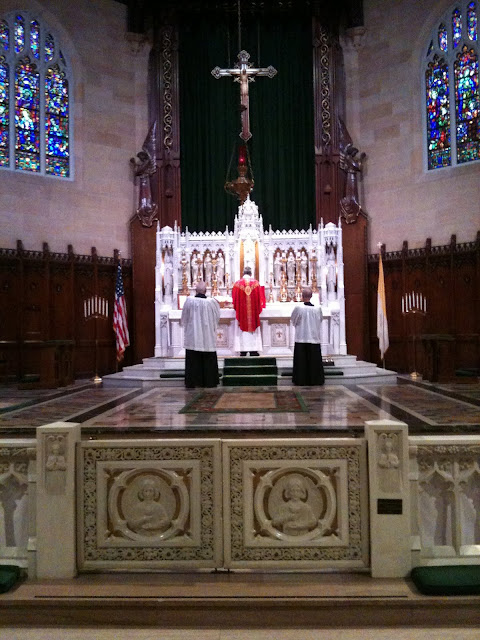
At the wonderful parish, Assumption Grotto, in Detroit, the free-standing altar set up in the middle of the sanctuary – in front of the beautiful main altar – has now been removed.

The blog Te Deum Laudamus covers what is going on at Assumption Grotto and there are photos.

That, friends, is what the sanctuary was designed to look like.

Compared to:

Think of all the money that was spent over the last decades to ruin churches that could have been used for other parish needs, all in the name of the Second Vatican Council which never mandated these wreckovations.

As I understand it, the removal of the ironing-board altar… sorry, perhaps that is too dismissive… picnic-table altar… was the result of a patient process.  Over the years some ad orientem Masses were reintroduced, then the high altar was used, the Extraordinary Form was brought in, and then it became obvious that the table, blocking the sanctuary, had to go.  The table altar was nice, for a table altar.  But, in front of that beautiful main altar?  I call to mind an essay in Notitiae which established that the principle of the unicity of the altar in the sanctuary was so important that where there was a fine main altar, nothing should be set up in front of it and that a desire for versus populum should be sacrificed.  An easy sacrifice, frankly.

Clearing that sanctuary is a concrete gesture for the promotion of the New Evangelization.

WDTPRS kudos to Fr. Perrone!

The parish could use your support.  There is a donation button which you can use right after you use my donation button!

Posted in Brick by Brick, Fr. Z KUDOS, Liturgy Science Theatre 3000, New Evangelization, Our Catholic Identity, The future and our choices | Tagged , , , ,
26 Comments

QUAERITUR: Putting incense in thurible while seated

From a reader:

Is it permissible for a priest to load a thurible whilst sitting? I
thought I heard only a bishop was allowed to load the thurible sitting and the priest must stand.

I can’t off the top of my head think of a moment in the Extraordinary Form when the priest would load, or charge, the thurible while seated. However, when I was frequently celebrant for “high” Masses at St. Agnes in St. Paul, before the Gospel I would charge the thurible while seated.  I am not sure that that was properly done, since I believe this is an episcopal privilege, but that is what we did.  When I am celebrant I obey the MC.

However, the priest (and deacon) can always load his Beretta when seated, which is a good idea as the smoke clears.

Posted in "How To..." - Practical Notes, ASK FATHER Question Box, Linking Back, Liturgy Science Theatre 3000 | Tagged , ,
14 Comments

Brick By Brick in Ireland

For your Brick By Brick file comes this good news.

I learned from a friend (and I think the news is now getting around) that the Institute of Christ the King has obtained a church in Limerick, Ireland.

The rather wordy press release is HERE.

Here is a nice bit of news in it:

The prior of the Church of the Sacred Heart is a 38 year-old priest, Canon Wulfran Lebocq, choir-master of the Institute and permanently resident in the diocese since 2010. For the time being, the community in Limerick is composed of four members, whose average age is 32.

HERE.

Brick by Brick!

Posted in Brick by Brick, Just Too Cool, New Evangelization, Our Catholic Identity, SUMMORUM PONTIFICUM | Tagged ,
7 Comments

Fr. Hugh Twaites, SJ – R.I.P.

I saw this on the site of His Hermeneuticalness, Fr. Finigan, whom I hope to see fairly soon:

A correspondent just sent me news of the death of Fr Hugh Thwaites SJ earlier today. I had the privilege of meeting Fr Thwaites when I was a young student and from time to time since then. He converted to the Catholic faith as a result of his experience as a prisoner of the Japanese during World War II. He never bore resentment for his treatment, reasoning that the Japanese guards did not have the benefit of the Christian faith. His approach to evangelisation was direct and simple because he understood the truth and beauty of the Christian faith and wished others to benefit from it.

Fr Thwaites always spoke in a kindly and gentle manner while firing off spiritual advice that could blow you off your feet; he was a priest who made many converts almost instantly by his sincerity and holiness, and converted countless lukewarm Catholics to a deeper following of Christ. He was passionately devoted to the Rosary, loved the older form of the Mass, and remained faithful to the traditional Jesuit daily spiritual exercises.

May the Lord have mercy on his soul, forgive any sins he committed through human frailty, and bring him speedily into the presence of Our Lord, in the company of Our Lady whom he loved so faithfully and St Ignatius whose way of life he followed with fidelity. Requiescat in pace.

Euge serve bone, et fidelis, … intra in gaudium domini tui.

Update 25 Aug:

A reader sent me this:

Oddly enough the funeral rite for Father Hugh Thwaites SJ will be in the New Rite. This wasn’t his wish. Ironically, a few days after his death, it has been announced that the Institute of Christ the King have purchased the former, wonderful, Jesuit church in Limerick (Ireland) as an exclusive Old Rite parish. The Jesuits are disappearing in Ireland, as they are in this country and around the world.

What a shame that those “in charge” would not honor Fr. Thwaites’ wishes for his funeral.

What a shame.

Granted, we should not follow requests for things that liturgical abuses.  But there is nothing wrong with requesting the Extraordinary Form.  And given the fact that this was Fr. Thwaites, … it’s just a shame.


Posted in PRAYER REQUEST | Tagged , ,
15 Comments

Neil Armstrong: R.I.P.

In your kindness, please stop and pray for Neil Armstrong, who has died at the age of 82.

[wp_youtube]HCt1BwWE2gA[wp_youtube]

Posted in Look! Up in the sky!, PRAYER REQUEST | Tagged ,
12 Comments

IMPORTANT: PCED response to two “dubia” about “legitimacy” in Universae Ecclesiae

I am on the road, and it is hard for me to work with this, but here is a first go at something which I think is pretty important.

The following article copy-pasted from the PDF of the 8/23/2012 edition of The Wanderer.

Pontifical Commission Ecclesia Dei
Issues Response Favorable To Traditionalists

A bishop who wishes to remain anonymous recently submitted two dubia to the Pontifical Ecclesia Dei Commission [Actually, it’s PCED.], regarding the interpretation of “legitimacy” in the 2011 instruction Universae Ecclesiae, n. 19. The response from the commission is conciliatory to hard-line traditionalist groups [ehem… and not so “hard line” also.  Who wrote this?] such as the SSPX, because Rome is only requiring devotees of the Extraordinary Form Mass to acknowledge that the Ordinary Form is “legitimate” from the standpoint of human (ecclesiastical) law, not necessarily from the standpoint of divine law. [That seemed reasonable to me, since Summorum Pontificum is a juridical document.] It also means Rome is not requiring Catholics who want access to the Extraordinary Form Mass to admit that such innovations as altar girls and Communion in the hand are acceptable in God’s sight. We reprint below the letter submitted by the bishop and the response of the pontifical commission.

The author of the bishop’s letter is a retired theology professor. He passed that letter and the Roman response to The Wanderer after the response was forwarded to him by the bishop concerned.

Two Dubia Submitted To The Pontifical Commission [Alas, we don’t have the date, though I think we can assume that it was fairly recent.]

In article 19 of the commission’s instruction of April 30, 2011, UniversaeEcclesiae (UE), it is laid down that those Catholics who desire celebrations of the Eucharist in the extraordinary form of the Roman Rite (using the 1962 Missal) may not support, or be members of, any groups which “challenge the validity or legitimacy” (validitatem vel legitimitatem impugnent) of the ordinary form.

While very few still question the validity of Mass celebrated with the reformed Roman Missal, certain prominent “traditionalist” groups, individuals, and publications have been openly and defiantly challenging its legitimacy.  [In a nutshell, while most will admit that Paul VI had the juridical, legislative authority to impose the Novus Ordo, he didn’t have the – let’s put it this way – moral or even religious authority.  He had the right/power but he didn’t really have the right.] However, there often appears to be confusion and conflicting assumptions in these circles as to how, precisely, the latter word is to be understood. As a result, it is not always clear to those priests wishing to serve Catholics attached to the traditional liturgy whether or not some of these folks are in fact in compliance with this requirement of the Apostolic See enunciated in UE, n. 19.

In order, therefore, to clarify this matter and facilitate a consistent pastoral application of article 19, could the Commission graciously consider and respond to the following two dubia? [He set this up well.]

1. Whether legitimitas in UE, article 19, is to be understood as meaning:

(a) duly promulgated by appropriate procedures of ecclesiastical law (ius ecclesiasticum); [let’s call that 1A] or

(b) in accord with both ecclesiastical law and divine law (ius divinum), that is, neither doctrinally unorthodox nor otherwise displeasing to God. [1B]

2. If (b) above represents the mind of the Commission in regard to the meaning of legitimitas, whether UE, n. 19 is then to be understood as allowing access to Mass in the extraordinary form:

(a) only to those Catholics who  do not challenge the legitimacy of any specific text or practice whatsoever that has been duly approved by either universal or local ecclesiastical law for use in celebrating the ordinary form; [altar girls, Communion in the hand, etc. – 2A] or

(b) to those faithful mentioned in (a) [2A] and also to those who acknowledge in principle the legitimacy of Masses celebrated according to the reformed Roman Missal and its General Instruction, but not the legitimacy of certain specific practices which, while not mandated therein, are permitted as options by universal or local liturgical law. [altar girls, Communion in the hand, EMHC’s, etc., are all permitted.  They are actually deviations from the norm (i.e. male only service, Communion on the tongue, distribution by clergy, etc.]

The second dubium has in mind those many traditionally inclined Catholics who accept the legitimacy (in sense l [b] above [the Novus Ordo is “legitimate” by both Church law and divine law]) of ordinary-form Masses in which more traditional options are used, [I am not sure the questioner gets this wording right here, but go on…] but who regard as wrong and displeasing to God certain practices which were for many centuries universally disapproved and forbidden by the Church but which are now permitted by the local liturgical law of many or most dioceses or episcopal conferences (e.g., Communion given in the hand, female altar service, and the use of extraordinary lay ministers of Communion).  [Clear?]

Rome’s Response

Pontificia Commissio Ecclesia Dei

Prot. 156/2009 [WOAH  2009?  This goes back a while.  So, the questions raised were raised a long time ago and were recast in a new form after UE came out, or the PCED decided to economize and not open another protocol number and use a new folder.  If it were not something that was a continuation, it would have a protocol of 2012.  Anyway, Father’s tired and his brain hurts.]
Vatican City, 23 May 2012

Your Excellency,

This Pontifical Commission has received, via your Excellency’s good offices, a copy of a correspondence from [name blacked out] placing before the Commission two dubia as to the interpretation of article 19 of this Commission’s Instruction Universae Ecclesiae.

The first [dubium] asked whether legitimas in UE, article 19, is to be understood as meaning:

(a) Duly promulgated by appropriate procedures of ecclesiastical law (ius ecclesiasticum); or

(b) In accord with both ecclesiastical law and divine law (ius divinum), that is, neither doctrinally unorthodox nor otherwise displeasing to God.

This Pontifical Commission would limit itself to saying that legitimas is to be understood in the sense of 1(a). The second [dubium] is responded to by this answer. [Interesting.  They answer the 1st dubium.  Instead of then going on to say to the 2nd dubium either yes or no explicitly, the response says no (that is, it is not to be considered “legitimate” also in the sense of ius divinum, that is, stick with the answer we just gave you.  In other words, it is A (ius ecclesiasticum and not also ius divinum) but we don’t want to go into the weeds.]

With the hope that Your Excellency will communicate the contents of this letter to the individual concerned, this Pontifical Commission takes this opportunity to renew its sentiments of esteem.

Sincerely yours in Christ

Mons. Guido Pozzo
Secretary

My impression is “When you get the answer you want, don’t keep asking.”   The PCED answered ius ecclesiasticum (at least) and then stopped.   “‘Shut up!’, they explained.”, isn’t quite it, but I’ll take it.

By this response, the PCED is clarifying that those who want the older form of Mass do NOT have to admit that practices such as Communion in the hand, or altar girls, or EMHCs, etc., are good.  They might be legal, but they might also be abominations in the sight of God … depending on your point of view.  Furthermore, a priest or a bishop cannot say “Because your group, over there at St. Cunigunda’s in Frostbite Falls, denies the ‘legitimacy’ of altar girls, you therefore do not quality as a stable group that can ask for the Extraordinary Form.”

Posted in "How To..." - Practical Notes, Liturgy Science Theatre 3000, Our Catholic Identity, SUMMORUM PONTIFICUM, The Drill, The future and our choices, Universae Ecclesiae | Tagged , , , , , ,
36 Comments