Trinity Sunday can be a tricky moment for a preacher.
Was there a good… I wrote GOOD… point in the sermon you heard for your Sunday Mass?
Let us know what it was.

Trinity Sunday can be a tricky moment for a preacher.
Was there a good… I wrote GOOD… point in the sermon you heard for your Sunday Mass?
Let us know what it was.
The Metropolitan Museum is jam-packed today, which is to be expected. I limited myself to a brief assault just to see a couple pieces. I did, however, want to share a Christological goldfinch in this painting by Sano di Pietro (+1480). The Sienese like the finches. They also often show little Jesus with some Mom’s veil in his hand.

A closer look.

I am pretty sure that grasping her veil or cloak is a reference to His having taking our humanity from her.
I also liked this delightful (not quite) still life by Georg Flegel (+1630):


An early version of: Today I am as happy as a bird with a French fry!
It’s time to get out into the wind and the sun, to find some dappled paths and soughing in the leaves.

UPDATE:
A beautiful day in the park.


UPDATE
After supper, I got a lift home from friends. Heading across town on 46th we saw a HUGE nearly full dark yellow moon rising between the buildings across the width if the island.
The photo doesn’t do it justice.


A little while ago, some people who hate on the new translation of the Roman Missal had a little survey of priests and their reception of the translation. It may not come as a huge surprise that the survey found that the majority of priests didn’t like it!
An expert on polls looked at the survey and offered that the results are probably not accurate. The respondents were self-selecting. Therefore, those who responded were those who wanted to vent. Even then, only only 59% didn’t like it, compared with 39% who did like it.
Sheesh! My polls are self-selecting too, but even I get better results than that!
From CNA with my emphases and comments:
Survey on priests’ dislike of Missal may be inaccurate
By Carl BundersonHamden, Conn., May 25, 2013 / 04:03 pm (CNA/EWTN News).- A survey of U.S. priests’ attitudes towards the new English translation of the Roman Missal showing “widespread skepticism” may be inaccurate because of its methods, according to a polling expert.
On May 21, St. John’s School of Theology, located in [liberal]Collegeville, Minn., released its survey results saying that the majority of priests in America dislike the new Missal.
Of the some 1,500 priests who responded to the survey, 39 percent like the new text, and 59 percent dislike it, according to the Collegeville survey.
“All 178 Roman Catholic Latin rite dioceses in the U.S. were invited to take part in this study; 32 dioceses participated…in the period February 21 – May 6, 2013, priests in participating dioceses were invited to participate in the online survey via an email to all priests on the diocesan distribution list,” according to the survey’s executive summary.
Peter Brown, who is assistant director of Quinnipiac University’s Polling Institute, discussed polling procedures with CNA May 23. [NB:]“Random sampling is the key to getting accurate poll results,” he said.
Since only a few dioceses chose to participate in the survey – just under 18 percent – and only some priests in those dioceses chose to respond, survey respondents were “self-selecting.” [That means that the sample wasn’t representative of priests in the USA.]
“They participated not randomly, but because they were the ones that chose to respond,” Brown explained. “Self-selected samples are not generally thought of….they don’t produce a random sample.”
Since polls rely on a small number of people to represent the attitudes or beliefs of a larger population, “you have to be absolutely sure that the random group is a random group.”
The Collegeville survey, Brown said, “might not meet those criteria” since its participants were self-selecting.
“It’s very difficult to know exactly” in this particular case, he added, though he had noted that self-selecting samples are generally not random. [Did he mentioned “self-selecting”?]
The survey’s project manager, Chase Becker, is a graduate student in liturgical studies at St. John’s School of Theology, and holds a bachelor’s degree in philosophy. No ostensible polling experts were involved, and the survey’s professional consultant was an associate professor of psychology at the institution. [LOL!]
The poll also had no indication of its margin of error. [It just get’s better, doesn’t it?]
The survey’s results were welcomed by vocal critics of the new translation, such as Bishop Donald W. Trautman, Erie’s bishop emeritus. [There’s a shocker.]
[…]
You can read the rest of the autopsy over there.
And so we begin another trip. New author, too!
I wonder if he will hold even a candle to Patrick O’Brian. I hope he ain’t a slubberdegullion or a blatteroon.

UPDATE:
Time for the next leg.
This is starting out to be pretty strange.
UPDATE:
Ugh.
I am glad that’s over. The woman next to me was so bizarre, so irritating, so … ugh… that the flight crew was apologizing to me by the time we were on the ground.
But my bag arrived right away and my ride is nearby and I am neither too tired nor too hungry.
All in all…
From a reader:
I am a Seminarian who is in a parish which has a “Vigil Mass of Sunday” on Saturday evenings. I have read your posts regarding receiving communion twice in one day, and I know the “Vigil” Mass legally fulfills ones obligation. My question is; does this mean I can’t receive communion on Saturday night and the two Sunday Masses (I sometimes have to serve all three)? Would it be a mortal sin?
No, all things being equal it is not a mortal sin. Yes, the law permits that you receive Holy Communion on Saturday evening and then twice on Sunday.
Reception of Communion and fulfilling your Sunday obligation are different issues. You fulfill your obligation by participating, attending Holy Mass. You are not obliged to receive Communion at every Mass. As a matter of fact, if you know you are not in the state of grace, you should not receive Communion.
Back to the issue of the number of times you may receive in a 24 hour period.
The 1983 Code of Canon Law says:
Can. 917 – Qui sanctissimam Eucharistiam iam recepit, potest eam iterum eadem die suscipere solummodo intra eucharisticam celebrationem cui participat, salvo praescripto Can. 921, § 2. … Someone who has already received the Most Holy Eucharist can receive it again (iterum) on the same day only within the Eucharistic celebration [i.e. Mass] in which the person participates, with due regard for the prescription of can. 921 § 2.
Remember: iterum does not mean “again and again”, but merely “again one more time”.
Also, that “Eucharistic celebration” in the canon does not mean just any service involving Communion. It means Mass. That was cleared up by the Holy See in an official response to a dubium.
Can. 921 § 2 says that if a person is in danger of death, he may receive Communion even it is not in the context of Mass. That is Viaticum.
Saturday ends at midnight. At midnight Sunday begins. You can receive even twice on Saturday and then twice on Sunday.
Work out with your spiritual director whether or not you want to receive three times in such a short time span.
Since it’s Friday, and since I was down about something today, it is time to post something funny.
I’ve posted it before, but it is still funny!


In the combox under a different entry, one of the participants here posted a link to a video that wasn’t perfectly relevant to the topic, but… I can’t resist sharing it with a wider audience.
Keep in mind that the Latin Church example is pretty strange. I don’t the maker of the video had any intention to be “fair”. But that underscores a problem, doesn’t it? The Novus Ordo is susceptible to this.
Anyway… it is an interesting video.
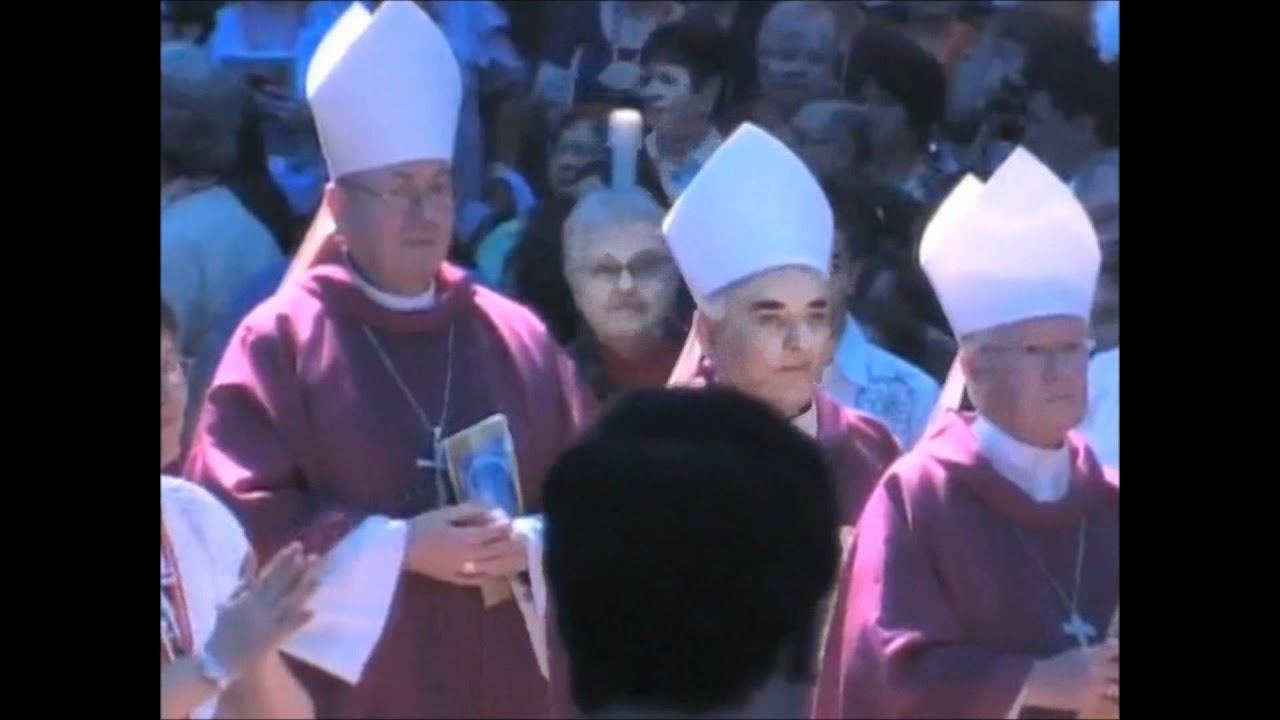
Yesterday the Holy Father lead a profession of Faith for all the Italian bishops as they are meeting in plenary session. He addressed them. At the end of the address, Francis pronounced a prayer to Mary which should move any but the coldest heart.
This isn’t Secretariat of State boilerplate. This is Francis.
Some context: Before this prayer, Francis had mentioned that the first faithful bishops have are their priests. He spoke about obedience and self-emptying, the gift of self as what distinguishes pastoral ministry. He mentions the Devil again, of course. He warns about the seduction of a career, money, laziness, being a functionary, worrying about structures more than people. The whole thing bears reading.
Then, after saying “I place you, and I place myself, too, under the mantle of Mary, Our Mother”, he concluded with this!
Mother of the silence that preserves the mystery of God, deliver us from the idolatry of the present, to which those who forget are condemned. Purify the eyes of pastors with the balm of memory:that we might return to the freshness of the beginning, for a praying and penitent Church.
Mother of the beauty that blossoms from fidelity to daily work, remove us from the torpor of laziness, of pettiness, and defeatism. Cloak Pastors with that compassion that unifies and integrates: that we might discover the joy of a humble and fraternal servant Church.
Mother of the tenderness which enfolds in patience and mercy, help us burn away the sadness, impatience, and rigidity of those who have not known what it means to belong.
Intercede with your Son that our hands, our feet and our hearts may be swift: that we may build the Church with the truth in charity.
Mother, we will be the People of God, on pilgrimage towards the Kingdom. Amen.
Benedict has his voice. Francis has his.
From a reader:
we will be on a Greek island without a Catholic church on a Sunday:
can we attend the Greek mass and/or receive the Sacrament?
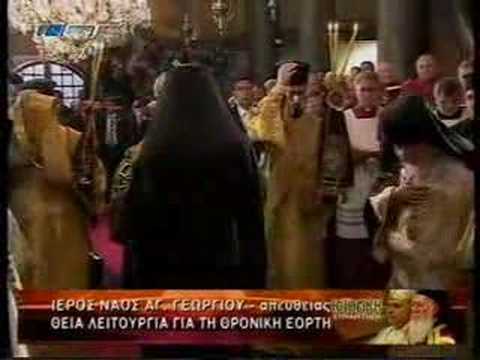
You can, and I think should, attend the Greek Divine Liturgy if attending a Catholic Mass is not possible. The impossibility of attending a Catholic Mass in a Catholic church or chapel that day absolves you of your obligation (no one is bound by law to do what is impossible).
Even though you can’t fulfill your canonical Sunday obligation, and therefore you are absolved of that obligation, you still have an obligation in natural law to worship God.
Since the Liturgy of the Greek Church is valid and reverent, you can surely fulfill your natural law obligation than to worship with the Greek Orthodox Church.
As to the reception of Holy Communion, can. 844 §2 states,
“whenever necessity requires or a genuine spiritual advantage commends it, and provided the danger of error indifferentism is avoided, Christ’s faithful for whom it is physically or morally impossible to approach a Catholic minister, may lawfully receive the sacraments of penance, the Eucharist, and anointing of the sick from non-Catholic ministers in whose Churches these sacraments are valid.”
Therefore, it is possible, from the Catholic perspective, to receive. However, the Greek Orthodox Church may differ!
As I understand it, the Orthodox do not entirely agree with us on this principle. They will not, as I understand it, administer the Eucharist to non-Orthodox congregants. In other words, we say we may receive from them, but they say they will not give to us.
Out of respect for their law and practices, it would probably be best not to approach to receive Communion.
You have, instead, the opportunity to make a Spiritual Communion.
Use Communion time to pray, not only for the unity of our Church, as Christ Himself willed, but also for all those who should not receive the Eucharist, perhaps because of irregular marriage situations or even the lack of a priest for their parish.
And I’ll just say it again:
Benedict XVI was the Pope of Christian Unity.
UPDATE:
Some people are shocked that I suggested attending liturgical worship of God in an Orthodox Church. Some even suggest that I am advocating mortal sin.

Coat of Arms by D Burkart









A Daily Prayer for Priests


They find you a pro-life agent in your area who commits to giving a portion of the fee to a pro-life group!

PLEASE subscribe via PayPal if it is useful. Zelle and Wise are better, but PayPal is convenient.
A monthly subscription donation means I have steady income I can plan on. I put you my list of benefactors for whom I pray and for whom I often say Holy Mass.
In view of the rapidly changing challenges I now face, I would like to add more $10/month subscribers. Will you please help?
For a one time donation...



Help Monks in Wyoming (coffee – UPDATED LINK) and Norcia (beer) and the wonderful "Soap Sisters" of Summit, NJ!


Please follow me on Twitter!










Visits tracked by Statcounter
since Sat., 25 Nov. 2006:


