A long-time reader alerted me to an interesting article on the non-Catholic site The Christian Century (“a progressive, ecumenical magazine based in Chicago”). The writer, Carol Zaleski, professor of world religions at Smith College in Northampton, MA, makes some comments on the new, corrected translation of the Roman Missal which be in use pretty soon.
Here is the last part of her piece with my emphases:
If reception of this new translation is as generous as it should be, the period of adjustment will be a chance to rediscover the shape of the liturgy and the essentials of Christian belief and hope. The biblical concreteness of the liturgy and its humbling, exultant, awe-inspiring notes, muted in the old translation, are about to be restored. Thus, for example, when the celebrant echoes the angelic and Pauline greeting, “The Lord be with you,” the congregation responds, “and with your spirit,” a more vivid and theologically interesting translation of et cum spiritu tuo than the functional “and also with you.” In the Gloria, “We praise you, we bless you, we adore you, we glorify you, we give you thanks for your great glory,” replaces the tepid abridgment to “we worship you, we give you thanks, we praise you for your glory,” so that the summons to adoration may come across as clearly as in the biblically based original. Threefold petitions and rhythmic repetitions, once stripped from the English in the interest of simplicity, evoke a sense of mystery that surpasses prosaic speech.
The Credo duly begins “I believe,” spoken in unison to convey at once the individual and corporate character of faith. In the account of creation, “all things visible and invisible” maps the material and spiritual cosmos more adequately than “all that is seen and unseen.” Speaking of Christ as “consubstantial with the Father” and “incarnate of the Virgin Mary” plumbs the divine-human nature more deeply than the abstract “one in Being with the Father” and “born of the Virgin Mary.” In “Holy, Holy, Holy Lord God of hosts” the angels return, having been exiled for no fault of their own from the English Sanctus. Just before communion, the centurion’s voice rings out again: “Lord, I am not worthy that you should enter under my roof”—living words that transport the worshiper into the gospel environment. Best of all, we get to reclaim the beautiful and dignified word soul from the dustbin to which a passing fad in theological anthropology had consigned it; “only say the word and my soul shall be healed” universalizes the centurion’s petition and intensifies the communicant’s prayer.
Change can be unsettling, but in this case the change is right and just. The postconciliar Catholic mass has found its English voice. The best response I can imagine is a Hebrew word that survives intact in all tongues, the final word of the New Testament—Amen.
Great comments. Well written. Fair-minded. Properly informed.
Prof. Zalesky is decidedly more positive than many I have read from Catholic writers of a certain persuasion.
Also, some time ago she wrote a terrific article for First Things about the long “dark night of the soul” experienced by Bl. Teresa of Calcutta.
WDTPRS kudos to the writer from this self-described progressive ecumenical site!
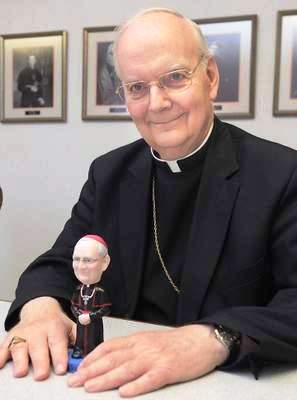 Erie’s Trautman gets bobblehead bishop
 From a reader:



 ProfessorCover on Daily Rome Shot 1116: “This reminds me of something Thomas Pink said in a response to a question fromAndrew Cusak: Many European Bishops are…”




























