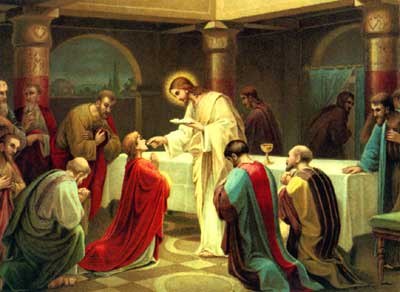
QUAERITUR: Degrees of dialogue during the Extraordinary Form – WDTPRS POLL

QUAERITUR: Degrees of dialogue during the Extraordinary Form - WDTPRS POLLI do confess that it is sometimes disconcerting while saying Mass in the Extraordinary Form, to turn around, say “Dominus vobiscum” and not even hear crickets in return and barely a chirp from the server(s).  I have gotten used to this, over the years, of course, but it is still strange.

Of course we keep in mind that, when talking about the Extraordinary Form, the classic view is that the sacred texts of Holy Mass are ideally pronounced only by clerics.  By extension they are pronounced by those who substitute for clerics.  Nevertheless, quite a while before the Second Vatican Council, certainly under the influence of the Liturgical Movement, Popes and the Congregation for Rites had already made provisions for different levels of responses on the part of the congregation.

The “dialogue Mass” was born.

So… how does the dialogue Mass fit with our use the provisions of Summorum Pontificum?  They are certainly permitted, since they were permitted at the time the 1962 books were in force.

From a priest:

Father, thanks for all you do. I have started an extraordinary form Low Mass at my parish and I was wondering about the peoples responses in the Mass. It seems this issue becomes black and white for many, i.e. no responses at all or always a full dialogue Mass. My grandmother’s old Missal shows there were/are 4 degrees of dialogue – the highest degree is when people make all the server’s responses and the lowest degree is when the people say a few of the short responses (et cum spiritu tuo, deo gratias). I find the later, the lowest degree, to be the most suitable as it seems to keep the integrity and solemnity of the older form without denying the people some vocal responses. I find that the full dialogue seems to harm the solemnity of the Mass. For instance, I find that when the people respond to the prayers at the foot of the altar, the Mass is rather noisy and impersonal for the priest. Any thoughts or comments?

“For the priest….”   Okay.  Welllll… Mass isn’t all about Father.  Yes, it’s “Father’s Mass”, in that he is the single indispensable person present.  It is good when he focused on doing his part well and he is recollected.  But if the doors are open, it is a scheduled Mass, then, by their baptism, people also participate in a genuine way.  But “for the priest…”,… yes, sure.  I think the priest should, for the most part, just focus on performing his role properly, saying the black and doing the red, without screwing up or imposing himself on the action.

Much of this hinges also on what we mean by “active participation”.

“Active participation” applies just as much to participation in the older form of Mass as in the newer.  The problem is that the very notion of “active participation” has been distorted beyond recognition by many of the liberal liturgist stripe to mean singing every word, clapping, carrying stuff around, taking liturgical roles that properly belong to the priest, etc.  On the other hand, what the Church really means by “active participation” must begin with an interior activity which at proper moments and ways leads to an outward expression.

To take this another step, only the baptized are able to participate in the sense meant by the Church.  Only the baptized, through their common priesthood, are able to join their sense of sacrifice to that of the ordained priest.  Only the baptized receive the graces that come from reception of the Eucharist.  In fact, just before the Council in a document on sacred music, there is a description of the most perfect form of “active participation”: reception of Holy Communion in the state of grace.  It really all comes together in that, no?  “Active participation” is first and foremost our active receptivity to what Christ is offering through the sacred mysteries of our liturgical worship.  Reception of Holy Communion requires that the baptized person in harmony with the Body of Christ the Church be properly disposed physically and spiritually to receive.  They then physically, that is outwardly, get up, go forward, and in a physical action receive.  At other times they engage their will to receive by listening, watching,  then inwardly pondering and weighing, etc.   I once gave a sermon on this issue of active participation in light of the Magnificat and Mary’s pondering of mysterious things before giving outward expression.

That said, since “active participation” should lead to outward expression, it is hard to find fault with the Catholic who, with the Church’s permission, says “Dominus vobiscum” when sitting in the pews, or even sings it with the choir!   At the same time, I cannot find a reason to fault a person who wants to be quiet and even say the Rosary, just being there, as it were, and then receiving Communion… or not.  We all have different ways to participate at different moments in our lives.

We also have to consider liturgical decorum. We have to weigh what is aptum et pulchrum, the signs and outward expressions which are fitting for liturgical worship.  It may be that bad singing is, after all, not actually apt for liturgical worship.  I have had the experience of an entire congregation singing well the whole Gregorian Chant ordinary.  It was great. On the other hand, if a congregation isn’t ready to sing things, then it may be good to wait until they can and provide instruction until they can.

This is a complicated question and, frankly, I don’t think there is a single answer for all circumstances.  A good deal rests on the sensibilities and abilities of the congregation.  I don’t think there should be rigid uniformity in this.  Each community is going to have to find their mode of doing things in this regard, always under the prudent and well-informed tutelage of the priest.

Again, remember that this “dialogue”, at different levels, was in fact permitted quite a while before the Council.

Just so that people don’t have to ask, here in a nutshell are the degrees that were permitted.

The parts that could be said or sung by the congregation were of two kinds: the parts to be sung at High Mass (Pontifical, Solemn, Sung), and the parts which are responses of the ministers or the server at Low Mass.  Keep in mind that the servers and ministers responded on behalf of the congregation.  The 1958 document Musica sacra, alluded to above, divides dialogue Masses down into four degrees of outward, vocal expression.  In a nutshell,

  1. The congregation makes the shorter responses such as the Amen, Deo gratias, Et cum spiritu tuo along with the servers.
  2. Same as above but adding all the responses of the servers, including the prayers at the foot of the altar, Second Confiteor where used, etc..
  3. Same as above adding the Ordinary (e.g. Kyrie, Gloria, Credo, etc.) together with the priest and/or choir.
  4. Same as above adding even the Propers (Introit, etc.) with the priest and/or choir.

Certain texts of the Mass are reserved to the priest, and should never be said aloud by the faithful.  Period.

Another problem arises from a divided congregation: some want to respond while others do not.  Also, sometimes the priest wants no responses but the congregation does, etc.  It would probably be a good idea for priests and people to be on the same page with this and, for visitors, make know what is done in some particular place through a note in the bulletin, hand out, etc.

Let’s have poll.  Chose your best answer – I won’t be able to cover all possibilities – and leave your comment in the combox.  You don’t have to be registered to vote.

QUAERITUR: Degrees of dialogue during the Extraordinary Form - WDTPRS POLLI am interested what other people have to say about this.   Given that this is a topic about which many  have strong views, I will impose on the combox once again the stricture:

Do not engage each other.  Let others have their say without fear of being attacked.

Think about this, have some Mystic Monk Coffee, and vote.

I think you can pick TWO answers.

About Extraordinary Form "dialogue" Mass.

View Results

Loading ...
Posted in "How To..." - Practical Notes, ASK FATHER Question Box, POLLS, SUMMORUM PONTIFICUM, The Drill | Tagged , , , ,
42 Comments

SSPX Bp. Fellay on the state of the “talks” and how the Holy Father is being undermined

SSPX Bp. Bernard Fellay, at a recent ordination in Winona, MN, told his followers that rumors about the break down in talks with the Holy See should be taken with caution.  Fellay wanted people to know that he is supposed to meet again with the CDF, at the request of Card. Levada, in September.

Along the way there are some strong statements in support of Pope Benedict. He explains to these SSPX followers that the Holy Father’s initiatives are being blocked and undermined by the people surrounding him.  Fellay provides several examples.

Go here for more.

Posted in SESSIUNCULA | Tagged ,
35 Comments

Reaction of NY bishops to the unions-contrary-nature legislation

From the website of the Archdiocese of New York.

My only question… was there a statement of all the bishops before the vote took place?

The following is a statement from Archbishop Timothy Dolan and the bishops of New York State:

The passage by the Legislature of a bill to alter radically and forever humanity’s historic understanding of marriage leaves us deeply disappointed and troubled.

We strongly uphold the Catholic Church’s clear teaching that we always treat our homosexual brothers and sisters with respect, dignity and love. But we just as strongly affirm that marriage is the joining of one man and one woman in a lifelong, loving union that is open to children, ordered for the good of those children and the spouses themselves. This definition cannot change, though we realize that our beliefs about the nature of marriage will continue to be ridiculed, and that some will even now attempt to enact government sanctions against churches and religious organizations that preach these timeless truths.

We worry that both marriage and the family will be undermined by this tragic presumption of government in passing this legislation that attempts to redefine these cornerstones of civilization.

Our society must regain what it appears to have lost – a true understanding of the meaning and the place of marriage, as revealed by God, grounded in nature, and respected by America’s foundational principles.”

+Timothy M. Dolan
Archbishop of New York

+Howard J. Hubbard
Bishop of Albany

+Nicholas DiMarzio
Bishop of Brooklyn

+Edward U. Kmiec
Bishop of Buffalo

+Terry R. LaValley
Bishop of Ogdensburg

+Matthew H. Clark
Bishop of Rochester

+William F. Murphy
Bishop of Rockville Centre

+Robert J. Cunningham
Bishop of Syracuse

Will this be read from all the pulpits of all the dioceses of New York?

Posted in SESSIUNCULA | Tagged , ,
66 Comments

PRAYERCAzT/PODCAzT: Corpus Christi: singing the whole nine yards

I again inflict my singing on you for most of this project.

Quite a while back I started a PRAYERCAzT series, wherein I read and/or sang the prayers and readings for upcoming Sundays and Feasts for the Extraordinary Form. I meant to be helpful to men who were faced with singing the texts and who were, perhaps, not so familiar with what to do. It was also meant to help people in the pews get the sounds of the Latin into their ears so that their participation at Mass would be more comfortable and fruitful.

Not long ago I received a very useful new book which published by the Canons regular at St. John Cantius in Chicago. The book is called Canticum Clericorum Romanum, and it is the first volume.

In the celebration of the older, traditional form of Holy Mass in the Roman Rite, the Extraordinary Form, when Mass is celebrated with greater solemnity, the texts are sung. The prayers or orations, the readings, the preface, every thing is sung. This volume has all the texts for all the Sundays of the year and most major feasts in Gregorian musical notation. Not only that, since there are different tones or melodies we can use to sing texts, the book has the alternative tones as well.

Some time ago I started an audio project, especially intended for priests, who might have to sing the texts during the Extraordinary Form but who may not be very familiar with these old Roman ways.

Priests, deacons (actual deacons and priests who serve as deacons), laymen who serve as “straw subdeacons”… must sing texts, which for some men is nerve wracking enough. You wind up looking at examples of paradigmatic texts in, say, the Liber Usualis, and then you look at the Missale, perhaps making a photocopy, perhaps penciling in lines under the vowel where you are supposed to go up….

This new book from the canons in Chicago book has it all laid out.

What I do in this audio project is sing through all the texts of the Mass, in the different alternatives, for Corpus Christi, often transferred to Sunday. For the collect there will be a festive tone and a solemn tone. The first reading has its own tone. There are three possibilities for the Gospel, the tonus evangelii, tonus antiquior, tonus ad libitum. There is no tone, of course, for the Secret because it is silent. And then the two tones we had for the Collect also used for the Post Communion.

This book does not have prefaces, which are in the Missale Romanum. But there are three tones for the Common Preface, in the ferial, solemn and more solemn.  The ferial tone would not be used on Corpus Christ.

I’ll sing through the prayers and texts using the new book from the canons. Then I will switch books and sing all three versions of the Common Preface. You will notice the different introductory dialogues. I suggest before singing the tonus solemnior that perhaps you could start with the tone for the tonus solemnis, which people are more likely to know, and then switch seamlessly into the tonus solemnior. That way, you don’t have chaos at the beginning.

PRAYERCAzT/PODCAzT: Corpus Christi: singing the whole nine yardsI am doing this so that people can hear the different tones, with the same texts, and, if some priest or deacon out there finds them useful as he looks at the texts and wonders how to sing them, well… this is a public service as it were.

Posted in "How To..." - Practical Notes, PODCAzT, PRAYERCAzT: What Does The (Latin) Prayer Really Sound L |
7 Comments

Eucharistic FLASH MOB – WDTPRS POLL

Please watch this whole video before reacting.  Then think about it for a few minutes before reacting.

A Franciscan priest and a small group with him took it to the streets and staged a Eucharistic Flash Mob.

[wp_youtube]cZ5aYoSr3Hg[/wp_youtube]

What do you all think of this for urban centers in wealthy countries?

I think something like this needs some care to preserve proper reverence for the Blessed Sacrament.  I am not sure how this squares with liturgical law, involvement with the local bishop, etc.

But… if those things can be worked through…

Does this fit with the New Evangelization?

Is this what we need to do?

Let’s have a WDTPRS POLL.

Please choose your best answer along this short scale and leave a comment in the combox.

IMPORTANT: I ask that you allow everyone else to have their say.  Don’t attack other people’s opinions.  Let’s aim for the high road in the combox.

TEST POLL (because it was broken and we're fixing it))

View Results

Loading ...

UPDATE:

The Franciscan priest who organized this describes how he did this. Here.

Posted in "How To..." - Practical Notes, Brick by Brick, New Evangelization, Our Catholic Identity, The future and our choices | Tagged , , ,
127 Comments

Vespers – Nativity of John the Baptist

One frill 2nd Vespers for the feast of John the Baptist.  Vespers read from the Breviarium Romanum.  There may some some discrepancy of antiphons depending on your edition.

I sing the famous hymn Ut queant laxis.

Posted in SESSIUNCULA |
1 Comment

The showdown is coming in China over bishops

The showdown is coming in China over bishops.  This is from AFP with my emphases.

China wants to ordain bishops ‘without delay’

(AFP) – 10 hours ago

BEIJING — China’s state-controlled Catholic church wants to ordain at least 40 bishops “without delay”, its vice president said Friday, in a move likely to further irritate ties with the Vatican.

Liu Bainian, deputy head of the Chinese Patriotic Catholic Association, confirmed an official Xinhua news agency report that said more than 40 of the country’s 97 dioceses were without a bishop.

The report said leaders of China’s Catholic church had agreed at a recent meeting that they would “strive to select and ordain bishops at these dioceses without delay”.

Liu told AFP that China’s existing bishops would “help various areas to select their own bishops. It’s the best opportunity to spread the Gospel in China.”

The Vatican and China have not had formal diplomatic ties since 1951. Beijing insists it has the right to ordain its own bishops, defying the Holy See, which says ordinations can only go ahead with the pope’s blessing.

Last November, China angered the Vatican when it ordained a bishop for the northern city of Chengde without the Holy See’s approval.

Another ordination in the central province of Hubei was postponed earlier this month, although Liu said Friday it was still “under examination.”

In May, the pope himself called on Catholics across the world to pray that Chinese bishops refuse to separate from Rome, despite what he called “pressure” from communist authorities.

The Vatican and China cut ties when the Holy See angered Mao Zedong’s Communist government by recognising the Nationalist Chinese regime in Taiwan as the legitimate government of China.

The atmosphere worsened when in 1957 China set up its own Catholic Church administered by the atheist Communist government.

The 5.7 million Catholics in China are caught between staying loyal to the ruling Communist Party in Beijing and showing allegiance to the pope as part of an “underground” Church not recognised by the authorities.

Posted in Our Catholic Identity |
13 Comments

St. Paul/Mpls: Archdiocesan Corpus Christi Procession – Sunday 26 June

Archdiocesan Corpus Christi Procession, Sunday, June 26, 2:00-3:30 p.m., Little Sisters of the Poor to the Cathedral of St. Paul. Bring your family and friends for this festive walk with our Eucharistic Lord. Ice cream social follows. Park in the Cathedral parking lot and ride a free shuttle bus to Little Sisters’ from 1:15 to 1:45 p.m. Details at www.WalkWithHim.net or call (651) 239-8574.

Spread the word
Tell others; post a flyer at your church or elsewhere, available at www.WalkWithHim.net (English and Spanish).

Volunteer
Could you help us with any of the following?
* Parking and busing: we need a full crew to direct traffic and help people on and off buses
* Set-up and take-down
* Medical assistance: doctor, nurse, EMT

Support
You or your business can sponsor buses, flower arrangements for the altars, and ads.

Pray: A Short Novena for Corpus Christi (starts Friday)
O Lord Jesus Christ, You who have given us Your precious Body and Blood to be our meat and drink, grant that through frequent reception of You in the Holy Eucharist, I may be strengthened in mind and body to do Your holy will. Amen.

More details and resources (including catechetical resources, prayers, reflections by the saints, and excerpts from the texts of Pope Benedict XVI and Pope John Paul II) are available at www.WalkWithHim.net.

Posted in The Campus Telephone Pole | Tagged ,
4 Comments

What Does GIRM 160 for the USA Really Say?

What Does GIRM 160 for the USA Really Say?When the new English translation of the Roman Missal is released, it will sport a new translation of the GIRM, the General Institution/Instruction of the Roman Missal.
There are, of course, adaptations for the USA and other Anglophone regions.

As it happens, the Congregation for Divine Worship has … tweaked some items.  I am sure this was to harmonize the language of the GIRM with the language of the rest of the Roman Missal.  However, tweaks may have been tweaked for other reasons.

For example, take a look at GIRM 160 for the USA.  The Latin is found on the USCCB website.

LATIN:
… Fideles communicant genuflexi vel stantes, prout Conferentia Episcoporum statuerit. Cum autem stantes communicant, commendatur ut debitam reverentiam, ab iisdem normis statuendam, ante susceptionem Sacramenti faciant.

What Does GIRM 160 for the USA Really Say?OLDER USA ADAPTATION VERSION:
… The norm for reception of Holy Communion in the dioceses of the United States is standing. Communicants should not be denied Holy Communion because they kneel. Rather, such instances should be addressed pastorally, by providing the faithful with proper catechesis on the reasons for this norm.

NEWER USA ADAPTATION VERSION:
… The norm established for the Dioceses of the United States of America is that Holy Communion is to be received standing, unless an individual member of the faithful wishes to receive Communion while kneeling (Congregation for Divine Worship and the Discipline of the Sacraments, Instruction, Redemptionis Sacramentum, March 25, 2004, no. 91).

The rest of GIRM 160 remains as it was.

There is no mention of addressing the instances “pastorally” or giving “properly catechizing” people who kneel to receive their GOD.

In other words, when people kneel to receive Almighty GOD, priests and other ministers are to give Communion to the person and keep their mouths shut.

Posted in "How To..." - Practical Notes, WDTPRS | Tagged , ,
26 Comments

Visiting a Roman basilica? There’s an app for that.

It would be nice to have some silence during visits to beautiful churches in Europe.

This comes from CNA:

Visiting a Roman basilica? There's an app for that.Vatican hopes iPod can bring silence to Rome’s churches

Rome, Italy, Jun 24, 2011 / 06:10 am (CNA/EWTN News).- The Vatican has introduced a new way of keeping silence in their churches while also informing tourists – the iPod.

Today is the first full day of a trial which sees pilgrims to the basilica of St. John Lateran given the audio-guide with a special app explaining the 1,700-year history of the church, which serves as the Pope’s cathedral.

“I can easily say that in Italy there are no examples of experiences like this in religious contexts, probably not even those in museums,” Jelena Jovanovic said to CNA. Her company, Antenna International, created the handheld device.

The multi-lingual guide offers audio, video, photos and texts to give an interactive experience to pilgrims. It also provides historical re-enactments narrated by actors.

Tourists can now listen to the experience of their fellow pilgrims from centuries past or even a “first-hand” account of the Battle of the Milvian Bridge in 312, when the Emperor Constantine saw a cross in the sky and converted to Christianity.

But the primary purpose of the guide is not entertainment or even education – it’s prayer and silence.

Bishop Luca Brandolini, the head of Pastoral Care for the Diocese of Rome, explained to CNA that “Unfortunately, our basilicas have become more like noisy meeting places at many times.”

“We need to bring back a place and time for silence. So I think this audio-guide will help achieve that.”

The Managing Director of the Opera Romana Pellegrinaggi, the Vatican body that oversees all pilgrim activity in the Diocese of Rome, agrees.

“Those who want to enter into a basilica to pray must be able to pray. So this multimedia guide helps with that,” said Fr. Caesar Atuire.

“Everyone can now do what they have to do without disturbing others.”

There is no charge for the use of the guide, but pilgrims do have to leave a document, such as a passport, as security.

The Vatican will monitor the experiment at St. John Lateran until December. Then officials will decide whether or not to roll the scheme out to other basilicas and churches in the Diocese of Rome.

Posted in Just Too Cool | Tagged
3 Comments