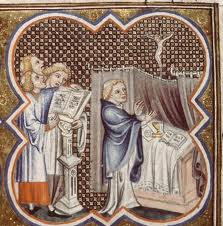
Archbp. Nichols (Westminster) on the priest’s role at Mass

From Zenit with my emphases and comments.

Archbishop Nichols on Priests and the Mass

“We Don Vestments to Minimize Our Personal Preferences”

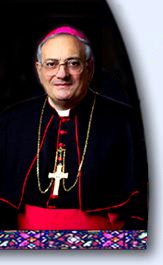
LONDON, JUNE 25, 2011 (Zenit.org).- Here is the text of a homily given by Archbishop Vincent Nichols at the Diocese of Westminster’s annual Celebration of Priesthood, held June 7.

The Gospel of our Mass today takes us into the heart of the relationship of Father and Son.   This is the wonder of our calling, the wonder of the mystery we minister: that we human beings are welcomed into the intimacy and love of Father and Son, which is the life of the Holy Spirit.

This mystery we enter most powerfully through our celebration of the Mass.  Here all is the gift of the Father. [If “all” is “gift”, then our challenge is to be actively receptive.] Here all is to the glory of the Father and the Son.  [and the Holy Spirit.  But the point is: it’s not about us, even though it is for us.] Here is our sharing in that glory, conscious that it is expressed in and through the self-sacrificing love of the cross.

In the light and depth of this great mystery I would like to reflect on our priestly part in the celebration of the Mass. [A qualitatively different priesthood from that of the baptized.] I want to do so with a directness and immediacy for, when it comes to Liturgy, we are living in a sensitive and creative time. This is a time in which the Church is asking us to recover some of the richness and depth of our liturgical heritage and, at the same time, always to ensure that the Liturgy is the sign and good at that.  Among us priests Liturgy easily becomes a point of contention.  It should not be so.

Today we use the text of the new English translation.  It symbolises so much.  We are sharply aware of the newness of the words we are using.  We need to concentrate on them.  We need a fresh approach in contrast to long-formed habits and familiarity.  [Hmmm.  We need a better approach to the language, perhaps.  Isn’t repetition the essence of ritual?  I think he is driving at the point that a corrected translation will give us more to work with.]

I would like to reflect on our part in all this and offer you my convictions. Thereby I hope I might help to shape your responses.  I can but try.
There are four key points that shape my reflection, all in the context of the Gospel truth we have heard. They are, fundamentally, matters of the heart, of our disposition. As such they can shape what we do. We do well to examine what lies in our hearts.

1. My first conviction is this: Liturgy is never my own possession, or my creation.  It is something we are given, from the Father.  Therefore my own tastes, my own preferences, my own personality, my own view of ecclesiology, are marginal, of little importance, when it comes to the celebration of the Mass. [This is surely correct.] We don vestments to minimise our personal preferences, not to express or emphasise them. [Good point.] Liturgy is not ours. It is never to be used as a form of self-expression.  Indeed the opposite is the truth. Within the diocese, when the priests of a parish change there should be clear continuity in the manner in which Mass is celebrated. [I am sure he doesn’t mean that abuses should be perpetuated simply because they were going on.  Continuity is provided by saying the black words and doing the red words of the Roman Rite, which has two forms.  Continuity also embraces more than what parish X has been doing for Y number of years.] The Mass is the action of the Church.  That’s what matters, not my opinion.  I once heard that Blessed Pope John Paul never commented on a Mass he had celebrated.  It’s the Mass.  My task is to be faithful. [Exactly.]

2.    My second point flows from this: the Liturgy forms us, not us the Liturgy.  The words of the Mass form our faith and our prayer.  They are better than my spontaneous creativity.  At Mass my place is very clear: I am an instrument in the hand of the Lord.  I am not a conductor, still less a composer.  Ordained into the person of Christ the Head, I am just an instrumental cause of this great mystery.  This is so important.  My celebration of the Mass each morning shapes my heart for the day ahead.  At Mass I am the Lord’s instrument just as I hope to be in the day that follows.  In all the events of the day, in the decisions I make, the words I speak, my greatest, safest hope is that the Lord will use me and that I, personally, will not get in His way.  We are servants of the Liturgy through which God opens to us His saving life.

3.      My third conviction is this: our part is to offer the Mass as a service to the people. In doing so we make choices and judgements about how aspects of the Mass are to be done. In doing this we must always have upper most in our minds that the heart of Liturgy is the people’s encounter with the Lord. Everything about the Liturgy is to serve this purpose. So in the choices we make, which give a particular tone to the Liturgy, our positive criterion should be: will this serve the encounter of the people with the Lord? Of course, things old and new can serve. Our choices though are shaped both by the instruction of the Church in its norms and guidance and by our duty to serve our people.

It seems to me that one thing above all is needed for this precious, transforming encounter with the Lord to take place in: space, space which allows for the movement of the heart to the Lord and of Him to us. At Mass we need space – spaces of silence, spaces for the quiet recollection of the people, both before and during Mass. [Surely after Mass as well.] So, the fashion of our celebration of the Mass should never be dominating or overpowering of those taking part. It should be well judged, respectful of its congregation, sensitive to their spiritual needs.

In my view one quality enhances this sense of divinely filled space in which we worship God: it is the beauty of the Liturgy and its reverence.  A beautiful, cared for church is the best preparation we can provide. I was recently reminded of the words of Cardinal Hume: that our churches are not simply buildings in which we worship the Lord, but buildings with which we worship Him. I thank you for all your efforts in this important regard.  The church as an arena of beauty for the Lord is, it seems to me, always a springboard of a vibrant parish.

4.    My fourth and final point follows: whenever the Liturgy of the Church, the celebration of the Mass, truly enters our heart and soul, then the result is a vibrant sense of mission. When we meet the Lord in all His love for us, then we are ready to respond, especially in the care we give to the poorest and those most in need, those closest to the Heart of our Saviour.  [Interiorly active receptivity within the church leads to ourward expression outside the church.] Our Diocesan ‘Conversation in Caritas’, about the social outreach of our parishes, has a Eucharistic centre. I thank you for your participation in it.  A profound celebration of the Mass inexorably gives rise to a practical expression of compassion and willing service.  It just is so.

My brothers, I am conscious of the length of these words and their strained character as a homily.  But these are important matters, now, in the months ahead, in our hearts.

In the Mass all that we receive is a gift of the Father.  It is never ours to use or shape as we please.  In the Mass all is to the glory of the Son.  In this we are no more than instruments, humble and delighted to play our part.  [It is true that the priest is an instrument, rather, the agent through whom God is working.  But the priest does speak in the first person.  This is my Body… I absolve you…. There is a strong identification between the priest and the Priest/Victim.] In the Mass all is for the sake of our people: [And the priest’s own sake, too.] that they may encounter the one true God and Jesus Christ whom He has sent.  In the Mass we who know Him also know that we are in this world to serve its humanity in His name, until He comes again. These are the hallmarks of our Liturgy, the measures against which we can test our hearts, our intentions and our actions.

Among us let there be a humble, joyful service of the Lord. [Do I hear an “Amen!”?] Let us accept with joy the search for a renewal in our celebration of the Mass guided solely by the Church and let our own faith and prayer be tutored daily by what is asked of us.  Amen.
Posted in "How To..." - Practical Notes, New Evangelization, Non Nobis and Te Deum, SUMMORUM PONTIFICUM, The Drill, The future and our choices | Tagged , , ,
16 Comments

St. Paul, MN: 60 Hours of Adoration for Benedict XVI’s 60th Jubilee

A reader sent:

Saw your post today – we are also doing a 60 hours adoration for Pope Benedict. Click HERE or HERE.

60 hours of Eucharistic adoration

Join us in marking the 60th anniversary of Pope Benedict XVI’s priesthood with 60 hours of Eucharistic adoration at The Saint Paul Seminary School of Divinity.

Archbishop John Nienstedt invites Catholics of the archdiocese to mark Pope Benedict XVI’s 60th anniversary of ordination to the priesthood with 60 hours of Eucharistic adoration, with prayer for the intentions of the Holy Father, an increase in vocations and priestly sanctity.  Beginning with a solemn opening liturgy with Archbishop Nienstedt on June 28 at 7:00 pm, St. Mary’s Chapel at the seminary will be open for 60 hours for all who wish to come for prayer.  Click HERE to read more about the event and see the full schedule.

Please consider signing up for an hour of adoration by calling the seminary at 651-962-5050 or sending an email.

The Saint Paul Seminary is located at 2260 Summit Avenue, St. Paul 55105.  Parking is available in all lots near the seminary.

Posted in The Campus Telephone Pole | Tagged , ,
4 Comments

To honor Benedict XVI’s 60th: 60 hours of adoration, prayer for priests and vocations

A reader alerted me to a very good initiative in the Archdiocese of Denver.

60-Hour Adoration Details

Why: To mark the 60th anniversary of Pope Benedict’s priestly ordination

What: 60 hours of eucharistic adoration to pray for priests and priestly vocations

Dates: June 27-July 1
Times: 6 a.m.-6 p.m. daily; 9 a.m.-9 p.m. June 29
Where: Christ the King Chapel at St. John Vianney Theological Seminary
Address: 1300 S. Steele St., Denver (John Paul II Center)
Chapel tours: Following 6 p.m. Benediction on June 27 and July 1
Information or to Sign Up: call 303-715-3221 or email tony.schoenberger@archden.org

Prayer Cards: Download at www.foryourvocation.org

Posted in "How To..." - Practical Notes, Just Too Cool, Our Catholic Identity, The Campus Telephone Pole | Tagged , , ,
6 Comments

Bp. DiMarzio (D. Brooklyn) about Gov. Cuomo, NY legislature, contrary-to-nature unions

Bp. DiMarzio (D. Brooklyn) about Gov. Cuomo, NY legislature, contrary-to-nature unionsH.E. Most. Rev. Nicholas DiMarzio, Bishop of the Diocese of Brooklyn, has reacted to the passage of the legislation to redefine marriage so as to equate marriage with contrary-to-nature unions.

My emphases and comments.

Today, Governor Andrew Cuomo [I am glad he begins with the name of the most important person in what happened.] and the state legislature have deconstructed the single most important institution in human history. Republicans and Democrats alike succumbed to powerful political elites [Except for those who agreed.  The others were moral cowards.] and have passed legislation that will undermine our families and as a consequence, our society.

With this vote, Governor Cuomo has opened a new front in the culture wars that are tearing at the fabric of our nation. [What’s next? Will he promote the “marriage” of people with their dogs?  Guinea Pigs?] At a time when so many New Yorkers are struggling to stay in their homes and find jobs, we should be working together to solve these problems. However, the politicians have curried favor with wealthy donors who are proponents of a divisive agenda in order to advance their own careers and futures. [There are stronger possible words to describe this sort of thing.]

What is needed in our state is leadership and not political gamesmanship.

In light of these disturbing developments and in protest for this decision, I have asked all Catholic schools to refuse any distinction or honors bestowed upon them this year by the governor or any member of the legislature who voted to support this legislation. Furthermore, I have asked all pastors and principals to not invite any state legislator to speak or be present at any parish or school celebration.  [And, Your Excellency, what about Holy Communion?]

The above request is intended as a protest of the corrupt political process in New York State. More than half of all New Yorkers oppose this legislation. Yet, the governor and the state legislature have demonized people of faith, whether they be Muslims, Jews, or Christians, and identified them as bigots and prejudiced, and voted in favor of same-sex “marriage.” It is mystifying that this bill would be passed on the last day of an extended session under the cover of darkness.

This issue has been framed as upholding marriage equality. This is not the case since one of the principal purposes of marriage is to bring new life into the world. This cannot happen in same-sex marriage. [NB] It is not a civil rights issue, but rather a human rights issue upholding the age-old understanding of marriage. Our political leaders do not believe their own rhetoric. If they did, how in good conscience could they carve out any exemption for institutions that would be proponents of bigotry and prejudice?

Republicans and Democrats equally share responsibility for this ruinous legislation and we as Catholics should hold all accountable for their actions.

Good and well-expressed.  But there is a missing piece.

Holy Communion?

There may have to be an investigation or process before such a decision is made by a bishop, so we have to give him the benefit of the doubt, I suppose.   See Dr. Peters piece about this.

The official statement of the whole Conference of New York.

Posted in 1983 CIC can. 915, One Man & One Woman | Tagged , , ,
53 Comments

Time for fun

Sometime ago I think I posted a photo of this watch. I just ran across it again as I am doing some tidying and tossing.

Just for fun!

20110626-094909.jpg

Posted in SESSIUNCULA | Tagged
23 Comments

Ed Peters on NY Gov. Cuomo’s support of contrary-to-nature unions and Holy Communion

Ed Peters on NY Gov. Cuomo's support of contrary-to-nature unions and Holy CommunionThe Canonical Defender, the great Ed Peters, has opined about the scandalous, aggressive, public support given to contrary-to-nature-unions by NY state Gov. Andrew Cuomo, catholic.

My emphases. My comments. I inserted his own footnotes, indicated by asterisks, directly into the text within my usual []. Be sure to check his site.

What canonical consequences might Andrew Cuomo face now?

Reminder: 1. This website offers my* [* Many in the secular media seem incapable of understanding or accepting that, in my blog commentary, I speak only for myself, and not for any other group or organization, particularly the Vatican/Holy See. Continued disregard of this simple point, which I make plain at the upper right column of my blog, is a dereliction toward the truth.] commentary on the canonical implications of certain news events. 2. My regular readers are familiar with sound Catholic thought in such areas as, for example, the nature of marriage, the moral parameters of private and governmental decision-making, personal sin and public scandal, the theology of holy Communion, and the basic role of canon law in the Church, and so I do not lay the kinds of foundations in such matters that one engaged in, say, apologetics would otherwise have to provide. 3. If anyone finds himself insufficiently familiar with some of the Catholic terminology and concepts assumed in this discussion, I would urge study of the pertinent passages in the Catechism of the Catholic Church or consultation with the auctores probatos.

The Catholic Church, drawing upon the teachings of Jesus Christ and echoing Natural Law, holds that marriage is possible only between a man and a woman and, consequently, that only men and women who have undertaken to live in such a relationship should be recognized and treated as married. The male-female requirement for marriage is an unalterable teaching of the Church and, while it might be subjected to ridicule by some nowadays, it is not subject to revision by either Church or State. Moreover, unlike some teachings of the Church that have no practical implications in the civil arena, that teaching which holds marriage possible only between a man and a woman has vital ramifications for civil society and—long story omitted—for those Catholics privileged to be especially charged with caring for the common good through political institutions.  [I love the way this guy writes.]

Among the many persons laboring in New York to accord same-sex unions the civil legal status of marriage, no one played a more important, and indeed a constitutionally essential, role than did the governor of the Empire State, Andrew Cuomo, a Roman Catholic. Cuomo’s gubernatorial campaign touted his strong support for “gay marriage”, [I detest that label.  There is nothing “happy” about these unions, in the true sense of happiness, and they are not “marriages”, in the true sense of marriage.] he used his enormous influence to push key legislators into voting for New York’s “gay marriage” bill, and he signed that bill into law hardly an hour after it was passed. Without Cuomo’s long-standing and vigorous public support for “gay marriage”, without his unswerving political efforts to advance that project and, most specifically, without his signature on the bill (placed there with obvious enthusiasm and much self-satisfaction), New York would not have legalized “gay marriage” on June 24.

In the wake of these incontestable facts, and speaking only from my expertise in Catholic canon law (leaving cultural and political commentary to others) Andrew Cuomo faces, as I see it, at least two major canonical problems.

First, Cuomo’s long pattern of conduct in regard to “gay marriage” warrants, in my opinion, a canonical investigation under Canon 1717 into whether he has “in a public show or speech, published writings, or in other uses of the instruments of social communications … gravely injure[d] good morals…” [A canonical investigation is certainly in order.  However, on the face of it, Gov. Cuomo, a catholic, has certainly used his position and the media to promote something which will result in harm of morality and confusion among the faithful.] and on that account is to be punished (puniatur) with a just penalty per Canon 1369. That said, only rarely has the canonical criminal process been invoked against lay persons in our lifetimes** [** Offhand, the most recent American example that comes to mind is New Orleans Abp. Joseph Rummel’s 1962 excommunication of three lay Catholics for agitating against the desegregation of archdiocesan schools.], and the outlines of that process deserve more treatment than can be accorded them in a blog post. In any event, assuming the canon means what it plainly says, I suggest that some among the friends and foes of Cuomo (I figure among neither group) begin briefing Canon 1369.  [In other words, let someone start a process?]

Second, and much more urgently because it arises from sacramental discipline and not from the canonical penal process, Cuomo’s long pattern of conduct in regard to “gay marriage” triggers, in my opinion, an obligation on his part to refrain from approaching for holy Communion per Canon 916 and, should he approach anyway, upon ministers of holy Communion to withhold that august sacrament from “those obstinately persevering in manifest grave sin” per Canon 915.

I am already on record as believing Cuomo ineligible for holy Communion on the basis of his improper living arrangements with a television celebrity, a relationship I characterized as “public concubinage” and which characterization no one has yet canonically challenged, let alone rebutted. See generally Edward Peters, “The Cuomo-Communion Controversy”, Catholic World Report (May 2011) 33-35.  [You can look back at some of that controversy, and the vain, agitated, distracted and empty attacks on Dr. Peters here.]

But in almost every relevant way, Cuomo’s protracted actions in regard to “gay marriage” are even more brazen.

Cuomo’s concubinage gives prominent bad example against marriage, but his official actions in regard to “gay marriage” have changed the very definition of marriage in the populous state under his care; Cuomo’s living arrangements are of immediate canonical concern to only two of New York’s eight arch/bishops, but his political actions in regard to “gay marriage” negatively impact the pastoral mission of every Catholic bishop, parish priest, deacon, and lay minister throughout the Province of New York; finally, while most of the bishops of New York said little or nothing about Cuomo’s living with a woman not his wife, his long-standing actions in regard to “gay marriage” were challenged repeatedly, directly, and forcefully by the Archbishop of New York and by all his seven suffragans.

In light of the foregoing, I see no way, absent a public reversal of his public conduct, that Andrew Cuomo may present himself for holy Communion (per Canon 916), and, if he does present himself, I see no way that a minister of holy Communion may administer the sacrament to him (per Canon 915). Indeed, the only question in my mind [NOTA BENE:] is whether the ordinaries of New York should lift from the shoulders of individual ministers the burden of reaching this decision, by making a determination to this effect themselves [That would be the pastoral thing to do in regards to the ministers.  No?] and, assuming they do reach this conclusion, whether they should announce it publicly or in a personal letter to Cuomo. (Personally, I think a public announcement more befits the markedly public character of Cuomo’s conduct and responds better to the danger of scandal presented to the faithful by his actions).

Some other brief points:

Application of Canon 915 to Andrew Cuomo would not mean that he is excommunicated. I am not aware of any actions by Andrew Cuomo to date for which he faces excommunication. [Interesting.]

Cuomo is still bound to attend Sunday Mass (c. 1247), irrespective of his situation under Canons 915 or 916.

The New York State Catholic Conference does not have canonical authority over the application of Canons 915 and/or 1369, but it might provide a convenient mechanism for coordinating episcopal action.

Assuming the application of Canon 915 against Cuomo, I believe that other ministers outside of New York with knowledge of the decision should honor it as a function of communion per Canon 209.

Cuomo has repeatedly stated that he hopes New York’s legalization of “gay marriage” will serve as a powerful statement to others across the country. He need have no doubt about that, for it certainly will. But, by the same token, however the bishops of New York respond to Cuomo’s pivotal role in securing the legalization of “gay marriage” in New York will undoubtedly serve as an example to other bishops confronting Catholic complicity in the push to grant the legal status of marriage to same sex unions in their territories.

Some other prominent Catholics played important roles in bringing about the events of June 24, but analysis of their situations warrants a separate treatment. There is, in the meantime, nothing wrong with starting with the most serious case.

I cannot but agree with everything Dr. Peters has written.

Posted in 1983 CIC can. 915, One Man & One Woman, Our Catholic Identity | Tagged , , , , , , , , ,
25 Comments

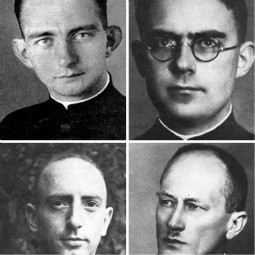
The Martyrs of Lübeck: 3 priests beatified and a Lutheran minister honored

The Martyrs of Lübeck: 3 priests beatified and a Lutheran minister honoredFrom CNA:

Three priest-martyrs of Nazis beatified in Germany

Hamburg, Germany, Jun 25, 2011 / 12:02 pm (CNA/EWTN News).- Three Catholic martyrs executed under the Nazi regime were beatified in Germany today, June 25. The event was also noteworthy for its rememberance of their Lutheran companion.  [Non-Catholics cannot be beatified.]

Fathers Hermann Lange, Eduard Müller and Johannes Prassek, along with Lutheran pastor Karl Friedrich Stellbrink, were guillotined in a Hamburg prison in November 1943. The Nazi regime found them guilty of “defeatism, malice, favoring the enemy and listening to enemy broadcasts.”  [In an article such as this, it might be hard to figure out how those things constitute the criteria for “martyrdom”.  To be a martyr, you have to be killed for hatred for Christ, Christianity, the Church or those doctrine and virtues which cannot be separated from faith in Christ.  Of course we don’t know from the description of the sentence, above, what the real reasons are… yet.  Let’s read on.]

At a ceremony in the northern German city of Lubeck, Cardinal Angelo Amato, the Prefect of the Congregation for the Causes of Saints, declared the trio of Catholic clergy to be ‘blessed.’ He also expressed an ‘honorable remembrance’ for the priests’ fellow Christian martyr, Pastor Stellbrink.

“What distinguishes these four also is the fact that in the face of National-Socialist despotism they overcame the divide between the two faiths to find a common path to fight and act together,” says the official history which accompanied the ceremony.  [I am still waiting for an explanation of the martyrdom, knowing that the writer may not have known that it should probably be given.  Having worked together, Catholics and Lutherans, is not grounds for being declared “martyrs”.]

It’s estimated that over 9,000 pilgrims – both Catholic and Protestant – attended today’s ceremony. Twenty Catholic and four Protestant bishops planned to attend.

On June 24 Lutheran Vespers were prayed for the martyrs at Lubeck’s Memorial Church. Former president of the Pontifical Council for Promoting Christian Unity, Cardinal Walter Kasper, spoke at the ceremony.

The official history recounts that the men would copy and distribute the anti-Nazi sermons of Bishop Clemens August Graf von Galen of the Catholic Diocese of Munster.  [Okay!  We are getting closer.  The Nazis really hated the Lion of Munster, Bl. Clemens von Galen.]

“They felt, like many others, the liberating tone of these sermons, which broke the silence and proclaimed aloud the thoughts many had in their hearts, when the Nazi action for the ‘destruction of unworthy lives’ began, the euthanasia of innocent mentally retarded persons,” the history says.  [So… were they killed because of their defense of human life?]

The men’s last letters, written just hours before their deaths, have been preserved and were put on display this weekend. Father Johannes Prassek wrote his family:

“I am so happy, I can hardly explain how happy. God is so good to have given me several beautiful years in which to be his priest. [Several?  Sounds young.]

“Do not be sad! What is waiting for me is joy and good fortune, with which all the happiness and good fortune here on earth cannot compare.”

Father Eduard Muller wrote to his bishop:

“It gives me great pleasure to be able to write a few lines to you in this, my last hour. Whole-heartedly, I thank you first of all for the greatest gift which you gave me as a successor of the apostles, when you placed you hands on me and ordained me as God’s priest.

“But now we must embark upon this – in human terms difficult- final walk, which is to lead us to Him, whom we served as priests.”

Beatification is public recognition by the Catholic Church that a deceased person has entered Heaven. It is the third of the four steps towards canonization and confers the title “blessed.”

Here is a link to the Wikipedia article on the “Martyrs of Lübeck“.  It seems as if these men were killed because of the hatred of Christian resistance to the diabolical aims of National Socialism.

Perhaps some of you readers can add more about the details.

Posted in Modern Martyrs, Saints: Stories & Symbols | Tagged , , , , , ,
22 Comments

RECENT POSTS OF INTEREST and THANKS

As they scroll along.

First, I ask your continued prayers for two personal and important intentions.

Also, many thanks to RB,MMc,PG, ML, MK, KB, BKC, CS, whose names I have added to me list of benefactors whom I shall recall at Mass on Monday morning.  It is an honor and duty to pray for benefactors of all sorts.  I also received a few items from my wish list.  Thanks to AM, CEF, DB, JM.  A few things came without any indications.  Each thing is a boost.  Particular greetings and, today, sympathy to a person in Albany – How long, O Lord? – who sent an iTunes gift card from my wishlist.

I am very grateful to all of you who have recently sent kind notes.  I ask your continuing prayers for me and a heavy pressing need.

Posted in SESSIUNCULA |
Comments Off on RECENT POSTS OF INTEREST and THANKS

Sneak preview of new Vatican News site

It will apparently be online from 29 June onward.

Check it out.

Here.

Posted in Brick by Brick, The Campus Telephone Pole | Tagged ,
4 Comments

QUAERITUR: A priest must defend “ad orientem” for the Novus Ordo

QUAERITUR: A priest must defend "ad orientem" for the Novus OrdoFrom a priest starting ad orientem worship in his parish. Heavily edited:

… [The dean] supports my decision for ad orientem in the Novus Ordo this weekend.  It will be in English.  He warned me that the bishop will give me heck.

My question is: Where does Rome/any documents back up this practice if I get a phone call?

My response right now is that my confrere in the neighboring parish has
“one-sin” penance services, Easter Vigils at 4 p.m., and other liturgical abuses and not one word is said.

I just want to have my ducks in a row.

I wonder how effective it will be pointing to the bishop’s failure in governance as a defense of your own good practice.  Just wondering about that.

First, I suppose one could ask for a document which requires that Mass be celebrated versus populum.  There isn’t one, of course.

Also, one could point out that the rubrics of the Missale Romanum assume that Mass is celebrated ad orientem, since there are moments when the priest instructed to turn to the people and then turn to the altar.

I want to ask readers to chime in with references to documents or with good and useful arguments.  You can keep the “I like X better!” to yourselves.

That said, here is a piece of documentation which could be useful.

CONGREGATIO DE CULTU DIVINO
ET DISCIPLINA SACRAMENTORUM

Prot. No 2086/00/L

The Congregation for Divine Worship and the Discipline of the Sacraments has been asked whether the expression in no. 299 of the Instituto Generalis Missalis Romani constitutes a norm according to which, during the Eucharistic liturgy, the position of the priest versus absidem [facing towards the apse] is to be excluded.

The Congregation for Divine Worship and the Discipline of the Sacraments, after mature reflection and in light of liturgical precedents, responds:

Negative, and in accordance with the following explanation.

The explanation includes different elements which must be taken into account.

It is in the first place to be borne in mind that the word expedit does not constitute an obligation, but a suggestion that refers to the construction of the altar a pariete sejunctum [detached from the wall] and to the celebration versus populum [towards the people]. The clause ubi possibile sit [where it is possible] refers to different elements, as, for example, the topography of the place, the availability of space, the artistic value of the existing altar, the sensibility of the people participating in the celebrations in a particular church, etc. It reaffirms that the position towards the assembly seems more convenient inasmuch as it makes communication easier (Cf. the editorial in Notitiae 29 [1993] 245-249), without excluding, however, the other possibility.

However, whatever may be the position of the celebrating priest, it is clear that the Eucharistic Sacrifice is offered to the one and triune God, and that the principal, eternal, and high priest is Jesus Christ, who acts through the ministry of the priest who visibly presides as his instrument. The liturgical assembly participates in the celebration in virtue of the common priesthood of the faithful which requires the ministry of the ordained priest to be exercised in the Eucharistic Synaxis. The physical position, especially with respect to the communication among the various members of the assembly, must be distinguished from the interior spiritual orientation of all. It would be a grave error to imagine that the principle orientation of the sacrificial action is [toward] the community. If the priest celebrates versus populum, which is a legitimate and often advisable, his spiritual attitude ought always to, be versus Deum per Jesus Christum [towards God through Jesus Christ], as representative of the entire Church. The Church as well, which takes concrete form in the assembly which participates, is entirely turned versus Deum [towards God] as its first spiritual movement.

It appears that the ancient tradition, though not without exception, was that the celebrant and the praying community were turned versus orientem [towards the East], the direction from which the Light which is Christ comes. It is not unusual for ancient churches to be “oriented” so that the priest and the people were turned versus orientem during public prayer.

It may be that when there were problems of space, or of some other kind, the apse represented the East symbolically. Today the expression versus orientem often means versus apsidem, and in speaking of versus populum it is not the west but rather the community present that is meant.

In the ancient architecture of churches, the place of the Bishop or the celebrating priest was in the center of the apse where, seated and turned towards the community, the proclamation of the readings was listened to, Now this presidential place was not ascribed to the human person of the bishop or the priest, nor to his intellectual gifts and not even to his personal holiness, but to his role as an instrument of the invisible Pontiff, who is the Lord Jesus.

When it is a question of ancient churches, or of great artistic value, it is appropriate, moreover, to keep in mind civil legislation regarding changes or renovations. Adding another altar may not always be a worthy solution.

There is no need to give excessive importance to elements which have changed throughout the centuries. What always remains is the event celebrated in the liturgy: this is manifested through rites, signs, symbols and words which express various aspects of the mystery without, however, exhausting it, because it transcends them. Taking a rigid position and absolutizing it could become a rejection of some aspect of the truth which merits respect and acceptance.

Vatican City, 25 September 2000.

Jorge A. Card. MEDINA ESTÉVEZ
Cardinal Prefect

Francesco Pio Tamburrino
Archbishop Secretary

That is in reference to the GIRM 299, which is mistranslated in the official English translation.  That is why the CDW clarified the grammar of the Latin, above.

Remember, no document requires versus populum worship.  The rubrics of the Latin Missale Romanum presupposed ad orientem worship.  The Latin edition is the norm above all and it is always valid for use everywhere.  There are good motives for changing to ad orientem worship, including the catechetical advantage it brings in teaching about the interior orientation we all need at Mass.

At the same time, keep in mind what Joseph Ratzinger wrote about the transition to ad orientem worship.  It should be done with care.  I made some PODCAzTs about this.  Try one here.

Posted in "How To..." - Practical Notes, ASK FATHER Question Box, Brick by Brick, Our Catholic Identity | Tagged , ,
25 Comments