Benedict XVI’s Palm Sunday Sermon

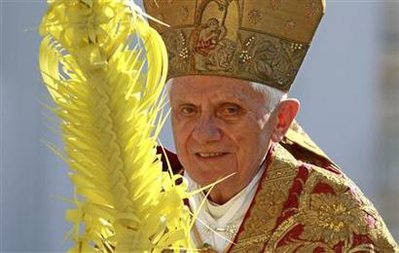
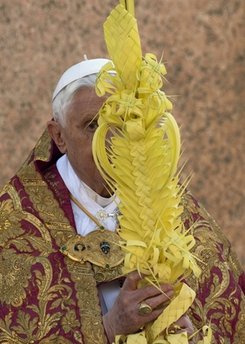
Benedict XVI's Palm Sunday SermonWith my emphases and comments:

Dear Brothers and Sisters,

Dear young people! [Pueri, indeed.  Palm Sunday has associations with World Youth Day, I believe.]

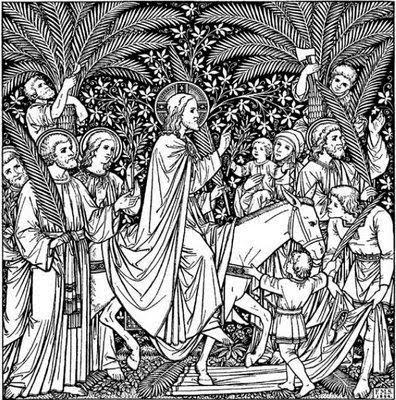
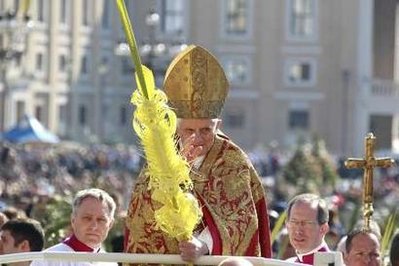
It is a moving experience each year on Palm Sunday as we go up the mountain with Jesus, towards the Temple, accompanying him on his ascent. [The Pope reminded us in his 2nd volume of Jesus of Nazareth about the literal ascent from the very low Sea of Galilee to the much higher Jerusalem.] On this day, throughout the world and across the centuries, young people and people of every age acclaim him, crying out: “Hosanna to the Son of David! Blessed is he who comes in the name of the Lord!” [And then many of them turned on Him.  Let’s not forget that.  We do to.]

But what are we really doing when we join this procession as part of the throng which went up with Jesus to Jerusalem and hailed him as King of Israel? Is this anything more than a ritual, a quaint custom? Does it have anything to do with the reality of our life and our world? To answer this, we must first be clear about what Jesus himself wished to do and actually did. After Peter’s confession of faith in Caesarea Philippi, in the northernmost part of the Holy Land, Jesus set out as a pilgrim towards Jerusalem for the feast of Passover. He was journeying towards the Temple in the Holy City, towards that place which for Israel ensured in a particular way God’s closeness to his people. He was making his way towards the common feast of Passover, the memorial of Israel’s liberation from Egypt and the sign of its hope of definitive liberation. He knew that what awaited him was a new Passover and that he himself would take the place of the sacrificial lambs by offering himself on the cross. He knew that in the mysterious gifts of bread and wine he would give himself for ever to his own, and that he would open to them the door to a new path of liberation, to fellowship with the living God. He was making his way to the heights of the Cross, to the moment of self-giving love. The ultimate goal of his pilgrimage was the heights of God himself; to those heights he wanted to lift every human being. [So far he is developing a theme of rising, even aiming high.]

Our procession today is meant, then, to be an image of something deeper, to reflect the fact that, together with Jesus, we are setting out on pilgrimage along the high road that leads to the living God. This is the ascent that matters. This is the journey which Jesus invites us to make. But how can we keep pace with this ascent? Isn’t it beyond our ability? Certainly, it is beyond our own possibilities. From the beginning men and women have been filled – and this is as true today as ever – with a desire to “be like God”, to attain the heights of God by their own powers. All the inventions of the human spirit are ultimately an effort to gain wings so as to rise to the heights of Being and to become independent, completely free, as God is free. [Think of the Tower of Babel… genetic manipulation….] Mankind has managed to accomplish so many things: we can fly! We can see, hear and speak to one another from the farthest ends of the earth. And yet the force of gravity which draws us down is powerful. With the increase of our abilities there has been an increase not only of good. Our possibilities for evil have increased and appear like menacing storms above history. Our limitations have also remained: we need but think of the disasters which have caused so much suffering for humanity in recent months. [In a sense we suffered from the earthquake in Japan because of Original Sin, but the Holy Father seems to be saying something more immediate and about technology.]

The Fathers of the Church maintained that human beings stand at the point of intersection between two gravitational fields. First, there is the force of gravity which pulls us down – towards selfishness, falsehood and evil; the gravity which diminishes us and distances us from the heights of God. On the other hand there is the gravitational force of God’s love: the fact that we are loved by God and respond in love attracts us upwards. Man finds himself betwixt this twofold gravitational force; everything depends on our escaping the gravitational field of evil and becoming free to be attracted completely by the gravitational force of God, which makes us authentic, elevates us and grants us true freedom.  [This is Augustinian.  In ancient times, people thought that gravity was a characteristic of the thing itself rather than an external force that worked on the object.  In ancient thought, things sought to go to the place they belonged, to their place of rest where they were in balance.  Augustine describes love in terms of weight, or gravity.  Amor meus pondus meum… my love is my weight.  When you love, love draw to what you love.  In the case of the human soul and mind and heart, we are necessarily drawn to God, the source and goal of our being.  Therefore, we must always be restless until we are with God, our perfect place of rest.  When we force ourselves to go to something else, a false resting point, we cannot be at rest or happy or in harmony with our end.]

Following the Liturgy of the Word, at the beginning of the Eucharistic Prayer where the Lord comes into our midst, the Church invites us to lift up our hearts: “Sursum corda!” [Hearts up.] In the language of the Bible and the thinking of the Fathers, the heart is the centre of man, where understanding, will and feeling, body and soul, all come together. The centre where spirit becomes body and body becomes spirit, where will, feeling and understanding become one in the knowledge and love of God. This is the “heart” which must be lifted up. But to repeat: of ourselves, we are too weak to lift up our hearts to the heights of God. We cannot do it. The very pride of thinking that we are able to do it on our own drags us down and estranges us from God. God himself must draw us up, and this is what Christ began to do on the cross. He descended to the depths of our human existence in order to draw us up to himself, to the living God. He humbled himself, as today’s second reading says. Only in this way could our pride be vanquished: God’s humility is the extreme form of his love, and this humble love draws us upwards.

Benedict XVI's Palm Sunday SermonPsalm 24, which the Church proposes as the “song of ascent” to accompany our procession in today’s liturgy, indicates some concrete elements which are part of our ascent and without which we cannot be lifted upwards: clean hands, a pure heart, the rejection of falsehood, the quest for God’s face. [That note about purity isn’t just for the young people.] The great achievements of technology are liberating and contribute to the progress of mankind only if they are joined to these attitudes – if our hands become clean and our hearts pure, if we seek truth, if we seek God and let ourselves be touched and challenged by his love. All these means of “ascent” are effective only if we humbly acknowledge that we need to be lifted up; if we abandon the pride of wanting to become God. We need God: he draws us upwards; letting ourselves be upheld by his hands – by faith, in other words – sets us aright and gives us the inner strength that raises us on high. We need the humility of a faith which seeks the face of God and trusts in the truth of his love.

Benedict XVI's Palm Sunday SermonThe question of how man can attain the heights, becoming completely himself and completely like God, has always engaged mankind. It was passionately disputed by the Platonic philosophers of the third and fourth centuries. For them, the central issue was finding the means of purification which could free man from the heavy load weighing him down and thus enable him to ascend to the heights of his true being, to the heights of divinity. Saint Augustine, [And here he is!] in his search for the right path, long sought guidance from those philosophies. But in the end he had to acknowledge that their answers were insufficient, their methods would not truly lead him to God. To those philosophers he said: recognize that human power and all these purifications are not enough to bring man in truth to the heights of the divine, to his own heights. And he added that he should have despaired of himself and human existence had he not found the One who accomplishes what we of ourselves cannot accomplish; the One who raises us up to the heights of God in spite of our wretchedness: Jesus Christ who from God came down to us and, in his crucified love, takes us by the hand and lifts us on high.

We are on pilgrimage with the Lord to the heights. We are striving for pure hearts and clean hands, we are seeking truth, we are seeking the face of God. Let us show the Lord that we desire to be righteous, and let us ask him: Draw us upwards! Make us pure! Grant that the words which we sang in the processional psalm may also hold true for us; grant that we may be part of the generation which seeks God, “which seeks your face, O God of Jacob” (cf. Ps 24:6). Amen.
Benedict XVI's Palm Sunday Sermon

Posted in SESSIUNCULA | Tagged , ,
5 Comments

Confessions during the Triduum

Each year one sees confusion about the Sacrament of Penance during the Triduum.

Some priests, liturgical experts, and even diocesan liturgy offices wrongly claim the rubrics of the Missal or “Sacramentary” forbid the sacrament of Penance.

However, this claim is incorrect.

Here is what the texts really say.

The previous 1970 and 1975 editions of the Missale Romanum (the Novus Ordo) said of Good Friday and Holy Saturday (BTW… the language of this rubric goes back to Pope Innocent III +1216):

Hac et sequenti die, Ecclesia, ex antiquissima traditione, sacramenta penitus non celebrat… On this and the following day, the Church, from a most ancient tradition, does not at all celebrate the sacraments.

However, since this is in the Missal (the book for MASS), sacramenta refers only to the Eucharist, Holy Mass, and not the other sacraments.

The Congregation for Divine Worship and Discipline of the Sacraments (CDWDS) clarified this in its official publication Notitiae (1977 – no. 137 (Dec) p. 602).

In the 2002 edition of the Missale Romanum at paragraph 1 for Good Friday all doubt is removed.

The above cited text has been amended to say (the change with my emphasis):

Hac et sequenti die, Ecclesia, ex antiquissima traditione, sacramenta, praeter Paenitentiae et Infirmorum Unctionis, penitus non celebrat…Confessions during the Triduum On this and the following day, the Church, from a most ancient tradition, does not at all celebrate the sacraments, except for (the sacraments of) Penance and Anointing of the Sick.

Priests can indeed, and probably should, hear confessions on Good Friday and on Holy Saturday.

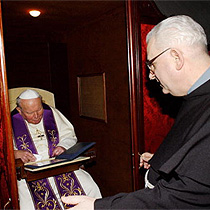
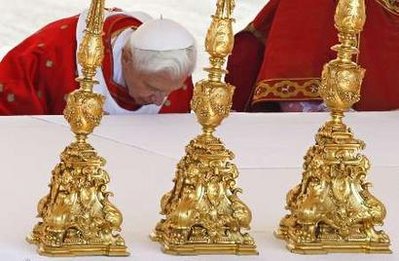
Who can forget the image of the late and soon-to-be-beatified Pope hearing confession in St. Peter’s Basilica on Good Friday?

Here is a bonus tip, speaking of confessions.

As I have posted before, it is both permitted and often appropriate for confessions to be heard during Holy Mass on other days of the year!

Want proof?  Try the CDWDS document Redemptionis Sacramentum 76 and also the Congregation’s Response to a Dubium in Notitiae 37 (2001) pp. 259-260.

Having a priest in a confessional before and even during Mass on Sundays and feasts could be a way to revive the use of this ailing but essential sacrament.

Posted in "How To..." - Practical Notes, Brick by Brick | Tagged , ,
19 Comments

Getting ready for Palm Sunday

We are getting ready for Palm Sunday.

20110417-104011.jpg

20110417-104025.jpg

20110417-104037.jpg

20110417-104050.jpg

20110417-104059.jpg

Posted in Brick by Brick, Just Too Cool, Our Catholic Identity, SESSIUNCULA, What Fr. Z is up to | Tagged ,
10 Comments

YOUR Palm Sunday and Holy Week

Give us a description of Palm Sunday at your parish as well as what is going on during Holy Week before the Triduum begins.

For my part, I will be involved with the Palm Sunday in the Extraordinary Form at Holy Innocents in Manhattan (NYC).   Mass today will have Gregorian chant for the Ordinary and Proper.

Posted in Brick by Brick | Tagged ,
56 Comments

Cincinnati: Extraordinary Form Triduum

I had a note from St. Mark’s Chaplaincy and Una Voce Cincinnati that the Triduum including Tenebrae will be celebrated in the Extraordinary Form.

For further information about any of these services, please call (513)
393 9872.

Posted in Brick by Brick | Tagged
Comments Off on Cincinnati: Extraordinary Form Triduum

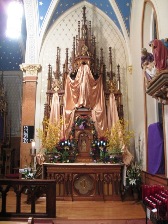
QUAERITUR: Holy Thursday altar of repose in the basement where coffee is usually taken

QUAERITUR: Holy Thursday altar of repose in the basement where coffee is usually takenFrom a reader:

Is there any guidance about where the Altar of Repose on Holy Thursday should be located? For many years at my parish, it was located at one of the side altars in the Church (we have five to choose from). Our current pastor has experimented with its placement over the last three years; last year it was set up in the Church basement on a temporary altar, which is a space normally used for parish activities such as meetings and the Sunday morning coffee hour. Many parishioners are not happy about trekking out of the main Church and down to the hall. The pastor plans to use the same place this year, saying that under the rubrics the Altar of Repose is not supposed to be located at a side  altar, which is still part of the main sanctuary. Is this correct? Many of us would like to revert to its prior placement but are unsure what the “rules” provide.

In… the … basement…

That sounds silly to me.   But I am unreconstructed ossified manualist.

I think the Lord should be reposed on a side altar.  I believe that practice is well attested in our Latin tradition.

But… documents.  I don’t know at this moment, so I will open this to the readers, trusting that they will perhaps stay on topic.

Posted in "How To..." - Practical Notes, ASK FATHER Question Box, Liturgy Science Theatre 3000, Our Catholic Identity | Tagged ,
11 Comments

WDTPRS – Palm Sunday: an example so perfect that it has the power to transform us

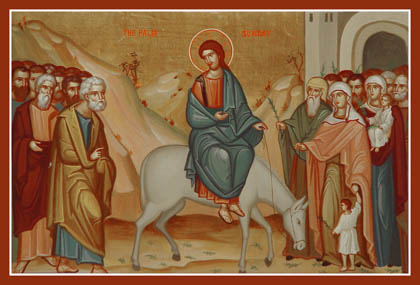
WDTPRS - Palm Sunday: an example so perfect that it has the power to transform usPalm Sunday marks the beginning of Holy Week.  The Sacred Triduum (triduum from tres dies – “three day space”) were once days of obligation when people were freed from servile work so that they could attend the liturgies, once celebrated in the morning.  In the 17th century, however, the obligation was removed under the influence of changing social and religious conditions.  As a result, the faithful lost sight of these beautiful liturgies and in general only priests and religious in monasteries knew them.
In 1951 Pope Pius XII began to restore the Triduum liturgies to prominence by mandating that the Easter Vigil be celebrated in the evening.  In 1953 Mass was permitted in the evening on certain days.  A reformed Ordo for Holy Week was issued in 1955 and took effect on 25 March 1956.   That is when the Sunday of Holy Week came to be called “The Second Sunday in Passiontide, or Palm Sunday”.  Matins and Lauds (Tenebrae, “shadows”) was to be sung in the morning.  Holy Thursday Mass was not to begin before 5 p.m. and no later than 8 p.m.  The idea was to make it easier for people to attend these all important liturgies.

The principal ceremonies of the Palm Sunday Mass include the blessing of palm branches (or olive branches in some parts of the world, such as Rome) and a procession around and into the church.  In the present Missale Romanum an interesting rubric about the procession harkens to ancient times:

“At a suitable hour the “collect” is made (fit collecta)in a lesser church or in another appropriate place outside the church toward which the procession marches.”

Here is our word “collect” used to describe a gathering of people.

Also in the rubrics there is something helpful for our understanding of “active participation”:

“Then as is customary the priest greets the people; and then there is given a brief admonition, by which the faithful are invited to participate actively and consciously (actuose et conscie participandam) in this day’s celebration.”

Those words actuose et conscie are very important.  The Second Vatican Council, when using the term actuosa participatio or “active participation”, meant mainly interior participation, the engaging of the mind, heart and will.  The Council Fathers did not mean primarily exterior participation.  Exterior participation should be the natural result of interior participation: we seek to express outwardly what we are experiencing within.  While the two influence each other, there is a logical priority to interior participation, which is by far the more important.

At the end of the procession, when everyone is gathered in the church, the priest says the…

COLLECT – LATIN TEXT (2002MR):
Omnipotens sempiterne Deus,
qui humano generi, ad imitandum humilitatis exemplum,
Salvatorem nostrum carnem sumere
et crucem subire fecisti,
concede propitius,
ut et patientiae ipsius habere documenta
et resurrectionis consortia mereamur.

The vocabulary of today’s Collect is incredibly complex.  We can only scratch at a fraction of what is there.

Our prayer was in older editions of the Missale Romanum and, before them, in the Gelasian Sacramentary.  In the Gelasian there is an extra helpful et: Salvatorem nostrum et carnem sumere, et crucem subire.  Wonderfully alliterative!  The editor of the Gelasian excludes a comma, which makes sense to me: qui humano generi_ ad imitandum…. There may be a touch of St. Augustine’s (+430) influence in the prayer.  In Augustine humilitatis appears with exemplum on close conjunction with documentum (ep. 194.3) and with documentum and patientiae in proximity to exemplum (en. ps. 29 en. 2.7).  In the context of the Passion Augustine says: “Therefore, the Lord Himself, judge of the living and the dead, stands before a human judge (Pilate), offering us a decisive lesson of humility and patience (humilitatis et patientiae documentum), not defeated, but giving the soldier an example of how one wages war (pugnandi exemplum): …”

There are two words for “example” here: exemplum…documenta. These words appear together in numerous classical and patristic texts. Our startlingly useful Lewis & Short Dictionary informs us that our old friend exemplum means, “a sample for imitation, instruction, proof, a pattern, model, original, example….”  Exemplum is a term in ancient rhetoric, an inseparable part of the warp and weft of the development of Christian doctrine during the first millennium.

For Fathers of the Church, all well-trained in rhetoric (how we need those skills today), exemplum identified a range of things including man as God’s image, Christ as a Teacher, and the content of prophecy.   In Greek and Roman rhetoric and philosophy, an exemplum could have auctoritas, “authority”, the persuasive force of an argument.  When we hear today’s prayer with ancient ears, exemplum is not merely an “example” to be followed: it indicates a past event with such authoritative force that it transforms him who imitates it.  Today we hear humilitatis exemplum, the authoritative model of humility who is Christ – Christ in action, or rather Christ in Passion, undergoing His sufferings for our sake.  This becomes the foundational and authoritative pattern of the Christian experience: self-emptying in the Incarnation and Passion leading to resurrection.   Exemplum is augmented later in the prayer by documenta.  Documentum is also a “pattern for imitation” like exemplum but also in some contexts having the meaning of “a proof”, that is, a concrete demonstration that what is asserted is true: evidence.   In this case it is a paradigm after which we are to pattern and shape our own lives.  But this pattern or model itself actually has power to shape us.  Christ transforms us the baptized who are made in his image and likeness, after his perfect exemplum, and who imitate His exempla and documenta, His words and deeds.

WDTPRS - Palm Sunday: an example so perfect that it has the power to transform usConsortium (from con-sors… having the same lot/fate/destiny with something or someone) classically is a “community of goods” and “fellowship, participation, society.”
Habere has a vast entry in the L&S. The common meaning is “have”, but it also indicates concepts like “hold, account, esteem, consider, regard” as well as “have as a habit, peculiarity, or characteristic.”  Habere is doing double-duty with two objects, documenta and consortia. This is why I use both “grasp” for the first application of habere and “have” for the second.  The meanings of the two different objects draw our two different senses of habere.

Patientia is from patior, “to bear, support, undergo, suffer, endure”, and it carries all its connotations as well as the meaning “patience”.  This is where the word “Passion” comes from.  Today is Second Passion Sunday.  We could say here, “examples of His long-suffering” or “exemplary patterns of His patient forbearance.”  Finally, note that nostrum goes with Salvatorem and not with carnem: caro, carnis is feminine and the form would have to have been nostram carnem.

SLAVISHLY LITERAL TRANSLATION:
Almighty eternal God,
who, for the human race,
made our Savior both assume flesh and undergo the Cross
for an example of humility to be imitated,
graciously grant,
that we may be worthy to grasp both the lessons of His forbearance
and also shares in the resurrection.

LAME-DUCK ICEL:
Almighty, ever-living God,
you have given the human race Jesus Christ our Savior,
as a model of humility.
He fulfilled your will
by becoming man and giving his life on the cross.
Help us to bear witness to you
by following his example of suffering
and make us worthy to share in his resurrection
.

NEW CORRECTED ICEL:
Almighty ever-living God,
who as an example of humility for the human race to follow
caused our Savior to take flesh and submit to the Cross,
graciously grant that we may heed his lesson of patient suffering
and so merit a share in his Resurrection
.

More can be said about that phrase patientiae ipsius.  Ipse, a demonstrative pronoun, is emphatic and means “himself, herself, itself”.  Could we personify patientia to mean, “grasp the lessons of Patience itself” or even “of Patience Himself”?   That would be poetically sublime.

In the fullness of time the Second Person of the Trinity, God the Son, the eternal Word through whom all things visible and invisible were made, by the will of the Father emptied Himself of His glory and took our human nature up into an indestructible bond with His own divinity.  He came to us sinners to save us from our sins and teach us who we are (cf. Gaudium et spes 22).  This saving mission began with self-emptying (in Greek kenosis).

Fathom for a moment the humility of the Savior, emptying Himself of His divine splendor, submitting Himself to His humble and hidden life before His public ministry.   When the time of His years and His mission was complete He gave Himself over again, emptying Himself yet again even to giving up His very life.   Every moment of Jesus earthly life, every word and deed, are conditioned by humility.   This is our perfect example to follow, an example so perfect that it has the power to transform us.

As Holy Week begins and the Sacred Triduum is observed, come to the sacramental observance of the sacred and saving mysteries with humble self-emptying.  Make room for Christ.

WDTPRS - Palm Sunday: an example so perfect that it has the power to transform us

Posted in LENT, SESSIUNCULA, WDTPRS | Tagged , ,
9 Comments

Baby pronounced dead at birth starts to breathe

Doctors pronounced this baby dead, but after 2 hours of the mother holding him in her arms, he started breathing again.

Watch.

[wp_youtube]hMAzOjExKMw[/wp_youtube]

Posted in Emanations from Penumbras, Just Too Cool | Tagged ,
16 Comments

A Universal Church should have universal Missal. Duh.

From the blog St. Louis Catholic comes a good note about an article in the New York Times the other day which I started working on for an entry here, but finally shrugged and gave it up as dumb, much like the even worse, even dumber article in the recent number of TIME (perhaps one of the dumbest things I have ever read).   But back to the point.   St. Louis Catholic made this observation about the article in the NYT:

A universal church, they say, should have the closest thing possible to a universal missal.

The above sentence is taken from this story in the New York Times, [By Laurie Goodstein, always ready to give the Catholic Church a swipe.] which details the intent of the schismatics of the left to disobey (what, again?) the Holy Father and to disregard the new English translation of the Paul VI Missal.  The new translations are defended, though with much needless hand-wringing, by Church officials in the U.S.

The Times sums up the position of “Church leaders” with the line above.  I semi-successfully prevented a spray of iced tea from my monitor, and ruefully chuckled to the effect that WE. ALREADY. HAD. ONE.

And still do, for that matter.

[…]

You have to make the adjustment in your head that here “universal church” really means the Latin, Catholic Church.  Maronites are obviously not going to be using the Roman Missal.

Posted in SESSIUNCULA |
12 Comments

Cradle Catholic – 30 years old – first confession

From a reader:

Due to your blog you singlehandedly managed to get me to my first confession ever (just before this lent, actually); my first, while I’m 30 years old and a cradle catholic. Obviously, that was quite a bit of a hurdle, which took me about a year (!) to overcome…

This sort of thing makes doing this worth it.

The writer made some other points the obstacles that remained to be overcome.

The writer made a decision to make a list, to let the priest sort out the doubtful points, and – because of nervousness about going to the local parish priest who didn’t seem very patient – to go to a different parish.

Sacramental preparation in some places was so bad, for so long, and the priests were lax in preaching about, preparing people for, and the actually getting to the confessional that many now adult catholics out there never made a 1st Confession as children before their 1st Holy Communion.

Posted in "How To..." - Practical Notes | Tagged , ,
23 Comments