The right to bear arms… and fill the freezer.

Even if Admiral Yamamoto didn’t actually say this, it is nevertheless true.  Se non è vero, è ben trovato:

You cannot invade the mainland United States. There would be a rifle behind every blade of grass.

I received this amusing piece via e-mail:

The state of Wisconsin has gone an entire deer hunting season without someone getting killed. That’s great. There were over 600,000 hunters. Allow me to restate that number. Over the last two months, the eighth largest army in the world – more men under arms than Iran; more than France and Germany combined – deployed to the woods of a single American state to help keep the deer menace at bay. But that pales in comparison to the 750,000 who are in the woods of Pennsylvania this week. Michigan ‘s 700,000 hunters have now returned home. Toss in a quarter million hunters in West Virginia , and it is literally the case that the hunters of those four states alone would comprise the largest army in the world. America will forever be safe from foreign invasion of troops with that kind of home-grown firepower.

Hunting – it’s not just a way to fill the freezer. It’s a matter of national security!

Posted in SESSIUNCULA | Tagged ,
58 Comments

Smells and bells and sights and sounds and snow

Yesterday, we had a beautiful solemn TLM at Holy Innocents in Manhattan, the undersigned as celebrant.  Here is a brief sample.  I set up my little camera on a ledge pointed toward the altar just to see what might happen.

Play

After Mass a priest friend and I had lunch at the rectory including panetone and prosecco for dessert.  I always have them at least once for Christmas.

panetone

Then we went to the Met.  You saw some of my photos of that in the post about the Christ Child and the Virgin’s veil.

Here is a grand Christological Goldfinch, getting devoutly squished by Baby Jesus, courtesy of Francesco Francia, painted around 1500-10.

goldfinch

Closer…

I get the feeling that he would rather be somewhere else.

But, some of you who haven’t been following this blog for a while, may not know what the point of the boid is in these Renaissance paintings of Madonna and Child.  The European Goldfinch has red feathers on its head.  The legend is that the finch tried to give comfort to the Lord while He was on the Cross by trying to pull thorns out of His Head.  As a result, little finch got some of His Blood on his head and stayed that way ever after.   So, in the paintings of the Madonna and Child, the finch is a symbol of the Passion and Death of the Lord, for which He was born.

We went for the lighting of the Christmas Tree in the Medieval Hall.  This is perhaps the best Christmas season thing to do in New York.

“But Father! But Father!”, you are no doubt saying.  “Wasn’t it snowing?  Was it hard to get around?  What was it like driving downtown on 7th?”

Sort of like this.  Happily, we followed some sanitation trucks with plows as we passed through Times Square.

Nasty.


Then I slogged over to see a movie… The King’s Speech.  GREAT.

This morning we had a little snow in Manhattan.   You may have heard.

Posted in On the road |
32 Comments

QUAERITUR: Which ’62 altar missal should I buy?

La BefanaFrom a priest reader:

Fr. Z, I’ve decided to take the plunge and use my Christmas money to
buy a 1962 Missale Romanum for the altar, so I can get up to speed on the EF in the next year. Any thoughts on which one to buy? I know of these three: PCP reprint, $400, which looks great, but I’ve heard it suggested they’re schismatics and they don’t have proper permission to publish; Roman Catholic Books, $110, which is a good price but I understand it’s really a ’61, so you need to use a sticker to insert St. Joseph in the Canon, etc.; and LEV, $334 plus shipping from Rome, in theory it’s nice to buy it right from the Vatican publisher, but considering how hideous their 2002 MR is, I don’t know if it’s a good idea. Do you have any thoughts on those three, or know of any others?

I wrote about the LEV edition here.

I wrote about the PCP edition here.  (The old Benziger edition.)

I wrote about the Roman Catholic Books edition here. [JUST SAY NO!]

I have been able to use both editions now.   I will also switch back and forth during this week and be able to give you a better assessment in a few days.

My immediate observation is that the edition of the LEV I have been using this week in NYC doesn’t lie open as well as the LEV edition I used another time elsewhere.  The PCP edition seems to lie open well.  It could be simply a matter of the binding.   Also, there is a page arrangement issue.

The LEV edition has the Canon across the whole page, instead of in columns.  Some priests may not like that.  I know the Canon well, and the page layout doesn’t make much difference to me.

The ribbons on the LEV are all the same color.  The PCP edition has different color ribbons.

The PCP, being the Benziger, has if I recall and appendix with feasts for the USA.  LEV doesn’t.

La BefanaPCP has more traditional art and it is available in either green or red.  You can get the LEV edition in any color you want, as long as it is red.

PCP has a slip cover case.  LEV doesn’t.

I would not object at all if on Epiphany La Befana were to zoom in on her broom to bring me a PCP edition of the Benziger reprint.

I don’t know if that helps you with the decision.

As far as the non-Catholic publisher, or “schismatic” question is concerned, it seems to me that at the time Benziger printed the original, it was a good edition.  That is what the PCP edition contains.  Also, while I would prefer to hire all practicing Catholics to, say, sew my cassocks, vestments, and build my church, I will sometimes have to hire non-Catholics.  I would rather have daily Communicants singing as soloists in a polyphonic choir, but that isn’t always possible.  But I always would want good music.  So, I hire someone who can do the job I want done.

Posted in "How To..." - Practical Notes, ASK FATHER Question Box, Brick by Brick, Mail from priests | Tagged , , ,
26 Comments

Tornielli on Protestant Traditionalists

Beyond the interview with Card. Canizares, Andrea Tornielli added a rather explosive entry to his blog:  The Liturgy and Traditionalist Protestantism.  (My translation.)

Let’s just say it: many (or some, or few, you decide) traditionalists do not love Pope Benedict’s hermeneutic of continuity, because, basically, they hold that the Council should be abolished.  Because they hold that the liturgical reform should be completely abolished.  They come to say that it is necessary that Rome be reconciled with Tradition.  But what Tradition?  The one they decide.  Tradition has always been living, and as Christianty is constitutively an event which enters into history – God who becomes flesh, dies on the Cross for our sins and rises, opening for us the doors of Paradise and promising us one hundred fold here below.  The Church updates herself, lives the challenges of time.  She seeks to present perennial truths in a suitable manner.

Look, I fear that a certain traditionalism could really slide into the exact opposite, Protestantism.  Or better, Gallicanism.  Who gives the right to this or that traditionalist to say: “this is Tradition, Rome is getting it wrong”?  Who gives them the authority to decide?  Traditionalism, is not the Magisterium.   Who gives the the right to throw Vatican II into the sea, sometimes with derision and distain?  Perhaps recourse to the authority of Archbishop Marcel Lefebvre (may he rest in peace), presented now in a hagiographical way, as a holy father of the Church?

Posted in Our Catholic Identity | Tagged
68 Comments

Interview with Card. Cañizares Llovera, Prefect of the Cong. for Divine Worship

The intrepid Andrea Tornielli has an interview in Il Giornale with the Prefect of the Congregation for Divine Worship, His Eminence Antonio Card. Cañizares Llovera.   The article is entitled: “Basta con la messa creativa, in chiesa silenzio e preghiera… Enough with the creative Masses, silence and prayer in Church”.  (That phrase was not in the interview.)

The Prefect spoke of the need for a “new liturgical movement” though he downplayed the phrase “reform of the reform”.  It is hard to figure out how a “new liturgical movement” doesn’t result in a “reform of the reform”, unless he means that there is nothing wrong with existing rites as they are in the books, but rather the books aren’t being followed, the ars celebrandi is bad, and there is discontinuity with the past.  Sounds like a need for both a “movement” and a “reform” to me.  And he doesn’t in any way speak about the desire expressed by the Vicar of Christ that use of the older, pre-Conciliar rites would have a influence on the post-Conciliar rites, one side of that “mutual enrichment” (what I call a “gravitational pull”).  But I digress…

Here is one of the questions and one of the answers:

Tornielli: How do you judge the state of Catholic liturgy in the world?

Card. Cañizares: “In view of a risk of the routine, in view of some confusion, impoverishment, and banality in singing and in sacred music, one can say that there is a certain crisis.  For this reason a new liturgical movement is urgent.  Benedict XVI, pointing to the example of St. Francis of Assisi, very devoted to the Most Holy Sacrament, explained that the true reformed is someone who obey the Faith: he doesn’t act in an arbitrary way and doesn’t claim for himself discretion over the rite.  He is not the master but the custodian of the treasure instituted by the Lord and entrusted to us.  The Pope asks, therefore, from our Congregation to promote a renewal in conformity with Vatican II in harmony with the liturgical tradition of the Church, without forgetting the Conciliare norm that orders not to introduce innovations when the true and verified need of the Church requires them, with the caution that new forms, in every case, must flow organically from those already in existence.”

Beyond this, the Cardinal doesn’t say much other than we need to celebrate the post-Conciliar rites better, in accordance with the books and in harmony with our tradition, and that we need to underscore the importance of beauty.


We will have a new translation in the English speaking world come next year.  Other language groups will receive new translations.  Getting that underway is “already something”, as we say in Italian.  More is needed.

May I suggest to His Eminence and the Congregation that, perhaps, the legislation issued by the aforementioned esteemed Congregation should be given some teeth?

Perhaps, after the incessant begging that bishops might ensure that the rites are following, pleading that priests obey the rubrics, there should be some consequences if they don’t?

How long can you beg before those not inclined to take Pope Benedict seriously  just hear a sort of vague buzzing?

The “biological solution” is taking care of some of what the Cardinal is talking about.

Priests and bishops of a certain age and formation, and the lay people who think they’re so groovy and with it, are declining in numbers even as they advance in age.  A new generation is taking over more and more of the devastated vineyard.  They are surveying the possibilities, making plans and rolling up their sleeves.

But if they really wanted something swifter than the “biological solution”, they had better provide for it by getting dirt under their fingernails with them and not just wringing their hands a lot and repeating… “reverence… obedience… beauty… pretty please…”.

Sure, the Holy Father is trying to lead by example.  No, we don’t want to create havoc by a too brutal imposition of X, Y or Z, as in the 60’s and 70’s.  But, after all these years of seeing that somethings aren’t working so well, perhaps it is time to change them?  If you have a tumor, you want it out.  Sure, sometimes you have to shrink it with chemo and radiation, but at a certain point you want it out. As St. Augustine mentioned in one of his descriptions of Christ as Medicus, the doctor doesn’t stop cutting just because the patient is screaming for him to stop.

If after all these years, priests, bishops, liturgists aren’t applying Redemptionis Sacramentum, which isn’t really too ambiguous, if there is still too much illicit creativity going on, then… do something about it.

Posted in "How To..." - Practical Notes, The Drill, Wherein Fr. Z Rants | Tagged
26 Comments

QUAERITUR: priest switches from incense censer to a bowl

From a reader:

Our pastor has stopped using the traditional censer at
Solemn Masses (of which he has very few –only the highest of feasts)
in favor of using a free-standing incense bowl that he places in front
of the altar of sacrifice. The celebrant adds incense to the bowl at
the beginning of Mass and again when he is returning to the altar
after accepting the Offertory Gifts, and the incense burns
continuously thereafter. To me, this seems like something in a pagan
ritual. Is this liturgically correct?

Grooooooovyyyyy.

What’s next?  A bong?

The shape of the censer, or thurible, is not prescribed.

On the other hand, over the centuries we have figured out the best ways to do things efficiently with out setting fire to any one… though in the matter of certain doctrinal errors and liturgical abuses I am open to discussing that  one again… or dumping the coals on the floor.

Just remind the priest that when people see that and smile, they aren’t smiling with him, they are smiling at him.

Posted in ASK FATHER Question Box, Liturgy Science Theatre 3000 | Tagged
32 Comments

QUAERITUR: priest in track suit for sacraments

From a reader:

Well.. a priest I know of, turned up late for a baptism and didn’t
vest before baptising this baby, he stayed in the tracksuit he was
wearing…and also he does not wear a stole while hearing confessions
at all. Im no expert on the law regarding vestmets…so I was just
wondering if that is normal, or if it makes any difference to the
validity of the Sacramant (I doubt it does…but Im slightly concerned
about the validity of the my confessions now). Any help would be much appreciated!

First, if…if… that happened, allow me to say… what a JERK.

That is not normal.  As a matter of fact, it is a dreadful abuse.  It does not affect the validity of the sacrament, but it was illicit and it was sure to affect the sensibilities of the people there.

Redemptionis Sacramentum says:

[126.] The abuse is reprobated whereby the sacred ministers celebrate Holy Mass or other rites without sacred vestments or with only a stole over the monastic cowl or the common habit of religious or ordinary clothes, contrary to the prescriptions of the liturgical books, even when there is only one minister participating. In order that such abuses be corrected as quickly as possible, Ordinaries should take care that in all churches and oratories subject to their jurisdiction there is present an adequate supply of liturgical vestments made in accordance with the norms.

Look… there may be a situation in which the regular priest is impeded from coming and a substitute dashes over from another parish, etc. etc. etc.  In that case, perhaps he could explain to people what the situation is and ask them to wait a couple minutes while he puts on the right gear.  Things happen.

But it this is regular…. well…

And also from RS,

[184.] Any Catholic, whether Priest or Deacon or lay member of Christ’s faithful, has the right to lodge a complaint regarding a liturgical abuse to the diocesan Bishop or the competent Ordinary equivalent to him in law, or to the Apostolic See on account of the primacy of the Roman Pontiff. It is fitting, however, insofar as possible, that the report or complaint be submitted first to the diocesan Bishop. This is naturally to be done in truth and charity.

I wouldn’t fool around with this clown very much.

Send a picture of this fellow to the local bishop with a copy to the Congregation for Divine Worship.

Posted in ASK FATHER Question Box, Liturgy Science Theatre 3000 | Tagged
22 Comments

“Here’s a fun game! Let’s grab the veil!”

As you know, on Sunday’s – if I can – I like to visit a nice museum if possible while traveling.

On this snowy snowy New York Sunday afternoon, a priest friend and I made our way to the Metropolitan Museum of Art for the lighting of the Christmas Tree in the Medieval Hall.

We also explored some galleries.   In our explorations, we saw some common features of many of the Italian late Medieval, early Renaissance depictions of Madonna and Child.

Little Jesus grabs or plays with Mother’s veil.

For example,  here is one of The Goodhart Duciesque Master painted early, from 1315-30 using the Duccio motif of the Child playing with the veil of the Virgin.  She looks out at us.

And he has a little flower, a carnation or “pink”.

There is Duccio himself, of course!

Taddeo Gaddi, a Florentine (+1366) did it too with this Madonna and Child Enthroned with Saints, rather old fashioned.

Lippo Memmi, Sienese, painted around 1350.  This is a little variation.  He is reaching in the same gesture as if for the tempting veil, but instead He’s giving Mother a little “pink”.

Sano di Pietro, Sienese (+1481) is still at the fun game of grab the veil, which is turning into a cloak.

This painting of Jacopo Bellini, Venetian, painted around 1440, is in rough shape.You can see the game continues with the cloak veil.

Michele da Verona, from, well… Verona, painted around 1490.

The style is changing as we move into the High Renaissance.  We no longer have flat gold backgrounds.  We are into landscapes and perspective.  But Jesus still likes that veil, even while He blesses little John.

Andrea del Sarto, Florentine, died in 1530.  It is harder to see here, but he is still at it.

There are more… but that is a good overview.

It is the most human thing imaginable to see every little Bundle-Of-Joy, every Stupor Mundi, grabbing hold of things that are nearby, and what is more convenient that mommy’s hair or clothing or, in the case of the styles of the time, veils.

But there is probably a theological dimension to this in paintings, even as it seems to become a convention copied over and over again through the centuries, particularly in Italy and then in northern countries who use Italian conventions.

I haven’t looked into this, perhaps someone more expert in art can help me, but I suspect that this shows something of how the Lord is grasping our humanity to Himself, especially as it shifts to her blue mantle.  Blue on the Virgin and on the Lord is often a symbol of humanity, while red is a symbol of divinity.

Posted in Just Too Cool, On the road, The Drill | Tagged ,
21 Comments

What the Military Must Learn from the Church

From the National Catholic Register with some editing and my emphases and comments.

While the consequences of abolishing Don’t Ask – Don’t Tell for the military is of great interest, for WDTPRS Mr. Drake’s comments on what homosexuality does to the priesthood and the whole Church are of greater importance.  I urge you also to take a look at the whole article.

What the Military Must Learn from the Church

by Tim Drake Thursday, December 23, 2010

Yesterday, our Commander in Chief – the man whose most central oath is to strengthen and defend our country and its military – signed into law an action that will do more to damage U.S. military strength than any bombs or tanks of our enemies. With all due respect to separation of Church and State, the U.S. military could learn some valuable lessons from the Roman Catholic Church.

The combat forces of the U.S. military, like the Catholic priesthood, have always been built on a distinctly masculine bond of obligation. Both bands of brothers gather to protect something Sacred. The priestly gathering is most visible whenever two or more gather around the altar to celebrate Mass, with Jesus Christ in the Eucharist, at the Sacred Center.

Just as the military bands together in its collective duty to protect the nation and her citizens, so the priestly fraternity bands together in its
duty to spiritually protect the Church and her members.

[…]

Been There, Done That

In Michael Rose’s 2002 book Goodbye! Good Men: How Catholic Seminaries Turned Away Two Generations of Vocations From the Priesthood, he explores the Church’s own period of openly accepting homosexual seminary candidates. Many seminaries celebrated the intimacies of homosexual relations, which are directly opposed to true “brotherhood.” [I’m afraid that this is true.   It was hell being in seminary in those days.]

Rose describes the “lavenderization” of seminaries such as Chicago’s Mundelein Seminary and the Catholic University of Louvain in Belgium, and the homosexual culture present there even into the 1990s.

It is this culture that gave rise to the ordination of homosexuals who later went on to become serial abusers, men like Daniel McCormack, who reportedly had engaged in homosexual relations prior to and during his time at Mundelein. After his ordination, Father Daniel McCormack molested at least 23 boys. [If that is the case (and it is) then this lavendarization must have begun a long time ago.]

The connection between homosexuality and abuse was clearly demonstrated in 2004’s The Nature and Scope of the Problem of Sexual Abuse of Minors by Catholic Priests and Deacons in the United States, otherwise known as the John Jay Report, which was conducted by the John Jay College of Criminal Justice and commissioned by the United States Conference of Catholic Bishops.

According to the John Jay Report, 81% of the victims of clerical sexual abuse were males, the majority of whom were between the ages of 11-17.

Dr. Paul McHugh, former psychiatrist in chief at Johns Hopkins Hospital, has said that the report shows that the Catholic abuse crisis was “homosexual predation on American Catholic youth.”
Psychiatrist Dr. Rick Fitzgibbons has echoed that.

“The John Jay report has revealed clearly that the crisis in the Church is not one of pedophilia but of homosexuality. The primary victims have not been children but adolescent males. Fitzgibbons told Catholic News Agency that “every priest whom I treated who was involved with children sexually had previously been involved in adult homosexual relationships.” [And yet many will assert that there is no connection between the the abuse and homosexuality, pointing to some other psychic flaw.  I don’t buy it.]

It has always been the policy of the Church not to accept homosexuals as priests.  For three decades that policy was egregiously disregarded. Following the sexual abuse crisis in the Church, and the results of the John Jay Report, the Church reaffirmed its policy in the 2005 statement, “Instruction Concerning the Criteria for the Discernment of Vocations with Regard to Persons with Homosexual Tendencies in View of their Admission to the Seminary and to Holy Orders.”

That statement indicated that “the Church…cannot admit to the seminary or to holy orders those who practice homosexuality, present deep-seated homosexual tendencies or support the so-called ‘gay culture.’” Furthermore, the statement went on, “Such persons, in fact, find themselves in a situation that gravely hinders them from relating correctly to men and women.”

In an accompanying Vatican commentary on the statement, Monsignor Tony Anatrella argued that theologically, homosexual priests cannot effectively incarnate either the “spousal bond” between God and the Church, or “spiritual paternity.

“He must, in principle, be suitable for marriage and able to exercise fatherhood over his children,” wrote Monsignor Anatrella. Because the priest acts in the “person of Christ,” Anatrella said that the Church calls only “men mature in their masculine identity.” [It will be interesting to see what the breakdown of the nuclear family will have on generations of priests to come.]

“The Church has the right to refuse holy orders to those who do not have the requested attitudes or who, in one way or another, are not in harmony with the teaching it has received from its divine master,” he added, saying that the homosexual tendency was actually a “counterindication to the call to holy orders.”

Homosexual relationships caused a deep fracture in the priestly male fraternity. Pseudo-intimacy and intrigue replaced the outward looking evangelization of apostolic brotherhood. Bishops were unwilling to discipline the abusive priests under their charge. The Communio became divided. Religious leaders hid their own homosexual proclivities. The worst priests desacralized the liturgy and their vows and their priestly identity, while good priests often became isolated, fearful, and rigid. All priests were maimed. [maimed]

[…]
Yet, the Church bears, in herself, the answer. The Church already possesses a robust anthropology of male love. We, as a Church, have a sacramentalized male bond. We’ve been informed by the institution we are in that there is a proper way for men to love one another. The priestly fraternity images brotherly love, properly ordered. Homosexual behavior images disordered affection. [Don’t we often see how certain perverse thinkers attempt to turn storied and decent friendships between men in the past into some kind of twisted relationship?  Most famous among these distorted friendships are that of Bl. John Henry Newman and Ambrose St. John, or St. Hildegard and a sister in the convent.  “These two were friends, men who loved each other and therefore they were homosexual!”  B as in B, S as in S.]

In the priesthood, the priest unites with the spotless Bride – the Church. The priest sacrifices his own desires, giving up the love of another, for a far greater love. He surrenders his own singular needs and desires for the good of the many – Christ’s Body, the Church.

A soldier makes this same archetypal masculine sacrifice for the nation. He sacrifices personal freedom and family for the good of the nation. In both cases, it’s a sacrifice that, in different times and places, requires the shedding of blood – for God and country. And, in both cases, it’s a peculiarly masculine sacrifice.

The Church has an intimate understanding of the human person and properly ordered love. When the brotherhood is perverted, the institution breaks down. The breakdown in fraternity is a fissure that threatens to corrupt the entire institution.

[…]

Posted in Clerical Sexual Abuse, The Drill | Tagged ,
90 Comments

WaPo, by indirection, finds direction out.

From WaPo‘s On Faith…  with my emphases and comments.

Pope’s master of liturgy helps Benedict restore traditions

By Jason Horowitz
Washington Post Staff Writer

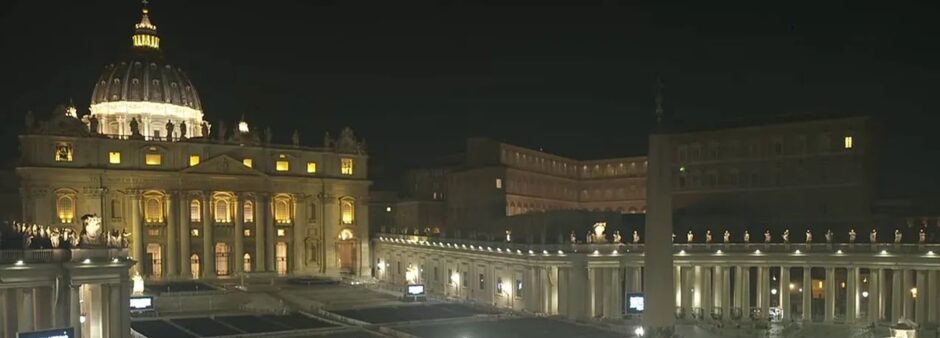
IN ROME On a rainy Christmas Eve, Pope Benedict XVI followed a procession of Swiss guards, bishops and priests down the central nave of St. Peter’s Basilica to celebrate midnight Mass before dignitaries and a global television audience.

And Monsignor Guido Marini, as always, followed the pope.

A tall, reed-thin cleric with a receding hairline and wire-framed glasses, Marini, 45, perched behind the pope’s left shoulder, bowed with him at the altar and adjusted the pontiff’s lush robes. As Master of Pontifical Liturgical Celebrations, he shadows the pope’s every move and makes sure that every candle, Gregorian chant and gilded vestment is exactly as he, the pope and God intended it to be. [A great ideal.]

“The criterion is that it is beautiful,” Marini said.

But beauty, especially when it comes to the rituals of Roman Catholic liturgy, is a topic of great debate between conservative and liberal Catholics, who share differing views on everything from the music and language of the Mass to where a priest should stand and how he should give Communion.

Some of the key trappings of the Mass – the vestments and vernacular, the “smells and bells” – have taken on a more ancient air since Benedict succeeded John Paul II, and since Marini succeeded Piero Marini.

Piero, 68, is a gruff [Could I tell a couple stories.] Vatican veteran, a progressive who advocates a more modern ritual that reflects the great church reforms of the 1960s. [wellll….] The younger and more punctilious Guido, who is not related to Piero, has argued for more traditional liturgical symbols and gestures – like the pope’s preference that the faithful kneel to accept Communion – that some church liberals interpret as the harbinger of a counter-reformation. [What an interesting comparison.  Pushed a little more, that would make the liberals the “Protestant” part of the equation.  No?]

‘Battle of the Marinis’

The coincidence of their shared last names has resulted in YouTube links like “Battle of the Marinis.” (“These things on the YouTube are fun but not important,” said Marini the Second.) But within Vatican and wider liturgical circles, the Marini schism is actually a profound one about the direction of the church.

The liturgical changes enacted under Guido Marini are “a great microcosm for broader shifts in the church,” said John Allen, a veteran Vatican watcher with the National Catholic Reporter.

Since the Marini II era began in October 2007, the papal Masses clearly have a stronger traditional element. Guido Marini, who has degrees in canon and civil law and a doctorate in the psychology of communication, caused considerable consternation among some progressive Catholics in January when he talked to English-speaking priests about a “reform of the reform.” [Let the counter-reforming begin!]

In an interview Thursday, he argued that the changes should not be seen as a liturgical backlash to modernity but as a “harmonious development” in a “continuum” that takes full advantage of the church’s rich history and is not subject to what he has called “sporadic modifications.[Get this…] Liturgical progressives, like Bishop Donald Trautman of Erie, Pa., are concerned that Marini considers the reforms of the 1960s ecumenical council known as Vatican II as being among those sporadic modifications. [His Excellency Bp. Trautman reads the documents on the liturgical reform … selectively.  A closer reading would suggest that Guido Marini is on target.]

At most papal Masses, a large crucifix flanked by tall candles is now displayed on the altar, even though many progressives say the ornaments block the view of the priest and the bread and wine[Well said!  Yes!  Progressives like focusing on the priest and the “bread and wine”.] They argue that this obstructs the accessibility urged by liturgical reforms associated with the Second Vatican Council.  [‘Cause staring that the priest’s dopey face is what the Second Vatican Council is all about.]

Marini responds by saying that the crucifix reminds the faithful of who [Who] is really front and center in the Mass. He also says that the pope cannot sit in front of the altar when it bears the crucifix because “the pope can’t give his back” to sacraments on the altar[And if not the Pope, then how the bishop?  How the priest?]

For Marini, Gregorian chants must be the music of the church because they best interpret the liturgy. [And there is that pesky paragraph in Sacrosanctum Concilium about Gregorian chant.] And in September, ahead of the pope’s visit to Britain, Marini told the Scottish paper the Herald that the pope would celebrate all the Prefaces and Canons of his Masses in Latin.

Piero Marini, who stepped down in 2007 after serving as the master of celebrations for 20 years, has championed the Vatican II reforms, [His ideas of the reforms, at least.] including the simplification of rites that he believes facilitates active participation.

In the name of “inculturation,” or integrating church rites with local customs, [A good way to put it.  For a truer vision of inculturation would seek to integrate local customs with Church rites.] the silver-haired Marini in 1998 accepted the request of local bishops to allow a troupe of scantily clad Pacific islanders in St. Peter’s Basilica to honor the pope with a dance during the opening liturgy of the Synod for Oceania. [Yah… that was a winner.] During John Paul II’s visit to Mexico City in 2002, Marini likewise granted a local bishop’s wish to let an indigenous Mexican shaman exorcise the pope during a Mass there. [Some of the Greatest Hits. And there are so many more!]

He said the changes that have been made since he left are obvious. “You don’t have to ask me,” said Marini, who has expressed wariness about the rollback of liturgical reforms. “Everyone can see it for themselves.

A ‘more sober’ style

His successor said that the two clerics had a good relationship and that it was only natural that things change under a new regime.

“It’s true that there were celebrations that gave more space to different expressions, but that was one style and now there is a different style, one that is more sober and more attentive to the essential things,” said Guido Marini, who, like his predecessor, hails from northern Italy but who, like the pope, expresses admiration for the old Latin Mass. He added that Benedict considered the Mass a heavenly space that shouldn’t be modified with “things that don’t belong.

Marini has said there are no plans to force the changes on parishes around the world, but he hopes that they slowly spread and seep in.

Under Benedict, the faithful at papal Masses take Communion on their knees and receive the wafer on the tongue. Guido Marini said the change “recalls the importance of the moment” and keeps the act from becoming “banal.” A recent picture of Queen Sofia in Spain receiving Communion from the pope in her hand – and while standing and not wearing a veil – brought rebukes from conservative Catholics. (“Reform of the reform apparently put on hold,” read the Catholic blog Rorate Caeli.) [But we learned a few other things about that episode along the way.]

Perhaps the most apparent and luxurious sign of the new era is the pope’s vestments. Benedict has worn an ancient form of the pallium, or cloak, preferred by first-millennium pontiffs. [I liked the the “normal” one.] He also brought back the ermine-trimmed red satin mozzetta, a short cape. And the pope clearly does not obey the article of American political faith to never don an unconventional cap. He has sported a red saturno, a sort of papal cowboy hat, and an ermine-trimmed camauro, a crimson cap that resembles a Santa hat and is worn on nonliturgical occasions.

According to one senior Vatican official who spoke on the condition of anonymity, Marini sent him a page-long list of vestments he had to wear during a special ordination in St. Peter’s. “I didn’t recognize half of the things on it,” the official said. “Then I had trouble getting it all on.”

“The pope likes new things and antique [To non-speakers of Italian, that means “old”.] things,” explained Marini, who compared the pope’s attire to someone in a family who likes modern fashions like, say, Gucci shades but also “the treasures of the family.”

At a Dec. 16 evening Mass, the pope opted for a paisley patterned crimson and gold chasuble, while Marini, his fingers tented in front of him, wore a white cotta with breezy lace sleeves over a purple cassock. As the frail pope sat in his throne, Marini adjusted Benedict’s robes and at the appropriate moments removed the gold miter in order to place a white skullcap atop the pontiff’s white hair. He adjusted the pages of prayer books that altar boys propped up before the pope. After the chorus sang about the divine promise made to David, Marini helped the pope up to read a prayer. At the end of the Mass, the pope followed the candles and large crucifix back up the nave. Marini, as always, trailed immediately behind.

“It’s hard work,” Marini said. “But it’s beautiful.”
Some interesting statements along the way… no?

Posted in The Drill | Tagged ,
30 Comments