Card. Mahony compares Arizona immigration bill to Nazism, Communism

Card. MahonyAs you read keep in mind that Archbishop Gomez will be taking over in Los Angeles before too long.

I add an observation at the end.

From CWN with my emphases and comments:


Cardinal Mahony compares Arizona immigration bill to Nazism, Communism
April 20, 2010

Cardinal Roger Mahony of Los Angeles has offered strong criticism of a measure passed by the Arizona legislature that would require police to arrest suspected illegal immigrants who are unable to provide documentation. The bill, if signed into law, would also make it illegal to hire day laborers off the street and to transport an illegal immigrant. [Note well: At issue is the ability of people who are in the USA illegally.  They are "illegal immigrants".]

[The Cardinal continues:] “The Arizona legislature just passed the country’s most retrogressive, mean-spirited, and useless anti-immigrant law [SB 1070, awaiting the expected signature of Gov. Jan Brewer],” Cardinal Mahony wrote on April 18. “The tragedy of the law is its totally flawed reasoning: that immigrants come to our country to rob, plunder, and consume public resources.” [I doubt that many people in the USA illegally are intending to "plunder".  But some are.  It would be nice to be able to prevent those who have that intention from carrying out their plans to commit crimes.  However, I do believe that quite a few people coming into the USA illegally do have the intention of consuming public resources.  No?  And if it is only a matter of a very few, it would still be good to know who they are and what their reasons are.  Are they truly refugees?  Do they need other forms of assistance?]

“The law is wrongly assuming that Arizona residents, including local law enforcement personnel, will now shift their total attention  ["total"?  Why does it have to be "total"?] to guessing which Latino-looking or foreign-looking person may or may not have proper documents,” he added. [I am guessing that His Eminence is not a supporter of profiling.] “I can’t imagine Arizonans now [Here it comes:] reverting to German Nazi and Russian Communist techniques whereby people are required to turn one another in to the authorities on any suspicion of documentation.”  [That would be a "no" vote from Card. Mahony.]

Although the measure would require police to ask for documents if there is a “reasonable suspicion” that a person is an illegal immigrant, The Los Angeles Timesnoted that the bill “would not require people to report suspected illegal immigrants to authorities, as [Cardinal] Mahony intimated.” 


The issue of illegal immigration is very complex.  People of good will can have differences of opinions about how to address the issue.  Cardinal Mahony is within his rights to express a negative view about the legislation in Arizona.  People are within their rights to express their view of Card. Mahony’s reaction.

What I find interesting in this is the fact that liberals – and I think it is fair to place His Eminence in the liberal camp, rather than the conservative or traditional side – can use whatever sort of inflammatory rhetoric they choose while conservatives are lambasted with all manner of criticism, accusations of incivility, even of sedition, if they use strong rhetoric.

Double standard.
Posted in The Drill | Tagged ,
117 Comments

“It’s the Pope’s fault – again.”

This is pretty interesting, especially for someone who once lost his iPhone.  From Newser.

How a Drunk Engineer Lost the Next iPhone
Sweet, sweet German beer responsible for leak

  (Newser)  – How did Gizmodo penetrate Apple’s ironclad security to get its hands on the next-generation iPhone? Thank the power of beer. Apple engineer Gray Powell, who was working on the Baseband Software that will allow the phone to actually make calls, lost the device at the beer garden not far from company headquarters, where he was celebrating his 27th birthday. He’d been testing it, disguised as a 3GS. His status update sent from the phone read, “I underestimated how good German beer is.”

He then left the device on his barstool, forgot about it, and left the bar. The stranger sitting next to him waited for him to return, but to no avail. The next morning it had been remotely bricked, but he fiddled around with it enough to open the faux-3GS outer shell and find the device within. When Apple wouldn’t return his calls, he contacted Gizmodo. The tech site quickly verified the find, and eventually tracked down Powell—who has, apparently, been neither killed nor fired by Apple’s secret police.

As one of my correspondents wrote, "It’s the Pope’s fault – again".

UPDATE:

Check here also.

Posted in SESSIUNCULA |
Comments Off on “It’s the Pope’s fault – again.”

FOTA III Conference in Cork, Ireland – 10-12 July 2010

One of the organizers of the FOTA conferences in Ireland sent a prospectus for the upcoming meeting. 

It is too long to post, but here is a good item:

The theme of the conference is:

“Benedict XVI and Sacred Music”

10th – 12th  July, 2010.
The Imperial Hotel, South Mall, Cork City, Ireland

The Conference will be opened by:

His Excellency the Most Reverend Raymond Leo Burke,
Prefect of the Signatura Apostolica

And he will speak on "The New Evangelization and Sacred Music: The Unbroken Continuity of Holiness, Beauty and Universality."

Posted in Brick by Brick |
8 Comments

Happy 5th Anniversary Holy Father!

On this day in 2005, the 265th Successor of Peter, the Bishop of Rome, was elected and took the name of Benedict.

May God grant Pope Benedict health and length of days!

(This video is no longer available.)

Where were you when you heard the news?

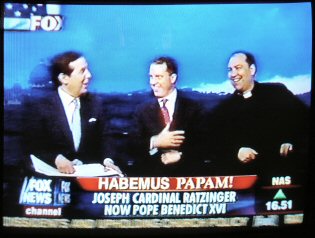
I was working with Fox News in Rome at the time and had the honor of being involved in the live broadcast of the event.
Here is a shot of what I was doing. (Many thanks to the person who sent me the video tape I took this photo from… not a great photo, but… there it is.)

Chris Wallace, Greg Burke, Fr. Zuhlsdorf

PODCAzT 20: Leo the Great and Benedict – Habemus Papam!

“Oremus Pro Pontifice” stuff and store

V. Oremus pro Pontifice nostro Benedicto.

R. Dominus conservet eum, et vivificet eum, et beatum faciat
eum in terra, et non tradat eum in animam inimicorum eius.
[Ps 40:3]

Pater Noster…,  Ave Maria….

Deus, omnium fidelium pastor et rector, famulum tuum
Benedictum, quem pastorem Ecclesiae tuae praeesse voluisti,
propitius respice: da ei, quaesumus, verbo et exemplo,
quibus praeest, proficere: ut ad vitam, una cum grege sibi
credito, perveniat sempiternam. Per Christum, Dominum
nostrum. Amen.

V. Let us pray for Benedict, our Pope.

R. May the Lord preserve him, and give him life, and make
him blessed upon the earth, and deliver him not up to the
will of his enemies. [Ps 40:3]

Our Father,  Hail Mary.

O God, Shepherd and Ruler of all Thy faithful people, look
mercifully upon Thy servant Benedict, whom Thou hast chosen
as shepherd to preside over Thy Church. Grant him, we
beseech Thee, that by his word and example, he may edify
those over whom he hath charge, so that together with the
flock committed to him, may he attain everlasting life.
Through Christ our Lord. Amen.

Posted in SESSIUNCULA |
56 Comments

Benedict XVI to young Maltese

The Holy Father gave this address today with my emphases and comments:

Żgħażagħ Maltin u Għawdxin, jien kuntent ħafna li ninsab maghkom,

[Dear young people of Malta and Gozo, I am very happy to be with you,]

[…]

Saint Paul, as a young man, had an experience that changed him for ever. As you know, he was once an enemy of the Church, and did all he could to destroy it. While he was travelling to Damascus, intending to hunt down any Christians he could find there, the Lord appeared to him in a vision. A blinding light shone around him and he heard a voice saying, "Why do you persecute me? … I am Jesus, whom you are persecuting" (Acts 9:4-5). Paul was completely overcome by this encounter with the Lord, and his whole life was transformed. He became a disciple, and went on to be a great apostle and missionary. Here in Malta, you have particular reason to give thanks for Paul’s missionary labours, which spread the Gospel throughout the Mediterranean.

Every personal encounter with Jesus is an overwhelming experience of love. Previously, as Paul himself admits, he had "persecuted the church of God violently and tried to destroy it" (Gal 1:13). But the hatred and anger expressed in those words was completely swept away by the power of Christ’s love. For the rest of his life, Paul had a burning desire to carry the news of that love to the ends of the earth.

["But Holy Father! But Holy Father!…"] Maybe some of you will say to me, Saint Paul is often severe in his writings. How can I say that he was spreading a message of love? My answer is this. God loves every one of us with a depth and intensity that we can hardly begin to imagine. And he knows us intimately, he knows all our strengths and all our faults. [He knows us better than we know ourselves and He can never be deceived.] Because he loves us so much, he wants to purify us of our faults and build up our virtues so that we can have life in abundance. When he challenges us because something in our lives is displeasing to him, he is not rejecting us, but he is asking us to change and become more perfect. That is what he asked of Saint Paul on the road to Damascus. God rejects no one. And the Church rejects no one. Yet in his great love, God challenges all of us to change and to become more perfect.

Saint John tells us that perfect love casts out fear (cf. 1 Jn 4:18). And so I say to all of you, "Do not be afraid!" How many times we hear those words in the Scriptures! They are addressed by the angel to Mary at the Annunciation, by Jesus to Peter when calling him to be a disciple, and by the angel to Paul on the eve of his shipwreck. To all of you who wish to follow Christ, as married couples, as parents, as priests, as religious, as lay faithful bringing the message of the Gospel to the world, I say, do not be afraid! [READ CAREFULLY:] You may well encounter opposition to the Gospel message. Today’s culture, like every culture, promotes ideas and values that are sometimes at variance with those lived and preached by our Lord Jesus Christ. Often they are presented with great persuasive power, reinforced by the media and by social pressure from groups hostile to the Christian faith. It is easy, when we are young and impressionable, to be swayed by our peers to accept ideas and values that we know are not what the Lord truly wants for us. That is why I say to you: do not be afraid, but rejoice in his love for you; trust him, answer his call to discipleship, and find nourishment and spiritual healing in the sacraments of the Church.

Here in Malta, you live in a society that is steeped in Christian faith and values. You should be proud that your country both defends the unborn and promotes stable family life by saying no to abortion and divorce. [Do I hear an "Amen!"?  I wonder if US Ambassador to Malta Doug Kmiec was there to hear that.] I urge you to maintain this courageous witness to the sanctity of life and the centrality of marriage and family life for a healthy society. In Malta and Gozo, families know how to value and care for their elderly and infirm members, and they welcome children as gifts from God. Other nations can learn from your Christian example. In the context of European society, Gospel values are once again becoming counter-cultural, just as they were at the time of Saint Paul.

In this Year for Priests, [Indeed… what a year!] I ask you to be open to the possibility that the Lord may be calling some of you to give yourselves totally to the service of his people in the priesthood or the consecrated life. Your country has given many fine priests and religious to the Church. Be inspired by their example, and recognize the profound joy that comes from dedicating one’s life to spreading the message of God’s love for all people, without exception.

I have spoken already of the need to care for the very young, and for the elderly and infirm. Yet a Christian is called to bring the healing message of the Gospel to everyone. God loves every single person in this world, indeed he loves everyone who has ever lived throughout the history of the world. In the death and Resurrection of Jesus, which is made present whenever we celebrate the Mass, he offers life in abundance to all those people. As Christians we are called to manifest God’s all-inclusive love. So we should seek out the poor, the vulnerable, the marginalized; we should have a special care for those who are in distress, those suffering from depression or anxiety; we should care for the disabled, and do all we can to promote their dignity and quality of life; we should be attentive to the needs of immigrants and asylum seekers in our midst; we should extend the hand of friendship to members of all faiths and none. That is the noble vocation of love and service that we have all received. Let it inspire you to dedicate your lives to following Christ. La tibżgħux tkunu ħbieb intimi ta’ Kristu. [Do not be afraid to be intimate friends of Christ.]

Dear young people, as I take my leave of you, I want you to know that I am close to you and I remember you and your families and friends in my prayers.

"Selluli għaż-żgħażagħ Maltin u Għawdxin kollha." ["Give my greetings to all young people of Malta and Gozo."]

Posted in SESSIUNCULA |
7 Comments

Your good news

Please give us a lift today and post your good news!

Posted in SESSIUNCULA |
79 Comments

“Where willows harmonize the wind”

"Where willows harmonize the wind"A biretta tip o{]:¬)   to the Laudator with my additions:

 韋 應 物  Wei Ying-wu (c. 737–791), East of the Town (tr. Witter Bynner, ellipses in original):

From office confinement all year long,
I have come out of town to be free this morning
Where willows harmonize the wind
And green hills lighten the cares of the world.
I lean by a tree and rest myself
Or wander up and down a stream.
…Mists have wet the fragrant meadows;
A spring dove calls from some hidden place.
…With quiet surroundings, the mind is at peace,
But beset with affairs, it grows restless again…
Here I shall finally build me a cabin,
As Tao Ch’ien built one long ago.

Tao Qian was a 5th century poet.

Listen to the Chinese, Mandarin.


Posted in SESSIUNCULA | Tagged , ,
6 Comments

Internal forum/confession and reporting crimes to the state

My friend Fr. Ray Blake, parish priest in Brighton at St. Mary Magdalen has a very good entry on his blog.  To a degree it represents also some of my own reflections in the last few days.

Let’s have a look:

Cardinal Castrillon Hoyos’ letter and Fr Lombardi’s response is still troubling me.

Obviously, we all want to root out the "filth that has infiltrated the Church", the Pope has made war on the sexual abuse of children by clergy and its cover-up. He has stressed that in this matter the members of the Church, including bishops, are not above the law and should co-operate with the civil authorities. Because of the horrific nature of such abuse and the long term affects of it on the victim, few could argue against such a stance with this particular crime.

My problem is my problem is the precedent it sets in the relationship of the priest and the Church with the law of the state, how far should our co-operation extend?

In the previous post most people have said that a priest should reveal those things told to him outside the confessional, as good Catholics they accept the inviolability of the "seal of Confession" but in today’s secular society the Confessional is hardly likely to constitute an acceptable legal defense in a civil court. [Furthermore, mark my word, the priest’s legal privilege in this regard is going to come under greater attack.]

In my experience spiritual direction is often linked to Confession, an hour long conversation may well lead into Confession. If someone has committed a serious sin as a priest my intention is to bring him to repentance. In some cases that might be my intention but necessarily the intention of person who has come to talk to me, in some cases this might be the object of a series of conversations lasting over a number of weeks and Confession my take place in the place where we are talking. [Therefore, what part of the process would be considered "under the Seal"?  It seems that the whole thing is a matter of the "internal forum".  But what would the state consider privileged?]

Therefore the problem for a priest is: what constitutes both confession and the confessional?  [Does it have to be in a confessional?  Obviously not.  But in general if I have to hear a confession after a long discussion of some sort elsewhere, I say that we should for the confession use the confessional.  That isn’t always possible.  But that is what confessionals are for.]

What does a priest do when, for example, an airline pilot wants to talk about his relationship problems and in the conversation he then reveals he has drink problem, or a doctor reveals his drug problem, both of which place others at serious risk? What does he do when the daughter of an elderly confused father tells him she gets so frustrated she hits him regularly or locks the door of the house and leaves him sitting in his own filth for hours on end? On a more prosaic level what does he do when someone tells him about benefit or tax fraud.

The implication of what the Pope has been saying is that the priest should report these occurrences, "The Church is not above the law". In the past a priest would want to lead the sinner to repentance and to get them to resolve the situation themselves.

Looking at the worst case situations: in Uganda the law says homosexual acts are illegal and punishable by imprisonment, what does a priest in Uganda do when someone tells him he is engaged in homosexual sex? In China where underground Christianity itself is illegal, what is bishop or priest to do?

In England, a Catholic teachers might in the future tell a priest that they have denied a child her right to access contraceptive or abortion services, would he be expected to report the teacher?


We will be hearing more about this in the future.

It may be that we will see a new wave of martyrs.

Posted in "How To..." - Practical Notes, Clerical Sexual Abuse, Our Catholic Identity, The future and our choices | Tagged , ,
31 Comments

A look at Fr. Pfleger’s parish in Chicago

I am amazed that Fr. Pfleger continues in his office of pastor at St. Sabina Church in Chicago. 

A reader sent me this:

A day or two ago I decided to see what St. Sabina’s website has to offer http://www.saintsabina.org/.

In looking through the various pages on the site I gradually realized a lacuna – there is almost no way to tell whether or not it is still a Catholic parish. 

– The parish is ever-referred to as ‘the Faith Community of Saint Sabina". 

– On the mission page it states that "St. Sabina is a Word-based, Bible teaching church" and that it is a "Is committed to building a Third Day Church". 

– Mass is only mentioned once on the site – in the history, in reference to the first Mass "celebrated in a storefront on South Racine Avenue." 

– The only other sacrament that is mentioned, once, is Confirmation – because it is on the calendar of events… even in that entry is a hidden oddity, it states, "If you were baptized in April 2010, please sign the form below and return to Minister Kimberly Lymore by April 5, 2010."  I didn’t know ‘Minister’ was a title one could take to herself.

– Mass is never on the schedule, only "worship services".

– Baptism, marriage, confession, Eucharist, pastoral care of the sick in any form are never mentioned.

– the only mention of ordination is, of course, that of Fr. Pfleger [who, it is noted became the youngest – at the time in 1981 – ‘full pastor in the diocese’… perhaps that was one of the first mistakes].

Finally, I found it interesting to see that he had the famous Rev. Jeremiah Wright preach the two last words of the ‘Seven Last Words’ on Good Friday past.

The question is – has he maintained, and helped his parish to maintain Communion with the Catholic Church, whether particular [in Chicago] or Universal [i.e. in Communion with the Apostolic See]?


UPDATE 22:28 GMT

From a reader:

To follow-up on your question as to whether Fr Pfleger is in communion with the Church, I decided to look at his parish’s website.

One thing in particular struck me.  He calls himself "Rev. Dr. Michael Louis Pfleger."  However, according to the biography, his doctorate is honoris causa.

No person is permitted to affix "Dr" before his name upon receiving an honorary doctorate, even though this is a consistent practise of many Protestant theologians.  Jerry Falwell is a classic example of this.  I find Fr Pfleger to be strangely Protestant on this point.

Fr Pfleger has done many good works.  If only he were more Catholic, his works would be so much more meritorious.

Posted in Our Catholic Identity, The Drill, Throwing a Nutty | Tagged
72 Comments

PODCAzT 100: Benedict XVI, Pius XII, Justin Martyr and Fr. Z rants about liturgical abuse

Here is PODCAzT 100.  I wasn’t feeling very creative today, so I set out with the intention of simply reading to you about St. Justin Martyr (+165).  A selection of his 1st Apology is in the Liturgy of the Hours today and his feast was just on 14 April, in the older, traditional Roman calendar.

It seems as if I am running into Justin Martyr all the time these days.

But… then I got going and started with digressions and… the rest is history.

So, in this project we will hear Pope Benedict XVI from one of his Wednesday General Audiences back in 2007 talk about St. Justin.

Then I drag into service Ven. Pius XII about people who go astray in liturgy because they want to return to earlier forms.  Thus we hear something from Mediator Dei of 1947.

Then I start to digress on liturgical abuse and haul out Redemptionis Sacramentum which explains that all the faithful have the duty to report liturgical abuses.
PODCAzT 100: Benedict XVI, Pius XII, Justin Martyr and Fr. Z rants about liturgical abuse
And I rant for a while.

https://wdtprs.com/podcazt/10_04_18.mp3

Posted in PODCAzT, Saints: Stories & Symbols, Wherein Fr. Z Rants | Tagged , , , ,
21 Comments