Because this week wasn’t bad enough already…

Okay… lemme get this straight.

In midst of this controversy, the Pope’s preacher stands up Good Friday, not at all a controversial day for this pontificate, and… like Joe Biden with an open mic… compares the present persecution of the Church to the persecution of the Jews.

Please… someone … tell me that no one vetted Fr. Cantalamessa’s sermon today and that he was bobbing and weaving out there all by himself.

Please bring Fr. Lombardi more coffee, ’cause it’s going to be a looong night.

Hell’s Bible now has their quote for the rest of Holy Week.

I can just picture a back office of editors at the NYT, sitting around with cocktails and dreaming about how the Vatican could possibly make this worse.

"Well…. maybe what if a, like, cardinal or…. watzit… monsignor? …. nah… never happen.  No one could be that…"

"WHAT?" they ask, pouring more shots.

"Well… what if someone in the Vatican compared their problems to… wait for it… the Holocaust."

[gales of laughter… the sound of more ice tumbling in glasses]

"[sniffing]… sigh… good… yah… never happen…."

Posted in SESSIUNCULA | Tagged , ,
64 Comments

Taking it to the street

A small Greek Orthodox Church near where I am staying took it outside today.

With the help of New York’s finest, they actually blocked 8th Ave for a while.

Taking it to the street

Posted in SESSIUNCULA |
6 Comments

LOCK AND LOAD! LUTHERAN CLARITY about the attacks on Pope Benedict!

There is a spectacular examination of the recent attacks on Pope Benedict – the Pope of Christian Unity – and on the Church by a LUTHERAN theologian on a Lutheran site, Logia, a Lutheran theological journal.

It is long but worth it.  Here is a bit of the beginning with my E & C.

The dictatorship of relativism strikes back—and goes nuclear
Wednesday, 31 March 2010 15:43

Some ecumenical thoughts at Holy Week 2010 from John Stephenson

The secular press has had it in for Joseph Ratzinger for going on three decades. Before his election as Pope in the spring of 2005, he was routinely derided in his homeland as the Panzerkardinal (“tank cardinal”) and caricatured in North America as the “Enforcer” or even the “Rottweiler.” The roots of this negative reputation stretch back at least as far as the book-length interview he granted to the Italian journalist Vittorio Messori that catapulted him to global fame when published as The Ratzinger Report in 1985. [He dared to question to liberal, modernist grip on the narrative of Vatican II and how things were going as a result of the misapplication of the Council.] Prior to that juncture, as a heavyweight German academic who had leapfrogged over a major episcopal see (Munich-Freising) to become a leading official in the Roman curia (as cardinal prefect of the Congregation for the Doctrine of the Faith) under the still new John Paul II, Ratzinger’s was hardly a household name.

But shrewd observers must wonder about [get this…] the startling disproportion between the enormous hue and cry artificially whipped up by the media and the softly spoken real life figure who seems always to have avoided hyperbole like the plague. [One of the best sentences on this controversy yet.]  Even though the curial department over which he presided for almost a quarter century is the direct heir to the 16th-century Inquisition, the disciplinary measures dealt out by Ratzinger against barely a score of wildly Modernist (actually mostly apostate) theologians over more than two decades add up to a string of fairly mild censures, gentle slaps on the wrist in most cases. Hans Küng [ultra-discontinity agent and star theological punchline] lost the right to teach theology as an accredited representative of the magisterium (as his missio canonica was stripped from him), but (despite his clear disavowal of the divinity of Christ!) retained his status as an incardinated (=rostered) Roman Catholic priest, and he has, well, greatly profited in fame and fortune from his much trumpeted role as Rome’s chief dissident. Had he rather than Ratzinger landed in the chair of cardinal prefect back in the early 1980s, the media would have shown no sympathy for the advocates of traditional Christianity that a totalitarian liberal such as Küng [excellent… "totalitarian liberal".  Right!  Liberals are those with whom you are "free" to agree!] would have hounded to the remotest margins of Church life; ironically, there is no more illiberal force on earth than a liberal with his hands on the levers of power.  [POW!  BIF!]

 Moreover, when someone takes the trouble to examine Ratzinger’s huge opus over close to six decades as a professional theologian, they make the discovery that he occupies a centrist position in the constellation of modern Roman Catholic theology; he is at most mildly “conservative”, the “ultra-conservative” label routinely affixed to him by most sections of the press being sheerly laughable.  [Folks… I didn’t write this… I promise you, I didn’t.  I wish I had, however.]

As I set forth the Roman Catholic reality in our St. Catharines Religious Bodies (Comparative Symbolics) course, I point out the current uneasy coexistence of three groupings in that vast church body.

[I will cut this off soon… but… here is a little more.]

Modernism on the rampage (or the elephant actually destroying the living room)

In the one corner are the media-supported Modernists, those who do not acknowledge the definitive quality of God’s unsurpassable self-revelation in Christ, and who thus regard faith and practice not as givens to be handed down intact but as man-made constructs to be refashioned at whim according to the capricious desire of succeeding generations. Roundly condemned and solemnly proscribed by Pius X (1903-1914) and still held back to a great extent by Pius XII (1939-1958), the Modernists crawled out of the woodwork during the reign of John XXIII (1958-1963), and Modernism swiftly rose to a dominant position in Roman Catholic theology in, with, under, and around the (sixteen) officially promulgated documents of Vatican II (1962-1965).  [OORAH!]

As a young theologian, Ratzinger attended Vatican II as a peritus (=expert) of somewhat “progressive” tendencies. By Council’s close he was uneasy over the tone and content of its last document, Gaudium et spes, the Pastoral Constitution on the Church and the Modern World. Shocked to the core by the virulently anti-Christian positions embraced even by theology students (led by such figures as the radical Tübingen exegete Ernst Käsemann) in the student uprisings of 1968 (Achtundsechziger [“68ers”] is an actual word in modern German), Ratzinger firmed up his centrist credentials and switched his support from the left-leaning magazine Concilium (the house organ of Küng & Co.) to the middle of the road Communio (the substitute publication of von Balthasar and friends).

Clearly, the Modernists who surged forth to theological dominance in the wake of Vatican II have never forgiven Ratzinger for his “betrayal” of their cause; in their books (literally, in the case of Küng’s interminable memoirs) he is and remains a cross between Brutus and Judas Iscariot. At least some of his media woes are attributable to the Modernists’ insatiable thirst for revenge for, say, his pointed critique of Gaudium et spes written ten years after the close of the Council. But these pages of sober commentary are surely sweet music to orthodox Lutheran ears. [Are you itching to read more?] Yes, Vatican II was infected by the dementedly schwärmerisch optimism of the Kennedy era (Principles of Catholic Theology, 372; 383). Yes, Gaudium et spes considers the “world” a positive entity, with which it seeks dialogue and cooperation with a view to building jointly with it a better global state of affairs (Principles, 379f.). Had he lived much longer, Hermann Sasse, who was careful to register both the strengths and the weaknesses of Vatican II, would surely have added his Yea and Amen to Ratzinger’s analysis of Gaudium et spes.

As they still pretend that everything in the post-Vatican II Roman Catholic garden is fine and dandy, the Modernists undoubtedly continue greatly to resent Ratzinger’s telling Vittorio Messori in the early 1980s how “we must speak …of a crisis of faith and of the Church” (Ratzinger Report, 44; “the gravity of the crisis,” 62;  “in this confused period, when truly every type of heretical aberration seems to be pressing upon the doors of the authentic faith,” 105). Later in the same decade I headed the first chapter of CLD’s Eschatology volume “General Apostasy: the Sign of our Time.” Guess what? Ratzinger, the GAFCON Anglicans, and I are spot on. Might there be something slightly fishy in the direction ELCA, ELCiC, TEC (the US Episcopalians), and the Anglican Church of Canada have been heading lately? The Modernists and their media allies would much prefer that no one notice these developments.

[Fantastic…. here are his other headings.]

  • The traditionalist rump
  • In the centre receiving shots from both (all) sides
  • By the way, the world still hates, loathes, & detests Christ and His Church!
  • Christendom as a whole is under attack
  • Not in the same ballpark as Leo X & Co.

HUGE WDTPRS KUDOS to John Stephenson and Logia!

Some highlights….

When did you last read a fair account of the late Archbishop Marcel Lefebvre (1905-1991) in the “quality” press? When did you ever read there an objective appraisal of the Society of St. Pius X (SSPX) that Lefebvre founded to withstand the Modernist juggernaut that came out of the Council?

And…

To understand his papal programme (inasmuch as we may talk of such a thing), we must realise that he is endeavouring to steer his massive ecclesial ship back into a centrist channel after a good forty years of disastrous leftward lurch—just consider the pitiful liturgical shambles that emerged from Paul VI’s Novus Ordo of 1968, causing Hermann Sasse to remark in his last years how Rome had suddenly “canonised St. Zwingli.”

Who is this guy?  Can we make him a bishop?

And…

His papacy was barely a few hours old when the CBC (Canadian Broadcasting Corporation) evening news ran a segment on an aged Italian woman (a “good Catholic”, of course) who stood crestfallen amid a jubilant crowd as Benedict XVI appeared on the balcony of St. Peter’s, walking dejectedly away as she realized that women’s ordination, contraception, sexual licence, abortion on demand, and all that good stuff would still be denied the papal seal of approval.

And…

The negative reaction aroused already by the Ratzinger Report laid bare the sheer fury shared by Roman Catholic Modernists and the unbelieving world in general against anyone who dares to intimate that the historic Christian religion is, to put it bluntly, true. Neither apostates within Holy Christendom nor naked unbelievers outside her borders will ever forgive Ratzinger for the grave breach of secularist, pluralist etiquette involved in the first volume of his Jesus of Nazareth.

 And…


Can we picture Peter and Paul, around the year 68, stamping their feet and stressing the paramount need for Nero to respect the human rights of the nascent Christian community in Rome? Can we get our hands on evidence that the bishops and other ecclesial spokesmen of the day adopted the tone of these Anglican Evangelical prelates toward Decius and Diocletian? More to the point, can we imagine Diocletian, Decius, and Nero meekly agreeing to “remedy the serious developments” that had occurred on their respective imperial watches? Rather than issuing impotent appeals to the successive beasts that arise from the earth, bishops are to prepare and equip the Christian faithful to undergo the fires of tribulation that the Lord permits to come their way.


And…


Oh… just go read it!

Posted in Pope of Christian Unity, The Drill | Tagged , , ,
38 Comments

WDTPRS POLL: How much of the Sacred Triduum will you attend?

This is a busy time for all of us, but this is also the most sacred and profound time of the whole liturgical year.

Here is a little poll… which is entirely anonymous.
WDTPRS POLL: How much of the Sacred Triduum will you attend?
You might prefer your local parish for the Triduum.  You might travel a great distance for something you consider more worthy.  You might be able to go to everything offered or just part of it.  You might even wind up going to more than one!

This is more about actual plans to go, if you can, rather than whether you long to go but can’t.

But vote and give us a comment in the combox.
Twitter
REMEMBER: Participation at the Easter Vigil on Saturday evening fulfills your obligation to attend Mass on Easter.

Also… GO TO CONFESSION if you need to and if you can!  JUST GO!

{democracy:50}

And don’t forget to follow me on Twitter and … the … thingy.

ALSO!… ALSO!….

Will you stay on Thursday for Adoration or will you also visit other Churches to see their Altars of Repose?
 

Posted in POLLS | Tagged
89 Comments

Liberal groups urge media boycot of Catholic League’s Bill Donohue

No joke here…. from the Catholic League.

ATTEMPTS TO CENSOR DONOHUE FAIL

April 1, 2010

Catholic League president Bill Donohue comments on recent attempts to censor him:

TV producers have been telling me for years that my critics have implored them never to invite me back on any program. But they always do. While the media are overwhelmingly liberal, they have an obligation to offer different points of view. Hence, their non-stop invitations asking me to speak.

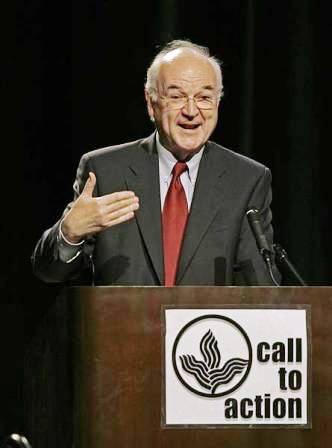
The latest attempt to silence me comes from GLAAD (Gay & Lesbian Alliance Against Defamation), Call to Action and the Interfaith Alliance. The three left-wing organizations have joined hands demanding that the media "ignore Bill Donohue." Their complaint? My telling the truth about the role homosexual priests have played in the abuse scandal.

The data collected by John Jay College of Criminal Justice show that between 1950 and 2002, 81 percent of the victims were male and 75 percent of them were post-pubescent. In other words, three out of every four victims have been abused by homosexuals. By the way, puberty, according to the American Academy of Pediatrics, begins at age 10 for boys.

No problem can be remedied without an accurate diagnosis. And any accurate diagnosis that does not finger the role that homosexuals have played in molesting minors is intellectually dishonest. The cover-up must end. And so must attempts to muzzle my voice. Everything I am saying is what most people already know, but are afraid to say it. It’s time for some straight talk.

Posted in Throwing a Nutty | Tagged ,
66 Comments

Benedict XVI’s Holy Thursday, Mass sermon

Benedict XVI's Holy Thursday, Mass sermonThe Holy Father’s sermon for the Mass of the Last Supper on Holy Thursday.

Pope Benedict teases out three sayings from the Lord’s discourse at the Last Supper in the Gospel of John.

1) "This is eternal life, that they may know you, the only true God, and Jesus Christ, whom you have sent" (Jn 17:3)
2) "I have made your name known to those whom you gave me from the world" (v. 6). "I have made your name known to them, and I will make it known, so that the love with which you have loved me may be in them, and I in them" (v. 26)
3) "I do not ask only on behalf of these – the community of the disciples gathered in the Upper Room – but also on behalf of those who will believe in me through their word, that they may all be one. As you, Father, are in me, and I am in you, may they also be in us, so that the world may believe that you have sent me" (v. 20ff.; cf. vv. 11 and 13)

My emphases and comments.

Dear Brothers and Sisters,

In his Gospel, Saint John, more fully than the other three evangelists, reports in his own distinctive way the farewell discourses of Jesus; they appear as his testament and a synthesis of the core of his message. They are introduced by the washing of feet, in which Jesus’ redemptive ministry on behalf of a humanity needing purification is summed up in a gesture of humility. Jesus’ words end as a prayer, his priestly prayer, whose background exegetes have traced to the ritual of the Jewish feast of atonement. The significance of that feast and its rituals – the world’s purification and reconciliation with God – is fulfilled in Jesus’ prayer, a prayer which anticipates his Passion and transforms it into a prayer. The priestly prayer thus makes uniquely evident the perpetual mystery of Holy Thursday: the new priesthood of Jesus Christ and its prolongation in the consecration of the Apostles, in the incorporation of the disciples into the Lord’s priesthood. From this inexhaustibly profound text, I would like to select three sayings of Jesus which can lead us more fully into the mystery of Holy Thursday.

First, there are the words: [1] "This is eternal life, that they may know you, the only true God, and Jesus Christ, whom you have sent" (Jn 17:3). Everyone wants to have life. We long for a life which is authentic, complete, worthwhile, full of joy. This yearning for life coexists with a resistance to death, which nonetheless remains unescapable. [Which is at the heart of why we must worship God and not distract ourselves by introducing that which is unworthy in our worship.] When Jesus speaks about eternal life, he is referring to real and true life, a life worthy of being lived. He is not simply speaking about life after death. He is talking about authentic life, a life fully alive and thus not subject to death, yet one which can already, and indeed must, begin in this world. [Though it can only be fulfilled in the next.] Only if we learn even now how to live authentically, if we learn how to live the life which death cannot take away, does the promise of eternity become meaningful. But how does this happen? What is this true and eternal life which death cannot touch? We havBenedict XVI's Holy Thursday, Mass sermone heard Jesus’ answer: this is eternal life, that they may know you – God – and the one whom you have sent, Jesus Christ. Much to our surprise, we are told that life is knowledge. This means first of all that life is relationship. No one has life from himself and only for himself. We have it from others and in a relationship with others. If it is a relationship in truth and love, a giving and receiving, it gives fullness to life and makes it beautiful. But for that very reason, the destruction of that relationship by death can be especially painful, it can put life itself in question. Only a relationship with the One who is himself Life can preserve my life beyond the floodwaters of death, can bring me through them alive. Already in Greek philosophy we encounter the idea that man can find eternal life if he clings to what is indestructible – to truth, which is eternal. He needs, as it were, to be full of truth in order to bear within himself the stuff of eternity. But only if truth is a Person, can it lead me through the night of death. We cling to God – to Jesus Christ the Risen One. And thus we are led by the One who is himself Life. In this relationship we too live by passing through death, since we are not forsaken by the One who is himself Life.

But let us return to Jesus’s words – this is eternal life: that they know you and the One whom you have sent. Knowledge of God becomes eternal life. Clearly "knowledge" here means something more than mere factual knowledge, as, for example, when we know that a famous person has died or a discovery was made. Knowing, in the language of sacred Scripture, is an interior becoming one with the other. Knowing God, knowing Christ, always means loving him, becoming, in a sense, one with him by virtue of that knowledge and love. Our life becomes authentic and true life, and thus eternal life, when we know the One who is the source of all being and all life. And so Jesus’ words become a summons: let us become friends of Jesus, let us try to know him all the more! Let us live in dialogue with him! Let us learn from him how to live aright, let us be his witnesses! Then we become people who love and then we act aright. Then we are truly alive.

[2] Twice in the course of the priestly prayer Jesus speaks of revealing God’s name. "I have made your name known to those whom you gave me from the world" (v. 6). "I have made your name known to them, and I will make it known, so that the love with which you have loved me may be in them, and I in them" (v. 26). The Lord is alluding here to the scene of the burning bush, when God, at Moses’ request, had revealed his name. Jesus thus means to say that he is bringing to fulfilment what began with the burning bush; that in him God, who had made himself known to Moses, now reveals himself fully. [Don’t forget GS 22.] And that in doing so he brings about reconciliation; thBenedict XVI's Holy Thursday, Mass sermonat the love with which God loves his Son in the mystery of the Trinity now draws men and women into this divine circle of love. But what, more precisely, does it mean to say that the revelation made from the burning bush is finally brought to completion, fully attains its purpose? The essence of what took place on Mount Horeb was not the mysterious word, the "name" which God had revealed to Moses, as a kind of mark of identification. To give one’s name means to enter into relationship with another. The revelation of the divine name, then, means that God, infinite and self-subsistent, enters into the network of human relationships; that he comes out of himself, so to speak, and becomes one of us, present among us and for us. Consequently, Israel saw in the name of God not merely a word steeped in mystery, but an affirmation that God is with us. According to sacred Scripture, the Temple is the dwelling-place of God’s name. God is not confined within any earthly space; he remains infinitely above and beyond the world. Yet in the Temple he is present for us as the One who can be called – as the One who wills to be with us. This desire of God to be with his people comes to completion in the incarnation of the Son. Here what began at the burning bush is truly brought to completion: God, as a Man, is able to be called by us and he is close to us. He is one of us, yet he remains the eternal and infinite God. His love comes forth, so to speak, from himself and enters into our midst. The mystery of the Eucharist, the presence of the Lord under the appearances of bread and wine, is the highest and most sublime way in which this new mode of God’s being-with-us takes shape. "Truly you are a God who is hidden, O God of Israel", the prophet Isaiah had prayed (45:15). This never ceases to be true. But we can also say: Truly you are a God who is close, you are a God-with-us. You have revealed your mystery to us, you have shown your face to us. You have revealed yourself and given yourself into our hands… At this hour joy and gratitude must fill us, because God has shown himself, because he, infinite and beyond the grasp of our reason, is the God who is close to us, who loves us, and whom we can know and love.

The best-known petition of the priestly prayer is the petition for the unity of the disciples, now and yet to come: [3] "I do not ask only on behalf of these – the community of the disciples gathered in the Upper Room – but also on behalf of those who will believe in me through their word, that they may all be one. As you, Father, are in me, and I am in you, may they also be in us, so that the world may believe that you have sent me" (v. 20ff.; cf. vv. 11 and 13). What exactly is the Lord asking for? First, he prays for his disciples, present and future. He peers into the distance of future history. He sees the dangers there and he commends this community to the heart of the Father. He prays to the Father for the Church and for her unity. It has been said that in the Gospel of John the Church is not present. Yet here she appears in her essential features: as the community of disciples who through the apostolic preaching believe in Jesus Christ and thus become one. Jesus prays for the Church to be one and apostolic. This prayer, then, is properly speaking an act which founds the Church. [!] The Lord prays to the Father for the Church. She is born of the prayer of Jesus and through the preaching of the Apostles, who make known God’s name and introduce men and women into the fellowship of love with God. Jesus thus prays that the preaching of the disciples will continue for all time, that it will gather together men and women who know God and the one he has sent, his Son Jesus Christ. He prays that men and women may be led to faith and, through faith, to love. He asks the Father that these believers "be in us" (v. 21); that they will live, in other words, in interior communion with God and Jesus Christ, and that this inward being in communion with God may give rise to visible unity. Twice the Lord says that this unity should make the world believe in the mission of Jesus. It must thus be a unity which can be seen – a unity which so transcends ordinary human possibilities as to become a sign before the world and to authenticate the mission of Jesus Christ. Jesus’ prayer gives us the assurance that the preaching of the Apostles will never fail throughout history; that it will alwaBenedict XVI's Holy Thursday, Mass sermonys awaken faith and gather men and women into unity – into a unity which becomes a testimony to the mission of Jesus Christ. But this prayer also challenges us to a constant examination of conscience. [!] At this hour the Lord is asking us: are you living, through faith, in fellowship with me and thus in fellowship with God? Or are you rather living for yourself, and thus apart from faith? And are you not thus guilty of the inconsistency which obscures my mission in the world and prevents men and women from encountering God’s love? It was part of the historical Passion of Jesus, and remains part of his ongoing Passion throughout history, that he saw, and even now continues to see, all that threatens and destroys unity. As we meditate on the Passion of the Lord, let us also feel Jesus’ pain at the way that we contradict his prayer, that we resist his love, that we oppose the unity which should bear witness before the world to his mission.

At this hour, when the Lord in the most holy Eucharist gives himself, his body and his blood, into our hands and into our hearts, let us be moved by his prayer. Let us enter into his prayer and thus beseech him: Lord, grant us faith in you, who are one with the Father in the Holy Spirit. Grant that we may live in your love and thus become one, as you are one with the Father, so that the world may believe. Amen.

Posted in Pope of Christian Unity, SESSIUNCULA | Tagged ,
2 Comments

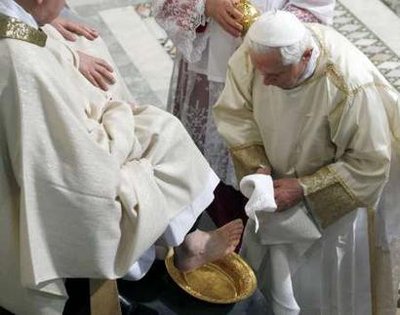
Bp. Dewayne (D. Venice): male feet only

Appropos the liturgical abuse that regularly occurs on Holy Thursday in so many places… this is in from the Herald Tribune in Florida.

His Excellency Most Rev. Frank Dewayne of the Diocese of Venice in Florida has told priests that if they are going to wash feet, they must be male feet.

My emphases and comments.

A gender debate on foot washing

By Todd Ruger

Published: Tuesday, March 30, 2010 at 1:00 a.m.
Last Modified: Monday, March 29, 2010 at 11:14 p.m.

SARASOTA COUNTY – In a move that brings a national debate home to Southwest Florida Catholic churches, Bishop Frank Dewane has reminded priests that only men should have their feet washed during a pre-Easter ceremony.

Many Catholic priests in Southwest Florida have customarily [Perhaps they also want to claim it is okay because it is a "custom".  But it is contrary to the Church’s repeated rubrics and clarifications.] washed the feet of male and female parishioners on the Thursday before Easter in a symbol of humbly serving others.

Dewane, who became bishop in 2006, has garnered a reputation for bringing a more hands-on and conservative interpretation of church rules than his predecessor to his role as shepherd of 250,000 Catholics in Southwest Florida.

In the past, he has banned speakers on abortion from his churches, and last month he threatened to ex-communicate Catholics who went to a ceremony to install women as priests.  [Did he?  Good for him!]

Dewane sent his "Rules of the Road" [is that what it is really called?] letter to churches on Friday for the series of Masses and events leading up to Easter, and it included the foot washing clarification, the diocese said.

"The washing of the feet of chosen men which, according to tradition, is performed on this day, represents the service and charity of Christ, who came ‘not to be served, but to serve.’ This tradition should be maintained," the letter read, quoting church rules.

The letter goes on to explain that women were included once, [and should not have been] but that was a special case and does not indicate a change in policy.

In response, some priests called the bishop with concerns about having to change their church’s ritual and exclude women, the diocese said.  [I bet they did!]

Dewane’s letter was sent in response to questions about church policy on the washing of feet, and was not meant as an edict "from on high," diocese spokesman Bob Reddy said.  [It is just a clarification of what has already come from on REALLY High.]
 
"It does not tell them they have to use men only, this week or ever," Reddy said. "It’s just saying, priests want to know what the rules are, this is what the rules are."  [HUH?   Is there a special school that diocesan spokesmen go to for this?]

The bishop’s letter further fuels an ongoing national controversy over the inclusion of women in the foot-washing ceremony.

[Now… pay attention to this profoundly blinkered view of the issue, noting especially the enormous winged canard…] "I don’t know why men’s feet are more worthy than women’s," said Alice Campanella of Voice of The Faithful in Boston, [embarrassing, isn’t it?] where Archbishop Sean O’Malley upset many Catholic women in 2005 by inviting only men to participate in the Holy Thursday ritual.  [Perhaps upset many women who are less than clear about their Catholic identity?  I am sure it wasn’t because the Cardinal was rude about it.  I bet he bent over backward in pretzel-like twists to be kind about it.]

The church rules state that the priest will pour water on the feet of "men who have been chosen" [viri selecti] and then dry them, an imitation of Jesus’s washing of the feet of his disciples at the Last Supper.

However, the U.S. Conference of Catholic Bishops acknowledges that it is customary in many places to invite men and women to be participants.  [That doesn’t make it okay to do.]

The Vatican told O’Malley he could wash women’s feet, as is the practice of many priests, the Boston Globe reported at the time.  [I doubt that permission has been reiterated, however.  And it was local, and for him.  No?]

Dewane’s letter to his priests Friday referenced that decision, but added that "it was for a particular case and does not represent a change." [Exactly.]

"This letter is not saying they can’t," Reddy said. "He said, if I wanted only men, I would state ‘therefore, I want only men.’"  [HUH?]

The role of women in church practices has been a constant issue for the Catholic church. Polls show that about two-thirds of U.S. Catholics believe women should be ordained, an increase of 20 percent over similar polls in the 1980s.  [Sorry.]

In a Pew Research Center survey, the treatment of women in the church was cited by 39 percent of former Catholics as part of the reason they left.  [Thus putting their souls in peril of eternal separation from God.]

Attempts to reach several local priests and officials at local churches for comment were unsuccessful.

Posted in Brick by Brick | Tagged
46 Comments

Benedict XVI’s Chrism Mass sermon: “In the lamp of our lives, the oil of mercy should never run dry.”

"In the lamp of our lives, the oil of mercy should never run dry."

The Holy Father celebrated the Chrism Mass today, with priests of Rome.

My emphases and comments:

Dear Brothers and Sisters,

At the centre of the Church’s worship is the notion of "sacrament". [Allow me to remind you, dear reader, that sacramentum is the way Latins translated Greek mysterion.  I am constantly going on in these electronic pages about our need for an encounter with mystery in our worship.  This next part reinforces what we have been saying here for years: "active participation" is really about active receptivity, an interior participation which finds outward expression at the right moments and in the right way.] This means that it is not primarily we who act, but God comes first to meet us through his action, he looks upon us and he leads us to himself. Another striking feature is this: God touches us through material things, through gifts of creation that he takes up into his service, making them instruments of the encounter between us and himself. [We encounter mystery.] There are four elements in creation on which the world of sacraments is built: water, bread, wine and olive oil. Water, as the basic element and fundamental condition of all life, is the essential sign of the act in which, through baptism, we become Christians and are born to new life. While water is the vital element everywhere, and thus represents the shared access of all people to rebirth as Christians, the other three elements belong to the culture of the Mediterranean region. In other words, they point towards the concrete historical environment in which Christianity emerged. God acted in a clearly defined place on the earth, he truly made history with men. On the one hand, these three elements are gifts of creation, and on the other, they also indicate the locality of the history of God with us. They are a synthesis between creation and history: gifts of God that always connect us to those parts of the world where God chose to act with us in historical time, where he chose to become one of us.

Within these three elements there is a further gradation. Bread has to do with everyday life. It is the fundamental gift of life day by day. Wine has to do with feasting, with the fine things of creation, in which, at the same time, the joy of the redeemed finds particular expression. Olive oil has a wide range of meaning. It is nourishment, it is medicine, it gives beauty, it prepares us for battle and it gives strength. Kings and priests are anointed with oil, which is thus a sign of dignity and responsibility, and likewise of the strength that comes from God. Even the name that we bear as "Christians" contains the mystery of the oil. The word "Christians", in fact, by which Christ’s disciples were known in the earliest days of Gentile Christianity, is derived from the word "Christ" (Acts 11:20-21) – the Greek translation of the word "Messiah", which means "anointed one". To be a Christian is to come from Christ, to belong to Christ, to the anointed one of God, to whom God granted kingship and priesthood. It means belonging to him whom God himself anointed – not with material oil, but with the One whom the oil represents: with his Holy Spirit. Olive oil is thus in a very particular way a symbol of the total compenetration of the man Jesus by the Holy Spirit.

In the Chrism Mass on Holy Thursday, the holy oils are at the centre of the liturgical action. They are consecrated in the bishop’s cathedral for the whole year. They thus serve also as an expression of the Church’s unity, guaranteed by the episcopate, and they point to Christ, the true "shepherd and guardian" of our souls, as Saint Peter calls him (1 Pet 2:25). At the same time, they hold together the entire liturgical year, anchored in the mystery of Holy Thursday. Finally, they point to the Garden of Olives, the scene of Jesus’ inner acceptance of his Passion. Yet the Garden of Olives is also the place from which he ascended to the Father, and is therefore the place of redemption: God did not leave Jesus in death. Jesus lives for ever with the Father, and is therefore omnipresent, with us always. This double mystery of the Mount of Olives is also always "at work" within the Church’s sacramental oil. In four sacraments, oil is the sign of God’s goodness reaching out to touch us: in baptism, in confirmation as the sacrament of the Holy Spirit, in the different grades of the sacrament of holy orders and finally in the anointing of the sick, in which oil is offered to us, so to speak, as God’s medicine – as the medicine which now assures us of his goodness, offering us strength and consolation, yet at the same time points beyond the moment of the illness towards the definitive healing, the resurrection (cf. Jas 5:14). Thus oil, in its different forms, accompanies us throughout our lives: beginning with the catechumenate and baptism, and continuing right up to the moment when we prepare to meet God, our Judge and Saviour. Moreover, the Chrism Mass, in which the sacramental sign of oil is presented to us as part of the language of God’s creation, speaks in particular to us who are priests: it speaks of Christ, whom God anointed King and Priest – of him who makes us sharers in his priesthood, in his "anointing", through our own priestly ordination.

I should like, then, to attempt a brief interpretation of the mystery of this holy sign in its essential reference to the priestly vocation. In popular etymologies a connection was made, even in ancient times, between the Greek word "elaion" – oil – and the word "eleos" – mercy. In fact, in the various sacraments, consecrated oil is always a sign of God’s mercy. So the meaning of priestly anointing always includes the mission to bring God’s mercy to those we serve. In the lamp of our lives, the oil of mercy should never run dry.  [Nice.] Let us always obtain it from the Lord in good time – in our encounter with his word, in our reception of the sacraments, in the time we spend with him in prayer.

As a consequence of the story of the dove bearing an olive branch to signal the end of the flood – and thus God’s new peace with the world of men – not only the dove but also the olive branch and oil itself have become symbols of peace. The Christians of antiquity loved to decorate the tombs of their dead with the crown of victory and the olive branch, symbol of peace. They knew that Christ conquered death and that their dead were resting in the peace of Christ. They knew that they themselves were awaited by Christ, that he had promised them the peace which the world cannot give. They remembered that the first words of the Risen Lord to his disciples were: "Peace be with you!" (Jn 20:19). He himself, so to speak, bears the olive branch, he introduces his peace into the world. He announces God’s saving goodness. He is our peace. Christians should therefore be people of peace, people who recognize and live the mystery of the Cross as a mystery of reconciliation. Christ does not conquer through the sword, but through the Cross. He wins by conquering hatred. He wins through the force of his greater love. The Cross of Christ expresses his "no" to violence. And in this way, it is God’s victory sign, which announces Jesus’ new way. The one who suffered was stronger than the ones who exercised power. In his self-giving on the Cross, Christ conquered violence. As priests we are called, in fellowship with Jesus Christ, to be men of peace, we are called to oppose violence and to trust in the greater power of love.

A further aspect of the symbolism of oil is that it strengthens for battle. This does not contradict the theme of peace, but forms part of it. The battle of Christians consisted – and still consists – not in the use of violence, but in the fact that they were – and are – ready to suffer for the good, for God. It consists in the fact that Christians, as good citizens, keep the law and do what is just and good. It consists in the fact that they do not do whatever within the legal system in force is not just but unjust. The battle of the martyrs consists in their concrete "no" to injustice: by taking no part in idolatry, in Emperor worship, they refused to bow down before falsehood, before the adoration of human persons and their power. With their "no" to falsehood and all its consequences, they upheld the power of right and truth. Thus they served true peace. [Today…] Today too it is important for Christians to follow what is right, which is the foundation of peace. Today too it is important for Christians not to accept a wrong that is enshrined in law – for example the killing of innocent unborn children. [There it is… Speaker Pelosi, devout Catholic that you are.] In this way we serve peace, in this way we find ourselves following in the footsteps of Jesus Christ, of whom Saint Peter says: "When he was reviled he did not revile in return; when he suffered, he did not threaten; but he trusted to him who judges justly. He himself bore our sins in his body on the tree, that we might die to sin and live to righteousness" (1 Pet 2:23f.).

The Fathers of the Church were fascinated by a phrase from Psalm 45 (44) – traditionally held to be Solomon’s wedding psalm – which was reinterpreted by Christians as the psalm for the marriage of the new Solomon, Jesus Christ, to his Church. To the King, Christ, it is said: "Your love is for justice; your hatred for evil. Therefore God, your God, has anointed you with the oil of gladness above other kings" (v. 8). What is this oil of gladness with which the true king, Christ, was anointed? The Fathers had no doubt in this regard: the oil of gladness is the Holy Spirit himself, who was poured out upon Jesus Christ. The Holy Spirit is the gladness that comes from God. From Jesus this gladness sweeps over us in his Gospel, in the joyful message that God knows us, that he is good and that his goodness is the power above all powers; that we are wanted and loved by him. Gladness is the fruit of love. The oil of gladness, which was poured out over Christ and comes to us from him, is the Holy Spirit, the gift of Love who makes us glad to be alive. Since we know Christ, and since in him we know God, we know that it is good to be a human being. It is good to be alive, because we are loved, because truth itself is good.

In the early Church, the consecrated oil was considered a special sign of the presence of the Holy Spirit, who communicates himself to us as a gift from Christ. He is the oil of gladness. This gladness is different from entertainment and from the outward happiness that modern society seeks for itself. [NB] Entertainment, in its proper place, is certainly good and enjoyable. It is good to be able to laugh. But entertainment is not everything. It is only a small part of our lives, and when it tries to be the whole, it becomes a mask behind which despair lurks, or at least doubt over whether life is really good, or whether non-existence might perhaps be better than existence. [I have gone on and on in these electronic pages about the need for mystery in worship.  Connected to that I have pointed to the way we distract ourselves in myriad ways lest we reflect on our own death or the fearsome yet alluring mystery we might encounter in a more transcendentally oriented liturgical worship.]  The gladness that comes to us from Christ is different. It does indeed make us happy, but it can also perfectly well coexist with suffering. It gives us the capacity to suffer and, in suffering, to remain nevertheless profoundly glad. It gives us the capacity to share the suffering of others and thus by placing ourselves at one another’s disposal, to express tangibly the light and the goodness of God. [Is the Holy Father now speaking about any recent events?] I am always struck by the passage in the Acts of the Apostles which recounts that after the Apostles had been whipped by order of the Sanhedrin, they "rejoiced that they were counted worthy to suffer dishonour for the name of Jesus" (Acts 5:41). Anyone who loves is ready to suffer for the beloved and for the sake of his love, and in this way he experiences a deeper joy. The joy of the martyrs was stronger than the torments inflicted on them. This joy was ultimately victorious and opened the gates of history for Christ. As priests, we are – in Saint Paul’s words – "co-workers with you for your joy" (2 Cor 1:24).  [From what I remember about Card. Ratzinger, this is one of the only bishops I have ever met who truly convinced me that he meant what he said when he spoke in such a way about priests as "coworkers".]  In the fruit of the olive-tree, in the consecrated oil, we are touched by the goodness of the Creator, the love of the Redeemer. Let us pray that his gladness may pervade us ever more deeply and that we may be capable of bringing it anew to a world in such urgent need of the joy that has its source in truth. Amen.
Just a reminder:

"Today too it is important for Christians not to accept a wrong that is enshrined in law – for example the killing of innocent unborn children."

Posted in Pope of Christian Unity, SESSIUNCULA | Tagged
14 Comments

A useful summary of the controversy

The UK’s best Catholic weekly, The Catholic Herald, has a useful summary of the controversy which has lately engulfed the Holy Father and the Church.

Posted in SESSIUNCULA |
9 Comments

How anti-Catholic is Newsweek? They published Richard McBrien.

How anti-Catholic is Newsweek?   They published a piece by Richard McBrien.

As you read this keep in mind a couple things.

First, Richard McBrien is a liberal dissident.  He detests Pope Benedict.  That is what his following dreck is about.

When the Holy Father wrote to the people of Ireland, he said that we need to return to more traditional practices of penance and prayer to help deal with the situation of the Church and society.  Perhaps McBrien would prefer to preserve the status quo, the same environment in which the abuse rose in Ireland rather than support anything the Pope wants.

McBrien wants you to take away from this piece that a conservative agenda in the Church will perpetuate the environment of abuse.  If we become enlightened and embrace the liberal agenda, these problems will be healed.   

Don’t accept this guy’s premises and follow him down the rabbit hole into his assumptive world.

My emphases and comments.

How anti-Catholic is Newsweek? They published Richard McBrien.Rollback Rollback

Conservatives in the Catholic Church had a champion in Pope Benedict, whom they counted upon to turn back the clock. That may be over now.

The child sex-abuse scandal in the Catholic priesthood—and the worldwide cover-up that seems, at least indirectly, to have involved Cardinal Joseph Ratzinger before he was elevated to the papacy—has embarrassed the Catholic Church and angered parishioners. It’s a good bet Pope Benedict XVI won’t resign under pressure; it’s not his style and, more importantly, nobody can compel him. But that doesn’t mean the scandal will simply go away. Benedict brought a clearly conservative moral agenda to the Vatican, [THAT is the real point of this hit piece.  McBrien doesn’t care about the kids.  He hates Benedict.] and he has gone about implementing it slowly. Yet until he comes clean on what he knew—and fires bishops who mishandled abuse cases—his changes are likely to stall or fail altogether.  [Instead of obsessing over the Pope, why doesn’t McBrien apply his insights to something close to home?  Has there never been any sexual abuse at Notre Dame?  In the Notre Dame theology department, for example?  Has ND ever urged students to come forward about sexual abuse on campus?  Have they, I don’t know,… established a hotline?  If there ever was such abuse, say, in the theology department, did the chairman of the department work to discover if there were any other cases?  Did he write to the bishop? To the Vatican’s Congregation for Education about what was going on?  Or did he perhaps leave it to the … who does this sort of thing in universities… the provost?   Did anyone issue a press release for the sake of transparency? Nah.  That might make "donors feel uncomfortable".]

The pope’s ideas about the church include his belief [RED HERRING ALERT!] that interpreters of Vatican II overly weakened the church’s teachings on salvation outside the church (that is, they relaxed the message that only Catholic dogma can lead to salvation), [My God!  It isn’t even thinly disguised, is it!] ecumenical relations with other Christian communities, abortion, homosexuality, and contraception, for example. [Does McBrien favor these things?  Probably.]  There is already an air of widespread indifference, if not outright opposition, to some of Benedict’s objections, such as those related to human sexuality and reproduction.

But the pope’s minority agenda [Not even thinly veiled.] is avidly supported by various high-ranking officials in the Curia Romana (the papal "cabinet"), many cardinals and bishops around the world, and a number of conservative organizations like Opus Dei and the Legionaries of Christ. [Again… no problems at all at Notre Dame?] With Benedict at the helm, this group—many of whom implicitly regard the Second Vatican Council’s reforms of the liturgy and the way authority is exercised in the church, from the bottom up rather than the top down, as a serious mistake and hope to repeal them—obviously has much greater clout than it otherwise would have. [What sort of sentence was that?] Through the pope’s forceful personality [LOL!] and the adroit control of the Vatican’s administrative machinery, [ROFL!  Who is this Pope that McBrien is talking about?!  I would love to meet him!   Folks… this clown doesn’t have a clue as to what sort of administrator Pope Benedict is, nor any clue about the "force" of his personality… which is forceful only by the impressive nature of his gentleness and good humor.  McBrien is clinging to the old smear label of "God’s Rotweiler".] Benedict has made headway in his rollback, especially in the appointment and promotion of like-minded bishops and curial officials, in his efforts to reverse some of the changes made at the 1965 council.

Now, though, the pope’s moral authority is very much in doubt. Especially if additional cases surface, his teaching on moral matters will hold much less sway among ordinary Catholics. [This is what he wants.  McBrien wants the Pope’s moral authority to be harmed.] The indifference to his agenda would probably expand into outright rejection.  [That is what McBrien is promoting, dear readers.] And Benedict would likely be less able to draft undecided Catholics to his side, except perhaps the most conservative.  [And, as liberals know, they are just knuckle-dragging cave-dwellers.]

Damage to Pope Benedict XVI’s moral authority would also probably affect his capacity to impose his conservative liturgical initiatives on the worldwide Church.  [This really freaks out the liberal dissidents such as McBrien.  They know that if we revitalize our worship, their out-of-date hippie-thing will be unmasked for what it really is.  But just take these ravings for what they are.  McBrien is terrified of the transcendent in worship.  Remember how he despises Eucharistic Adoration.] Vatican II and the late Pope Paul VI were adamantly opposed to having two liturgical rites, functioning side-by-side in the Roman Catholic Church—one in the vernacular for the majority of Catholics, and one still in Latin for a deeply conservative minority. [That "minority" has the ring of the "n-word", doesn’t it?] The Vatican II’s reforms also led to the turning around of the altar in order to enhance what the council and Paul VI called "the active participation" of the laity in the church’s main act of worship. [Nooo….] But to Bendict, these are anathema, [Has this clown ever actually read what Benedict has to say about "active participation"?  McBrien wants to link Benedict’s conservative liturgical agenda to clerical sexual abuse cover-ups.  I wonder if Notre Dame ever had on their faculty any clerical sexual abuser in their ultra-liberal, McBrien-harmonious, summer liturgical institute?  Ever?]  and he had hoped to turn the alter [sic!] back away from the congregation, encourage the celebration of mass in Latin, promote eucharistic adoration (a devotion outside of mass that focuses one’s attention and prayer on the consecrated Host), [See what I mean?] and support new and controversial translations of the texts for the mass and the other sacraments that many find overly literal and stilted.  [Again, this is not about kids who were harmed.  This is raw hatred for Pope Benedict.]

Each of these changes—they are often referred to as a "reform of the reform" by church insiders—requires political capital and widespread respect, even if it comes grudgingly. Yet with every day and every revelation, the pope has suffered a little more injury, [from people like McBrien, among others] and the collateral damage is a proportionate injury to his agenda. And with that would follow the sinking fortunes of the conservative Catholic minority, in the curia and beyond, who would like nothing better than the effective repeal of Vatican II. [Brush off the spittle and continue.]

In the Catholic Church, conservatives have been riding high since 1978, [You have got to be kidding me.  Conservatives have been riding high?  On which planet?  How can I go there?] when Karol Wojtyla was elected Pope John Paul II. Five years ago, with the election of Benedict XVI, their power was reaffirmed, and conservatives have benefited, as noted above, from appointments to crucial posts and bishoprics. Now, with sexual-abuse scandals reaching the very highest office, their control is suddenly in jeopardy. If Benedict does not find a way to put down the controversy, their power will finally begin to ebb.

McBrien is [inexplicably] a professor of theology at the University of Notre Dame and the author, most recently, of The Church: The Evolution of Catholicism .

I think McBrien is pissed off that Hans Kung got press on this issue before he did.

Folks… don’t accept McBrien’s premises and follow him down the rabbit hole into his assumptive world.

Posted in The Drill | Tagged ,
110 Comments