WSJ: A different tone of coverage about the German scandal

You know that the MSM is clicking and smacking their spittle-flecked chops at the chance to bite at the Pope.

The Times and the NYT and AP are good examples of twisted coverage which aims at guiding the reader to their predetermined conclusion. 

With my and From the :

WSJ: A different tone of coverage about the German scandalSex Scandal Finds Pope’s Diocese

Amid German Priests’ Abuse Cases, Pontiff’s Munich Home Base Describes His Role in Decisions on an Offender in 1980

By STACY MEICHTRY And DAVID CRAWFORD

VATICAN CITY—A burgeoning sex-abuse scandal among German priests escalated on Friday with a disclosure by Pope Benedict XVI’s former archdiocese, [NB: The Times Hell’s Bible and its satellites would have said in its opening that it was the Pope’s diocese, period… that the guilt was getting closer and closer… etc.] which said a priest known to the church as a sex abuser had been returned to pastoral work there while Benedict was the presiding archbishop in 1980.

"It was decided to house (the priest) in a vicarage so he could begin his therapy," the statement said, adding that then-Archbishop Ratzinger "helped make this decision."

In Feb. 1980, General Vicar Gerhard Gruber, [Vicar General] the top administrative official in the Munich-Freising archdiocese, decided to return the priest to a parish in Munich, where he worked as a pastor "without any further restrictions" on his ministry, the statement said.  [Again, the VG often would handle issues like that in a German diocese.]

Note the different tone taken by  compared to the NYT or Times or AP.


In your discussions you need to keep clear that the role of a Vicar General in German dioceses can be quite a bit stronger in personnel matters than in other countries. 

Posted in SESSIUNCULA, The Drill |
14 Comments

WDTPRS – 4th Sunday of Lent (Laetare) – COLLECT (2002MR)

WDTPRS - 4th Sunday of Lent (Laetare) - COLLECT (2002MR)The nickname Laetare originated from the first word of the Introit chant for the today’s Mass, “Rejoice!”  

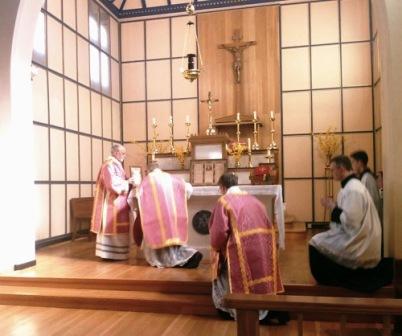
On Laetare Sunday there is a slight relaxation of Lent’s penitential spirit, because today we have a glimpse of the joy that is coming at Easter, now near at hand. 

As WDTPRS has explained before, the custom of rose vestments is tied to the Station churches in Rome.  The Station for Laetare Sunday is the Basilica of the Holy Cross of Jerusalem where the relics of Cross and Passion brought from the Holy Land by St. Helena (+c. 329), mother of the Emperor Constantine (+337), were deposited.  It was the custom on this day for Popes to bless roses made of gold, some amazingly elaborate and bejeweled, which were to be sent to Catholic kings, queens and other notables. The biblical reference is Christ as the “flower” sprung forth from the root of Jesse (Is 11:1 – in the Vulgate flos “flower” and RSV “branch”).  Thus Laetare was also called Dominica de rosa…. Sunday of the Rose.  It didn’t take a lot of imagination to develop rose colored vestments from this. Remember, the color of the vestments is called rosacea, not pink.  This Roman custom spread by means of the Roman Missal to the whole of the world.     

Our Collect is a new composition for the 1970MR and subsequent editions of the Novus Ordo based on a prayer in the Gelasian Sacramentary and a section of a sermon by St. Pope Leo I, the Great (+461).   There is some similarity between this Collect with those of Advent.  On the 2nd Sunday of Advent, we heard: in tui occursum Filii festinantes… “those hurrying to meet your Son.”   On the 3rd Sunday (this Sunday’s fraternal twin Gaudete, the only other day for rose vestments) we heard: votis sollemnibus alacri laetitia celebrare…”, to celebrate…with eager jubilation by means of solemn offerings.”  There is rosy anticipation in today’s Collect just as there was in Advent.  Without further delay, here is the beautiful Latin followed immediately by the atrocious but happily lame-duck ICEL version.

COLLECT – LATIN TEXT (2002MR):
Deus, qui per Verbum tuum
humani generis reconciliationem mirabiliter operaris,
praesta, quaesumus, ut populus christianus
prompta devotione et alacri fide
ad ventura sollemnia valeat festinare.

LAME-DUCK ICEL (1973 translation of the 1970MR):
Father of peace,
we are joyful in your Word,
your Son Jesus Christ,
who reconciles us to you.
Let us hasten toward Easter
with the eagerness of faith and love.

I try to be positive in these columns.  I really do.  But this makes you want to pound your head against the table.  What would happen if we translated the ICELese back into Latin?   If the ICEL were accurate, you might expect some similarities, right? 

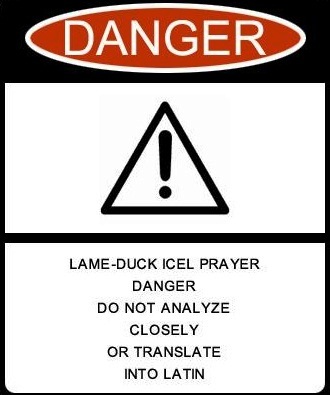
WDTPRS - 4th Sunday of Lent (Laetare) - COLLECT (2002MR)WARNING: Do not attempt this at home.  Spiritual harm and damage to property can be caused by thinking about these ICEL versions.  Leave this sort of thing to trained professionals and people with tough foreheads.

LATIN REVERSION of the LAME-DUCK ICEL:
Pater pacis,
in tuo Verbo, Iesu Christo filio tuo,
qui nos tibi reconciliat, laetamur.
Fidei studio et amoris
ad diem Paschalis festinemus.

Oookaayyy… ‘nuf said about that, I think.

Sollemnia is the neuter plural of the adjective sollemnis meaning “yearly”, that which is established to be done each year.  In religious contexts, it comes out as “religious, festive”.  As a substantive, it is “a religious or solemn rite, ceremony, feast, sacrifice, solemn games, a festival, solemnity”.  Sollemne, the neuter noun, is also, “usage, custom, practice”.  In legal contexts, it can be “formality”.  In later, Christian Latin words related to sollemnis came to indicate the celebration of the Eucharist.  Alacer is “lively, brisk, quick, eager, active; glad, happy, cheerful”.  Promptus, a, um is from the verb promo.  Promptus indicates, “brought to light, exposed to view” and by extension “at hand, i. e. prepared, ready, quick, prompt, inclined or disposed to or for any thing.”

LITERAL TRANSLATION:
O God, who by Your Word
wondrously effect the reconciliation of the human race,
grant, we beg, that the Christian people
may be able to hasten toward the upcoming solemnities
with ready devotion and eager faith.

Note the marvelous parings of alacer fides and prompta devotio … “eager faith” and “ready devotion”.   We know that fides “faith” can refer to the supernatural virtue which is given to us in baptism and also to the content of what we believe.  This content must be understood as both the things we can learn and memorize with love, but more importantly the divine Person whom we must learn and contemplate with love.  There is a faith by which we believe, the virtue God gives us, and a faith in which we believe, the content of the Faith.   On the other hand, whereas fides is a supernatural virtue, devotio is an “active” virtue according to St. Thomas Aquinas in the Summa Theologica.  The Angelic Doctor wrote: “The intrinsic or human cause of devotion is contemplation or meditation. Devotion is an act of the will by which a man promptly gives himself to the service of God.  Every act of the will proceeds from some consideration of the intellect, since the object of the will is a known good; or as Augustine says, willing proceeds from understanding. Consequently, meditation is the cause of devotion since through meditation man conceives the idea of giving himself to the service of God” (STh II-II 82, 3).  The Jesuit preacher Louis Bourdaloue (1632-1704) underscored devotion as especially “a devotion to duty”.  What we do, including our “devotions”, must help us keep the commandments of God and stick to the duties of one’s state in life before all else.  There is an interplay between our devotions and our devotion.  

Each of us has a state in life, a God-given vocation we are duty bound to follow.  We must be devoted to that state in life, and the duties that come with it, as they are in the here and now.  That “here and now” is important.  We must not focus on the state we had once upon a time, or wish we had, or should have had, or might have someday: those are unreal and misleading fantasies that distract us from reality and God’s will.  If we are truly devoted and devout (in the sense of the active virtue) to fulfilling the duties of our state as it truly is here and now, then God will give us every actual grace we need to fulfill our vocation.  Why can we boldly depend on God to help us?  If we are fulfilling the duties of our state of life, then we are also fulfilling our proper roles in His great plan, His design from before the creation of the universe.  God is therefore sure to help us.  And if we are devoted to our state as it truly is, then God can also guide us to a new vocation when and if that is His will for us.  Faithful in what we must do here and now, we will be open to something God wants us to do later.  This attachment to reality and sense of dutiful obedience through the active virtue devotio is a necessary part of religion in keeping with the biblical principle in 1 John 2:3-5:

“And by this we may be sure that we know Him, if we keep His commandments.  He who says ‘I know Him’ but disobeys His commandments is a liar, and the truth is not in him; but whoever keeps his word, in him truly love for God is perfected.  By this we may be sure that we are in Him: he who says he bides in Him ought to walk in the same way in which He walked.”

Posted in SESSIUNCULA |
10 Comments

“Tolerance goes both ways, Boulder”

We have been following the controversy in Boulder, CO where a homosexual activst lesbian "couple" attempted to force a child (sadly) in their care into a Catholic school knowing that the Archdiocese had a policy not to accept such children.

The purpose of the Archdiocesan policy was, of course, to protect the children.

Those protesting against the Archdiocese, school and priest have been parroting the usual canards are being "tolerant".

From the daily camera of Boulder, CO, comes this editorial.  My emphases and comments.

Danaher: Tolerance goes both ways, Boulder
By Charlie Danaher

If one didn`t know better you could easily conclude that there is a heartless bunch running Sacred Heart of Jesus Parish School in Boulder.

Outrage erupted after the school gave notice to a lesbian couple that their two children would not be allowed to attend school the year after next. Many were shocked by the fact that school administrators thought it a bad idea to subject children to religious teaching that unambiguously states that the lifestyle of their parents is not good or healthy. What should not be shocking, or a secret to any, is the fact that the Catholic faith finds unacceptable sexual relations outside of marriage, and defines marriage as between a man and a woman.

As Father Bill Breslin, pastor of SHJ, stated in his blog of March 5 "If a child of gay parents comes to our school, and we teach that gay marriage is against the will of God, then the child will think that we are saying their parents are bad. We don`t want to put any child in that tough position — nor do we want to put the parents, or the teachers, at odds with the teachings of the Catholic Church."

He`s right. It`s easy to see why school officials concluded that having children in such a setting is likely to result in a philosophical conflict, where the children are certain to be confused and uncomfortable. [Exactly.  What is so reprehensible about what the lesbian couple did to that child is make her a pawn in their own game.  Getting her into that school was not going to be the end of the manipulation.]

Denver archbishop Charles Chaput writes in the March 10 issue of the Denver Catholic Register, "These students are always welcome so long as their parents support the Catholic mission of the school and do not offer a serious counter-witness to that mission in their actions." As Christians, we are called to be a witness to our faith. And if we engage in a lifestyle that, publicly, runs counter to our faith, or as Chaput stated, is a counter-witness, then it serves as a vocal rejection of the faith. And the church has every right to find such behavior intolerable. [YES.]

Some have wondered why children born out-of-wedlock or of divorced parents aren`t also denied enrollment. A fair question. It comes down to whether the parents are currently, on an on-going basis, deliberately living a lifestyle that displays public opposition to church teaching. For instance, in the past, a parent may have had a child out-of-wedlock or gotten divorced. Because it`s in the past, such an action, in and of itself, is not a public display of a philosophy in discord with church policy.  [And let’s not forget that homosexual activity is against the nature God wrote into human beings.]

For all we know, these single parents or divorcees may have repented for their past actions and would not choose to repeat them. Therefore their current status does not directly oppose church teaching. But unmarried couples (gay or straight) living together, because of their actions, are deliberately living a lifestyle that serves as a counter-witness to the faith. [Though what they are doing isn’t against nature it is still against even natural law and God’s law.] I think it`s reasonable for the church to expect that members not live in a manner that publicly displays disagreement to the church`s tenets.

Some say this action by the parish shows insensitivity toward children and hatred toward the gay parents. Actually, I think neither is true. The school administrators may very well be acting out of compassion for the children, and I take Fr. Bill at his word that this was a very difficult thing to do. As far as hating gays, I think the saying Love the sinner, hate the sin applies here.

To be sure some do hate gays, even some so-called Christians. But that certainly is not the position of the church. [Nor is that the situation in Boulder.] The church recognizes that we are all sinners, and that we are all loved by God. The church simply expects us to resolve to amend our lives.

[NB] Some people will not be satisfied until the church is either run out of business, is silenced or abandons all principle. [I think that that is what lies at the root of this controversy.] We may never all agree but hopefully we can be tolerant of the church`s position and respect their dedication to the faith.

Posted in Our Catholic Identity, SESSIUNCULA, The Drill | Tagged , , ,
30 Comments

WDTPRS POLL: length of Sunday sermons

WDTPRS POLL: length of Sunday sermonsThere was recently story on CNA about the "ideal" length of a Sunday sermon/homily. 

First, the person who proposed in a book that "8 minutes" is the Secretary for the Cong. for Bishops, Archbishop Nikola Eterovic. 

Second, while the Archbishop hedges with an "in general", to propose an "ideal" length of a sermon is absurd.

There may be an ideal length "in general" for this community or that, but there cannot be an ideal length for all.

Also, depending on the preacher 30 seconds can be too long, while others can preach for 30 minutes and people still want more.

That said,

One long-time participant here wrote to me about this adding the comment:

"a sermon should not be longer than the Eucharistic Prayer. I recall a 28-minute sermon followed by EP II in 2 min 45 sec, which sent mixed message on the importance of the Sacrifice."

Again, I am not sure about that.  It depends on the circumstances.  I cannot think that it would have been a good idea to preach for only 2’30" in that instance.   Should the Eucharistic Prayer have been longer?  If you think so, then how much longer?  Was it silent as in the Extraordinary Form?

Another issue is that of daily Masses, where there is no obligation (or tradition) of preaching at all, though I recognize that in most places I have been people are so hungry for good things from the Church that they welcome a fervorino even on weekdays.

So, let’s have a little poll.

Cast your vote and then give your reasons in the combox.

{democracy:46}

Posted in POLLS, SESSIUNCULA | Tagged ,
91 Comments

Catholic Health Ass. supports pro-abortion Senate bill

From Serviam:

Sister Carol Keehan, the uber-compensated (over $850K a year) President of the Catholic Health Association, broke with the USCCB and Pro Life groups and announced the CHA’s support of the pro-abortion Senate health care bill.


See Lifesite:


Washington, DC (LifeNews.com) — The Catholic Health Association is coming under fire today for releasing a statement not only endorsing the pro-abortion Senate health care bill but issuing a misleading statement making it appear the bill does not fund abortions. The head of a national pro-life organization disabused the CHA in response.

Sister Carol Keehan, president of the Catholic Health Association, a network of Catholic hospitals, issued the new statement.

“The time is now for health reform,” the statement backing the bill said.

“On the moral issue of abortion, there is no disagreement,” Keehan contends. “On the technical issue of whether this bill prevents federal funding of abortions, we differ with Right to Life.”

Douglas Johnson, legislative director for National Right to Life, spoke with LifeNews.com about Keehan’s statement and dismissed the so-called segregation of funds as an accounting gimmick.

“The House and Senate bills do not merely differ on a ‘technical issue,’as Carol Keehan would have people believe,” he said. “This is another regrettably attempt to minimize the substantive issues involved in order to smooth the way for the Obama legislation.”

“In reality, the Senate bill contains multiple pro-abortion provisions, which in total constitute the most pro-abortion single piece of legislation to reach the House floor since Roe v. Wade,” Johnson added.

Johnson pointed to the new memo from the Catholic bishops to Congress agreeing that “the Senate bill would result in direct federal funding of elective abortions, federal subsidies for plans that cover elective abortions (including some federally administered plans), and authority for federal officials to mandate inclusion of abortion coverage in private plans.”

He has written a detailed analysis of the myriad of ways in which the Senate bill forces Americans to pay for abortions and could force insurance companies to cover them.


Moreover:

This is not the first time that Sr. Keehan has chosen to deviate from Church teaching.  She has supported pro-abortion political appointments and supported previous pro-abortion health care bills.  This of course, is her choice to make and judgment is reserved to God.  However, her doing so under the banner of CHA creates confusion and scandal and affords a smokescreen to pro-abortion politicians who can use the CHA endorsement to mislead Catholics and the media.  She has succeeded in making CHA, like the National Catholic Reporter – Catholic In Name Only.

Of course, as Jack Smith in the Catholic Key Blog pointed out months ago:

CHA is not a repository of Catholic social teaching with regard to health care or an association of moral theologians or a charity in service of the poor. It is a trade association. There is nothing wrong with a trade association, but too many reporters, including members of the Catholic press, have sought comment from CHA without recognizing they are primarily an organization with a vested financial interest in the outcome of the health care debate.

Please make sure your Catholic circle knows the truth about CHA and feel free to express your feelings to CHA here.

WDTPRS is appalled.  Not surprised, but appalled.


Posted in SESSIUNCULA | Tagged , , ,
28 Comments

Getting my German on for Saturday Night

I have a guest for the weekend and so I made something a bigger more expansive than I would were I on my own.

Three large pork chops were delivered by the aforementioned guest, along with sauerkraut… as Dr. Maturin would observe, a fine antiscorbutic.

As I turned on the Minnesota Golden Gopher men’s hockey game, I got out a glass pan, since I intended to do these in the oven.

Lay down a bed of kraut.

"But Father! But Father!" you may be saying.  Shouldn’t you clear off the flies before …"

No… no… not flies.  These are juniper berries!

Also mixed in with the sauerkraut is a chopped up medium sized yellow onion.

I salted and peppered and added dry white wine.

Getting my German on for Saturday Night

For some color at the last minute, some chopped green onion.

Getting my German on for Saturday Night

I salted and peppered the porkchops and just set them on top.

Getting my German on for Saturday Night

Oven… 350…. for a while.  I think it must have been about an hour.

Getting my German on for Saturday Night

Served with Yukon Gold potatoes… pork chops and sauerkraut with onion and juniper.

Getting my German on for Saturday Night

Sometimes pork chops can get a little dry and tough if you over cook them.  These were neither.  

As Preserved Killick would have lamented, "Which they left nary a scrap".

If you want, you could add some slices of crisp apple.

Serve with beer or dry white wine, such as Sauvignon blanc.  You could serve a sweeter white as well.

Gophers’ victory over hated North Dakota.

Tonight, I think I will do sausage and eggs and hashbrowns and watch them beat ND again.

Posted in Fr. Z's Kitchen, SESSIUNCULA | Tagged , ,
23 Comments

WDTPRS – 4th Sunday of Lent – Prayer over the people (2002MR)

During Lent, I have been including the Oratio super populum now restored in the 2002MR.  The priest says this, or will when he uses Latin, after the Post communio.  It should be in a future English translation.

ORATIO SUPER POPULUM (2002MR):
Tuere, Domine, supplices tuos, sustenta fragiles,
et inter tenebras mortalium ambulantes
tua semper luce vivifica,
atque a malis omnibus clementer ereptos,
ad summa bona pervenire concede.

(Cf. 2 Cor 4 – “The people who walked in darkness have seen a great light” and Isaiah 9:2, a text usually associated with Christmas).

MY LITERAL RENDERING:
Defend, O Lord, your humble ones, sustain the fragile,
and by your light always breathe life into
those walking amidst the shadows of mortal things,
and grant them, having been mercifully snatched away from all evils,
to attain to the highest of all goods.

Posted in LENT |
2 Comments

Interview with the CDF’s “prosecutor” of priests who commit “graviora delicta”

Sandro Magister has on his site today an English text of an interview with Msgr. Charles Scicluna, an official of the CDF, who handles the cases of priests who commit graviora delicta against minors.

Let’s have a look with my emphases and comments.

"It would be better for him if a millstone were put around his neck…"

"… and he were thrown into the sea than that he should scandalize one of these little ones" (Luke 17:2). Ten years of accusations, trials, and sentences for pedophilia among the clergy. An interview with Charles J. Scicluna, promoter of justice for the congregation for the doctrine of the faith. From "Avvenire," March 13, 2010

by Gianni Cardinale

Interview with the CDF's "prosecutor" of priests who commit "graviora delicta"

ROME – Msgr. Charles J. Scicluna is the "promoter of justice" of the Congregation for the Doctrine of the Faith. He is effectively the prosecutor of the tribunal of the former Holy Office, whose job it is to investigate what are known as "delicta graviora;" i.e., the crimes which the Catholic Church considers as being the most serious of all: crimes against the Eucharist and against the sanctity of the Sacrament of Penance, and crimes against the sixth Commandment ("thou shall not commit impure acts") committed by a cleric against a person under the age of eighteen. These crimes, in a motu proprio of 2001, "Sacramentum sanctitatis tutela," come under the competency of the Congregation for the Doctrine of the Faith. In effect, it is the "promoter of justice" who deals with, among other things, the terrible question of priests accused of paedophilia, which are periodically highlighted in the mass media. Msgr. Scicluna, an affable and polite Maltese, has the reputation of scrupulously carrying out the tasks entrusted to him without deferring to anyone.

Q: Monsignor, you have the reputation of being "tough", yet the Catholic Church is systematically accused of being accommodating towards "paedophile priests"

A: It may be that in the past – perhaps also out of a misdirected desire to protect the good name of the institution – some bishops were, in practice, too indulgent towards this sad phenomenon. And I say in practice because, in principle, the condemnation of this kind of crime has always been firm and unequivocal. Suffice it to recall, to limit ourselves just to last century, the famous Instruction "Crimen sollicitationis" of 1922.

Q: Wasn’t that from 1962? [!]

A: No, [!] the first edition dates back to the pontificate of Pius XI. Then, with Blessed John XXIII, the Holy Office issued a new edition for the Council Fathers, but only two thousand copies were printed, which were not enough, and so distribution was postponed sine die. In any case, these were procedural norms to be followed in cases of solicitation during confession, and of other more serious sexually-motivated crimes such as the sexual abuse of minors.

Q: Norms which, however, recommended secrecy…

A: A poor English translation of that text has led people to think that the Holy See imposed secrecy in order to hide the facts. But this was not so. Secrecy during the investigative phase served to protect the good name of all the people involved; first and foremost, the victims themselves, then the accused priests who have the right – as everyone does – to the presumption of innocence until proven guilty. The Church does not like showcase justice. Norms on sexual abuse have never been understood as a ban on denouncing the crimes to the civil authorities.

Q: Nonetheless, that document is periodically cited to accuse the current Pontiff of having been – when he was prefect of the former Holy Office – objectively responsible for a Holy See policy of covering up the facts…

A: That accusation is false and calumnious. [Do I hear from the readers a big "Amen!"?] On this subject I would like to highlight a number of facts. Between 1975 and 1985 I do not believe that any cases of paedophilia committed by priests were brought to the attention of our Congregation. [?!?] Moreover, following the promulgation of the 1983 Code of Canon Law, there was a period of uncertainty as to which of the "delicta graviora" were reserved to the competency of this dicastery. Only with the 2001 motu proprio did the crime of paedophilia again become our exclusive remit. From that moment Cardinal Ratzinger displayed great wisdom and firmness in handling those cases, also demonstrating great courage in facing some of the most difficult and thorny cases, "sine acceptione personarum." Therefore, to accuse the current Pontiff of a cover-up is, I repeat, false and calumnious.

Q: What happens when a priest is accused of a "delictum gravius"?

A: If the accusation is well-founded the bishop has the obligation to investigate both the soundness and the subject of the accusation. If the outcome of this initial investigation is consistent, he no longer has any power to act in the matter and must refer the case to our Congregation where it is dealt with by the disciplinary office.

Q: How is that office composed?

A: Apart from myself who, being one of the superiors of the dicastery, also concern myself with other matters, there are the bureau chief Fr. Pedro Miguel Funes Diaz, seven priests and a lay lawyer who follow these cases. Other officials of the Congregation also make their own vital contribution depending upon the language and specific requirements of each case.

Q: That office has been accused of working little and slowly…

A: Those are unjustified comments. In 2003 and 2004 a great wave of cases flooded over our desks. Many of them came from the United States and concerned the past. Over recent years, thanks to God, the phenomenon has become greatly reduced, and we now seek to deal with new cases as they arise. [Which I believe explains, in part, the appointment of an American Prefect of that Congregation.]

Q: How many have you dealt with so far?

A: Overall in the last nine years (2001-2010) we have considered accusations concerning around three thousand cases of diocesan and religious priests, which refer to crimes committed over the last fifty years.

Q: That is, then, three thousand cases of paedophile priests?

A: No, it is not correct to say that. We can say that about sixty percent of the cases chiefly involved sexual attraction towards adolescents of the same sex, another thirty percent involved heterosexual relations, and the remaining ten percent were cases of paedophilia in the true sense of the term; that is, based on sexual attraction towards prepubescent children. The cases of priests accused of paedophilia in the true sense have been about three hundred in nine years. Please don’t misunderstand me, these are of course too many, but it must be recognised that the phenomenon is not as widespread as has been believed.

Q: The accused, then, are three thousand. How many have been tried and condemned?

A: Currently we can say that a full trial, penal or administrative, has taken place in twenty percent of cases, normally celebrated in the diocese of origin – always under our supervision – and only very rarely here in Rome. We do this also in order to speed up the process. In sixty percent of cases there has been no trial, above all because of the advanced age of the accused, but administrative and disciplinary provisions have been issued against them, such as the obligation not to celebrate Mass with the faithful, not to hear confession, and to live a retired life of prayer. It must be made absolutely clear that in these cases, some of which are particularly sensational and have caught the attention of the media, no absolution has taken place. It’s true that there has been no formal condemnation, but if a person is obliged to a life of silence and prayer, then there must be a reason…

Q: That still leaves twenty percent of cases…

A: We can say that in ten percent of cases, the particularly serious ones in which the proof is overwhelming, the Holy Father has assumed the painful responsibility of authorising a decree of dismissal from the clerical state. This is a very serious but inevitable provision, taken though administrative channels. In the remaining ten percent of cases, it was the accused priests themselves who requested dispensation from the obligations deriving from the priesthood, requests which were promptly accepted. Those involved in these latter cases were priests found in possession of paedophile pornographic material and, for this reason, condemned by the civil authorities.

Q: Where do these three thousand cases come from?

A: Mostly from the United States which, in the years 2003-2004, represented around eighty percent of total cases. [!] In 2009 the United States "share" had dropped to around twenty-five percent of the 223 cases reported from all over the world. Over recent years (2007-2009), the annual average of cases reported to the Congregation from around the world has been two hundred and fifty. [And this will now increase.] Many countries report only one or two cases. There is, then, a growing diversity and number of countries of origin of cases, but the phenomenon itself is much reduced. It must, in fact, be borne in mind that the overall number of diocesan and religious priests in the world is four hundred thousand, although this statistic does not correspond to the perception that is created when these sad cases occupy the front pages of the newspapers.

Q: And in Italy?

A: Thus far the phenomenon does not seem to have dramatic proportions, although what worries me is a certain culture of silence which I feel is still too widespread in the country. The Italian Episcopal Conference (CEI) offers an excellent technical-juridical consultancy service for bishops who have to deal with these cases. And I am very pleased to observe the ever greater commitment being shown by Italian bishops to throw light on the cases reported to them.

Q: You said that a full trial has taken place in around twenty percent of the three thousand cases you have examined over the last nine years. Did they all end with the condemnation of the accused?

A: Many of the past trials did end with the condemnation of the accused. But there have also been cases in which the priest was declared innocent, or where the accusations were not considered to have sufficient proof. In all cases, however, not only is there an examination of the guilt or innocence of the accused priest, but also a discernment as to his fitness for public ministry.

Q: A recurring accusation made against the ecclesiastical hierarchy is that of not reporting to the civil authorities when crimes of paedophilia come to their attention.

A: In some English-speaking countries, but also in France, if bishops become aware of crimes committed by their priests outside the sacramental seal of Confession, [The issue of internal forum is important to consider.] they are obliged to report them to the judicial authorities. This is an onerous duty because the bishops are forced to make a gesture comparable to that of a father denouncing his own son.[Is Monsignor perhaps a little idealistic?]  Nonetheless, our guidance in these cases is to respect the law.

Q: And what about countries where bishops do not have this legal obligation?

A: In these cases we do not force bishops to denounce their own priests, but encourage them to contact the victims and invite them to denounce the priests by whom they have been abused. Furthermore, we invite the bishops to give all spiritual – and not only spiritual – assistance to those victims. In a recent case concerning a priest condemned by a civil tribunal in Italy, it was precisely this Congregation that suggested to the plaintiffs, who had turned to us for a canonical trial, that they involve the civil authorities in the interests of victims and to avoid other crimes.

Q: A final question: is there any statue of limitation for "delicta graviora"?

A: Here you touch upon what, in my view, is a sensitive point. In the past, that is before 1898, the statue of limitations was something unknown in canon law. For the most serious crimes, it was only with the 2001 motu proprio that a statute of limitations of ten years was introduced. In accordance with these norms in cases of sexual abuse, the ten years begin from the day on which the minor reaches the age of eighteen.

Q: Is that enough?

A: Practice has shown that the limit of ten years is not enough in this kind of case, in which it would be better to return to the earlier system of "delicta graviora" not being subject to the statue of limitations. On 7 November 2002, Venerable Servant of God John Paul II granted this dicastery the power to revoke that statue of limitations, case by case following a reasoned request from individual bishops. And this revocation is normally granted.

(Vatican translation).

__________

The newspaper of the Italian bishops’ conference, which published the interview on March 13, 2010:

> Avvenire

A fascinating interview, which gives the lie to many false claims about the process.

Sandro Magister did a real service to have this put into English from the original Italian in Avvenire.

Posted in SESSIUNCULA | Tagged , ,
15 Comments

To those who desire to accomodate

"If the Church were to accommodate herself to the world in any way that would entail a turning away from the Cross, this would not lead to a renewal of the Church, but only to her death."

Joseph Ratzinger
Posted in SESSIUNCULA |
13 Comments

Loyal Chinese priest arrested

From AsiaNews with Ucan with my emphases and comments:

Priest arrested in Fujian for organizing winter camp for 300 university students

Fr. John Baptist Luo was arrested on 3 March. Three other priests have been issued arrest warrants, but not yet detained. Another three have to pay a fine. Fr. Luo told AsiaNews: "I’m ready to go to jail. I would be happy to serve as a witness to Christ and follow the example of many holy martyrs. " [OORAH!]

Fuan (AsiaNews/Ucan) – An underground priest from the Diocese of Mindong (Fujian) was arrested for organizing a camp with 300 students. Three other priests who work with him have received an arrest warrant, not yet  carried out, a further three were fined up to 500 Yuan (about 50 Euros). Weeks before his arrest, the priest had said: "I would be happy to serve as a witness to Christ and follow the example of many holy martyrs."   

Fr. John Baptist Luo, 39, and 6 other priests from the underground church had organized a winter camp for four days with 300 students, divided into two stages, in late January and early February. On 3 February, the public security came to the camp (in the church of Saiqi) and ordered the priests to cancel the event. The priests refused and explained the situation to the students present there, inviting those who were afraid to leave the area and reassuring those who remained that the priests would always be with them. Only 20 of the students left. The next day members of the public security subjected the priests to a long interrogation but did not make any arrests. 

In those days, Fr. Luo told AsiaNews that he was "ready to go to jail," that he had "nothing to fear" and that he was "proud to be a Catholic priest, eager to profess his faith with actions." He added: "I would be happy to serve as a witness to Christ and follow the example of many holy martyrs."   

Fr. Luo is very active a evangelist, even on the internet,[!]  where he has a very popular blog: http://blog.sina.com.cn/frluo. 

 Since March 3 he is in "administrative detention" in a guest-house (prison) of the Fuan government. Three other priests, Fathers Guo Xijin, Miu Yong and Liu Maochun received arrest warrants but so far the police have not carried out the arrests. Three others were penalized to pay 500 yuan, but the faithful say that they prefer to go to jail rather than pay the fine. 

The Diocese of Mindong is almost entirely made up of believers of the underground Church: out of 80 thousand Catholics, more than 70 thousand are unofficial, very organized and vibrant, with over 50 priests, 96 nuns and 400 lay catechists. Their bishop is Mgr. Vincent Huang Shoucheng, 86. Mindong also has a patriotic bishop, Mgr. Zhan Silu, who is followed by a few faithful. 


Some things do not change.

Posted in Our Catholic Identity, SESSIUNCULA, The Last Acceptable Prejudice | Tagged , , ,
14 Comments