Justice Clarence Thomas dissented today.
In his dissent to the SCOTUS majority opinion in WHOLE WOMAN’S HEALTH v. HELLERSTEDT Thomas wrote about the false principles they are using, and have been using.
Here are a few excerpts from his 16 page dissent:
Ultimately, this case shows why the Court never should have bent the rules for favored rights in the first place. Our law is now so riddled with special exceptions for special rights that our decisions deliver neither predictability nor the promise of a judiciary bound by the rule of law.
[…]
The majority’s furtive reconfiguration of the standard of scrutiny applicable to abortion restrictions also points to a deeper problem. The undue-burden standard is just one variant of the Court’s tiers-of-scrutiny approach to constitutional adjudication. And the label the Court affixes to its level of scrutiny in assessing whether the government can restrict a given right—be it “rational basis,” intermediate, strict, or something else—is increasingly a meaningless formalism. As the Court applies whatever standard it likes to any given case, nothing but empty words separates our constitutional decisions from judicial fiat.
Though the tiers of scrutiny have become a ubiquitous feature of constitutional law, they are of recent vintage.Only in the 1960’s did the Court begin in earnest to speak of “strict scrutiny” versus reviewing legislation for mere rationality, and to develop the contours of these tests. See Fallon, Strict Judicial Scrutiny, 54 UCLA L. Rev. 1267, 1274, 1284–1285 (2007). In short order, the Court adopted strict scrutiny as the standard for reviewing everything from race-based classifications under the Equal Protection Clause to restrictions on constitutionally protected speech. Id., at 1275–1283. Roe v. Wade, 410 U. S. 113, then applied strict scrutiny to a purportedly “fundamental” substantive due process right for the first time. Id., at 162– 164; see Fallon, supra, at 1283; accord, Casey, supra, at 871 (plurality opinion) (noting that post-Roe cases interpreted Roe to demand “strict scrutiny”).At about this point in the post you might need some.
Then the tiers of scrutiny proliferated into ever more gradations. See, e.g., Craig, 429 U. S., at 197–198 (intermediate scrutiny for sex-based classifications); Lawrence v. Texas, 539 U. S. 558, 580 (2003) (O’Connor, J., concurring in judgment) (“a more searching form of rational basis review” applies to unpopular group”); Buckley v. Valeo, 424 U. S. 1, 25 (1976) (per curiam) (applying “‘closest scrutiny’” to campaign-finance contribution limits). Casey’s undue-burden test added yet another right-specific test on the spectrum between rational-basis and strict-scrutiny review.
The illegitimacy of using “made-up tests” to “displace longstanding national traditions as the primary determinant of what the Constitution means” has long been apparent. United States v. Virginia, 518 U. S. 515, 570 (1996) (Scalia, J., dissenting). The Constitution does not prescribe tiers of scrutiny. The three basic tiers— “rational basis,” intermediate, and strict scrutiny—“are no more scientific than their names suggest, and a further element of randomness is added by the fact that it is largely up to us which test will be applied in each case.” Id., at 567; see also Craig, supra, at 217–221 (Rehnquist,J., dissenting).
But the problem now goes beyond that. If our recent cases illustrate anything, it is how easily the Court tinkers with levels of scrutiny to achieve its desired result. …[…]
Eighty years on, the Court has come full circle. The Court has simultaneously transformed judicially created rights like the right to abortion into preferred constitutional rights, while disfavoring many of the rights actually enumerated in the Constitution. But our Constitution renounces the notion that some constitutional rights are more equal than others. A plaintiff either possesses the constitutional right he is asserting, or not—and if not, the judiciary has no business creating ad hoc exceptions so that others can assert rights that seem especially important to vindicate. A law either infringes a constitutional right, or not; there is no room for the judiciary to invent tolerable degrees of encroachment. Unless the Court abides by one set of rules to adjudicate constitutional rights, it will continue reducing constitutional law to policy-driven value judgments until the last shreds of its legitimacy disappear.
* * *
Today’s decision will prompt some to claim victory, just as it will stiffen opponents’ will to object. But the entire Nation has lost something essential. The majority’s embrace of a jurisprudence of rights-specific exceptions and balancing tests is “a regrettable concession of defeat—an acknowledgement that we have passed the point where‘law,’ properly speaking, has any further application.” Scalia, The Rule of Law as a Law of Rules, 56 U. Chi. L. Rev. 1175, 1182 (1989). I respectfully dissent.
[…]

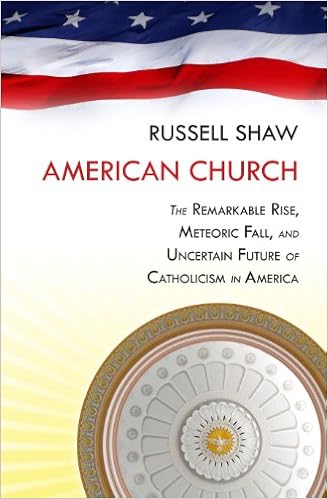
Meanwhile, I received a book which I am looking forward to digging into… after Thursday. Russell Shaw’s new book, American Church: The Remarkable Rise, Meteoric Fall, and Uncertain Future of Catholicism in America.