Your Sunday Sermon Notes – 4th Sunday after Easter (N.O. 5th Sunday OF Easter)

Too many people today are without good, strong preaching, to the detriment of all. Share the good stuff.

Was there a GOOD point made in the sermon you heard at your Mass of obligation for this 4th Sunday after Easter (N.O. 5th Sunday OF Easter)?

Tell us about attendance especially for the Traditional Latin Mass.

Any local changes or (hopefully good) news?

A taste of what I offered at 1 Peter 5 this week:

[…]

Desursum, “from above”, so that our hearts may be sursum, “upward”. Every good gift comes down from the Father of lights, with whom, as James says, there is “no variation or shadow due to change.” God is immutable. God is the source of all that is truly good. If the gift is not good, perhaps we should look elsewhere for its origin. Perhaps toward the “prince of this world”.

That phrase in the Gospel deserves attention. The Lord says that “the prince of this world is already judged,” or, in the RSV, “the ruler of this world is judged.” The “árchon toútou kósmou… princeps huius mundi” is the Devil. The same image of “archon… princeps” appears in the Synoptic tradition when the Lord’s enemies speak of Beelzebub as the “prince of the devils” (cf. Matthew 9:34; 12:24; Mark 3:22). In John 14:30, Christ says, “the prince of this world is coming. He has no power over me.” See also John 12:31.

There is no dualism here. God alone is King. The Devil, however marvelous a creature he once was before his fall, can never be king of anything. He can be a ruler in the sense of a tyrant. He can dominate, seduce, accuse, claim. Fallen angels have a measure of domination over material creation, always under the restraint of Almighty God. Because of Original Sin, we too fell under the domination of the Enemy of the Soul.

This explains the sober realism of the traditional Roman rites.

In the ancient rites of Baptism there are exorcisms. In the traditional Rituale Romanum, when priests bless certain objects, especially important sacramentals, there are exorcisms before constitutive blessings. When Father blesses an object in that way, he tears it away from the “prince of this world” and hands it over to the King. It is no longer ordered to ordinary, temporal, profane use. Profane comes from pro-fanum, “outside the sacred place”. After a constitutive blessing, the thing or place is sacred and demands reverent treatment. It now belongs, invisibly and juridically in the realm of sacred signs, to the dominion of Christ.

The new-fangled Book of Blessings, in its Preface, explicitly seeks to eliminate the distinction between invocative blessings and constitutive blessings. An invocative blessing calls down God’s favor here and now. A constitutive blessing renders a place, thing, or person sacred. That distinction matters. When we flatten such distinctions, we become poorer in our spiritual grammar.

When we eliminate, say, the Leonine Prayers after Low Mass, with their invocation of St. Michael the Archangel, and when we eliminate constitutive blessings, we are cruising for spiritual bruising. Look around.

[…]


Posted in SESSIUNCULA |
4 Comments

ROME 26/5– Day 39 & 40: A True Scoundrel

In Rome we got sun at 06:02.

It set at 20:13.

The Ave Maria Bell is in the 20:30 cycle.

In the Novus Ordo calendar, along with being the 5th Sunday OF Easter, it is the Feast of the Apostles Philip and James the Lesser.

In the Vetus Ordo, in the back of the Missal, we find texts today the Feast of the Finding of the Cross.  The orations are terrific.

Please remember me when shopping online. Thanks in advance.  US HERE – UK HERE

Welcome Registrants:

Phil the Elder
LMC (added to the live stream list for when I start up again, since you followed Masses during COVID Theatre)

The damage this man did was inestimable.

White to move and win.

NB: I’ll hold comments with solutions ’till the next day so there won’t be “spoilers” for others.

A screenshot of this instead of posting code, so that I don’t slime up my page.   Two comments.  A priest how long and that was a first Mass ad orientem?  Celebrating Mass this way is so far off his radar that he doesn’t know enough Latin to spell it correctly.  St. Ignatius would be so proud.

Pray that he have the courage to work with Courage.

I was out to lunch with The Great Roman™ after Mass today.   We went to a nearly legendary place right on the Campo and had a great meal.  We ate inside in the “upper room”.  It was quiet and some air was on the move with open windows.  The saltimbocca was, honestly, the best I’ve had in a Centro restaurant for years.  Mixed salad for veg and a glass of Cesanese (a varietal common in Lazio).  More on that below.

I took a big step.  I got my jasmine (no, not the Jesuit).   I’ll transplant it into that nearby planter and let it climb.

In the restaurant today there was a great framed “Bando” decree from 1716 fixing prices of meats, qualities and terms of sales.

I quite enjoy the stipulation that …

Terrific saltimbocca today.  With a little bread at the end … ho fatto la scarpetta.

Posted in SESSIUNCULA |
3 Comments

WDTPRS – 5th Sunday of Easter (Novus Ordo): The prayer’s very word order reveals God’s love – UPDATED/CORRECTED

UPDATE 3 May 2026:

Well!   This shows how out of touch I have been with the Novus Ordo and I posted from my work in the old days, on the 1970 edition.   But I did write about the 2002 edition Collect in 2016 HERE.   Folks, you can use the SEARCH feature.

In the 2002 edition of the Missale Romanum (the third typical edition), the Latin orations for the 5th Sunday of Easter were updated to include a new collect. This collect was drawn from Saturday of the fourth week of Easter in previous editions.  WHY???!???

Omnípotens sempiterne Deus, semper in nobis paschále perfice sacraméntum, ut, quos sacro baptísmate dignátus es renováre, mirábili tuitióne foveas. Per Dóminum.

Music Sacra has an interesting post which lists changes – TINKERITIS ANYONE? (if you needed more proof) – to the orations of the Easter season in the Novus Ordo.  HERE  It’s astonishing.  Here it is in small, just to give an idea.  You can see larger type there.

In case it’s of marginal interest to anyone:

I’ve discovered that a number of the collects for Easter weekdays are not ju2nd Week of Easter, Monday
was previously based on the 19th Week in Ordinary Time, but now has its own collect

2nd Week of Easter, Thursday
was previously the same as Monday of the Sixth Week of Easter, but now has its own collect

2nd Week of Easter, Friday
was previously the same as Wednesday of Holy Week, but now has its own collect

2nd Week of Easter, Saturday
was previously the same as the 23rd Week in Ordinary Time (and the Fifth Sunday of Easter), but now has two unqiue collects from which to choose

3rd Week of Easter, Monday
was previously the same as the 25th Week in Ordinary Time, but now has its own collect

4th Week of Easter, Monday
was previously the same as the 14th Week in Ordinary Time, but now has its own collect

4th Week of Easter, Saturday
now has a new collect because…

5th Sunday of Easter
was previously the same as the 23rd Week in Ordinary Time (and Saturday of the 2nd Week of Easter), but now has the collect that was previously assigned to Saturday of the 4th Week of Easter

5th Week of Easter, Monday
was previously the same as the 21st Week in Ordinary Time, but now has its own collect

6th Week of Easter, Tuesday
was previously the same as the Third Sunday of Easter, but now has its own collect

There is also a new collect provided for the Vigil Mass (and 1st Vepsers) of the Ascension, as well as an alternate collect for the Ascension itself.

While most of this work seems to be concentrated on Eastertide, there are a handful of other days in the Proper of Time that have had “touch-ups”:

In Lent, there is an new alternate collect provided for Friday of the Fifth Week of Lent.

The “new” collect for the Vigil Mass (and 1st Vespers) of the Epiphany was formerly the collect for January 7/Monday after the Epiphany, which has now received a new collect.

The alternate collect for the Baptism of the Lord is duplicated from January 8/Tuesday after the Epiphany.


Originally posted 2 May 2026

As we journey from the passion and Easter toward Ascension and Pentecost, the Church in Holy Mass leads us through meditations on the fruits of the Resurrection and our baptism.  Our mysterious procession was made possible by the Cross.  Our Collect today, for the 5th Sunday of Easter in the Ordinary Form calendar, is a delightful little piece of polished oratory.

It also has the Cross at its core.

Deus, per quem nobis et redemptio venit et praestatur adoptio, filios dilectionis tuae benignus intende, ut in Christo credentibus et vera tribuatur libertas, et hereditas aeterna.

This prayer, not in pre-Conciliar editions of the Roman Missal, was in the ancient Gelasian Sacramentary in a section for evening prayers during Paschaltide. Its vocabulary suggests Patristic sources (e.g., Hilary of Poitiers, de trin 6, 44; Ambrose of Milan, ep 9, 65, 5).

Note the lovely chiasms (from the Greek letter chi, which looks like a “X”): redemptio venit…praestatur adoptio (subject verb – verb subject … and note that the endings of the subjects match) and vera libertas…hereditas aeterna (adjective noun – noun adjective).  These rhetorical flourishes are intended to delight the ear and help us link concepts within the text.  A chiasm is mapped out as

A       B
X
B        A

The Cross is embedded in the prayer’s very structure.

LITERAL VERSION:

O God, from whom both redemption comes to us and adoption is fulfilled for us, kindly give attention to your beloved children, so that both true freedom and an everlasting inheritance may be bestowed on those believing in Christ.

We pray for the freedom that is true, not the false and deceptive freedom of those enslaved to the world, the flesh and the devil… or false mercy, which fogs over the truth deceiving people smoothly.  We want an inheritance which is lasting, eternal, not passing.

CURRENT ICEL (2011):

O God, by whom we are redeemed and receive adoption, look graciously upon your beloved sons and daughters, that those who believe in Christ may receive true freedom and an everlasting inheritance.

Christ is the Father’s Son by His nature (He is consubstantial with the Father). We are sons and daughters by grace (conferred through baptism).

Our adoption through grace is “perfect” (perfecta).  It is complete (perficio, “bring to an end or conclusion, finish, complete”).  God the Holy Trinity puts the imperishable mark upon us in baptism and confirmation.  Nevertheless, our redemption and adoption, our freedom and inheritance, will only be completed and ratified as such if we persevere throughout our lives and, having died in a state of grace, having died in the supernatural love which is charity, we see God face to face.

Today’s Collect has its foundation certainly in the New Testament’s imagery of adoption (Ephesians 1:5, Romans 8:15, Galatians 4:5), but I think it also flows out of ancient Roman legal concepts of manumission and adoption, the freeing of slaves and the adoption of heirs.

In ancient Rome even a father’s natural children required his recognition before they were legally legitimate and heirs with any rights.  Adoption could grant those same rights and privileges.  Roman adoptio removed a person from one familia and put him into another, placing him under the authority of the paterfamilias, the head of the family and whole household.

By baptism and the life of grace, we are not only freed from the slavery of sin and death, but we undergo an adoption.

We are not merely former slaves, we are free members of the Church and sons and daughters of God.

No longer subject to Satan and destined for hell, we are now under new mastership and fatherhood of God.

Our prayer today also underscores the concepts of redemption and adoption, together with freedom and inheritance.  This too is reflected within the Collect, in another pattern of words called synchesis (A-B-A-B) useful for showing how one set of concepts reveals the relationship of another set.

The subjects of the Collect are found in this order:

Freedom is the result of redemption, inheritance the result of adoption.

This week we have connections and interconnections of words.  The phrases and patterns they make weave in and out of each other.  It seems to me that this whole collect provides a good reflection on how deeply intertwined are the effects of the resurrection.   And – the Cross – makes this all possible.

redemptio ↔ adoptio (A – A)
                ⤡     ⤢
        ⇵   dilectio   ⇵
                ⤢     ⤡
libertas ↔ hereditas (B – B)
And even as the Cross over-weaves the prayer, in the very heart we find dilectio, “love”.

Posted in SESSIUNCULA |
2 Comments

WDTPRS – 4th Sunday after Easter (Vetus Ordo): “The smoke of Satan has entered into the temple of God”


We’ve come to the 4th Sunday after Easter according to the older, traditional Roman calendar.

Today’s Collect survived the slash and hack editors of the Novus Ordo.  You can find it in the Novus Ordo for the 21st Sunday of Ordinary Time as well as Monday of the Fifth Week of Easter.  That is… of Easter.  In the post-Conciliar calendar Sundays are reckoned “of Easter”. In the pre-Conciliar calendar they are “after Easter”.  In the newer calendar Easter Sunday itself is included in the reckoning of Sundays of the Easter season.  In the older calendar Sundays are counted from the first Sunday after Easter.  So, in the new calendar today is the Fifth Sunday of Easter and in the older it is the Fourth Sunday after Easter.

However, today’s Collect is in the ancient Gelasian Sacramentary for the Third Sunday after the close of Easter!  Our more distant ancestors counted Easter Sunday, the days of the Octave, and “Low” Sunday in albis as being one single liturgical idea, one day, as if the clock stopped for that whole Octave.  Thus, what is the Fifth Sunday of  Easter (2002MR) and the Fourth Sunday after Easter (1962MR) is also the Third Sunday after the close of Easter (GelSacr).

Is it clear now?

COLLECT
– (1962MR):
Deus, qui fidelium mentes unius efficis voluntatis: da populis tuis id amare quod praecipis, id desiderare quod promittis; ut inter mundanas varietates ibi nostra fixa sint corda, ubi vera sunt gaudia.

Beautiful.  Elegant.

The Novus Ordo version adds commas “ …ut, inter mundanas varietates,…”  All those long eeee sounds produced by the Latin letter “i” are marvelous to hear and to sing. Note the nice parallels in the construction: id amare quod praecipis, id desiderare quod promittis as well as ibi…sint corda with ubi…sunt gaudia.  In the first line the genitives unius…voluntatis are elegantly split by the verb efficis.

A genius wrote this prayer.  Let’s find out what it really says.

Now in paperback!

The densely packed leaves of your own copy of the thick Lewis & Short Dictionary (HERE) show that varietas means “difference, diversity, variety.”  It is commonly used to indicate “changeableness, fickleness, inconstancy”; “vicissitude” hits it square and sounds wonderful to boot.  The adjective mundanus, a, um, “of or belonging to the world”, must be teased out in a paraphrase.  Efficio (formed from facio) means, “to make out, work out; hence, to bring to pass, to effect, execute, complete, accomplish, make, form”.   Voluntas means basically “will” but it can also mean things like “freewill, wish, choice, desire, inclination” and even “disposition towards a thing or person”.

LITERAL TRANSLATION:
O God, You who make the minds of the faithful to be of one will,
grant unto Your people to love that thing which You command,
to desire that which You promise,
so that, amidst the vicissitudes of this world,
our hearts may there be fixed where true joys are.

Let us revisit that id…quod construction. We could simply say “love that which you command,” or “love what you command”, but to me that seems vague and generic.  Of course, we must love everything God commands, but the feeling I get from that id…quod is concrete.  We love and desire God’s will in the concrete situation, this concrete task.  A challenge of living as a good Christian in “the world” is to love God in the details of life, especially when those details are little to our liking.  We must love him in this beggar, this annoying creep, not in beggars or creeps in general.  We must love him in this act of fasting, not in fasting in general.  This basket of laundry, this paperwork, this Jesuit…. Didn’t I say it was a challenge?  God’s will must not be reduced to something abstract, as if it is merely a “heavenly” or “ideal” reality. “Thy will (voluntas) be done on earth as it is in heaven.”

What did the Anglican Church do with this back in the day?

1662 Book of Common Prayer (Fifth Sunday in Lent):
O almighty God, who alone canst order the unruly wills and affections of sinful men:
Grant unto thy people, that they may love the thing which thou commandest,
and desire that which thou dost promise,
that so, among the sundry and manifold changes of the world,
our hearts may surely there be fixed, where true joys are to be found.

You have to love that!  I often wonder why the original incarnation of ICEL didn’t use the Book of Common Prayer as a model.  But… right… first the redactors of the Novus Ordo cut certain unpleasantries, such as guilt and sin, out of the Latin original and then the people working for ICEL cut out all the rest of the meaningful concepts.

When you slaughter a critter, first you bang it on the head, then you tear its guts out, and afterwards hang upside down to drain out all its blood.

Sort of like Traditionis custodes, followed by the DDW “dubia” without origin, etc.

So what did the pre-reformed ICEL do to this prayer?

OBSOLETE ICEL (1973):
Father,
help us to seek the values
that will bring us lasting joy
in this changing world.
In our desire for what you promise
make us one in mind and heart.

This makes me want to scream.

Note the theological catch-all word “help”, a technical term in obsolete ICELese and rather Pelagian.  Does “help us” underscore our total reliance on God?  He does a bit more than “help”.  What did ICEL did to God’s “commands”?

Presto-chango they are now “values”.

And did no one in ICEL or in Rome, where blame for this translation disaster must also be ascribed, see a theological problem with “lasting joy in this changing world”?

The Latin says the world is “fickle” (mundanas varietates).  We cannot have “lasting” joy in this world.  It can be attained only in the life to come.

More about the slippery word “values”.  We should make a distinction between values and virtues.  To my mind, values have an ever shifting subjective starting point while virtues are rooted in something objective.  In 1995 Gertude Himmelfarb wrote in The De-Moralization of Society: From Victorian Virtues to Modern Values: “it was not until the present century that morality became so thoroughly relativized that virtues ceased to be ‘virtues’ and became ‘values.’

Rem acu tetigit!   In this post-Christian, post-modern world the term “values” seems to indicate little more than our own self-projection.  I suspect this is at work in the obsolete ICEL prayer with its “help us” and the excision of God’s commands and promises.

We should be on guard about that word “values”, in this time of growing conflict between what the Church embraces and worldly relativism.  Can “values” be rescued, used properly? Perhaps. John Paul II used it in Evangelium vitae, but in a concrete way.

Benedict XVI constantly presented us with the threats we face from both religious and secular relativism, the reduction of the supernatural to the natural, caving in to “the world”, that which shifts constantly, is subjective.

Holy Scripture also warns us about “the world” which has its Prince.

The Enemy still dominates this world until Christ the King will come again.   St. Paul wrote to the Romans: “Do not be conformed to this world but be transformed by the renewal of your mind, that you may prove what is the will of God, what is good and acceptable and perfect” (12:2 – RSV).  Christ put His Apostles on guard about “the world”: “The world cannot hate you, but it hates me because I testify of it that its works are evil” (John 7:7).

When what “the world” has to give is given preeminence over what God has to give through His Church, we wind up in the crisis Pope Paul VI described on the ninth anniversary of his coronation (29 June 1972):

“…da qualche fessura sia entrato il fumo di Satana nel tempio di Dio… through some crack the smoke of Satan has entered into the temple of God”.

Today’s Collect, in both the Novus Ordo and the Vetus form of the Roman Rite, is a spiritual safeguard in the vicissitudes of this world.

Posted in WDTPRS |
1 Comment

ROME 26/5– Day 39: Evviva San Giuseppe!

It’s the feast of St. Joseph Opifex… the Worker. On 19 March 1937 (the Feast of Saint Joseph), Pius XI placed “the vast campaign of the Church against world Communism under the standard of Saint Joseph, her mighty protector.” In 1955, Pius XII established the Feast of Saint Joseph the Worker on 1 May. He said that he was instituting the new feast “so that the dignity of human labor might sink more deeply into souls”. This is an explicit anti-Communist, anti-Socialist day for the Church favoring the dignity of the human person who works. As Pius IX wrote, no one can be both a Socialist and a Catholic.

The Roman sun rose at 6:07 on this feast, a civic holiday in Italy – Labor Day – probably because it is a special day for Communists. That’s how things are, I’m afraid.  It was chosen by Marxists to be International Workers’ Day to commemorate the 1886 Haymarket affair in Chicago. The sun will set on Rome at 20:09.

The Ave Maria Bell is supposed to ring at 20:30.

It is the Feast of the Old Testament Prophet Jeremiah.   He figures in a newish book by Michael O’Brien, By The Waters Of Babylon which follows the youth and exile of Ezekiel with the Jews. O’Brien is a pleasure to read.  US HERE  UK HERE

It is a 1st Friday.

I was out with a friend tonight.  An aperitif at a usual spot, then to a place he remembered we have been to before and he liked.

The caponata is terrific.

He has a pistacchio crusted salmon with cabbage.

I, some pasta with tuna, artichoke and mentuccia.  While good, it was not something that I will get again.

It was one of the dailies.  Here are the others.   Maybe too many?

Full moon tonight.

CLICK

Please remember me when shopping online and use my affiliate links.  US HERE – UK HERE  WHY?  This helps to pay for health insurance (massively hiked for this new year of surprises), utilities, groceries, etc..  At no extra cost, you provide help for which I am grateful.

White can mate in 4.

NB: I’ll hold comments with solutions ’till the next day so there won’t be “spoilers” for others.

Priestly chess players, drop me a line. HERE

Interested in learning?  Try THIS.

Posted in SESSIUNCULA |
4 Comments

ROME 26/4– Day 38: Jasmine news (not the Jesuit)

At 6:06 the sun began to appear in Rome.

It’s evening disappearing act commences at 20:10.

The Ave Maria Bell is in it’s 20:30 cycle.

In the NO calendar we celebrate St. Pius V and in the VO, St. Catherine of Siena.

It is the Feast of St. Quirinus, martyr.

This is the 120th day of the year.   Full Moon tomorrow.

This morning was cloudy, but we wound up with clear deep blue skies and a breeze. It was a real pleasure to walk about after Mass. I went for a hair cut and a chat with mighty Pippo the florist about getting a jasmine (not the Jesuit) for my micro patio. He was against it because when I go, it will need watering. However, this afternoon a spoke with the fellow who cleans the entrance to my building every Thursday. He has to go back to the area where my patio is to get water for mopping the pavement. He said he would water my plants when I am gone. So, I am going to get myself a jasmine (not the Jesuit) and let it start doing its jasmine things (not promoting a sin that cries to Heaven). Will post a photo? You bet. However, I must wait until Saturday because tomorrow is a holiday and Pippo won’t be at the Campo. Non vedo l’ora.

Welcome Registrants:

Hiram
thequietsacristan

Of great interest…

CLICK

Please remember me when shopping online and use my affiliate links.  US HERE – UK HERE  WHY?  This helps to pay for health insurance (massively hiked for this new year of surprises), utilities, groceries, etc..  At no extra cost, you provide help for which I am grateful.

Anyone who has spent time as an adult on earth will recognize this… at least if you have spent even 10 minutes in Italy, the shape is so iconic.

Here are a couple of the jasmines (not the Jesuit).

If you want to visit the mighty Pippo’s site…

I already have a basil and rosemary for my cooking.  I might need a lavender too, but not for the Jesuit.

BTW… today I was told by Pippo and Anastasia that one of the priests from The Parish™ stopped in after a long absence.  “Of course”, quoth I, “tomorrow is May, the month dedicated to Mary and many flowers will be needed for her altar for the whole month.”

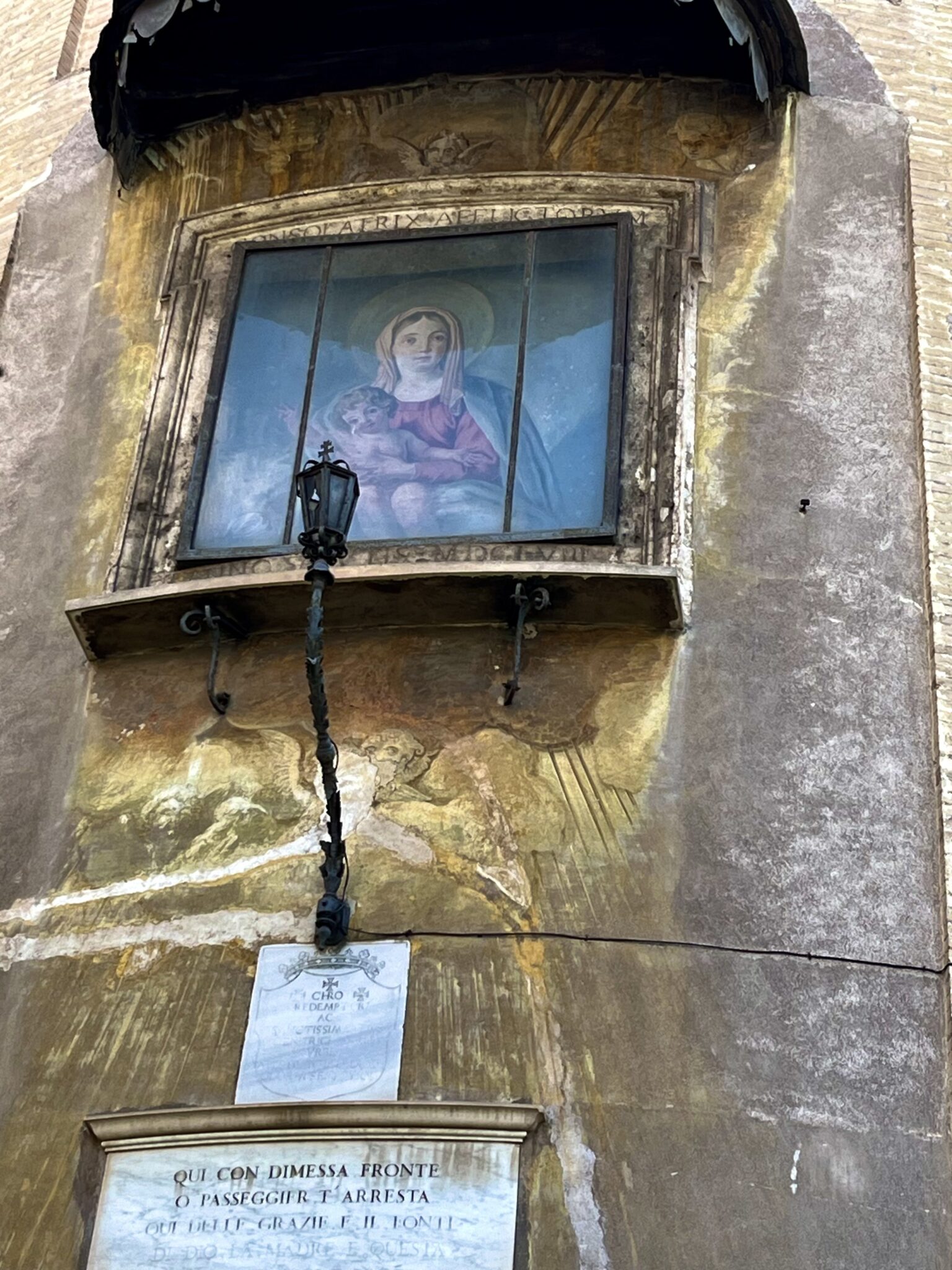
Also, in The Parish™ news, as I left church after Mass, a crew was returning from cleaning the little chapel up the street that once held the original of the beautiful Marian image now venerated in church.  Recent contacts were made with the management of the government entity that controls that little property and it is now being thoroughly cleaned and redecorated, including with the replacement of the copy of the original painting.   I wrote with photos HERE a couple of years ago when it was open – a very rare occasion back in the day.

It will be great once there is a new lighting system.

A couple nights ago I made a couple of involtini, to cover a couple of days.

I love the Roman afternoon colors.


Posted in SESSIUNCULA |
Leave a comment

Bishop wants to ordained married men because “pastoral emergency”. Could you repeat that?

At Rorate there is a bit of  alarming but, giving the player involved, not surprising news.

Bp. Bonny of Antwerp, Belgium, said “I will make every effort to ordain married men as priests for our diocese by 2028.”

He claims that he is doing this “out of pastoral necessity.”

It will be interesting to see what Rome does about this.

Answering the question “Aren’t you being a lone rider?” He answers:

Johan Bonny: ‘Not at all. In football terms, I consider myself a midfielder. I want to bring the ball forward so that a striker can kick it into the goal. We have been in extra time for too long. There are regions where there are no priests left. We are entering a situation of pastoral emergency. For many bishops, ordaining married men has become a matter of conscience. The way things are going now, we really won’t make it anymore.’

And now look at this through the lens of the SSPX.

This crazy Belgian bishop says that they are in a state of pastoral emergency.

The SSPX could look at him and what he intends and conclude exactly the same thing.

Again, it will be interesting to see what Rome does about this.

Posted in Blatteroons, Pò sì jiù | Tagged ,
19 Comments

Report from the ground: Charlotte

A long-time reader and supporter here had a road trip to Charlotte, NC.  He recounts for us his experience of a Sunday Mass.   I’ll anonymize the comments to remove specific references and not post photos because I strongly suspect that Bp. Martin would go out of his way to hurt these parishioners in some way.


Father,

Happened upon one of the traditional parishes while visiting my daughter in Charlotte, NC. Wanted to share this story as I saw someone else reached out to you about this troubled traditional community.

It’s been an extraordinary weekend, as my wife and I journeyed down through NJ, Pennsylvania, Maryland, WV, VA and into North Carolina for a visit with our daughter. Lots to share but as this is about Sunday, this is really a report about the faith community we encountered….

I was literally blown away by the faith, community, prayerfulness, beautiful liturgy, spectacular chant by the choir, and preaching by the parish priest.

We attended a morning mass and you’d think it was Easter or Christmas! Standing room only, people in the side aisles and narthex, along with well dressed robust families with scores of children – in what I think is what remains of a traditional community who has been mistreated by the local competent authority…with lots of veiled women and young ladies. I have seldom heard the strong, clear responses in English and ordinary of the mass in Latin at a Novus Ordo – for instance the Gloria and Credo sung by everyone.

There were more than a dozen young men serving, all attentive and clearly very well trained.

I exited quickly and caught the parish priest telling him how impressed I was, pledging prayers from me and my friends in NY and saying that what a shame they cannot pray as they want. He appreciated the pledge of prayer, invited me back then made sure to add: we will win in the end.

[E]veryone who communicated knelt at the first step of the sanctuary, on a carpet, and received there, one-by-one. It was striking.

We should pray for this and other communities of strong Catholic tradition in the Diocese of Charlotte if what I saw today is representative of their love of the church, the Eucharist and Our Lord!

I am buoyed with great hope for the church after praying with these people today. May God keep them strong in faith and Our Lady protect them!

Posted in The future and our choices, The Last Acceptable Prejudice | Tagged
3 Comments

“I am the good shepherd”

And HERE

Redemptionis Sacramentum 91

Posted in SESSIUNCULA | Tagged ,
19 Comments

ROME 26/4– Day 37: trading places

Rome enjoyed a new sunrise at 06:07 and looks forward to another beautiful building hue changing sunset this evening at 20:09.

Entering a new cycle, the Ave Maria is supposed to ring… but won’t… mostly… at 2o:30.

In the Novus calendar it is the Feast of St. Catherine of Siena, Patroness of Italy. In the Vetus calendar, she is celebrated tomorrow in the Vetus Ordo. Today, however, in the Vetus is the Feast of St Peter Martyr, who was killed with a sword to the head by a Cathar assassin.  Those zany Cathars!  He is said to have, in life, conversed with Sts. Catherine of Alexandria, Agnes and Cecilia.  I think the Novus Ordo dropped him completely, because, really, who cares about the first Dominican martyr, right?  In the sacristy today, I conversed with a deacon from Milan who described that the skull of St Peter clearly reveals his death wound.   Fastest canonization in history. Greg DiPippo posted interesting photos over at NLM.

CLICK

Please remember me when shopping online and use my affiliate links.  US HERE – UK HERE  WHY?  This helps to pay for health insurance (massively hiked for this new year of surprises), utilities, groceries, etc..  At no extra cost, you provide help for which I am grateful.

BTW… I received a report today… it was way down, which is a bit of a problem.

Towards Sant’Eustachio.

It was only a matter of time.

Meanwhile,  white to move.

NB: I’ll hold comments with solutions ’till the next day so there won’t be “spoilers” for others.

Posted in SESSIUNCULA |
5 Comments