Some years ago I posted my Patristic Rosary Project. Here is an oldie offering from that project on the…
3rd Glorious Mystery: Descent of the Holy Spirit
 Pentecost is the birthday of the Church, when the Holy Spirit breathes His own life into the Body and all the members. The descent of the Holy Spirit marks one of the ways in which Christ is faithful to His promise that He would be “with us always” (Matthew 28). The Scriptures describe the coming of the Holy Spirit, ru’ach, as a mighty wind rushing and as fire fifty days after the Lord’s Resurrection on a Jewish festival called the “feast of weeks” (Cf. Exodus 34:22; Deut 16:10). Here is St. Cyril of Jerusalem (+386):
‘And there appeared unto them cloven tongues like as of fire, and it sat upon each of them; and they were all filled with the Holy Spirit’ (Acts 2:3-4). They partook of fire, not of burning but of saving fire; of fire which consumes the thorns of sins, but gives luster to the soul. This is now coming upon you also, and that to strip away and consume your sins which are like thorns, and to brighten yet more that precious possession of your souls, and to give you grace; for He gave it then to the Apostles. And He sat upon them in the form of fiery tongues, that they might crown themselves with new and spiritual diadems by fiery tongues upon their heads. A fiery sword barred of old the gates of Paradise; a fiery tongue which brought salvation restored the gift. [Catechetical Lectures 17.15]
Do you remember that image of the fiery sword in the hands of the angel who closed the gates behind Adam and Eve? We have seen the Father’s refer to this before. Notice also how Cyril makes the event of Pentecost so personal. This leads to the question: Upon whom did the Holy Spirit descend? On the Twelve alone? Here is St. John Chrysostom (+407):
Was it upon the twelve that it [the Holy Spirit] came? Not so; but upon the hundred and twenty. For Peter would not have quoted to no purpose the testimony of the prophet, saying, ‘And it shall come to pass in the last days, saith the Lord God, I will pour out of My Spirit upon all flesh: and your sons and your daughters shall prophesy, and your young men shall see visions, and your old men shall dream dreams’ (Joel 2:28). ‘And they were all filled with the Holy Spirit.’ For, that the effect may not be to frighten only, therefore it is both ‘with the Holy Spirit, and with fire. And began to speak with other tongues, as the Spirit gave them utterance’ (Mt. 3:11). [Homilies on the Acts of the Apostles]
One of the signs of the working of the Spirit in the new Church is the anti-Babel, or anti-babble He produced. You remember that as punishment for his pride, in the book of Genesis God inflicted man with different languages. From that point men could no longer understand each other with facility. At Pentecost, they hear each other as if they were all using everyone else’s mother tongue. Here is St. Gregory Nazianen (+389):
But as the old Confusion of tongues was laudable, when men who were of one language in wickedness and impiety, even as some now venture to be, were building the Tower; for by the confusion of their language the unity of their intention was broken up, and their undertaking destroyed; so much more worthy of praise is the present miraculous one. For being poured from One Spirit upon many men, it brings them again into harmony. And there is a diversity of Gifts, which stands in need of yet another Gift to discern which is the best, where all are praiseworthy. [Oration on Pentecost]
The spellbinding Romanos the Melodist (+6th c.) has this about our praise of the Spirit. Amazing imagery:
Brothers, we shall hymn with praise the tongues of the disciples, because, not with elegant speech, But in divine power they have revived all men. Because they took up His Cross as a reed, So that they might again use words as fishing lines and fish for the world Since they had speech as a sharp fishhook, Since the flesh of the Master of all Has become for them a bait, it has not sought to kill But it attracts to life those who worship and praise The All-Holy Spirit. [On Pentecost]
One of my favorite lines in all of Scripture is John 21:3: Simon Peter said to them, “I’m going fishing.”
Many don’t realize the great importance the feast has always had in the Church. In the pre-Conciliar Roman rite, Pentecost actually had more liturgical bells and whistles attached to it that Easter Sunday. St. Pope Leo I, “the Great” (+461) preaches about the granduer of Pentecost with his characteristic elegance:
Pentecost holds great mysteries in itself, mysteries new and old. By them it is clear that grace was foretold through the old law, and the old law was fulfilled through grace. When the Hebrew people were freed from the Egyptians, the law was given on Mount Sinai on the fiftieth day after the sacrifice of the lambs. So, after the suffering of Christ — the true Lamb of God, who was slain — and on the fiftieth day from His resurrection, the Holy Spirit came down upon the Apostles and the crowd of believers. The true Christian can easily see how the beginnings of the Old Testament prepared for the beginnings of the gospel, and that the second covenant was founded by the same Spirit who had set up the first …
Oh, how swift are the words of wisdom! How quickly the lesson is learned when God is the Teacher! No interpretation is needed for understanding, no practice for using, no time for studying. The Spirit of Truth blows where He wills (see Jn 3:8), and the languages of each nation become common property in the mouth of the Church. So, from that day, the Gospel preaching has resounded like a trumpet. From that day, the showers of gracious gifts, the rivers of blessings, have watered every desert and all the dry land. To “renew the face of the earth” (Ps 103:30), the Spirit of God “was moving over the face of the waters” (Gen 1:2); and to drive away the old darkness, flashes of new light shone forth. By the blaze of those busy tongues, the Lord’s bright Word kindled speech into fire — fire to arouse the understanding and to consume sin. Fire has the power to enlighten and the power to burn.
God’s word has authority, and it is ablaze with these and countless other proofs. Let us, all together, wake up to celebrate Pentecost. Let’s rejoice in honor of the Holy Spirit, through whom the whole Catholic Church is made holy, and every rational soul comes alive. He is the Inspirer of Faith, the Teacher of Knowledge, the Fountain of Love, the Seal of Chastity, and the Source of all Power.
Let the spirits of the faithful rejoice. Let one God, Father, Son, and Holy Spirit, be praised throughout the world, by the confession of all languages. And may that sign of His presence, the likeness of fire, burn perpetually in His work and gift.
The Spirit of Truth makes the house of His glory shine with the brightness of His light, and He wants nothing in His temple to be dark or lukewarm.
Note the images of water, the baptismal medium, and the fire. Let’s stick with that for a moment longer. Here is St. Ambrose of Milan (+397):
So, then, the Holy Spirit is the River, and the abundant River, which according to the Hebrews flowed from Jesus in the lands, as we have received it prophesied by the mouth of Isaiah. This is the great River which flows always and never fails. And not only a river, but also one of copious stream and overflowing greatness, as also David said: “The stream of the river makes glad the city of God.”
For neither is that city, the heavenly Jerusalem, watered by the channel of any earthly river, but that Holy Spirit, proceeding from the Fount of Life, by a short draught of Whom we are satiated, seems to flow more abundantly among those celestial Thrones, Dominions and Powers, Angels and Archangels, rushing in the full course of the seven virtues of the Spirit. For if a river rising above its banks overflows, how much more does the Spirit, rising above every creature, when He touches the as it were low-lying fields of our minds, make glad that heavenly nature of the creatures with the larger fertility of His sanctification.
And let it not trouble you that either here it is said “rivers,” or elsewhere “seven Spirits,” for by the sanctification of these seven gifts of the Spirit, as Isaiah said, is signified the fulness of all virtue; the Spirit of wisdom and understanding, the Spirit of counsel and strength, the Spirit of knowledge and godliness, and the Spirit of the fear of God. One, then, is the River, but many the channels of the gifts of the Spirit. This River, then, goes forth from the Fount of Life.
And here, again, you must not turn aside your thoughts to lower things, because there seems to be some difference between a Fount and a River, and yet the divine Scripture has provided that the weakness of human understanding should not be injured by the lowliness of the language. Set before yourself any river, it springs from its fount, but is of one nature, of one brightness and beauty. And do you assert rightly that the Holy Spirit is of one substance, brightness, and glory with the Son of God and with God the Father. I will sum up all in the oneness of the qualities, and shall not be afraid of any question as to difference of greatness. For in this point also Scripture has provided for us; for the Son of God says: “He that shall drink of the water which I will give him, it shall become in him a well of water springing up unto everlasting life.” This well is clearly the grace of the Spirit, a stream proceeding from the living Fount. The Holy Spirit, then, is also the Fount of eternal life. . . .
Good, then, is this water, even the grace of the Spirit. Who will give this Fount to my breast? Let it spring up in me, let that which gives eternal life flow upon me. Let that Fount overflow upon us, and not flow away. For Wisdom says: “Drink water out of thine own vessels, and from the founts of thine own wells, and let thy waters flow abroad in thy streets.” How shall I keep this water that it flow not forth, that it glide not away? How shall I preserve my vessel, lest any crack of sin penetrating it, should let the water of eternal life exude? Teach us, Lord Jesus, teach us as Thou didst teach Thine apostles, saying: “Lay not up for yourselves treasures upon the earth, where rust and moth destroy, and where thieves break through and steal.” [On the Holy Spirit, 1.177-82]
Ambrose is good in print, even in translation. But when you read him in Latin, out loud and will some energy, you get a sense of why even someone like Augustine, who was a professional orator in the Imperial court, was completely captivated and much in awe of this mighty figure. In his piece above, Ambrose is very much bringing our baptism to mind. Our baptism is like our own personal Pentecost. Another captivating Latin Father, St. Hilary of Poitiers (+367) wrote about the commission laid by Christ on the Church to baptize:
Our Lord commanded us to baptize in the name of the Father and of the Son and of the Holy Spirit. In baptism, then, we profess faith in the Creator, in the only-begotten Son and in the gift which is the Spirit. There is one Creator of all things, for in God there is one Father from whom all things have their being. And there is one only-begotten Son, our Lord Jesus Christ, through whom all things exist. And there is one Spirit, the gift who is in all. So all follow their due order, according to the proper operation of each: one power, which brings all things into being, one Son, through whom all things come to be, and one gift of perfect hope. Nothing is wanting to this flawless union: in Father, Son and Holy Spirit, there is infinity of endless being, perfect reflection of the divine image, and mutual enjoyment of the gift.
Our Lord has described the purpose of the Spirit’s presence in us. Let us listen to his words: I have yet many things to say to you, but you cannot bear them now. It is to your advantage that I go away; if I go, I will send you the Advocate. And also: I will ask the Father and he will give you another Counsellor to be with you for ever, the Spirit of truth. He will guide you into all the truth; for he will not speak on his own authority, but whatever he hears he will speak, and he will declare to you the things that are to come. He will glorify me, for he will take what is mine.
From among many of our Lord’s sayings, these have been chosen to guide our understanding, for they reveal to us the intention of the giver, the nature of the gift and the condition for its reception. Since our weak minds cannot comprehend the Father or the Son, we have been given the Holy Spirit as our intermediary and advocate, to shed light on that hard doctrine of our faith, the incarnation of God.
We receive the Spirit of truth so that we can know the things of God. In order to grasp this, consider how useless the faculties of the human body would become if they were denied their exercise. Our eyes cannot fulfil their task without light, either natural or artificial; our ears cannot react without sound vibrations, and in the absence of any odor our nostrils are ignorant of their function. Not that these senses would lose their own nature if they were not used; rather, they demand objects of experience in order to function. It is the same with the human soul. Unless it absorbs the gift of the Spirit through faith, the mind has the ability to know God but lacks the light necessary for that knowledge.
This unique gift which is in Christ is offered in its fullness to everyone. It is everywhere available, but it is given to each man in proportion to his readiness to receive it. Its presence is the fuller, the greater a man’s desire to be worthy of it. This gift will remain with us until the end of the world, and will be our comfort in the time of waiting. By the favors it bestows, it is the pledge of our hope for the future, the light of our minds, and the splendor that irradiates our understanding. [On the Trinity, 2.1.33,35]
We can spend some more time with St. Augustine as he describes the Spirit as the love. Take a moment to hear Augustine. Read all the Fathers aloud, but especially Augustine:
There is no gift of God more excellent than this. It alone distinguishes the sons of the eternal kingdom and the sons of eternal perdition. Other gifts, too, are given by the Holy Spirit; but without love they profit nothing. Unless, therefore, the Holy Spirit is so far imparted to each, as to make him one who loves God and his neighbor, he is not removed from the left hand to the right. Nor is the Spirit specially called the Gift, unless on account of love. And he who has not this love, “though he speak with the tongues of men and angels, is sounding brass and a tinkling cymbal; and though he have the gift of prophecy, and know all mysteries and all knowledge, and though he have all faith, so that he can remove mountains, he is nothing; and though he bestow all his goods to feed the poor, and though he give his body to be burned, it profiteth him nothing.”
How great a good, then, is that without which goods so great bring no one to eternal life! But love or charity itself,–for they are two names for one thing,–if he have it that does not speak with tongues, nor has the gift of prophecy, nor knows all mysteries and all knowledge, nor gives all his goods to the poor, either because he has none to give or because some necessity hinders, nor delivers his body to be burned, if no trial of such a suffering overtakes him, brings that man to the kingdom, so that faith itself is only rendered profitable by love, since faith without love can indeed exist, but cannot profit. And therefore also the Apostle Paul says, “In Christ Jesus neither circumcision availeth anything, nor uncircumcision, but faith that worketh by love:” so distinguishing it from that faith by which even “the devils believe and tremble.” Love, therefore, which is of God and is God, is specially the Holy Spirit, by whom the love of God is shed abroad in our hearts, by which love the whole Trinity dwells in us. And therefore most rightly is the Holy Spirit, although He is God, called also the gift of God. And by that gift what else can properly be understood except love, which brings to God, and without which any other gift of God whatsoever does not bring to God? . . .
Wherefore, if Holy Scripture proclaims that God is love, and that love is of God, and works this in us that we abide in God and He in us, and that hereby we know this, because He has given us of His Spirit, then the Spirit Himself is God, who is love. Next, if there be among the gifts of God none greater than love, and there is no greater gift of God than the Holy Spirit, what follows more naturally than that He is Himself love, who is called both God and of God? And if the love by which the Father loves the Son, and the Son loves the Father, ineffably demonstrates the communion of both, what is more suitable than that He should be specially called love, who is the Spirit common to both? For this is the sounder thing both to believe and to understand, that the Holy Spirit is not alone love in that Trinity, yet is not specially called love to no purpose. [On the Trinity 15.18.32; 19.37]
Several of the Fathers, East and West, wrote on the Holy Spirit. Here is St. Basil the Great (+379) talking about the effect of the indwelling of the Spirit:
Now the Spirit is not brought into intimate association with the soul by local approximation. How indeed could there be a corporeal approach to the incorporeal? This association results from the withdrawal of the passions which, coming afterwards gradually on the soul from its friendship to the flesh, have alienated it from its close relationship with God. Only then after a man is purified from the shame whose stain he took through his wickedness, and has come back again to his natural beauty, and as it were cleaning the Royal Image and restoring its ancient form, only thus is it possible for him to draw near to the Paraclete.
And He, like the sun, will by the aid of thy purified eye show thee in Himself the image of the invisible, and in the blessed spectacle of the image thou shalt behold the unspeakable beauty of the archetype. Through His aid hearts are lifted up, the weak are held by the hand, and they who are advancing are brought to perfection. Shining upon those that are cleansed from every spot, He makes them spiritual by fellowship with Himself. Just as when a sunbeam falls on bright and transparent bodies, they themselves become brilliant too, and shed forth a fresh brightness from themselves, so souls wherein the Spirit dwells, illuminated by the Spirit, themselves become spiritual, and send forth their grace to others.
Hence comes foreknowledge of the future, understanding of mysteries, apprehension of what is hidden, distribution of good gifts, the heavenly citizenship, a place in the chorus of angels, joy without end, abiding in God, the being made like to God, and, highest of all, the being made God [that is, sharers in the divine nature]. Such, then, to instance a few out of many, are the conceptions concerning the Holy Spirit, which we have been taught to hold concerning His greatness, His dignity, and His operations, by the oracles of the Spirit themselves. [On the Holy Spirit, 9]
Basil is referring to the “divinization” of our souls, an ongoing process in the life come when God shares His own glory with us. I love the image of the light in a trasparent body. We have all seen light defract through the flowing water of a stream or falls, or though a prism. The light makes luminous what it illuminates and seems almost to be increased. The thing illuminated is made more than it was. So, Basil says that we who are weak are “taken by the hand” and lead on the proper path. Stunning.
Turning now to an Easterner relocated in the West, we hear St. Irenaeus of Lyon (+202) on the effect of the Spirit not on just the individual, but on the collective:
When the Lord gave to the disciples power to confer rebirth into the life of God, he said: “Go, make disciples of all nations, baptizing them in the name of the Father and of the Son and of the Holy Spirit”.
He promised through his prophets that he would pour out this spirit in the last times on his servants and handmaidens so that they would prophesy. And so the Spirit came down on the Son of God, who became the Son of man, and with him became accustomed to dwell in the human race and to abide in God’s creation, within men, working the Father’s will among them and making their old natures new with the newness of Christ.
Luke says that at Pentecost, after the ascension of the Lord, the Spirit came down on the disciples with power to grant all nations entry into life, and to open the new testament. And so in every language they sang a hymn to God in unison; for the Spirit brought the scattered races together into a unity, and offered to the Father the first-fruits of all the nations.
Therefore the Lord promised to send us the Holy Spirit to make us fit for God’s purposes. Just as dry flour cannot coalesce into a lump of dough, still less a loaf, without moisture, so we, who to begin with are dry wood, can never bear the fruit of life unless the rain from heaven falls upon our wills.
For our bodies through the water of baptism have received the unity which leads to freedom from corruption; but our souls have received it through the Spirit.
The Spirit of God came down on the Lord, “the Spirit of wisdom and understanding, the Spirit of counsel and might, the Spirit of knowledge and devotion, the Spirit of fear of the Lord”. He gave the same Spirit again to the Church, sending the Counselor to every nation from heaven, from which the Lord said “the devil was cast down like lightning”. Accordingly we need God ‘s dew, so as not to be burnt up and made unfruitful but rather to have a Counselor when we have an accuser. For the Lord entrusts to the Holy Spirit his man who had fallen among thieves. Taking pity on him he has bound up his wounds, and given two imperial coins, stamped with the image of the Spirit and the inscription of the Father and the Son. We are to accept them, and make the coin entrusted to us bear fruit and multiply for the Lord. [Against Heresies]
Hmmm…. dew of the Spirit… where have I seen that before? If you are registered on this blog, I think you get the use of a search function and can look up the many entries I posted on the Fathers and dew imagery. But let’s shift images back to one of the most dramatic of the Holy Spirit: tongues of fire. Since this blog is interested in translation issues and various tongues, we can linger over something of the Great Basil:
That day all the believers were gathered together in one place. Suddenly there came a sound from heaven like a strong wind blowing, and it filled the whole house where they were sitting. Then they saw what looked like tongues of fire coming down to rest on each one of them. They were all filled with the Holy Spirit and began to speak in other tongues as the Spirit gave them the power of utterance (Acts 2:1-4).
No sooner had the Spirit come upon them than they began to speak in tongues. They needed no time to study the languages they were given, nor practice to gain facility. Nor did their hearers need an interpreter. God was the master of speakers and hearers alike; it was his Spirit that inspired the apostles to give testimony and enabled the crowds to understand them. That day the wonderful works of God were proclaimed in every language of the world. The Spirit of Truth breathes where he will, and since the day of Pentecost each country’s native tongue has become common property in the mouth of Christ’s Church, as the gospel is preached throughout the world. The Spirit of God has swept over the chaos once more to renew the face of the earth, watering every barren place with a rain of charismatic gifts and blessings. The tongues of men declare God’s mighty deeds and proclaim his word in the power of the Spirit, while the Lord works with them and confirms their message by accompanying signs (cf. Mark 16.20).
The perrenial message of the gospel is that the Lord has saved his people. he has conquered sin and death, and given us new life as God’s adopted sons. And because we are sons, God has sent the Spirit of his Son intou our hearts, crying “Abba, Father!” (Gal. 4:6). Now where the Spirit of the Lord is, there is freedom (2 Cor. 3:17). We are no longer slaves, but free men. It belongs to the dignity of free men to play some part in their own salvation; our task is to elude the enemy’s clutches by constantly turning in repentance to our Redeemer and proclaiming that Jesus is Lord of our whole lives. [On the Holy Spirit]
We pray that those who are working now in the matter of translating the Church’s liturgy into many languages of the world will be open to the promptings of the Holy Spirit.
There is too much to read from the Fathers on Pentecost and the Holy Spirit. We can close with a magnificent piece again from the eloquent Leo speaks about the effect of the Holy Spirit in the Church today. Among the many things I note in this is the appeal to reason much as Leo’s successor Benedict XVI is doing. You will note that this is for the Vigil of Pentecost. Through the centuries Catholics dedicated themselves to serious fasts so that they could participate more fully and consciously and actively in the liturgy.
By these and other numberless proofs, dearly-beloved, with which the authority of the Divine utterances is ablaze, let us with one mind be incited to pay reverence to Whitsuntide [Pentecost], exulting in honour of the Holy Ghost, through Whom the whole Catholic Church is sanctified, and every rational soul quickened; Who is the Inspirer of the Faith, the Teacher of Knowledge, the Fount of Love, the Seal of Chastity, and the Cause of all Power. Let the minds of the faithful rejoice, that throughout the world One God, Father, Son, and Holy Ghost, is praised by the confession of all tongues, and that that sign of His Presence, which appeared in the likeness of fire, is still perpetuated in His work and gift. For the Spirit of Truth Himself makes the house of His glory shine with the brightness of His light, and will have nothing dark nor lukewarm in His temple. And it is through His aid and teaching also that the purification of fasts and alms has been established among us. For this venerable day is followed by a most wholesome practice, which all the saints have ever found most profitable to them, and to the diligent observance of which we exhort you with a shepherd’s care, to the end that if any blemish has been contracted in the days just passed through heedless negligence, it may be atoned for by the discipline of fasting and corrected by pious devotion. On Wednesday and Friday, therefore, let us fast, and on Saturday for this very purpose keep vigil with accustomed devotion, through Jesus Christ our Lord, Who with the Father and the Holy Ghost lives and reigns for ever and ever. Amen. [s. 75.5]
“Pious devotions”. The recitation of the Holy Rosary, with a meditation on the mystery of Pentecost, will help us focus our gaze on the Person of Christ who sent His Spirit upon and and who is with us until the ending of the world.






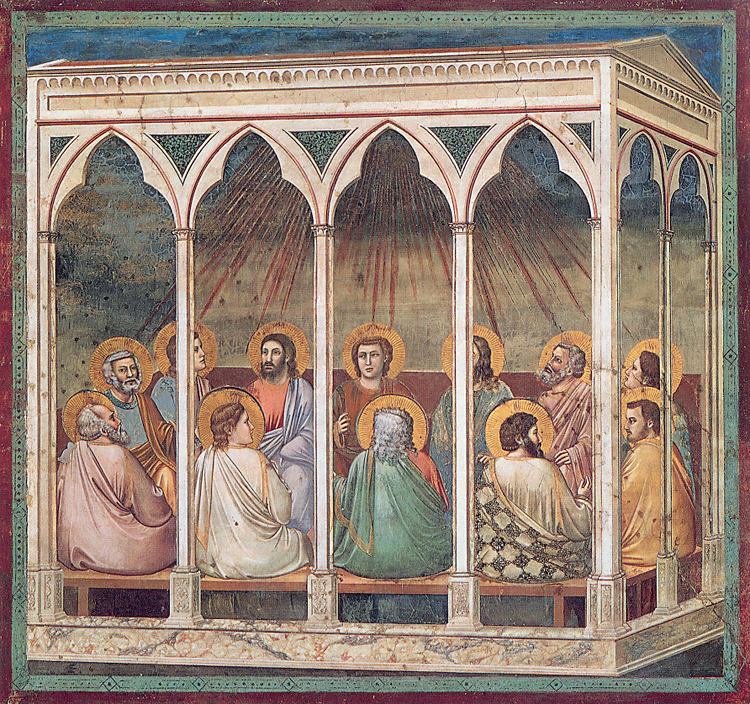 Pentecost is the birthday of the Church, when the Holy Spirit breathes His own life into the Body and all the members. The descent of the Holy Spirit marks one of the ways in which Christ is faithful to His promise that He would be “with us always” (Matthew 28). The Scriptures describe the coming of the Holy Spirit, ru’ach, as a mighty wind rushing and as fire fifty days after the Lord’s Resurrection on a Jewish festival called the “feast of weeks” (Cf. Exodus 34:22; Deut 16:10). Here is St. Cyril of Jerusalem (+386):
 Let the spirits of the faithful rejoice. Let one God, Father, Son, and Holy Spirit, be praised throughout the world, by the confession of all languages. And may that sign of His presence, the likeness of fire, burn perpetually in His work and gift.
 We can spend some more time with St. Augustine as he describes the Spirit as the love. Take a moment to hear Augustine. Read all the Fathers aloud, but especially Augustine:
 the indwelling of the Spirit:
 Hmmm…. dew of the Spirit… where have I
 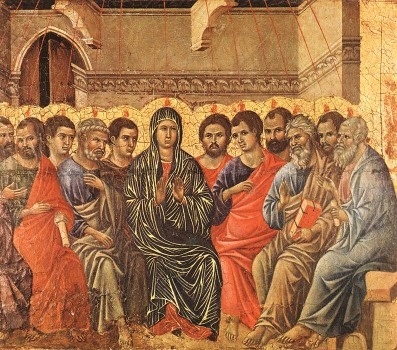 We pray that those who are working now in the matter of translating the Church’s liturgy into many languages of the world will be open to the promptings of the Holy Spirit.




























