Card. Kasper invokes journalist war against another Cardinal?

Card. Kasper looks around for people to blame for his own enormous gaffe.  But the ending is a little … dunno… threatening?

From CWR. Go there for links and other stuff.

The controversy about statements made last week about African bishops and their contributions to the Synod on the Family by the Roman Curial prelate Cardinal Walter Kasper continues. Most recently BILD-Zeitung [a German tabloid newspaper] took up the topic last Friday and headlined its story: “Racism Blooper?” BILD also quoted a German bishop who opined, “Insulting, lying and falsely accusing is not prescribed by the Catechism.” There was criticism about Cardinal Kasper’s remarks over the weekend, as Cardinal Raymond Burke calledthe remarks “profoundly sad and scandalous” in an interview with CWR.

Cardinal Kasper has now offered a qualified apology for his statements and expressed his esteem for the Church in Africa. Kasper had previously denied he’d made the remarks attributed to him by journalist Edward Pentin, then stated that he had been recorded speaking to journalists without his knowledge. Kasper himself has now confirmed to Kath.net that he had had a conversation with three journalists. In Kasper’s opinion, though, it was not an interview; there has to be an agreement for an interview as such. Then the Cardinal made it clear:

“If one of my remarks about Africans was perceived as demeaning or insulting, then I am honestly sorry. That was and is not my intention, and not my view at all. No one will deny that Africa’s culture is different from Europe’s in many respects. But I have been in Africa too often not to esteem African culture highly.” [Translated for CWR by Michael J. Miller]

Cardinal Kasper was quoted by Pentin as describing the problems of the African Church as “impossible” for the synod to solve, while saying that the African bishops “should not tell us too much what we have to do.” The publication of Kasper’s comments to Pentin, his disavowal of them, and the subsequent release of the full audio of the interview were the source of much controversy late last week as the bishops concluded the two-week Synod on the Family. Some speculated that the appointment of Cardinal Wilfrid Napier of South Africa to the committee responsible for drafting the synod’s final document was a response to Kasper’s remarks.

Another comment made by Cardinal Kasper in speaking with Kath.net is quite breathtaking: he talked again about a “deliberate dirty trick” to denounce him. “The fact that Catholic media (and unfortunately a cardinal in person) should participate in it, in order to tear down another position morally, is shameful,” Kasper opined. When Kath.net asked as a follow-up question who that cardinal was, Kasper unfortunately gave no answer. The retired Curial Cardinal announced, however, that “other journalists” are going to take action against such “undignified machinations”.

Is that so?  Is there going to be an attack by Kasper’s journalist sympathizers against Card. Burke?

Moderation queue is ON.

I am getting onto an international flight, so you have lots of time to really think through your comments.

Posted in SESSIUNCULA | Tagged
44 Comments

My View For Awhile: Midtown Tunnel Edition

I hurtled through the Midtown Tunnel and I am on the Van Wyck on the way to JFK.

IMG_2668.JPG

And so the pilgrimage to Rome begins.

UPDATE

I had a note that a couple of priest friends are also heading to Rome. Different flight.

Meanwhile… ah the allure of the international flight.

IMG_2672-0.JPG

Posted in On the road, What Fr. Z is up to |
7 Comments

Extraordinary Synod on Family is, thanks be to God, over.

The Extraordinary Synod on the family is, thanks be to God, over.

The bishops will meet again next year at the same time in the Ordinary Synod on the same topic: the Family.

Let me start with the pessimistic take, first.

In sum, I think this Synod caused defeats for all sides.

It was a big defeat for liberals/progressivists because they didn’t get what they wanted. The liberals in the Synod weren’t able to ram through their agenda. In the end, they overplayed their hands and the conservative/Magisterium defenders rose up and said “No more!” It was also a defeat, but less so, for the defenders of the Magisterium because, frankly, some of the things which were hotly debated at the Synod, shouldn’t have been debated at all. Thus, liberals got their way a little bit: they managed to get their points on the agenda.

Also, the Catholic people everywhere were defeated: great confusion has been sown about matters such as Communion for the divorced and civilly remarried and the “welcome” we are supposed to show as a Church to homosexuals. I am already hearing from priests that people as saying things like, “I’m remarried but Francis says I can go to Communion”. That’s ridiculous, but, as I said, there is confusion. Some people will have the notion that we now “welcome” (whatever that means) homosexuals because they are homosexual rather than because they are human beings. That’s ridiculous, but, as I said, there is confusion.

The Synod was positive in the sense that in the end enough bishops rose up to put a halt to the lemming rush – nay, rather – walking together towards the cliff.  But we shouldn’t be aiming at the cliff at all.

Who knows if it will be possible to halt this thing during next year’s Synod. Some of the key players who stopped the liberal surge and manipulation in the Synod, probably won’t be involved next year. I doubt Card. Burke will be there. He was there this time in his role as head of a dicastery of the Roman Curia. So were Card. Pell and Card. Mueller.  Who knows who will receive special appointments as participants. If this Synod couldn’t be manipulated, and clearly a manipulation was attempted through the control of information and texts, next year’s could be controlled by stacking the deck, changing the slate of participants to favor one side.

Extraordinary Synod on Family is, thanks be to God, over.

CLICK

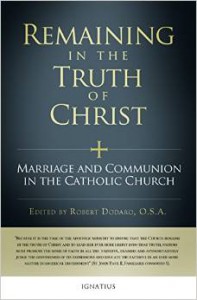
However, one factor that will remain is “The Five Cardinals Book”. This important book will have been read and absorbed well by next October. In the face of the books explanations, many of the liberal issues simply fall apart.

A few more points, in no special order.

First, there was controversy about how we are to “welcome” (accogliere) “gays” (I hate that word now). What on earth does “welcome gays” mean? What does it mean for the divorced and civilly remarried? This “welcome” strikes me as incredibly superficial. It reflects sentiments, not real thought.

Does “welcome” for gays and remarried mean just avoiding any words that might be imagined by some to be off-putting?  Does it mean admittance to Holy Communion? I think it does, ultimately. If that is the case, then I think we just have to say “game over”. Think about it. What does Communion become, through the open admission of those who are objectively and often openly in the state of mortal sin? Communion becomes that white thing someone puts in your hand to make you feel “welcome”, like you “belong”. Then you sing the song and go on your way. You don’t have to think about how you live, or what you are doing with you receive the Eucharist. 1 Corinthians is a dead letter. Why bother going at all? One you have obtained the victory of self-affirmation, of deciding for yourself about Communion without any regard for the Church’s perennial teaching, why even bother with Mass?

The talk about “graduality” was interesting, but again there is confusion about the term.  We do not approve sin. Sin is not good.  We are pleased when people move away from sin toward virtue.  We are happy when people sin less, but we are not happy with the sins they still commit.  Moreover, this is a way of helping individuals stop sinning and come to live a good Christian life, it is not a program for whole groups of people.  This is something to be applied in the internal forum rather than in vague phrases of “welcoming”.

Also, and perhaps I am wrong about this, but I think not… it seems to me that in the words “traditionalist” and “intellectualist” the Magisterium of John Paul II was undermined. It seems now that if you believe in the Catechism of the Catholic Church or Familiaris consortio, you are a “traditionalist” and “intellectualist”. Under attack during the Synod, by liberals, was the Magisterium of John Paul II, especially as found in Familiaris consortio and the Catechism of the Catholic Church. I would like to point out that everything Card. Burke wrote in his contribution to the Five Cardinals Book, is supported by the CCC or Familiaris consortio. Hey! FC is 33 years old! That’s outdated by now, right?  So, the term “dissenter” will be applied to people who defend doctrine.

Weird, no?  It is as if we are now walking about with a Salvador Dali landscape.

I sound pessimistic, I know.  I, therefore, rush to add that we can all be grateful for the participants in the Synod who, fed up, held their hands up, got to their feet, and said “No!”

A week ago, we had no idea what was going to happen.  One camp thought their scheme was going to work like a charm.  They aren’t so confident now, I think.

I am also reminded of the pessimist and the optimist who are discussing the state of things.  The pessimist says, “Things can’t possibly get any worse!”.  The optimist replies, “Oh yes they can!”

Putting on my optimist hat now, I turn my gaze to Sunday 4 October 2015, which should be the date that the next Synod begins.  In the Novus Ordo calendar it will be the 27th Sunday of Ordinary Time, Year B.

What is the Gospel reading for that day?  I knew you would ask.

Mark 10:2-16

Just to refresh your memory:

The Pharisees approached Jesus and asked,
“Is it lawful for a husband to divorce his wife?”
They were testing him.
He said to them in reply, “What did Moses command you?”
They replied,
“Moses permitted a husband to write a bill of divorce
and dismiss her.”
But Jesus told them,
“Because of the hardness of your hearts
he wrote you this commandment.
But from the beginning of creation, God made them male and female.
For this reason a man shall leave his father and mother
and be joined to his wife,
and the two shall become one flesh.
So they are no longer two but one flesh.
Therefore what God has joined together,
no human being must separate.”
In the house the disciples again questioned Jesus about this.
He said to them,
“Whoever divorces his wife and marries another
commits adultery against her;
and if she divorces her husband and marries another,
she commits adultery.”

Yes, that is the reading for the corresponding Sunday for next year’s opening of the Synod of Bishops.

We have a year now, during which the debates are going to continue.

For a whole year, as you listen to the rhetoric about mercy v. law, pastoral v. intellectual, compassion v. doctrine, everyone will remember what Gospel they should have for the Synod of 2015.

Meanwhile, friends, do not let up.  Let’s use those provisions of Summorum Pontificum and pray and take on mortifications for the sake of Holy Church in these troubling times.

The moderation queue is ON.  Also, I have a really long flight coming up, without internet.

Posted in Liberals, One Man & One Woman, Our Catholic Identity, Sin That Cries To Heaven, The Coming Storm, The Drill, The future and our choices | Tagged , , , , , , ,
55 Comments

VIDEO: Stop this and watch this

Watch and learn:

Play video

Enough said.

This is the guy who did this!

This book was the game changer.

VIDEO: Stop this and watch this

CLICK

As I post this 564 views.

Posted in One Man & One Woman, Our Catholic Identity | Tagged ,
39 Comments

ASK FATHER: Prayer for the Holy Father’s intention?

From a reader…

QUAERITUR:

To gain an indulgence we are required to “pray for the Pope’s intention”. How are we to understand this – are we asking God to answer the specific prayer intentions of the Holy Father (crudely, asking God to do what the Pope wants)? Or are we praying that God will give inspire and guide the Pope, i.e . that his intentions may be according to God’s will? No doubt this is a bit of a dumb question but I’ve never seen this explained clearly.

Good question. I suspect some people may be a little confused about this.

When you are asked to “pray for the intentions of the Holy Father”, you are not being asked to pray for the Holy Father, though that is good and all Catholics really ought to. Rather, you are asked to pray for the intentions that the Holy Father designates that we pray for. For instance, this month, October 2014 we have these intentions.

  • Peace. That the Lord may grant peace to those parts of the world most battered by war and violence.
  • World Mission Day. That World Mission Day may rekindle in every believer zeal for carrying the Gospel into all the world.

Next month, it’ll be something else.  There is usually a “general” intention and a “mission” intention.

If you don’t happen to know what the Pope’s designated intentions are, you can make a general intention to pray for what he wants.  However, in this internet age, you can find quickly what the Pope wants.  The intentions for the whole year are posted before each year begins.  You might print them out and put them by your wall calendar, or write them on slips of paper for your prayer book or hand missal or your refrigerator.  You could tack them up with a new Zed-Head magnet!

We are all in this together.  It is good to have intentions designated by the Vicar of Christ, for us to coordinate our prayer for specific issues.

Posted in "How To..." - Practical Notes, ASK FATHER Question Box, PRAYER REQUEST | Tagged , ,
16 Comments

NYC Day 2: Benedict Edition

The day began with eggs Benedict.

IMG_2658.JPG

By the way. Did you see how some loons are saying that some Cardinals tried to conspire with Benedict XVI to sway the proceedings of the Synod? Sheesh.

Next, from the Met.  There is an exhibit of some Pre-Raphaelite stuff.  Here is the Kelmscott printing of The Well at the World’s End, which I read when I was getting interested in the Inklings and their predecessors back when I was in “middle school” and high school.


IMG_2614.JPG

The atrium area of the Frick.

IMG_2659.JPG

I spent some time with Constable’s White Horse.

NYC Day 2: Benedict Edition

This is, by the way, an important painting.

More later.

Posted in SESSIUNCULA |
12 Comments

Your Sunday Sermon Notes

Was there a good point in the sermon you heard for your Sunday Mass?

Another question: Was the Synod that just closed mentioned in the sermon?  In what terms?

Was the Beatification of Paul VI mentioned?

Posted in SESSIUNCULA |
51 Comments

Wherein Card. Burke is compared to Archbp. Lefebvre

Just in case you were wondering what sort of people were on the other side of the issue, this is a Twitter exchange between the Jesuit James Martin and Massimo Faggioli, a liberal academic in St. Paul:

Wherein Card. Burke is compared to Archbp. Lefebvre

Card. Burke is compared to the late Archbp. Marcel Lefevbre. They invoke “schism”.

Schism?

Will they next say that St. John Paul II was a Lefebvrite?

St. John Paul issued Familiaris consortio and the Catechism of the Catholic Church and everything that Card. Burke has said can be found in both.

For a liberal, Lefebvre is the equivalent of the bogeyman, Hannibal at the gates, the monster under the bed.

If “ideologue” is now liberal code for “faithful”, I suppose that “schismatic” is now their code for “believer in the Magisterium”.

I hope that these guys have a fainting couch.

Posted in Liberals, One Man & One Woman, Sin That Cries To Heaven | Tagged , , , ,
58 Comments

Pope Francis’ final address to the Synod as it closes

Pope Francis addressed the Synod participants at the end of the Synod.  I’ll out the blah blah:

(Vatican Radio) At the conclusion of the Extraordinary Synod on the Family, Pope Francis addressed the assembled Fathers, thanking them for their efforts and encouraging them to continue to journey.

Below, please find Vatican Radio’s provisional translation of Pope Francis’ address to the Synod Fathers: 

[..]

I can happily say that – with a spirit of collegiality and of synodality [Q: How are they different?] – we have truly lived the experience of “Synod,” a path of solidarity, a “journey together.”

And it has been “a journey” – and like every journey there were moments of running fast, as if wanting to conquer time and reach the goal as soon as possible; other moments of fatigue, as if wanting to say “enough”; other moments of enthusiasm and ardour. There were moments of profound consolation listening to the testimony of true pastors, who wisely carry in their hearts the joys and the tears of their faithful people. Moments of consolation and grace and comfort hearing the testimonies of the families who have participated in the Synod and have shared with us the beauty and the joy of their married life. A journey where the stronger feel compelled to help the less strong, where the more experienced are led to serve others, even through confrontations. And since it is a journey of human beings, with the consolations there were also moments of desolation, of tensions and temptations, of which a few possibilities could be mentioned: [Not that we want to dwell on them…]

– One, a temptation to hostile inflexibility, that is, wanting to close oneself within the written word, (the letter) and not allowing oneself to be surprised by God, by the God of surprises, (the spirit); within the law, within the certitude of what we know and not of what we still need to learn and to achieve. From the time of Christ, it is the temptation of the zealous, of the scrupulous, of the solicitous and of the so-called – today – “traditionalists” and also of the intellectuals.  [“traditionalist” “intellectualisti“.  Really?] 

– The temptation to a destructive tendency to goodness [it. buonismo] [This also means a “going along to get along”, not to make waves.], that in the name of a deceptive mercy binds the wounds without first curing them and treating them; that treats the symptoms and not the causes and the roots. It is the temptation of the “do-gooders,” of the fearful, and also of the so-called “progressives and liberals.” [Because liberals are “do-gooders” and the traditionalists … aren’t?]

– The temptation to transform stones into bread to break the long, heavy, and painful fast (cf. Lk 4:1-4); and also to transform the bread into a stone and cast it against the sinners, the weak, and the sick (cf Jn 8:7), that is, to transform it into unbearable burdens (Lk 11:46).

– The temptation to come down off the Cross, to please the people, and not stay there, in order to fulfil the will of the Father; to bow down to a worldly spirit instead of purifying it and bending it to the Spirit of God.

– The temptation to neglect the “depositum fidei” [the deposit of faith], not thinking of themselves as guardians but as owners or masters [of it]; [I am not sure I get that part.  How can you both “neglect” the depositum fidei and then think you are its “owner”.] or, on the other hand, the temptation to neglect reality, making use of meticulous language and a language of smoothing to say so many things and to say nothing! They call them “byzantinisms,” I think, these things… [?  I didn’t get that part, either.  Who neglects reality?]

Dear brothers and sisters, the temptations must not frighten or disconcert us, or even discourage us, because no disciple is greater than his master; so if Jesus Himself was tempted – and even called Beelzebul (cf. Mt 12:24) – His disciples should not expect better treatment.

Personally I would be very worried and saddened if it were not for these temptations and these animated discussions; this movement of the spirits, as St Ignatius called it (Spiritual Exercises, 6), if all were in a state of agreement, or silent in a false and quietist peace. Instead, I have seen and I have heard – with joy and appreciation – speeches and interventions full of faith, of pastoral and doctrinal zeal, of wisdom, of frankness and of courage: and of parresia. And I have felt that what was set before our eyes was the good of the Church, of families, and the “supreme law,” the “good of souls” (cf. Can. 1752). And this always – we have said it here, in the Hall – without ever putting into question the fundamental truths of the Sacrament of marriage: the indissolubility, the unity, the faithfulness, the fruitfulness, that openness to life (cf. Cann. 1055, 1056; and Gaudium et spes, 48).

And this is the Church, the vineyard of the Lord, the fertile Mother and the caring Teacher, who is not afraid to roll up her sleeves to pour oil and wine on people’s wound; who doesn’t see humanity as a house of glass to judge or categorize people. This is the Church, One, Holy, Catholic, Apostolic and composed of sinners, needful of God’s mercy. This is the Church, the true bride of Christ, who seeks to be faithful to her spouse and to her doctrine. It is the Church that is not afraid to eat and drink with prostitutes and publicans. The Church that has the doors wide open to receive the needy, the penitent, and not only the just or those who believe they are perfect! The Church that is not ashamed of the fallen brother and pretends not to see him, but on the contrary feels involved and almost obliged to lift him up and to encourage him to take up the journey again and accompany him toward a definitive encounter with her Spouse, in the heavenly Jerusalem.

The is the Church, our Mother! And when the Church, in the variety of her charisms, expresses herself in communion, she cannot err: it is the beauty and the strength of the sensus fidei, of that supernatural sense of the faith which is bestowed by the Holy Spirit so that, together, we can all enter into the heart of the Gospel and learn to follow Jesus in our life. And this should never be seen as a source of confusion and discord.

Many commentators, or people who talk, have imagined that they see a disputatious Church where one part is against the other, doubting even the Holy Spirit, the true promoter and guarantor of the unity and harmony of the Church – the Holy Spirit who throughout history has always guided the barque, through her Ministers, even when the sea was rough and choppy, and the ministers unfaithful and sinners.

And, as I have dared to tell you , [as] I told you from the beginning of the Synod, it was necessary to live through all this with tranquillity, and with interior peace, so that the Synod would take place cum Petro and sub Petro (with Peter and under Peter), and the presence of the Pope is the guarantee of it all.  [I don’t think the mere presence of the Pope that guarantees anything.  The Pope also has to act and speak.  No?]

We will speak a little bit about the Pope, now, in relation to the Bishops [laughing]. So, the duty of the Pope is that of guaranteeing the unity of the Church; it is that of reminding the faithful of  their duty to faithfully follow the Gospel of Christ; it is that of reminding the pastors that their first duty is to nourish the flock – to nourish the flock – that the Lord has entrusted to them, and to seek to welcome – with fatherly care and mercy, and without false fears – the lost sheep. I made a mistake here. I said welcome: [rather] to go out and find them.  [Interesting!]

His duty is to remind everyone that authority in the Church is a service, as Pope Benedict XVI clearly explained, with words I cite verbatim: “The Church is called and commits herself to exercise this kind of authority which is service and exercises it not in her own name, but in the name of Jesus Christ… through the Pastors of the Church, in fact: it is he who guides, protects and corrects them, because he loves them deeply. [Because he loves them, he corrects them.] But the Lord Jesus, the supreme Shepherd of our souls, has willed that the Apostolic College, today the Bishops, in communion with the Successor of Peter… to participate in his mission of taking care of God’s People, of educating them in the faith and of guiding, inspiring and sustaining the Christian community, or, as the Council puts it, ‘to see to it… that each member of the faithful shall be led in the Holy Spirit to the full development of his own vocation in accordance with Gospel preaching, and to sincere and active charity’ and to exercise that liberty with which Christ has set us free (cf. Presbyterorum Ordinis, 6)… and it is through us,” Pope Benedict continues, “that the Lord reaches souls, instructs, guards and guides them. St Augustine, in his Commentary on the Gospel of St John, says: ‘let it therefore be a commitment of love to feed the flock of the Lord’ (cf. 123, 5); this is the supreme rule of conduct for the ministers of God, an unconditional love, like that of the Good Shepherd, full of joy, given to all, attentive to those close to us and solicitous for those who are distant (cf. St Augustine, Discourse [Sermon] 340, 1; Discourse 46, 15), gentle towards the weakest, the little ones, the simple, the sinners, to manifest the infinite mercy of God with the reassuring words of hope (cf. ibid., Epistle, 95, 1).”

So, the Church is Christ’s – she is His bride – and all the bishops, in communion with the Successor of Peter, have the task and the duty of guarding her and serving her, not as masters but as servants. The Pope, in this context, is not the supreme lord but rather the supreme servant – the “servant of the servants of God”; the guarantor of the obedience and the conformity of the Church to the will of God, to the Gospel of Christ, and to the Tradition of the Church, putting aside every personal whim, despite being – by the will of Christ Himself – the “supreme Pastor and Teacher of all the faithful” (Can. 749) and despite enjoying “supreme, full, immediate, and universal ordinary power in the Church” (cf. Cann. 331-334).

Dear brothers and sisters, now we still have one year to mature, with true spiritual discernment, the proposed ideas and to find concrete solutions to so many difficulties and innumerable challenges that families must confront; to give answers to the many discouragements that surround and suffocate families.

One year to work on the “Synodal Relatio” which is the faithful and clear summary of everything that has been said and discussed in this hall and in the small groups. It is presented to the Episcopal Conferences as “lineamenta” [guidelines].

May the Lord accompany us, and guide us in this journey for the glory of His Name, with the intercession of the Blessed Virgin Mary and of Saint Joseph. And please, do not forget to pray for me! Thank you!

[The hymn Te Deum was sung, and Benediction given.]

Thank you, and rest well, eh?

Posted in Francis | Tagged ,
3 Comments

NYC Day 1: Pastrami Edition

I am at the glorious Pastrami Queen on Lexington.

IMG_2581.JPG

Mushroom Barley soup

IMG_2583.JPG

Pastrami

IMG_2593.JPG

Corned Beef

IMG_2591.JPG

“Smile!” … yep… he was smiling.

IMG_2582.JPG

We spent time in the Metropolitan Museum of Art, sort of my Mecca, to which I bow several times when I come to this city.  There are exhibits of incredible tapestries right not by Pieter Coecke van Aelst. Wow. There is also a small exhibit of Pre-Raphaelite stuff, of which I can’t get enough. Fascinating movement and period.

UPDATE:

Some of the cases in the lower hallways (straight on) have been switched around. Here is something I haven’t seen:

IMG_2596.JPG

This is a late Roman or maybe Byzantine piece, 300-500. It’s a chariot mount.  You see three figures, two orators and a grammarian.  The scrolls and the raised hand, palm outward as a teaching gesture give them away.  They also have writing tablets.  My interest in ancient rhetoric caused my eye to zoom to this piece as we were charging by.

I find this little medallion, perhaps made in Alexandria but maybe found in Tivoli, made in the early 300’s, to be charming.

IMG_2598.JPG

A mother, probably wealthy given the hairdo, with her son.

Did any of you listen to my LENTCAzTs last year?

Behold…

IMG_2647.JPG

Jacques-Bénigne Bossuet (+1704).  This is a hard-paste biscuit porcelain piece from Sévres.  The Met, btw, has a spiffy collection of soft-paste, also.

When I am at the Met, I can feel my brain reactivate.

Also, during a short break for a refreshing beverage in the cafe of the American Wing, we were approached by a fellow who writes for Crisis, Tom Piatak.  Review his piece from last April about Divorce.  HERE  He makes great points drawn from Evelyn Waugh’s Brideshead Revisited.

More later.

Posted in On the road, SESSIUNCULA, What Fr. Z is up to | Tagged
22 Comments