The Feeder Feed: Motor City Edition

I am in Detroit! I just finished giving talks on sacred art at the Detroit Institute of Arts, a great museum.

Now that I can visit a gallery, I noticed a splendid Christological Goldfinch!

Here is a painting by Benozzo Gozzoli from about 1460.

20140215-143407.jpg

Interesting that the usual gold background is a myriad of very high angels, which the gold only suggests.

And now the star of the post…

20140215-143535.jpg

Once you notice these guys, you see them everywhere!

Posted in On the road, The Feeder Feed | Tagged , ,
11 Comments

French food pheun photo folly. Wherein Fr. Z meets the Inspector.

French food pheun photo folly. Wherein Fr. Z meets the Inspector.Who knew?

Just the other night Inspector Clouseau burst into the restaurant where I was dining with friends… at the Ritz, as a matter of fact:

“Eez dees yeur pheun?! Yeu arr teking zee pheuteaux wit yeur pheun!  Dees ees not allowed, le French food pheun photo.”

“My …. pheun?”

“Yes, yeur pheun.  Yeur zmarty pheun.”

“You mean my smart iPhone?”

“Of course!

“Why, yes.  As a matter of fact, I am.”

“I supose yeu intend too to post dem to yeur bleug?”

“My what?”

“Yeur bleug, bleug!!”

“My blog?”

“Dat eez what I had been saying, yeu feul!”

From The Beeb:

France: Top chefs crack down on ‘food porn’

Two Michelin-starred French chefs are cracking down on customers who take photographs of their food, it’s been reported.  [YIKES!]

Gilles Goujon, who runs the three-starred L’Auberge du vieux puits restaurant in Fontjoncouse in southern France, says it is poor etiquette to take photos of food, and more importantly, every time his creations appear on social networks it “takes away the surprise, and a little bit of my intellectual property”, news website France TV Info reports.

Another chef, Alexandre Gauthier of the Grenouillere restaurant in the northern French town of La Madelaine-sous-Montreuil, has gone as far as to add a “no cameras” logo to his menu – although photography isn’t strictly banned there. [No camera pheun logo?  Who’s the tacky one?  Next he’ll be putting pictures of the food on the menus and laminating them, for the love of all that’s holy.]

Gauthier lamented the fact that customers now take pictures of the food rather than the people they are dining with. “Before, they were pictures of family, grandmother, and now we take pictures of food… We tweet, we like, we respond to comments, and the dish is cold.” [Not when it’s in front of moi.]

But not all fine dining establishments take the same view – some have even been known to offer food photography courses.

I’m safe, I think, since I usually only go to two-star Michelin stops.

Speaking of which, here is a shot of some oysters I ate the other night. My mother and I always try to find a few dozen at a local place when I get to town. Yum.

20140214-165957.jpg

Yah… Red Stripe… I know.  But it’s a tradition.

Later I may be out with some priests and I will violate some etiquette again, just for fun.

Play video

Posted in Fr. Z's Kitchen, Lighter fare | Tagged , ,
32 Comments

When Church ‘music’ ditties and commercial jingles collide. What could go wrong?

When Church 'music' ditties and commercial jingles collide. What could go wrong?Maybe you have heard of “Parody Masses”. This is a technical term for a polyphonic Mass that elaborated a melody, often secular. For example, there is the famous Masses by Josquin des Prez, the Missa “L’homme armé”, based on a secular tune, though the “armed man” might be St. Michael. Dozens of Masses were composed based on this theme. Other Parody Masses are are based on a sacred hymn or antiphon, such as the Missa “Pange Lingua” by Josquin (not pronounced “hose-queen”, which I have actually heard). Many composers wrote many Masses this way.

In our modern time have you ever thought when listening to some out of tune guitars during Mass that you have heard that tune before?

In seminary, I’d swear we played one that sounded like the theme to Gilligan’s Island and another just like the old Hamm’s beer commercials.

Over at Corpus Christi Watershed (a great resource for learning Gregorian chant, by the way), there is something that you survivors of 70’s and 80’s church “music” are going to find a real hoot.  You readers of The Pill and The Fishwrap… not so much, I think.

Jeff Ostrowski found a remarkable similarity between the commercial jingle for “My Little Pony” and a Mass setting by Dan Schutte of the St. Louis Jesuits.

So, go read what Ostrowski has to say over there, but here is a sample of the Missa “Mannula mea”.

When Church 'music' ditties and commercial jingles collide. What could go wrong?UPDATE:

A search on My Little Pony leaves me confused.  So I looked it up, as one does!

On the one hand, it sounded promising with the World’s Biggest Tea Party.  “Could it be”, I wondered, “a, like, young conservative starter program?”

Boy… er um… cis-trans-er… was I wrong!

Then I saw all the stuff about “Rainbow Power” and “Runaway Rainbow” and “Equestria Girls” and “Friendship is Magic”, blah blah, and I got out of Dodge.  Fast.  The recent Girl Scouts and Planned Parenthood thing was depressing enough, after all.

The internet is a danger place!

Posted in Lighter fare, Liturgy Science Theatre 3000 | Tagged , , , ,
91 Comments

SOCCI: Did Pope Benedict really resign? Was it valid? Reeeeeally?

SOCCI: Did Pope Benedict really resign? Was it valid? Reeeeeally?Italian journalist Antonio Socci has opined HERE that perhaps Benedict XVI’s resignation was not canonically valid.

Kindly put, this is a stretch and a half.

Let’s see what he has to say.

The first part of his piece is mostly about how he, Socci, was right and others were wrong when he predicted that Benedict might resign.  Blah blah.  But, being right before means that he is right now.  Get it?

Then he brings up that after the 2005 conclave during which Ratzinger was elected, some cardinals violated the oath they swore with their hands on the Gospel about revealing anything about the conclave.  So!  There was Vatican intrigue!  Imagine.

Benedict was essentially forced to resign, you see.  That means that some canonists call the validity into question.  Socci wonders: Did Benedict resign interiorly?  That is, did he really mean it?  If not, well… then… who knows if he really resigned.

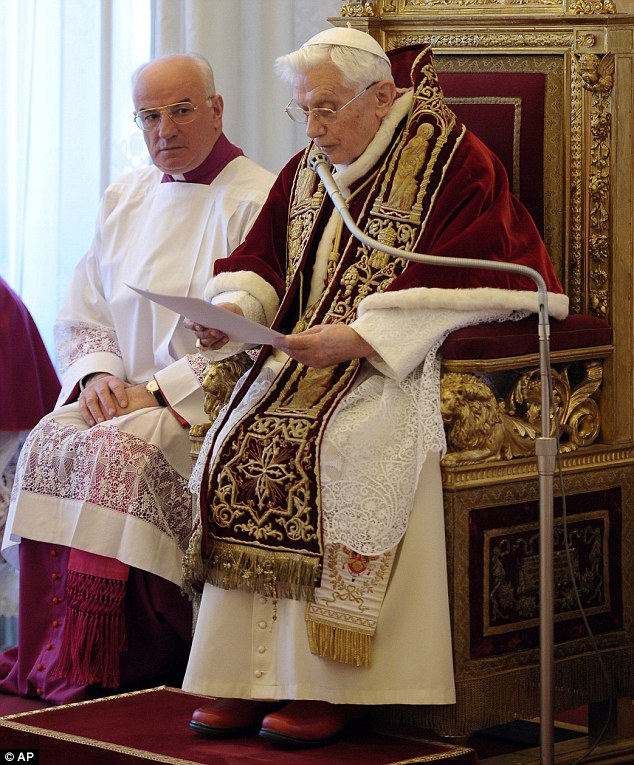
I dunno, I remember watching the video of him reading in perfectly intelligible Latin (the official language of the Church) in a consistory with cardinals that he was going to resign on a specific date and time.  I remember him then stopping being Pope, too.

And his peroration:

Beyond the language of the words, there is that of gestures.  What we see is that he chose to continue to remain “within the enclosure of Peter”, to dress in the white habit, to identify himself as “Pope Emeritus” and to continue to call himself Benedict XVI (he signs his name that way).

Moreover, he refused to change his coat-of-arms to that which he had as a cardinal, keeping still the keys of Peter.  The Vatican made it known that Benedict “prefers not to adopt a heraldic emblem expressing the new situation that was created with his resignation of the Petrine Ministry.”

We know that in the Church there is also a “voiceless/implicit magisterium” (magistero tacito).  Maybe this is the case.  And certainly Benedict is in agreement with Francis.  It’s a real mystery.

PS: I want to underscore, citing it, yesterday’s very beautiful and meaningful tweet from Pope Francis: “Today I invite you to pray for HIS HOLINESS BENEDICT XVI, a man of great courage and humility”.

Vatican intrigue!

Forced resignation!

Ghost writer Pope and secret Magisterium!

This is sooooo Italian.

A more interesting argument might have been the lawful right of cardinals to vote in the conclave if it could be demonstrated that they violated their oaths about the previous conclave and, thereby, incurred the traditional penalty.

I am not going to lose sleep over this…. except to write my novel, of course!   I need to travel to Rome to do research about the Roman restaurants in which the plot was worked out.   All I need to do is fill in the part about the super-secret Vatican Vampire Assassin Squad and the outline is nearly complete.


Posted in Benedict XVI, Francis, Lighter fare | Tagged , , ,
44 Comments

Ohio National Guard trains for 2nd Amendment terrorists

Ohio National Guard trains for 2nd Amendment terroristsFrom Media Trackers:

Ohio National Guard Training Envisions Right-Wing Terrorism

Documents from an Ohio National Guard (ONG) training drill conducted last January reveal the details of a mock disaster where Second Amendment supporters with “anti-government” opinions were portrayed as domestic terrorists. [Is this along the lines of the Obama Administration identifying Catholics as terror-threats, right?]

The ONG 52nd Civil Support Team training scenario involved a plot from local school district employees to use biological weapons in order to advance their beliefs about “protecting Gun Rights and Second Amendment rights.” [Sounds like a good idea for a novel, except make it liberals against the 2nd Amendment doing things like occupying city parks.]

Portsmouth Fire Chief Bill Raison told NBC 3 WSAZ-TV in Huntington, West Virginia that the drill accurately represented “the reality of the world we live in,” [?] adding that such training “helps us all be prepared.” [Because 2nd Amendment activists have threatened to use biological weapons?]

Internal ONG documents provided to Media Trackers after repeated delays provide further context to what WSAZ-TV reported last winter.

In the disaster-preparedness scenario, two Portsmouth Junior High School employees poisoned school lunches with mustard gas, acting on orders from white-nationalist leader William Pierce. [Yep, get all those liberal boogymen in their.  Are they also from the South?]

The ONG team discovered biological weapons being produced in the school, [In… chemistry class?] requiring activation of containment and decontamination procedures.

Participants in the disaster drill located documents expressing the school employees’ “anti-government” sentiments, as well as a note identifying Pierce as the fictional right-wing terrorists’ leader.

[NB] ONG’s 52nd Civil Support Unit participated in a similar drill involving left-wing terrorists with Athens County first responders last year; public officials apologized for that training the next day in response to complaints from local environmentalist groups.

No apology to Ohioans who support limited government and the Second Amendment appears to be forthcoming.

[…]

No apology? I’m shocked!  Shocked, I say!

This reminds me of Enemies Foreign and Domestic by Matthew Bracken.

Ohio National Guard trains for 2nd Amendment terrorists

This is a trilogy.  Yes, it is dystopian SHTF stuff.

Posted in Pò sì jiù, Religious Liberty, The Coming Storm, The Drill, The future and our choices, The Last Acceptable Prejudice | Tagged , , ,
27 Comments

ASK FATHER: Watching Mass on a monitor in a crying-room fulfills obligation?

ASK FATHER: Watching Mass on a monitor in a crying-room fulfills obligation?From a reader…

QUAERITUR:

Our Parish is “inviting” parents with children to fulfill their Sunday obligation by not coming in to the main Church, but going to the adoration chapel next door where a TV is set up with a live feed of the Mass next door. I’m not sure whether the EMCs come over there or the folks go next door at communion time, but does this really count?! If so, doesn’t it mean that if I lived next door to EWTN I could watch their Mass . . . what is the effectual “range” of Mass over live broadcast?

This is obviously sub-optimal.

At the same time, the physical act of “coming to” Mass and participating is there. You are “morally” present, at least.  It seems to me that you fulfill the obligation.

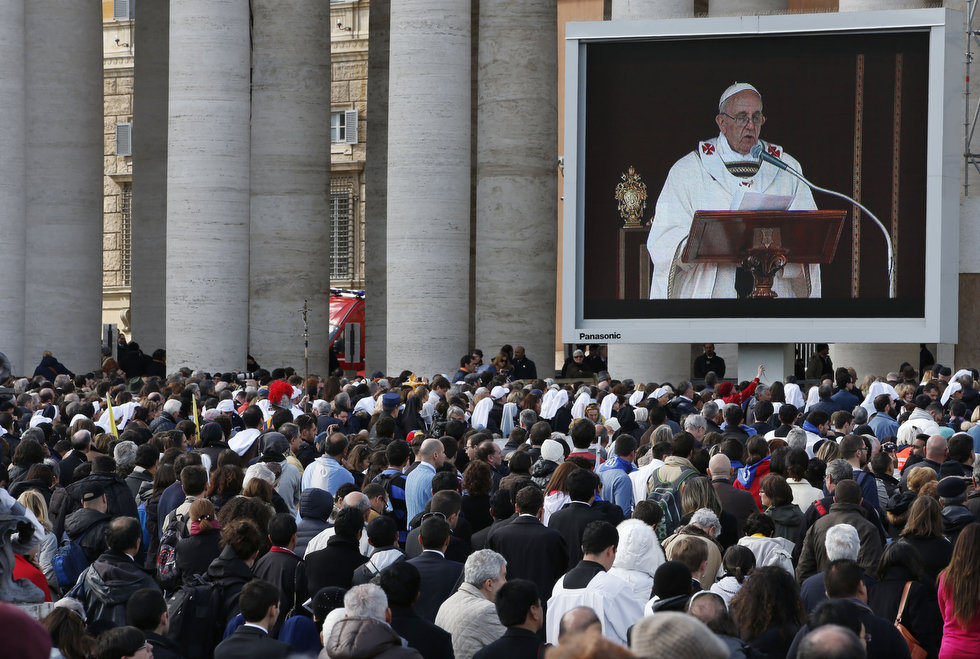
Look.  When you can attend a Mass in St. Peter’s Square to fulfill your obligation while you in no way “see” the sanctuary except by looking at the large projection jumbotrons in the piazza or the street… well…

A friendly call to the diocesan worship office might not be a bad plan.  Ask them what they think!

It is hard to argue that “watch on a screen next door” this is “full, actual, and conscious participation in the liturgy” desired by the Council.  But it fulfills the obligation.

Posted in "How To..." - Practical Notes, ASK FATHER Question Box, Liturgy Science Theatre 3000 | Tagged , , ,
23 Comments

Upcoming Synod, marriage confusion and ‘Casti connubii’

From a professorial reader concerned about the Church’s teaching on marriage, divorce, and the reception of Communion by the “remarried” come a helpful contribution.  He describes it (slightly edited):

I have to admit that I am concerned about the upcoming Synod, not because I think the Holy Spirit will allow the Church to teach error, but principally because [there is a great deal of] chattering, misunderstanding, and false opining as possible beforehand, creating a situation just like that which reigned before Humanae Vitae, when the “majority opinion” was in favor of contraception but the Pope disappointed everyone by re-affirming the traditional teaching.

If all of this hullaballoo is just a prelude to reaffirming the teaching, why bother to cause so much agitation, false hopes, and national schismatic behavior among Germans and Swiss, etc.?

Anyway, I believe it is time to spread, far and wide, authoritative statements of the Church’s unchanging teaching about the indissolubility of marriage. We may take it for granted, but it seems as if vast numbers of people have never even heard the teaching spelled out.

To that end, I gathered some especially clear and strong passages from Pius XI’s great encyclical Casti Connubii and hope that you might consider posting them in some fashion.

He put together a little document of helpful quotes, HERE.

A teaser:

34. And this inviolable stability, although not in the same perfect measure in every case, belongs to every true marriage, for the word of the Lord: “What God hath joined together let no man put asunder,” must of necessity include all true marriages without exception, since it was spoken of the marriage of our first parents, the prototype of every future marriage. Therefore although before Christ the sublimeness and the severity of the primeval law was so tempered that Moses permitted to the chosen people of God on account of the hardness of their hearts that a bill of divorce might be given in certain circumstances, nevertheless, Christ, by virtue of His supreme legislative power, revoked this concession of greater liberty and restored the primeval law in its integrity by those words which must never be forgotten, “What God hath joined together let no man put asunder.” Wherefore, Our predecessor Pius VI of happy memory, writing to the Bishop of Agria, most wisely said: “Hence it is clear that marriage even in the state of nature, and certainly long before it was raised to the dignity of a sacrament, was divinely instituted in such a way that it should carry with it a perpetual and indissoluble bond which cannot therefore be dissolved by any civil law. … And so, whatever marriage is said to be contracted, either it is so contracted that it is really a true marriage, in which case it carries with it that enduring bond which by divine right is inherent in every true marriage; or it is thought to be contracted without that perpetual bond, and in that case there is no marriage, but an illicit union opposed of its very nature to the divine law, which therefore cannot be entered into or maintained.”[1]

35. And if this stability seems to be open to exception, however rare the exception may be, as in the case of certain natural marriages between unbelievers, or amongst Christians in the case of those marriages which though valid have not been consummated, that exception does not depend on the will of men nor on that of any merely human power, but on divine law, of which the only guardian and interpreter is the Church of Christ. However, not even this power can ever affect for any cause whatsoever a Christian marriage which is valid and has been consummated, for as it is plain that here the marriage contract has its full completion, so, by the will of God, there is also the greatest firmness and indissolubility which may not be destroyed by any human authority.

Now that’s a Pope who knows how to Pope.  Crisp.  Clear.

Posted in "How To..." - Practical Notes, Hard-Identity Catholicism, HONORED GUESTS, New Evangelization, One Man & One Woman, Our Catholic Identity, The Drill | Tagged , , ,
26 Comments

My view for awhile

Back on the road after the great Legatus meeting and a few short days with my mother.

20140214-100008.jpg

Now I am heading North, but not immediately to the Steam Pipe Trunk Distribution Venue. No . I get to go to Detroit! Tomorrow I am to speak on sacred art at the Detroit Institute of Art for an event sponsored by the outstanding Call To Holiness initiative.

I still some work to do on the talk, mostly technical stuff, images and all that. Since I never use PowerPoint, I am behind the curve a little. We shall see.

UPDATE:

Waiting for “ground squirrels” to get us to our gate.

20140214-125206.jpg

Posted in Events, On the road, What Fr. Z is up to | Tagged , , ,
16 Comments

Canonist Ed Peters tears up anti-Catholic John Cornwell’s falsehoods about Pius X and confession

The Canonical Defender is back!  Canonist Ed Peters has taken it on himself to correct a few of the myriad – and I suggest purposeful – errors/lies in John Cornwell’s new anti-Catholic hit job.

Remember how Cornwell distorted the record about Pius XII in calling him “Hitler’s Pope”?

Peters has no combox over there, so I post here. But do go over and visit his blog and spike his stats in gratitude. It’ll take an instant to CLICK.  Mostly my emphases, some his, and my comments.

How wrong is John Cornwall’s attack on Pope St. Pius X? Let me count the ways.
by Dr. Edward Peters

Warning: It always takes longer, sometimes much longer, to correct mistakes than it takes to make them.

There used to be a job at newspapers called “fact-checker”, staff trained to identify assertions of fact (not of opinion, not of prognostication, but of fact) in draft articles and to check those assertions for their basic accuracy. Fact-checking was a service to readers who were spared false or mistaken claims, it was a service to the editors (whose reputations for reliability used to be more widely valued), and it was even a service to writers who learned not to assert more than they could reasonably prove.

Maybe the Daily Mail Online does not have fact-checkers, or maybe its fact-checkers were on break when John Cornwall’s screed against Pope St. Pius X and Confession was submitted for publication. Or maybe any news outlet that posts headlines like “How a pope called Pius turned the confessional box into a paradise for paedophiles” wouldn’t let quibbles from fact-checkers get in the way of a good old-fashioned Catholic bashing. [That’s more like it.] Still, I’d like to think there are yet some folks who care about facts, and it is for them that I write.

Central to Cornwall’s attack on the sacrament of Confession—celebrated in “a dark box like an upturned coffin, smelling of stale perfume and nasty body odours” (Cornwall actually wrote that, and the Mail Online actually published it) [Maybe it is Cornwall himself who needs to bathe?] —is his claim that: “It was the anxious and pessimistic Pius X, [and Benedict was Freddy Krueger to Francis’ Freddy Rogers] Pope from 1903-1914, who decreed in 1910 that children must make their first confession at the age of seven,” inaugurating, per Cornwall, a practice that reduced “child penitents [to] guinea-pigs in the greatest moral experiment ever perpetrated on children in the history of Catholicism.”

Deep breath time.

In passages such as these, we’re not faced with argument and we’re not dealing with reason; instead we confront invective and contempt. Such attacks are, I grant, better parried with spiritual replies than legal but, as Cornwall has chosen to wrap his claims in the thrice-invoked mantle of “investigation”, I may be allowed to reply based on my investigation. [Canonical Defender for President!]

1. Cornwall’s assertion that Pius X was pope from 1903-1914 is correct.

2. Cornwall’s characterization of Pius X as “anxious and pessimistic” is an opinion and he’s free to express it. [Perhaps Cornwell is a psychic.]

3. Cornwall’s assertion that Pius “decreed in 1910 that children must make their first confession at the age of seven” leaves me wondering, literally, what is Cornwall talking about?

Cornwall does not identify the papal decree allegedly ordering seven-year-olds to make confession—though he says the pope’s order came down in 1910, savoring, I suppose, of a specificity that implies that Cornwall actually read the papal document and noted its date. But considering the centrality of Pius’ alleged decree to Cornwall’s claim, I would think that his failure even to identity the document (let alone to quote from it) should have sent up warning flags in some editor’s office. Apparently Mail editors feel differently.

Oh well, on to my fact-checking.

Canon 989 of the 1983 Code requires Catholics above the age of discretion (generally reckoned about age seven) to confess grave sins (nb: not all sins, just grave ones, if any) at least once a year. That is plainly not the same thing as ordering all seven-year-olds to make confession, but Cornwall must have in mind older legislation.

The modern canon on confession can be traced back to the 1917 Code, Canon 906 of which required Catholics above the age of discretion to confess their sins. Now, those who know little beyond how to find canon numbers in a book might think this norm requires all Catholics above age seven to confess all sins. Those who actually know canonical jurisprudence, however, would find that canonists overwhelmingly interpreted Canon 906 to cover only grave sins (if any), and not all sins. Woywod I (1957) 512; Ayrinhac (1928) 267; Abbo-Hannan II (1952) 33-34; et c. Still, we’re almost back to 1910, so maybe Cornwall has in mind Pian legislation that pre-dated the 1917 Code.

What can I say? I have the Gasparri’s footnotes of the 1917 Code open before me, and I don’t see Pope Pius X listed as a source for Canon 906. Now, given that Gasparri was not shy about crediting Pius (the same pontiff who entrusted Gasparri with the codification project) for hundreds of contributions to canons (Gasparri’s Fontes IX: 83-85), it would be very strange for Gasparri to omit this papal contribution . . . had it actually happened. [If you can’t see the invisible duck swim, or hear it’s inaudible quack, maybe there isn’t a duck there at all.  I’m just sayin’.]

About this point one begins to wonder about another of Cornwall’s [stale and nasty] claims, namely, “that young children were not allowed to go to confession before [Pius X’s decree in] the 20th Century”. A glance at Gasparri’s footnotes suffices to destroy that claim.

The very first reference under Canon 906 takes one back to the Fourth Council of the Lateran in 1215. That holy council (c. 21) expressly required Catholics above the age of reason to confess grave sins once a year. The Council of Trent reiterated that requirement in 1551 (Sess. XIV, de poen., c. 8), and in 1910 a decree of the Congregation of Sacraments, Quam singulari, rebuked parents and priests who were preventing children above the age of reason from approaching the sacrament of Confession based solely on their age.

Nineteen-ten, you say? Could that be what Cornwall has in mind? Cornwall doesn’t identify the Pian decree, so readers are ultimately left guessing, but Quam singualri (which admittedly deals much more with Eucharist for children than it does with Confession) was approved by Pius X before it was published in 1910. Would that approval make it a Pian document?

No.

[NB] Roman dicasterial documents, which often boast ‘papal approval’, come in two types: those many approved by the pope “in forma communi” or those very few approved by him “in forma specifica”. Only if that latter sort of papal approval is expressly asserted in the document does the dicasterial document take on papal authority. Otherwise, the document “retains the juridical weight of the particular curial dicastery that has formulated the document and does not carry the added weight of a papal document or papal act.” Bretzke, Consecrated Phrases (1998) 62. I checked the original publication of Quam (AAS 10: 577-583) and papal approval was not given in forma specifica. In fact, Quam is printed in the AAS right alongside all the other dicasterial statements issued that year, not with the pontifical documents. [This, friends, is why Peters is so good.]

What then to make of Cornwall’s claim that Pius X, for the first time ever, ordered all seven-year-olds to confess their sins? [That he is talking out of his … hat?] Well, I find no such papal decree, certainly not directed at all sins (but only at grave sins, if any), and which even then would not, by centuries, have been the first time that Church authority directed Catholics age seven and older to confess their grave sins.

Except for those three things, Cornwall’s assertion about Pius X’s unprecedented order in 1910 to seven-olds to confess their sins stands up as well as any assertion wrong in so many respects stands up—if it’s made in a fact-free zone.

Ladies and gentlemen, I give you Ed Peters.

Kudos.

Finally, GO TO CONFESSION!

If you are Catholic and above the age of reason you are bound by law to confess your mortal sins once per year.  If you are smart, unless you are really holy, you will go more often than once per year.

Posted in Biased Media Coverage, Fr. Z KUDOS, GO TO CONFESSION, The Drill, The Last Acceptable Prejudice, You must be joking! | Tagged , , , , , ,
19 Comments

Latin… making a comeback?

Amusing.

From a reader:

Latin... making a comeback?


Posted in Lighter fare | Tagged
19 Comments