
Of Fr. Corapi and Casey Anthony

Of Fr. Corapi and Casey AnthonyMy maibox is filling with unrelated requests for my reaction to two things.  First, what about, I am asked, the additional news about Fr. John Corapi?  Second, did I watch the verdict in the trail of Casey Anthony?

I have paid as little attention as possible to both these stories.  Both stories, however, have things in common.  We can think about these stories in themselves and in respect to our reaction to them.

I am concerned that when it comes to human failures we can slide into ghoulish voyeurism.  The media purposely scratches that itch, which was left us as a result of Original Sin. Certainly the secular media has slavered over the later story.  I hope the Catholic media doesn’t slaver over the former.  Either way, we need to be careful.

Fr. Corapi’s case makes me very sad.  There: I’ve said it again.  I have paid as little attention to it as I can, though I couldn’t ignore this last wave of bad news.  I pray that eventually Corapi will get things sorted out.

Corapi has an immortal soul. He is need of a Savior just like the one writing this and you who are reading this.  And I would remind you that you, dear reader, are not sinless and neither am I.  Many people who admired Corapi will want to know what happens in his case, but I urge you to examine your consciences for your motives.  Those who didn’t like him, consider first your own state of soul and God’s mercy.  In any event, pray for him, who seems to be very troubled, and for all the people who have been harmed in the matter.

About the Anthony case, I don’t know enough of the facts to opine about it.   I found the media coverage loathsome.  Even I who avoided the coverage as if it were a really bad smell couldn’t fail to note the vast presumption of guilt before the verdict.  Now that she has been acquitted of the more serious charges, it will follow as the night the day that the same raving pundits will now rave about other aspects of the case, about themselves being right even though they were wrong, about who was right or wrong and how wrong or right they were and why and what is wrong with being right for the wrong reasons, who will get prosecuted next … blah blah blah slurp slurp.

I kept the TV off for most of the frenzy. When I did watch programs on news channels, used my DVR to scan through the hours of muck for the few tidbits of real news we were allowed without the ghoulish voyeurism.

I don’t find these stories entertaining.   I’ll admit that once in a while when watching a US Senate hearing on CSPAN about truly important issues I am tempted to make popcorn, but these other stories, Fr. Corapi and Casey Anthony and the mysterium iniquitatis they reveal, leave me feeling world weariness encroaching on my overarching sense of Christian joy.

Never were baseball, the Tour de France, or a black screen more welcome, a trend which has increased with each year that I pass in this vale of tears.

I’ll pray for Corapi and, if I am allowed, I’ll hope that the Anthony case fades from memory.
Posted in Biased Media Coverage, Wherein Fr. Z Rants | Tagged , ,
Comments Off on Of Fr. Corapi and Casey Anthony

Suffer the little ones to learn Gregorian chant and Latin

Liturgical liberals usually run down the intelligence of people in the pews, saying among other things that Joe and Mary Catholic will not be able to understand the new, corrected translation, or quod Deus avertat, LATIN.

“It’s toooo haaard!“, they whine.

B as in B.  S as in S.

Common sense and experience teaches quite the contrary.   This is especially the case with children, who take to hard language, heck, other and foreign languages, with a facility that we oldsters cannot rival.

When a willing teacher tell kids they can do something, and they usually can.

Thus I tip my biretta to my good friend the great Fabrizio, father of four children all of whom are learning Latin prayers like the good Catholic children they are, for this video he in turn picked up from The Curt Jester.

Listening to these children sing and then talk about what they are doing, might give you a sense of how we found a long term “new evangelization”.

[wp_youtube]ZDu90-eeulA[/wp_youtube]

Posted in "How To..." - Practical Notes, Brick by Brick, Just Too Cool, Lighter fare, New Evangelization, Our Catholic Identity, The future and our choices | Tagged , , , , ,
32 Comments

Cong. for Clergy issues a guide for confessors, with examination of conscience

The Congregation for Clergy issued a guide for confessors entitled The Priest, Minister of Divine Mercy – An Aid for Confessors and Spiritual Directors.

I have read through this once and will eventually comment on it more. I invite priests to read this and send me comments via email which perhaps can be collected into a larger entry here.

However, I want to bring to the attention of all priests and bishops that in an appendix there is an Examination of Conscience for priests with 20 points.

Here is one of them:

3. “Zeal for your house consumes me” (Jn 2:17).

Do I celebrate the Holy Sacrifi ce of the Mass according to the rites and rubrics established by the Church? Do I celebrate Holy Mass with a right intention and according to the approved liturgical books? Am I attentive to the sacred species conserved in the tabernacle and careful to renew it periodically? Do I pay due attention to the sacred vessels and ensure their conservation? Do I wear in a dignifi ed fashion all of the sacred vestments prescribed by the Church? Am I conscious that I act in persona Christi Capitis?

Posted in "How To..." - Practical Notes, Mail from priests | Tagged , , , , , ,
7 Comments

In SSPX news today…

First, we learn that SSPX Bp. Williamson, convicted in absentia in a German court for denying the WWII “Holocaust” (a crime in Germany), has appealed his conviction and fine of €10,000.

Next, we learn that the Holy See’s spokesman, Fr. Federico Lombardi, SJ, commented on recent SSPX priesthood ordinations, I assume both at Winona, MN, and Econe, Switzerland.  Lombardi said that the SSPX doesn’t have canonical status in the Church and that their ministers don’t legitimately exercise ministry in the Church.  The press release says that Fr. Lombardi was reaffirming Benedict XVI’s letter of 10 March 2009.

UPDATE: I heard this also on the broadcast of the English news on Vatican Radio.

Posted in SESSIUNCULA | Tagged , , , , ,
49 Comments

A priest defends true marriage against the promoters of contrary-to-nature unions

I picked up from the excellent blog The Sensible Bond, authored by a gent in England.  The video is about a priest in El Paso.   The blogosphere is amazing.

Fr. Michael Rodriguez spoke at a City Council Meeting about an ordinance extending health-care benefits to unmarried “partners” of city employees.  Then a City rep, a member of the Council, attacked the Catholic Church in response to Fr. Rodriguez statement.

[wp_youtube]CLAX8UZ9zoc[/wp_youtube]

And if you are wondering, here is a clip of Fr. R saying Mass.

[wp_youtube]kl4oXBeXGTs[/wp_youtube]

Posted in One Man & One Woman, Our Catholic Identity, The future and our choices, The Last Acceptable Prejudice | Tagged , ,
35 Comments

An observation about priests and Mass when they travel

The great P.P. of Brighton, Fr. Ray Blake, has an observation on his blog.  This probably will not surprise you too much.

I am delighted to offer hospitality to any priest. The strange thing is older priests visiting Brighton tend to sit in the congregation, middle aged priests want to concelebrate but younger priests are quite different, often they want to celebrate their own Mass, and not unusually in the Extraordinary Form, or at least in Latin. It is a generational thing, it is also an illustration of a change in the Church.

[…]

Yep.  That’s about right.

Posted in Mail from priests | Tagged ,
16 Comments

10 Points about prospective priests

I received some points of reflection from a priest friend who is a member of one of the oldest religious families.  I edited two of the points with his permission.

1. Prospective priests (Religious or Diocesan) are not looking primarily for community life, as we live it. They are looking for a Church-related mission that they believe in.
2. Prospective priests want to know what the Pope teaches, not what the U.N. teaches.
3. Prospective priests do not want to sit around with older “veterans” and listen to the latter whine about the Pope, Rome and the bishops.
4. Prospective priests are not in favor of women’s ordination. Period.
5. Prospective priests do not want to attend Masses that resemble hootenannies, Quaker meetings, or Presbyterian services.
6. Prospective priests are not ashamed of the Pro-life movement, they’re for it.
7. Prospective priests do not want to hear their brothers mock the Pope and gripe about liturgical norms.
8. Prospective priests do not want to study at theological unions/seminaries that are embarrassed by Catholic teaching.
9. Prospective priests know that Vatican II was not the only, or even the most important, Ecumenical Council.
10. Prospective priests are not embarrassed by Marian devotion, and are seen praying the Rosary.

Posted in "How To..." - Practical Notes, New Evangelization, Our Catholic Identity, The future and our choices | Tagged , , , , , , ,
50 Comments

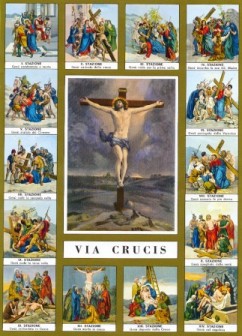
QUAERITUR: The arrangement of Stations of the Cross

QUAERITUR: The arrangement of Stations of the CrossFrom a reader:

I was wondering if the stations have to be in a certain direction in the church. I was in a church where they were just arranged on a single wall in rows one above the other in a sort of zig-zag. That’s doesn’t seem right to me.

In the recitation of the Stations there must movement from one station to another.  Station comes from Latin “statio… stopping place”.  In public recitation, it is not necessary for everyone in church to move.  Just the celebrant can move with the servers.   But if the crosses of the Stations are all grouped together, it is hard to imagine what sort of significant movement there can be.  Putting them all together seems like a bad idea to me – unless the space of the church or chapel or oratory is very small and not much area is available.  There could be some movement possible even if they are arranged very closely.

I don’t know if there more recent legislation about the Stations of the Cross, or Via Crucis as it is also called, but we can get some insight from an old (reprinted) liturgical manual by Trimeloni, which is an Italian version of Fortescue/O’Connell, for the Extraordinary Form.

Trimeloni has detailed descriptions of the contents and arrangement of a church, which includes, of course, Stations of the Cross.

Here is what I found:

1. For Latin Church Catholics to gain the indulgences, the Stations must be canonically “erected” by a Franciscan or someone who had an indult, such as all diocesan bishops.

2. The Stations themselves don’t have to have images, but they must have visible crosses of wood.

3. The order of the 14 images can start from either the Epistle side or the Gospel side, that is, the side of the church corresponding to the sides of the altar where the Epistle or the Gospel of Holy Mass are said or sung during Mass.  The direction of their order should correspond to the predominant direction of the artistic representation’s movement of the figures toward the right or left.  For example, if the figures move predominantly from right to left for most of the Stations (that won’t be the case with the Crucifixion, for example), the 1st Station would begin on the wall closest to the Gospel side of the altar, so that the figures are artistically/metaphorically moving away from the altar during the narrative of the Via Crucis.

4. During more solemn exercises of this devotion it is not necessary to light candles before the Stations, a processional Cross without a corpus is used, there can be a folded “shroud” hanging on the Cross, servers go on either side of the Cross with lighted candles, the priest does not wear a stole, since this doesn’t concern the Blessed Sacrament or a sacramental.

There are some places where Stations are done in the presence of the Blessed Sacrament exposed, which is somewhat avant-garde and controversial.  In that case, however, it seems reasonable that the priest would wear a stole.

A few other points.  The Stations were not always 14 in number, but they are now.  Adding a 15th Station is strange.  There are different ways to observe the Stations now, but the traditional 14 were once obligatory.  The Franciscans are deeply connected to this devotion from the time of pilgrimages in the Middle Ages to the Holy Land.  The devotion of the Stations, to correspond with the places of the Lord’s journey to the place of His Crucifixion, were for the benefit of people who couldn’t go to Jerusalem.  Franciscans still have custody of many pilgrimage places in the Holy Land.

The principle motivation for this devotion is for reparation for our part in the Passion and Crucifixion of the Lord and reparation for all the sins and offenses we commit which, in a sense, continue to crucify the Lord even now.

So, repeating my lack of awareness of some subsequent I don’t think there is a specific and obligatory arrangement or order, but the principles of common sense ought to apply.

I hope that helps a little.

Posted in "How To..." - Practical Notes, ASK FATHER Question Box, Liturgy Science Theatre 3000 | Tagged , , ,
14 Comments

Miracle claimed through intercession of Ven. Pius XII

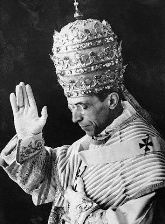
Miracle claimed through intercession of Ven. Pius XIIA tip of the biretta   o{]:¬)   to Sancte Pater for this link to an AP story on WaPo‘s site.

AP Exclusive: Woman claims miracle by WWII-era pope; backed by connected nun amid doubts
By Associated Press, Published: July 3

CASTELLAMMARE DI STABIA, Italy — Maria Esposito was ready to give up. Wasted away at 42 kilos (92 pounds), she couldn’t bear another dose of chemotherapy to fight the Stage IV Burkitt’s lymphoma that had invaded her body while she was pregnant with her second child.

But as she and her family had done since she was diagnosed with the rare and aggressive form of cancer in July 2005, Esposito prayed to the man who had appeared to her husband in a dream as the only person who could save her: Pope Pius XII.

Esposito survived, cured after a single, six-week cycle of chemotherapy — a recovery that, she says, stunned her doctors and convinced her that the World War II-era pope had intervened with God to save her.

[…]

The article is longish, but worth your time.

Of course the article goes in a couple predictable directions.  You can guess what they are before you even go to read it.

Posted in Pray For A Miracle | Tagged ,
10 Comments

Declaration concerning the consecration of bishops without papal mandate… in China

From VIS:

DECLARATION CONCERNING EPISCOPAL ORDINATIONS IN CHINA

VATICAN CITY, 4 JUL 2011 (VIS) – The Holy See Press Office today released the following English-language communique concerning the episcopal ordination of Fr. Paul Lei Shiyin, which took place on Wednesday 29 June and was conferred without the apostolic mandate.

“Fr. Lei Shiyin, ordained without the papal mandate and hence illegitimately, has no authority to govern the diocesan Catholic community, and the Holy See does not recognise him as the bishop of the diocese of Leshan. The effects of the sanction which he has incurred through violation of the norm of canon 1382 of the Code of Canon Law remain in place.

“Fr. Lei Shiyin had been informed, for some time, that he was unacceptable to the Holy See as an episcopal candidate for proven and very grave reasons.

“The consecrating bishops have exposed themselves to the grave canonical sanctions laid down by the law of the Church (in particular, canon 1382 of the Code of Canon Law; cf. Declaration of the Pontifical Council for Legislative Texts of 6 June 2011).

“An episcopal ordination without papal mandate is directly opposed to the spiritual role of the Supreme Pontiff and damages the unity of the Church. The Leshan ordination was a unilateral act which sows division and unfortunately produces rifts and tensions in the Catholic community in China. The survival and development of the Church can only take place in union with him to whom the Church herself is entrusted in the first place, and not without his consent as, however, occurred in Leshan. If it is desired that the Church in China be Catholic, the Church’s doctrine and discipline must be respected. [In China or anywhere else.]

“The Leshan episcopal ordination has deeply saddened the Holy Father, who wishes to send to the beloved faithful in China a word of encouragement and hope, inviting them to prayer and unity”.

Posted in The Drill | Tagged , ,
18 Comments