QUAERITUR: seminarians and earrings

VOTE FOR WDTPRSFrom a reader:

Do you think seminarians should be allowed to wear earrings? I know of two seminarians who are allowed to wear earrings or one earring in two different seminaries. Do these earrings mean something, as I have been led to believe.

NO.

I don’t think seminarians should be permitted any jewelry.  I don’t even think facial hair is a good idea.  I am rather old-fashioned in this regard.  I guess it’s what you are used to.  These things were once forbidden under the older Code for clerics of the Latin Church (except of course for some men in religious orders … and perhaps some members of the LCWR).

The 1983 Code of Canon no longer forbids them.  There is no legal proscription and seminarians (not clerics anyway unless they are deacons) are free to do as they please within the bounds laid down by the seminary and their bishops or superiors.

If I were their rector, however, I would probably frequently frown at those who wore them and would watch them with special attention.

I don’t know what earrings mean these day.  They may be more neutral.  I don’t know.  Still, they are a vanity and are meant to attract attention.

When I was in a US seminary in the late 80’s, the only guys who had or were interested in earrings were creepy effeminate heretics, now either out of the active priesthood or dead.

I remember one guy whose Archbishop told him explicitly to lose the earring.  He refused.  As a matter of fact, he didn’t even bother finishing his exams in his deacon year.  The Archbishop ordained him anyway.  He quit the priesthood within a couple years.  That seminary was hellish.  I am happy to report that it has been turned around like day from darkest night.

No.  No earrings. Nope.

Perhaps seminarians reading this can (after voting for WDTPRS) send me email or post here about the policies of their seminaries.  I am interested about the status quaestionis.

Posted in ASK FATHER Question Box | Tagged ,
58 Comments

WDTPRS – 6th Sunday of Ordinary Time: “being on the inside what we are on the outside”

VOTE FOR WDTPRSA swift look at the Collect for the 6th Sunday of Ordinary Time.

This is an ancient prayer, found already in the 8th c. Liber sacramentorum Gellonensis. I don’t think it was in the 1962 Missale Romanum or its Roman predecessors.

LATIN TEXT (2002MR):
Deus, qui te in rectis et sinceris manere pectoribus asseris,
da nobis tua gratia tales exsistere,
in quibus habitare digneris.

Pectus signifies a range of things from “the breast bone, chest”, “stomach” and therefore by extension concepts like “courage” and other “feelings, dispositions”.  It also refers to the “spirit, soul, mind, understanding.” In the ancient world, the heart was thought in some ways to be the seat also of the mind and understanding and not just of feelings and emotions. It is reasonable to translate this as “upright and pure hearts”. Exsisto according to the mighty Lewis & Short Dictionary is “to step out, emerge” and also “spring forth, proceed, arise, become.” It also means “to be visible or manifest in any manner, to exist, to be.”

SLAVISHLY LITERAL VERSION:
O God, who declare that You remain in upright and pure hearts,
grant us to manifest ourselves to be, by Your grace,
the sort of people
in whom You deign to dwell.

LAME-DUCK ICEL (1973 translation of the 1970MR):
God our Father,
you have promised to remain for ever
with those who do what is just and right.
Help us to live in your presence.

Quite simply dreadful.

CORRECTED ICEL TRANSLATION:
O God, who teach us that you abide
in hearts that are just and true,
grant that we may be so fashioned by your grace

as to become a dwelling pleasing to you
.

Better than the lame-duck ICEL.  It strays from the Latin at the end.  I think they did a back-flip here to avoid using the word “deign”.  Is that okay?  You decide.

In this Collect the distinction between “be” and “show forth” is tissue thin. We take from this the sense of being on the outside what we are inside, or rather in the case of the outwardly pious and practicing Christian, being sincerely and truly on the inside what we are showing on the outside.

At baptism the Holy Spirit enters our lives in the manner of one coming to dwell in a temple.

With the indwelling of the Holy Spirit comes “habitual” or sanctifying grace and all His gifts and fruits by which we live both inwardly and outwardly in conformity with His presence. We manifest His presence outwardly when He is present within. There is nothing we do to merit this gift of His presence and yet, mysteriously, we still have a role to play in His deigning to dwell in our souls. We can make choices about our lives. We can make use of the gifts and graces God gives, allow Him to make our hands strong enough to hold on to all He deigns to bequeath, and then cooperate in His bringing all good things to completion.

That phrase in today’s prayer, in brutally literal fashion “the sort of people in whom you have deigned to abide” (altered in the new, corrected version) forces us to reflect on our treatment of and conduct towards our neighbor, whom Christ commands us to love in accord with our love of God and self.

Paul writes in 2 Cor 13:11-13:

“Finally, brethren, farewell. Mend your ways, heed my appeal, agree with one another, live in peace, and the God of love and peace will be with you. Greet one another with a holy kiss. All the saints greet you. The grace of the Lord Jesus Christ and the love of God and the fellowship of the Holy Spirit be with you all.”

Posted in WDTPRS |
5 Comments

Philadelphia

PhiladelphiaIt’s time for more purification.

Are you ready, Philadelphia?

It is time for us all to get tough and bear this Cross in the face of the mysterium iniquitatis.

Get down on our knees and pray and do penance.

The MSM is sure to keep pouring it on so that this is white hot around the time John Paul II will be beatified by Benedict XVI.

Pray for the Church in the USA and, especially, in Philadelphia.

My heart goes out to the faithful priests and lay people there.

Posted in Biased Media Coverage, Clerical Sexual Abuse, Our Catholic Identity, The future and our choices, The Last Acceptable Prejudice | Tagged
111 Comments

Rosary for the Bishop Project

My friend Fr. John Boyle has a good project going: Rosary for the Bishop.  I would like a make it my own in solidarity.

Rosary for the Bishop Project

Fr. Boyle says:

Choose your own bishop to pray for. I have selected my diocesan Archbishop and the Bishop of the diocese in which I am currently working.
This is a great suggestion.
For years now after Mass I have said a Memorare for a list of bishops with whom I have had some personal contact.  It is good to pray for bishop.  The devil hates them and dissident forces in the Church are trying to undermine their teaching authority.  You know who I mean.

UPDATE:

I understand this project began in Madison, WI some 5 years ago!  I am delighted.  Hopefully the great Bp. Morlino benefits from it as well.

Rosary for the Bishop.

Rosary for the Bishop Project
Posted in SESSIUNCULA | Tagged
16 Comments

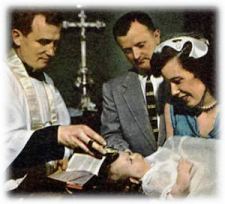
QUAERITUR: Can a traditional rite of baptism be in English?

baptismFrom a priest reader:

Please excuse my sending this request to you, but I have not been able to find an answer to my questions.

A couple have asked me to baptize their soon-to-be-born child, using the EF of Baptism.  I am happy to do so.  To wit, my questions;

1. May the rite be performed in English?
2. Do you know where booklets for the congregation may be purchased?

Yes, much of the older, traditional form of the Latin Church’s rite of baptism can be done in English, which is useful and disarming for some people in attendance.  However, when permission was given way back when for some vernacular languages to be used for baptism, certain parts had to be in Latin.  For example, the exorcisms and blessings of salt and water must be in Latin, the exorcism of the one to be baptized, the form of the sacrament, the anointing must be in Latin.

Books such as the Collectio Rituum have this laid out very clearly so that you know which parts can be English and which must be Latin, and also provide the English even of the part that must be in Latin.

There are booklets for the participants in the rite published by Angelus Press.

I think you will be edified by the older, traditional form of baptism which is richer in its symbols.  Thanks to the provisions of Summorum Pontificum 9  § 1 priests can also use the older Rituale Romanum for this foundational sacrament.  All priests should be familiar with the older book.  It is packed with useful things!

Posted in "How To..." - Practical Notes, ASK FATHER Question Box, SUMMORUM PONTIFICUM | Tagged , ,
20 Comments

RECENT POSTS OF INTEREST

Here are some recent posts of interest, ne pereant. Lot’s of questions in the last few days!

(“Quaeritur” is Latin for “It is asked”, a classic way of introducing questions of the philosophical/theological kind.  The Latin way of thinking likes impersonal questions.)

I draw your attention to two WDTPRS POLLS, one about women covering their heads in church (4000+ votes so far) and about the Sign of Peace during the Ordinary Form of Holy Mass (4400+ votes).

And don’t forget:

Posted in SESSIUNCULA |
Comments Off on RECENT POSTS OF INTEREST

QUAERITUR: Why is the Protestant “For the kingdom, the power, the glory…” in our Catholic Mass?

A reader asked:

One of the things I like about the TLM [Traditional Latin Mass] is that we don’t have to pray like the Protestants Our Father.  Isn’t the fact that Bugnini and crowd put “For the kingdom, the power, and the glory are yours now and forever” in our Catholic Mass a proof that they wanted to water down the Catholic Mass and make it more acceptable to Protestants?

Funny you should ask that.  I have written a weekly column for The Wanderer (for about 11 years now) focusing mainly on liturgical translation.  As a matter of fact that column gave rise to and the name to this blog.  I just dealt with this issue in a recent column (which I assume you haven’t read or you would already have your answer).

In the WDTPRS print series, we are in the section of Mass called the Ritus communionis, the preparation for and reception of Holy Communion.  Here is something of what I wrote for the recent column about the doxology that follows the “embolism” after the Lord’s Prayer.

“For the kingdom, the power and the glory are yours now and for ever.”

The translation of this will remain unchanged in the new, corrected ICEL version.

That said, where does little doxology come from?  A doxology, you will recall, is a short exclamation of praise.  It was not part of the Roman Rite before the Second Vatican Council.  It was inserted by the cutters and pasters of the Consilium.  So, the questioner is right about this: it was inserted by “Bugnini and crowd”.

Keep in mind that the Fathers of the Second Vatican Council stated that whatever changes were made in the liturgical reform they mandated, nothing should be done unless it was truly for the good of the people and there must be no innovations unless they are organic developments from previous tradition (cf. SC 23).  The insertion of this little doxology was an innovation.  Was it of great benefit to the people of the Latin Church?  I don’t know.  People weren’t clamoring for it.  Moreover, it was not an organic development from the previous tradition.

Being a convert from Lutheranism, every time I hear it… every time… it reminds me of how Protestants pray the Lord’s Prayer and how Catholics don’t.   I still find it jarring after all these years.  I can’t help it.  Until I dug into it, it didn’t seem ‘Catholic’ to me.

VOTE FOR WDTPRSStill, Holy Church includes it in the Ordinary Form of Mass and that is just the way it is.  We must respect that.  As faithful Catholics we “say the black” and “do the red” no matter the Rite of Mass.

But… this little doxology does have a history.  If we dig far enough back into history we find how Catholic it is … and then isn’t … before it is, again.

The little doxology is not found with the Our Father in the oldest manuscripts of Matthew.  It is not considered by scholars to be part of the original text of the Our Father/Lord’s Prayer in Matthew 6:9–13.

However, early non-Scriptural sources such as the Didache (late 1st c. – early 2nd c.) have an abbreviated version of the doxology after the Our Father.  There was a liturgical use of this doxology after the Lord’s Prayer.  An expanded version is found in the Apostolic Constitutions (c. 375-380).  Later Greek manuscripts of Matthew, as well as Syrian and Coptic manuscripts, do include a version of this doxology after the Lord’s Prayer.  It is thought that, at some point, a copyist picked it up from a margin note and included it in the text of Matthew itself. That is how down through history it shows up in some manuscripts and not others, and therefore some Bibles and liturgical rites, and not others.

So strong was the connection between the Lord’s Prayer and the doxology that eventually it was thought that the doxology was part of the Lord’s Prayer itself.

The inclusion of this little doxology in the Latin edition of the 1969/70 Missale Romanum after the Council concerns far more than just the English-speaking world.  But, for the sake of this column/blog entry and you readers I will confine myself mainly to how we got the English version of the Our Father we have.

Protestant Bibles, such as the King James Version, have this doxology because translators worked from manuscripts which contained the ancient Catholic liturgical interpolation.  King Henry VIII, before he shattered Catholic communion in England and broke with Rome, imposed a single version of the Our Father in English on his subjects based on Tyndale’s 1525 translation of the Bible.  It did not have the doxology.  In 1541, after his break with Rome, Henry again imposed English versions of major prayers.  Again, Henry’s version did not have the doxology at the end of the Lord’s Prayer.  That English version has remained more or less the way we all pray the Our Father in English even to our day.

The more precious the prayer, the more conservative we tend to be!

In the first Book of Common Prayer of 1549 during the tumultuous time of King Edward VI the doxology does not appear.  However, in a subsequent edition during the reign of Elizabeth I, it does appear.  It was their desire at that time to distinguish their Protestant manner of praying the Our Father from the Catholic way.  The interpolation of the doxology was an anti-Catholic, or rather non-Catholic gesture.

Adding the doxology to the Our Father became the English Protestant way of praying.

Catholics didn’t use the ancient Catholic prayer and Protestants did, in order to be Protestant, which is a ironic.

Therefore, this little prayer of praise arose from our most ancient Christian forebears in their liturgical worship.  The Catholic Church, however, stuck to the older Scripture tradition in her liturgical worship.  On the other hand, the Eastern Churches have the little doxology as part of their liturgical prayer.  This is entirely legitimate, of course, and quite ancient.

As I said, above, the inclusion of the doxology concerns more than merely the English speaking world.  There is a non-English history as well. It also concerns more than the Catholic Church’s way of praying.

All in all, traditional Catholics are justified in their hesitation about the inclusion of this doxology in Holy Mass.  It was not part of the Catholic liturgical tradition except in the very earliest times.  To be fair, in the Novus Ordo of Mass, the Ordinary Form, the doxology is separated from the Lord’s Prayer by the embolism.  Still, it is closely related in the Mass to the Our Father, for the embolism itself expands the Our Father’s final petition.

The inclusion of this doxology was an innovation that did not come organically from our Catholic liturgical tradition.  It seems to have been interpolated for ecumenical reasons: it harks to how Protestants and Orthodox pray.  I  don’t think it was just a gesture to Protestants.  The Orthodox too, and therefore Eastern Catholics, worked from different sources that included the doxology.

QUAERITUR: Why is the Protestant "For the kingdom, the power, the glory..." in our Catholic Mass?Were Catholics in the pews clamoring to say during Mass what rang in their ears as Protestant?  Of course they didn’t know that this was a very ancient Catholic prayer.  Its inclusion in the Catholic Mass is also an example of the liturgical archeology or antiquarianism Ven. Pius XII warned against in Mediator Dei.  To go that far back and revive an element of ancient worship and then artificially insert it into an order of Mass virtually unchanged for 1500 years is an example of liturgical archeology rather than organic development.  This was one of those impositions which, as Joseph Ratzinger pointed out in his preface to Klaus Gamber’s The Reform of the Roman Liturgy: its problems and background, gives traditional Catholics the impression that the post-Conciliar form of Mass constitutes a real rupture in our tradition of worship, that it is “a fabrication, a banal on -the-spot product.”

That said, the little doxology after the Our Father is not banal.  It is indeed venerable!  I include Ratzinger’s quote to underscore how some elements of the Ordinary Form of Mass constitute a rupture with our tradition.  The elements themselves, however, may be of great antiquity and quite Catholic in their origin.

Perhaps knowing more about this little doxology will make it less jarring for those who are sensitive to its inclusion in the newer form of Holy Mass.


Posted in ASK FATHER Question Box, Our Catholic Identity, WDTPRS | Tagged , ,
53 Comments

UPDATE REVIEW: iPhone app to help you make a good confession updated

I have reviewed the new iPhone app tool to help you examine your conscience and then make a good sacramental to a priest (the only way to get absolution, of course).

I pointed out that there were flaws in the app.   One of the flaws was that there was no explicit statement reminding people that using this app did not substitute for going to confession to a priest.   Perhaps that on the surface seems too obvious to include in the app, but, based on news reports we saw in the last few days, it winds up being a good idea to include it.

The developers have updated the app with a statement toward the bottom of this screen.

UPDATE REVIEW: iPhone app to help you make a good confession updated

They still lack a note about the need to be sure about the penance you are given.

After the screen which shows the list sins you created (in kind, but not in number – the app’s main flaw), there should be a screen that says that the priest may ask questions and/or give advice, and then assign a penance which you should be careful to remember.  Then it could move to the screen with your default Act of Contrition.

Again, they need to at least add a note that you should confess your mortal sins in both kind and number.

UPDATE 11 Feb GMT:

I found that you can beginning a phone call, and use the app at the same time. Perhaps there could be a way for the app to be used only when the iPhone is in Airplane Mode.

Also, I found you can use an app such as Audio Notes, to make recordings, and then use the confession app at the same time.

Posted in "How To..." - Practical Notes, REVIEWS | Tagged , ,
17 Comments

Pray for Egypt and the safety of Egyptian Christians

It looks like Pres. Mubarak is not stepping down.  I suspect some of the crowds may go bananas.  Pray for Egypt and especially the safety of fellow Christians in this time of uncertainty.

Posted in SESSIUNCULA | Tagged
17 Comments

QUAERITUR: Is it a sin not to pray every day?

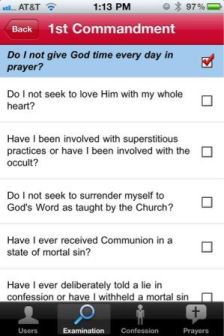
iphone app confessionRegarding the new iPhone app to help make a good confession (which I thoroughly reviewed here) a reader asks:

I read a couple bloggers didn’t like that the app includes that it is a sin not to pray everyday.  They even seem to make fun of that and excuse themselves.  What do you think?  Is it a sin to not pray everyday?

Yes.  It is a sin not to pray every day.

We are entirely dependent upon God for our very existence.  Without God we … aren’t.

We are also made in God’s image and likeness, with an intellect and will, the capacity to love.  We are in our very being oriented to God.

When you love someone, you want to be with that person, speak to and listen to that person.  Even if you are speechless, you long for the other’s presence.   We can be separated from any created thing, and people are created things.  There are times we cannot listen to, speak to, be with other people.  But we cannot be separated from God.  If we love God we seek God’s presence (hopefully eternal in heaven), we listen to God, we speak to God.  We pray.

Not praying daily indicates a lukewarm view of God in your life.

If we were perfect, our every action and thought would be a prayer, much as how I imagine the glorious minds of the angels.  But we aren’t angels.

We little humans need some discipline and help.  Holy Church helps us pray more perfectly and according to God’s will during our liturgical worship.  There are also a large number of prayers we can pray as good works for the benefit of others.  When you pray for the souls in purgatory, for example, you are demonstrating love for God and neighbor, for the dead are still our neighbors: souls in purgatory are still our brothers and sisters in the Church.  We show love and gratitude to God when we ask the saints for their intercession.  They pray for us before God in heaven.  Heaven itself is a glorious liturgy and prayer before God.  We foreshadow our heavenly reward when we pray now in this earthly life.

The virtue of religion, which we must all strive to cultivate at the risk of our immortal souls, binds us to give God what is His due: worship.  Since this is a virtue, it is habitual.  We do this willingly and easily.  It is a regular dimension of who we are.  The main acts of the virtue of religion are adoration, prayer and sacrifice.  The main sins against the virtue of religion are blasphemy, tempting God, sacrilege, perjury, simony, idolatry, superstition and, of course, neglect of prayer.

When we are made for God, in His image, how can it be hard for humans to pray?  It is the most natural thing, or would be if it weren’t for the wounds caused by original sin and by the interference of the enemy of our souls.  Somethings that should be easy can be hard, unless we have developed the habit.   The more you pray, the easier it gets to pray.  That doesn’t mean that prayer is fun, by the way.  Prayer can be very rough business, because prayer involves honesty and also listening.  Listening isn’t easy for modern man.  We have many distractions.

But those distractions might be in the place God should occupy.  Praying helps sort that out.

Praying helps you avoid hell too, which is a pretty good reason to do it.

Having prayers memorized helps.  Praying at regular times helps.  Pray regular prayers when you rise in the morning, go to bed at night, and take meals.  Put God at the beginning and ending of your day’s activities and you will more easily keep Him in mind in all your activities.  Food and drink are very important gifts from God among the many things He gives us.  Thank Him in prayer before and after meals.

Is that a simple way to pray everyday?  Rising and going to bed?  Before and after meals?   Is that so hard?

If you can’t or don’t do that – and you know that you ought to – yes, you are committing a sin against the 1st Commandment.  God is not in the first place in your life if you don’t pray in someway.

One of the shortest, high impact verses in the Bible is “Pray constantly.” (1 Thess 5:17).

If there is a choice between those who think neglect of daily prayer isn’t a sin, and St. Paul, I’ll stick with St. Paul.

The gravity of the sin of not praying daily will depend on the usual factors.  Nevertheless, don’t try to excuse yourself or claim that not praying everyday is somehow okay.

What does it take to say, “My Jesus, mercy!”?

There.  I prayed.  Didn’t take long.

“Thy will be done!” Yep.  Did it again.

Say that and mean it and you are praying too.  Say it everyday, you are praying everyday.  You could surely do more than that.  How about the Lord’s Prayer… isn’t there mention of something “daily” in that one?  Doesn’t take very long and I bet you know it already.

Not praying puts your soul in danger, which is a sin.  C’mon. It’s just right to pray.

Pray.

I bet readers can post fantastic quotes from the saints about the need to pray each day… that is daily.

Posted in ASK FATHER Question Box | Tagged , , , , ,
47 Comments