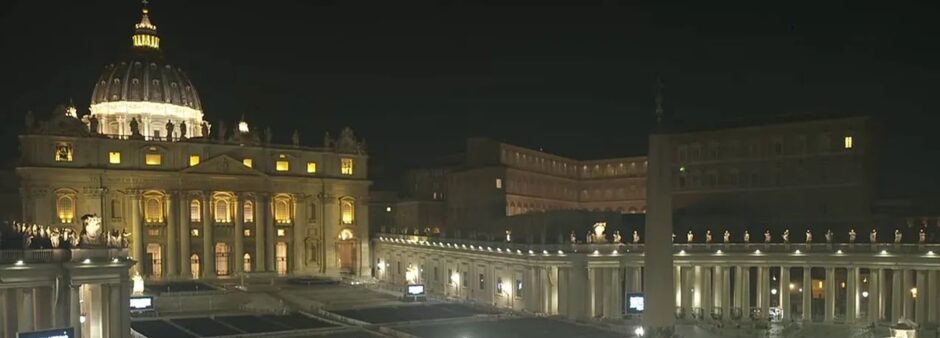
Here is the Collect for Wednesday of the 3rd Week of Advent.
COLLECT:
Praesta, quaesumus, omnipotens Deus,
ut Filii tui ventura sollemnitas
et praesentis nobis vitae remedia largiatur,
et praemia aeterna concedat.
This prayer was in Rotulus 6 published with the Veronese Sacramentary. It was in the Gelasian Sacramentary.
It is interesting that this is more or less the Collect that is in the 1962MR, though changed. I add some emphasis.
Praesta, quaesumus, omnipotens Deus: ut redemptionis nostrae ventura solemnitas, et praesentis nobis vitae subsidia conferat, et aeternae beatitudinis praemia largiatur.
Here is what it looked like in the Gelasian:
Praesta, quaesumus, omnipotens deus, ut filii tui uentura solem[p]nitas et praesentis nobis uitae remedia conferat et praemia aeterna concedat.
There is a parallelism between remedia and praemia. Subsidia and remedia closely related.
LITERAL VERSION:
Almighty God, grant, we beseech You,
that the upcoming solemn feast of Your Son,
both may lavish upon us remedies for this present life,
and also concede to us eternal rewards.
CORRECTED ICEL VERSION:
Grant, we pray, almighty God,
that the coming solemnity of your Son
may bestow healing upon us in this present life
and bring us the rewards of life eternal.
LAME-DUCK ICEL:
Father,
may the coming celebration of the birth of your Son
bring us your saving help
and prepare us for eternal life.
You decide.
What comes to my mind is the prayer that the priest says silently as he purifies the sacred vessels in both the older and the new form of Holy Mass: “Quod ore sumpsimus Domine, pura mente capiamus: et de munere temporali fiat nobis remedium sempiternum. … Into a pure heart, O Lord, may we receive the heavenly food which has passed our lips; bestowed upon us in time, may it be the healing of our souls for eternity.”
The Collect is already directed to the moment of Communion.

 I just put together an article for The Wanderer, my usual weekly column which was the origin of this blog.
 Augustine recounts an episode about his mother, St. Monnica, when she was with him in Milan. Monnica carried on with her North African custom of refrigeria (called laetitia in Confessions 6.2.2) which raised many Milanese eyebrows, including those of bishop Ambrose. Augustine says that Ambrose instructed Monnica not to do this in Milan, it was not their local custom. Ambrose said that when he was in Rome, he followed the Roman laws concerning fasting, which were different from those of Milan: “When I am here I do not fast on Saturday, but when I am at Rome I do; whatever Church you may come to, conform to its custom” (cf. Augustine ep 36.14.32 and ep 54.2.3).
 Basil L. Plumley was born January 1, 1920 in Shady Spring, West Virginia, the second son and fifth child of coal miner Clay Plumley (b.1879) and his wife Georgia (b.abt.1895), both of West Virginian stock. He is most famous for his actions as a Sergeant-Major of the US Army’s 1st Battalion, 7th Cavalry Regiment, at the Battle of Ia Drang (1965). General Hal Moore praised Plumley as an outstanding NCO and leader in the book
  Combat Infantryman Badge with two silver stars (three awards)
 Master Combat Parachutist Badge with gold star (indicating 5 combat jumps)
 Vietnam Parachutist Badge


 (Garry Owen shoulder insignias)
 7th Cavalry Regiment

 Gregg the Obscure on ASK FATHER: “Ghost” or “Spirit”, which is it? Wherein Fr. Z Rants.: “one of the most lovely churches in my hometown is Holy Ghost. shortly after i came into the Church i…”






























