QUAERITUR: removal of 2nd Confiteor harmful to the faithful?

From a reader:

I am a lay Catholic and over the month past month I have felt truly
home since going to the Mass of the Ages.

Please forgive my ignorance but the missal of blessed John XXIII has
omitted the prayers at the foot of the altar at certain occasions and
the 2nd confiteor before reception of the Eucharist of the faithful.
Are these changes though indiscernible harmful to the faith or
necessary and part of the organic growth of the Mass?

The 1962 Missale Romanum (the Missal of John XXIII) did not omit the prayers at the foot of the altar, except in the normal circumstances (e.g., Good Friday).  And there is a curtailed form in the Requiem Mass.

However, the 1962MR does not have the 2nd Confiteor before Holy Communion.  In many places, I would guess most places, it is done anyway regardless.

I don’t think it is harmful to the faithful to omit the 2nd Confiteor.   It is not harmful to the faithful to be without the prayers at the foot of the altar.

At the same time, consider that these two elements of the older, traditional form of Mass were omitted in the Novus Ordo even though the Second Vatican Council’s document on liturgy Sacrosanctum Concilium said that no changes should be made unless it should be for the true good of the faithful.

I cannot quite make out how the faithful benefit from the removal of those things.  They might not necessarily be harmed, but… how do they benefit?

Posted in ASK FATHER Question Box | Tagged
53 Comments

Pope Benedict speaks to Italian bishops about liturgy

The Holy Father sent a message to the Italian bishops through the intermediary of the President of the Italian Bishops Conference (CEI) in anticipation of a plenary meeting they will perpetrate in Assisi.

He begins the meat of his address by quoting Il Poeta, which was very satisfying.   My emphases and comments, translation by Zenit.

[…]

1. You have met these days in Assisi, the city in which “a sun was born to the world” (Dante, “Paradiso,” Canto XI), and who was proclaimed by the Venerable Pius XII as patron of Italy: St. Francis, who keeps intact his freshness and timeliness — the saints never have a sunset! — due to his having been conformed totally to Christ, of which he was a living icon.

As our own, the time in which St. Francis lived was also marked by profound cultural transformations, fostered by the birth of universities, by the growth of municipalities and by the spread of new religious experiences. [Benedict is painting that era in terms that should be familiar to us in ours.]

Precisely in that time, thanks to the work of Pope Innocent III — the one from whom the Poverello of Assisi obtained the first canonical recognition — the Church undertook a profound liturgical reformation. Eminent expression of this is the Fourth Lateran Council (1215), which counts among its fruits the “Breviary.” This book of prayer includes in itself the richness of theological reflection and of the praying experience of the previous millennium. Adopting it, St. Francis and his friars made their own the liturgical prayer of the Supreme Pontiff: In this way, the saint listened to and meditated assiduously on the Word of God, to make it his own and then transmit it in the prayers of which he was author, as in general in all his writings. [The Holy Father has been sending clear signals for us all to follow.  We too should make the Supreme Pontiff’s liturgical objectives our own.]

The Fourth Lateran Council itself, considering with particular attention the sacrament of the altar, inserted in the profession of faith the term “transubstantiation,” to affirm the presence of the real Christ in the Eucharistic sacrifice: “His Body and Blood are truly contained in the Sacrament of the altar, under the species of bread and wine, as the bread is transubstantiated into the Body and the wine into the Blood by the divine power” (DS, 802).

From attendance at Mass and reception with devotion of Holy Communion springs the evangelical life of St, Francis and his vocation to follow the way of the Crucified Christ: “The Lord — we read in the Testament of 1226 — gave me so much faith in the churches, which prayed simply thus and said: We adore you, Lord Jesus, in all the churches that are in the whole world and we bless you, because with your Holy Cross you have redeemed the world” (Franciscan Sources, No. 111). [Does that remind you of something?]

Found also in this experience is the great deference that he had toward priests and the instruction to the friars to respect them always and in every case, “because of the Most High Son of God I do not see anything else physically in this world, but his Most Holy Body and Blood which they alone consecrate and they alone administer to others” (Franciscan Sources, No. 113).  [Pope Benedict is deeply concerned for priests.  He gave us a Year for Priests.  He gave us Summorum Pontificum, which was clearly a gift for priests.  Perhaps he is suggesting to the bishops that they should value priests as well?]

Given this gift, dear brothers, what responsibility of life issues for each one of us! “Take care of your dignity, brother priests,” recommended Francis, “and be holy because He is holy” (Letter to the General Chapter and to all the friars, in Franciscan Sources, No. 220).  [NB:] Yes, the holiness of the Eucharist exacts that this mystery be celebrated and adored conscious of its greatness, importance and efficacy for Christian life, but it also calls for purity, coherence and holiness of life from each one of us, to be living witnesses of the unique Sacrifice of love of Christ[Note the connection of celebration of the “mystery” (mysterium = sacramentum) and identity.]

The saint of Assisi never ceased to contemplate how “the Lord of the universe, God and Son of God, humbled himself to the point of hiding himself, for our salvation, in the meager appearance of bread” (ibid., No. 221), and with vehemence he requested his friars: “I beg you, more than if I did so for myself, that when it is appropriate and you regard it as necessary, that you humbly implore priests to venerate above all the Most holy Body and Blood of Our Lord Jesus Christ and the holy names and words written of Him that consecrate the Body” (Letter to all the Custodians, in Franciscan Sources, No. 241).

2. The genuine believer, in every age, experiences in the liturgy the presence, the primacy and the work of God[Am I not forever harping about an “encounter with mystery”?] It is “veritatis splendor” (“Sacramentum Caritatis,” No. 35), nuptial event, foretaste of the new and definitive city and participation in it; it is link of creation and of redemption, open heaven above the earth of men, passage from the world to God; it is Easter, in the Cross and in the Resurrection of Jesus Christ; it is the soul of Christian life, called to follow, to reconciliation that moves to fraternal charity.

[We come to a concrete issue.  Note that when the Holy Father speaks to one group of bishops, he also speaks to others.  Surely what follows will also be important for the Anglophone world.] Dear brothers in the episcopate, your meeting puts at the center of the works of the Assembly the examination of the Italian translation of the third typical edition of the Roman Missal. The correspondence of the prayer of the Church (lex orandi) with the rule of the faith (lex credendi) molds the thought and the feelings of the Christian community, giving shape to the Church, Body of Christ and Temple of the Spirit. No human word can do without time, even when, as in the case of the liturgy, it constitutes a window that open beyond time. Hence, to give voice to a perennially valid reality calls for the wise balance of continuity and novelty, of tradition and actualization. [“actualization” here has to do with making things current, contemporary, apt for today’s exigencies.]

The missal itself is placed within this process. Every true reformer, in fact, is obedient to faith: He does not move arbitrarily, nor does he arrogate to himself any discretion about the rite; he is not the owner but the guardian of the treasure instituted by the Lord and entrusted to us. The whole Church is present in every liturgy: To adhere to its form is the condition of the authenticity of what is celebrated[This is another way of saying “Say The Black – Do The Red”.]

3. May this reason drive you, in the changing conditions of the time, to make ever more transparent and practicable that same faith that dates back to the age of the nascent Church.  [continuity] It is a very urgent task in a culture that — as you yourselves say — knows the “eclipse of the sense of God and the obfuscation of the dimension of interiority, the uncertain formation of personal identity in a plural and fragmented context, the difficulties of dialogue between generations, the separation between intelligence and affectivity” (“Educare alla vita buona del Vangelo,” No. 9). These elements are the sign of a crisis of confidence in life, and influence in a considerable way the educational process, in which sure references become fleeting.

Contemporary man has invested much energy in the development of science and technology, attaining in these fields objectives that are undoubtedly significant and appreciable. This progress, however, has often taken place at the expense of the foundations of Christianity, in which is rooted the fecund history of the European Continent: the moral sphere has been confined to the subjective realm and God, when he is not denied, is nevertheless excluded from the public conscience. And yet, a person grows in the measure in which he experiences the good and learns to distinguish it from evil, beyond the calculation which considers only the consequences of an individual action or that uses as criterion of evaluation the possibility of carrying it out.

To change the direction a generic call to values is not sufficient, [I love that phrase: “a generic call to values is not sufficient”.  I have blasted away at this a few times.  It is very gratifying that the Pope states this so well.] or an educational proposal that is content with purely functional and fragmentary interventions. Necessary instead is a personal relationship of fidelity between active subjects, protagonists of the relationship, capable of taking sides and of putting into play their own liberty (cf. ibid., No. 26).  [You cannot have a personal relationship with a “value” or with a “educational proposal”.]

Because of this, most opportune is your decision to call for mobilization on educational responsibility all those who give importance to the city of men and the good of the new generations. This indispensable alliance cannot but begin from a new proximity to the family, which recognizes and supports its educational primacy: It is within it that the face of a people is molded.

As the Church that lives in Italy, attentive to interpreting what happens in depth in today’s world and, hence, to understanding man’s questions and desires, renew the commitment to work willingly to listen and to dialogue, making available to all the Good News of the paternal love of God. You are encouraged by the certainty that “Jesus Christ is the way that leads each one to a complete fulfillment of himself according to the plan of God. It is the truth, which reveals man to himself and guides him on the way of growth in liberty. It is life, because in it every man finds the ultimate meaning of his existence and of his action: full communion of love with God for eternity” (ibid., No. 19).

4. On this way, I exhort you to appreciate the liturgy as perennial source of education to the good life of the Gospel. The latter introduces to the encounter with Jesus Christ, who with words and deeds constantly builds the Church, forming her in the depths of listening, of fraternity and of mission. The rites speak through their intrinsic rationality and educate to a conscious, active and fruitful participation (cf. “Sacrosanctum Concilium,” No. 11).

Dear brothers, let us lift our heads and let us allow Christ to look into our eyes, the only Teacher, Redeemer from whom proceeds all our responsibility to the communities that have been entrusted to us and to every man. May Mary Most Holy, with a Mother’s heart, watch over our way and accompany us with her intercession.

On renewing my affectionate closeness and my fraternal encouragement, I impart to you, Venerable Brother, to the Bishops, to the collaborators and to all those present my heartfelt Apostolic Blessing.

In the Vatican, Nov. 4, 2010

BENEDICTUS PP. XVI

[Translation by ZENIT]

I think I would have given my right arm had the Holy Father written:

Dear Brothers in the Episcopate, exercise your oversight and energy in correcting liturgical abuses.  For those of you in the Latin Church, you have the additional treasure which is the Extraordinary Form.  Be generous in your participation in worship with the traditional rites of our Holy Church, for what was sacred then is still sacred now.

If the Holy Father needs a speech writer, I am available.

Posted in Brick by Brick, The Drill | Tagged
4 Comments

A priest comments on the Baghdad massacre

Fr. Raymond de Souza had a comment about the massacre of Catholic Christians in Baghdad.  This is from Catholic Education Resource Center with my emphases and comments.

His Wrath Upon Their Heads
FATHER RAYMOND J. DE SOUZA
The blood of Baghdad screams out to heaven and earth. [The phrase is evocative.  The phrase “screams out to heaven” can only be completed in a certain way.]

There has been an orgy of violence in Iraq this week, as terrorists have set off a series of bombs, murdering well over 100 people. But what happened last Sunday was so utterly horrific that it merits special, and thunderous, condemnation, backed up with lethal force if necessary.

On Sunday, an al-Qaeda affiliated terrorist group stormed into the cathedral of the Syriac Catholic Church, Our Lady of Deliverance, during the evening Mass. They immediately killed the priest offering the Holy Mass – three priests in all were murdered. They began shooting members of the congregation, and held hostage others who took refuge in a locked room. When the security forces stormed the church, the jihadists killed as many as they could, and some of them set off the suicide bombs on their belts.

Close to 60 Catholics were killed. In their cathedral. At Mass. It has now come to this, where Christians are killed at prayer by Muslim fanatics. [It sounds very much as if they were killed precisely from hatred of Catholicism.]

Christians have been in Iraq from the earliest centuries, long before there was an Iraq or, one might note, there was Islam. Jihadists have launched a campaign with genocidal intent, aimed at driving out every last Christian from what they consider to be an Islamic land. It is now clear that the only place such jihadists envision for Christians in Iraq is the grave.

The Catholic archbishop has been killed. Priests have been riddled with bullets upon leaving their churches. Ordinary Christians, trying to live a quiet life, have been subject to harassment, threats and violence. Iraq in the aftermath of the American invasion has been particularly dangerous, but antiChristian violence stretches across the Islamic world.

Christians are slaughtered in Iraq, in their homes and churches, and the so-called ‘free’ world is watching in complete indifference, interested only in responding in a way that is politically correct and economically opportune, but in reality is hypocritical,” said Syriac Catholic Patriarch Ignace Joseph III Younan after these latest killings.

Indeed, the international community issued the usual boilerplate condemnations, most of them refusing to identify those responsible. [This is the usual situation.] The same statements could have been used had the Rotarians decided to massacre the Salvation Army. In the Church, too, there is often a reluctance to support vigorously Christians under attack, and to call things by name.

“As in the past and still existent today, some imbalances are present in our relations,” is how the final statement of the recent Vatican Synod of Bishops on the Middle East characterized Christian-Muslim relations. Imbalances? As in the imbalance between the jihadist throwing the grenade and the Catholic family being blown up?

The blood on the altar makes it clear. No amount of goodwill, no amount of dialogue, no amount of circumlocutory evasions, no amount of supine prostrations – nothing will dissuade the jihadists. So let us not abnegate ourselves over the dead bodies of our fallen brethren in Christ. Let us speak frankly of those who want to kill us.

Allahu Akbar – God is great! So those Catholics on Sunday heard the jihadists shout in the church. Can there be any greater sacrilege than to kill the innocent at prayer, while shouting that God is great?

The jihadists respect neither man nor God, not even their own. They have killed their fellow Muslims and bombed mosques. The Christians killed on Sunday were Iraqis, their fellow Arabs, their fellow citizens, their neighbours. They kill because they are seized with a murderous hatred. The least we can do is to summon a righteous anger in return. [I wonder if this needs to be expanded with a review of the tenets of Islam concerning the spread of Islam and dealings with the infidel.]

The Christian always hopes for conversion and offers forgiveness. There must also be justice and prudence, and prudence demands that those who would kill in the name of God are best despatched quickly to their judgment.

Vengeance is mine, says the Lord. So Scripture teaches us, and so it must be for us, leaving vengeance to the Lord, and imploring the grace of conversion and reconciliation. But let us not blanch from raising our voices to the Lord, with righteous anger and hot tears, that He might visit His vengeance upon those who did this, bring down His wrath upon their heads and exact upon them a terrifying justice in full measure.

That’s not the language of imbalances; it is the anguish and agony of the shepherd when the flock is being slaughtered.

WDTPRS KUDOS to Fr. de Souza for his forthright comments.

Posted in The Drill, The Last Acceptable Prejudice |
26 Comments

Fr. Finigan and his scalpel on spirichooaliddy

This evening I had supper with His HermeneuticalHelp. Fr. Z in  England!ness himself!  Fr. Tim Finigan!

He has on his excellent blog a good look at:

The dangers of “Woman’s Weekly” spirichooaliddy

I will give you a line or two.  I want you to go there and spike his stats in a spectacular fashion.

The Eucharist guarantees that every relationship is sacred; [Seriously – every relationship? Adulterous ones? Child abusing ones?] that no bitter tear or heartfelt wish is ever wasted; that nothing is ‘merely’ human any more; [That’s the key – Rahner-lite – “everything is grace”] that no sin is ever left unredeemed;

Fr. Finigan dissects the whole thing.

He has set his scalpel to something that remains a problem in the Church, particularly among the dumb… and liberal nuns.

Posted in SESSIUNCULA |
8 Comments

“It is good to strike the serpent’s head with your enemy’s hand.”

William Oddie of The Catholic Herald has an engaging piece about the mutual interests of Catholicism and Islam.

It may be pretty much impossible to have discussions on doctrine, but we have common ground in combating secularism and the dictatorship of relativism.

Here is a quote from Mr. Oddie:

But [Islam] is not, in the end, open to Catholicism, which unlike Anglicanism is an essentially dogmatic religion (that’s why, in the end, ARCIC foundered; there is only a marker buoy to record where it sank). So, incidentally, is Islam, even if its dogmatic content is more difficult to determine. But both religions believe that they have been given the truth by God; and while we are about it, we don’t even believe in the same God, since one non-negotiable Islamic belief is a denial of the doctrine of the Trinity, along with the Incarnation, the Resurrection and much else besides.

If there is a doctrinal issue that must be clarified, it would be that of whether or not we pray to the same God.  I know that there is a statement in a document of Vatican II about this which leaves open a positive response to that question.  I am inclined to think otherwise.

Furthermore, I believe that there was a sort of common ground initiative some years ago at a UN confab in Cairo, concerning contraception.

But think about the obvious problems involved both in the decision to cooperate manifestly and deciding to not cooperate.

Posted in Our Catholic Identity, The future and our choices | Tagged , ,
63 Comments

QUAERITUR: I saw a woman walk away with Host, put It in pocket

Help. Fr. Z in England!
From a reader:

At my confirmation “spirit” day my parish priest asked me to altar
serve. At communion one of the eucharistic ministers gave the host to
a lady and I saw her walking very far with it and I started walking after her, she cracked it in half and I believe she put half of it in her pocket. I ran to the deacon and he just said “thanks” and I told the priest and he said “Sometimes people make mistakes”. I almost cried. Who do I go to right now? He won’t make any announcements and he really doesn’t seem like he cared. I am questioning how much he believes in the true presence. What should I do?

No Communion in the handA terrible experience to be sure.

What should you do?

There is little you can do at this point about what happened in the past.

However, if this is something that is happening regularly, then it must be brought to the attention of proper authority.  That means the local bishop and/or the Congregation for the Doctrine of the Faith in Rome.   The CDF would be involved because it would involve profanation in a concrete instance.  Concerning the regular practice of Communion in the hand which could be leading to danger of profanation, you would contact the Congregation for Divine Worship and Discipline of the Sacraments.

In the document Redemptionis Sacramentum we read:

[92.] Although each of the faithful always has the right to receive Holy Communion on the tongue, at his choice, if any communicant should wish to receive the Sacrament in the hand, in areas where the Bishops’ Conference with the recognitio of the Apostolic See has given permission, the sacred host is to be administered to him or her. However, special care should be taken to ensure that the host is consumed by the communicant in the presence of the minister, so that no one goes away carrying the Eucharistic species in his hand. If there is a risk of profanation, then Holy Communion should not be given in the hand to the faithful.

It may be that the woman who took the Host or part of the Host had the desire to take it to a sick person at home and therefore thought a) she was doing a good thing or b) she had the right to do it.

Again, if this is happening regularly in that parish, or more than one person is doing this, then there is definitely “risk of profanation”.  If the parish priest is unwilling or unable to something about “risk of profanation”, then higher authority must.

What should take place in that parish, in my opinion, is that the pastor should give a workshop with clear instruction about how to distribute and when not to distribute.  Also, he should post in the bulletin and also preach from the pulpit about the proper manner of reception of Communion.  If there are more than one instances of this he should suspend Communion in the hand.

If this sort of thing is happening in the parish regularly, and the priest and the deacon(s) seem uninterested, then you may have the responsibility to bring this to the attention of the bishop of Congregation.

Toward the end of Redemptionis Sacramentum we read:

[183.] In an altogether particular manner, let everyone do all that is in their power to ensure that the Most Holy Sacrament of the Eucharist will be protected from any and every irreverence or distortion and that all abuses be thoroughly corrected. This is a most serious duty incumbent upon each and every one, and all are bound to carry it out without any favouritism.

[184.] Any Catholic, whether Priest or Deacon or lay member of Christ’s faithful, has the right to lodge a complaint regarding a liturgical abuse to the diocesan Bishop or the competent Ordinary equivalent to him in law, or to the Apostolic See on account of the primacy of the Roman Pontiff. It is fitting, however, insofar as possible, that the report or complaint be submitted first to the diocesan Bishop. This is naturally to be done in truth and charity.

You can always write to your local bishop, explaining what you saw happen, and then ask what you ought to have done after the parish priest did not seem concerned.  You always have the right to write to the bishop, and in this case you did already speak with the pastor.

If you write, don’t editorialize and don’t run any one down.  Be brief and respectful, sticking closely to the facts without lots of additional commentary.

Finally, I think that Communion in the hand increases the risk of profanation exponentially.  For that reason it should be suspended everywhere.  But that is above my pay grade.

Posted in "How To..." - Practical Notes, ASK FATHER Question Box |
44 Comments

QUAERITUR: using old Mass rubrics in the new Mass

From a reader:

Recently, our apostolate targeted priests to say the Ordinary Form properly as well, and even encourage the use of the rubrics of the Extraordinary Form, in the Novus Ordo. Nonetheless, one of our priest consultants (who is very, very supportive of Summorum Pontificum, and the proper celebration of the Liturgy) told me that according to Canon Law (and some of his Canon Lawyer friends) that it is forbidden to do so. And that the priest celebrant must only do exactly what is written in the rubrics of the Ordinary Form. I guess my question was, is this is indeed the case? And would you consider the Ordinary Form celebrated in the rubrics of the Extraordinary a liturgical abuse?

Technically, there is not to be a mixing of the rites or forms.   I would consider the Novus Ordo celebrated more like the TLM to be an improvement.  BUT!… BUT… there is at this point to be no mixing of the forms.

On the other hand, the Pope says that there should be a mutual enrichment.

Mutual enrichment will certainly be easier to figure out in the case of a priest’s ars celebrandi and with music, and with perhaps issues of the calendar and the addition of new feasts, etc.

Mutual enrichment will eventually have to occur with rubrics as well.  That is the point of “organic growth” over time.  I don’t know how that will work out or when.  I suspect it will take a long time.  First, use the older Mass is increasing.  Also, younger priests are celebrating the newer form of Mass with fewer abuses than their older brethren.  There are also those priests who say the Novus Ordo having learned also the older form.   Then there will be the factor of the shrinking of congregations attending the Novus Ordo and the slow increase of those going to the older Mass.

For now I would say that the older form of Mass should be celebrated as it is in the book.

I think the Novus Ordo should be celebrated as the book says, just saying the black and doing the red… but in close continuity with our many centuries of tradition, and under the clear influence of the older Mass.  In some ways the Novus Ordo hasn’t had a chance yet, since it has been so abused by so many for so long.  Yes, we must admit that the very structure of it and the use of vernacular and the dreadful table altars have opened the Novus Ordo up to far more abuse.   But the Novus Ordo has to be given a chance.

Lastly, it is said by some (by me) that the more the Novus Ordo is celebrated like the older form, the better it is.  If that is the case… if the older form is truly the paradigm, doesn’t that raise a question?

Posted in ASK FATHER Question Box, SUMMORUM PONTIFICUM | Tagged ,
22 Comments

Noblesse ought to oblige.

PLEASE CHECK THE UPDATES, below.

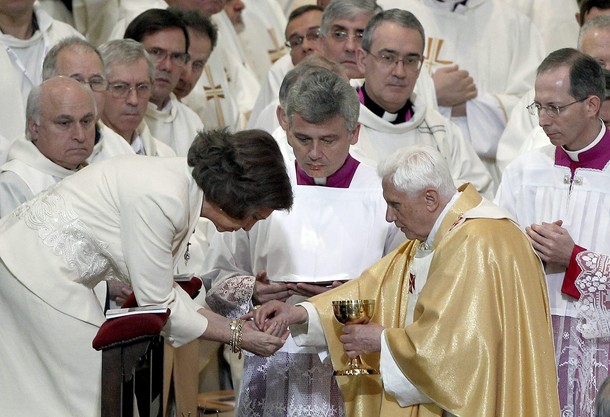
In Spain at Sagrada Familia Queen Sophia refused to kneel before GOD and receive the Body of her Divine Saviour in the manner that the same Divine Savior’s Vicar on earth has pointed to as the most appropriate.

UPDATE: 10 Nov 1015 GMT:

A friend sent this and I must, in justice, share it with everyone (edited).

As much as we would like it or suppose it, Queen of Spain never converted to Catholicism….

Remember, they even had a double wedding, one catholic, one orthodox, as forbidden as that may be in general. It still is common practice in Greece.

She however is by far the best and most faithful member in the Royal Family, and she does not fear to be unpopular in shabby Spain, even on the usual social issues ….

So the way she received communion is the orthodox one, and none other she would accept. And receiving communion is according to can. 844 § 3.

I was unaware that the Orthodox received in the hand.  I thought they received under both kind and directly in the mouth through the use of a spoon.

Nevertheless, I happily receive correction in this matter if this is the reason why the Queen received in that manner.   At the same time, when one is in Rome, one does best to receive as the Romans.  When I go to am Eastern Catholic Church and receive the Sacrament, I receive in their manner of receiving.  Food for thought.

UPDATE: 10 Nov 2344 GMT:

Someone sent via email:

I suggest you watch the video from the Barcelona mass. The picture of
the queen is a little misleading. She wasn’t at the kneeler in front
of the Pope. He went over to her and she was on a platform above him
in a very awkward position. I doubt she was being disrespectful.

Of course there was no link to the video.

Posted in Liturgy Science Theatre 3000, New Evangelization, Our Catholic Identity |
94 Comments

A social engineering experiment that didn’t work so well

It looks as if the openly homosexual Episcopalian bishop Gene Robinson is going to resign.

I suspect he will not be joining a Ordinariate of Anglicanorum coetibus.

It seems that Robinson wants more time with his “husband”.

Blech.

I guess that was a social engineering experiment that didn’t work so well.

I’ll now go wash.

Posted in Throwing a Nutty | Tagged
14 Comments

QUAERITUR: harmonizing with the priest during the doxology

From a reader:

Please don’t think I’m a heretic, but I was at one of those great
circumstances where multiple celebrants sang the last part of the
Eucharistic prayer (which I think is the doxology). They sang it
together and on key. That is so wonderful.

I would love to have a musical setting where it would be possible for
a cantor, choir, or congregation to harmonize with the celebrant(s). I understand it would confuse roles to have non-priests sing any of the same words as the priests. How would I explore this?

You don’t explore it.  It is forbidden for anyone other than the celebrant and, if present, concelebrants to sing that part at the end of the Eucharistic Prayer(s).  Even priests or bishops who are present, but not concelebrating, cannot sing that together with the celebrant.

Posted in ASK FATHER Question Box | Tagged
30 Comments