
My friend John Allen, the fair-minded nearly ubiquitous columnist and nearly only redeeming factor for the dissenting National Catholic Reporter had an excellent interview with Card. George of Chicago.
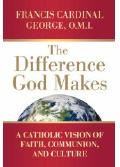 His Eminence has a new book, entitled The Difference God Makes. At the time if this writing you can pre-order it at a discount.
The whole interview is too long to fisk here, but a few excerpts are in order.
Prelude: Some years ago I attended in Chicago a meeting of the Catholic Press Association, a left-leaning organization. Card. George gave a splendid address on the vocation of a Catholic journalist.
His Eminence offered that the role of a Catholic journalist, among other things, was not to report so much on popes and bishops, but rather to report on the life of grace. He added that in order to recognize the life of grace in others the journalists had to be themselves in the state of grace.
They laughed.
Second Prelude: You know that I have been pounding away at need to revitalize our Catholic identity.
Let’s see some bits from John Allen’s interview with Card. George.
Allen’s first comments:
In essence, George argues that liberals too often function as “chaplains of the status quo,” taking their cues from the prevailing secular mindset, while conservatives often end up in a sectarian dead-end, clinging to a narrow and triumphalistic version of Catholic identity sealed off from the surrounding culture.
Instead, George argues for what he calls “simply Catholicism,” meaning a clear sense of Catholic identity that’s nevertheless open to the world. As examples, he points to Mother Teresa, the origins of the Catholic Worker movement, and the Community of Sant’Egidio – all, he says, share a “simply Catholic” concern for prayer and serving the poor.
Going on…
ALLEN: On that subject, you write that for modern American culture, everything is tolerated but nothing is forgiven, while for Christianity it’s exactly the reverse – many things aren’t tolerated, but everything can be forgiven. Would you see the explosion of legalism as the index of a culture that doesn’t know how to forgive? [I heard Card. George give a talk in Rome during which he said that American’s are simultaneously hedonistic and puritanical.]
Card. George: That’s right. Punishment has to be legal, and it has to be permanent.
ALLEN: You wade back into a debate you set off in 1998, when you defined liberal Catholicism as an “exhausted project.” Among other things, you write that while liberals and conservatives often see themselves as opposites, both share an implied ecclesiology that comes from St. Robert Bellarmine, defining the church as a visible society. Can you explain that?
For both of them, bishops take on an importance that’s disproportionate. Liberals and conservatives both define themselves vis-à-vis authority.
ALLEN: Broadly speaking, liberals want you to have less of it, and conservatives want you to use it more.
Liberals are critical of [authority], although they’ll use it when they’re in power. Conservatives would tend to be less critical, but equally dependent upon it.
Consequently, when you get into the church, you get the conservatives unhappy because bishops aren’t using power the way they’re supposed to, the way they want them to. You get liberals who are unhappy because [the bishops] have any power at all. Both of them are defining themselves vis-à-vis the bishops rather than vis-à-vis Christ, who uses the bishops to govern the church. It’s not a Christ-centered church, as it’s supposed to be, it’s a bishop-centered church.
ALLEN: Do the bishops bear part of the responsibility for that?
Sure, yes! That’s what we’re trying to work through now in the conference, I think. What is the bishop’s role, particularly in governance? Of course, to some extent the bishops are central to Catholic communion, in the sense that Ignatius of Antioch says – that nothing is done apart from the bishop. But, they don’t control the whole thing. They don’t in the Code of Canon Law, they don’t in Ignatius of Antioch.
…
ALLEN: Is there an example of what a relational model of leadership would look like?
You asked if bishops are responsible for the kind of disdain, or contempt, in which bishops are sometimes held by both left and right, for different reasons. The Second Vatican Council said we have to present the church to the world, and the truth of the gospel, and it said that you don’t have to worry about people who don’t believe. [The idea was that] this is so beautiful that they will come along and accept it, but that’s not true. You have people who weren’t catechized – not because they weren’t told the truth, but because they weren’t told ‘this is not the truth, and here’s why.’ That’s why I write about putting apologetics back into catechesis. [Excellent. People be able to gives reasons for the hope that is in us!]
There’s something comparable that’s happened on the governmental level. The council was the time for mercy, not justice, the time for persuasion and not coercion. When they redid the Code of Canon Law, it was assumed that if you just show the good, it will be so beautiful that everybody will follow. They didn’t worry very much about what happens with people who don’t, who are still caught in original sin. You not only have to say ‘this is good,’ you also have to say, ‘this is bad, and if you do it here are the consequences.’ Well, the consequences are minimal in the new Code. That’s why it’s a difficult document to use to govern, which became clear in the sex abuse crisis. We had to change the Code. Now they’re looking at that, looking precisely at the penal sections of the Code, to see if they’re adequate instruments of government. We have to do the same thing: We have to say that here’s the good and here’s the bad, and Catholics don’t do the bad. When they do, of course, they’re forgiven, but nonetheless they’re told it’s bad.
[…]
ALLEN: In general terms, you sketch three options for living as a Catholic in contemporary American culture: liberal Catholicism, conservative Catholicism, and “simply Catholicism.”
Yes, and the thing I meant to say was that I don’t have in mind ‘liberal Catholicism’ politically. That’s a misunderstanding. Everything today is understood in terms of politics, but that isn’t what [Cardinal John Henry] Newman was talking about. It’s ‘liberalism’ in the sense of what the pope means by ‘relativism.’
ALLEN: Your notion of “simple Catholicism” is different from a meeting in the middle between liberals and conservatives?
It’s completely different. It doesn’t worry about that. In a certain sense, the church was that, at least the church in which I grew up in Chicago, before the council. It was very sure of its own identity, it formed us in that, and then it prepared us to go out and transform the world. [YES! This is precisely what I am pounding on. We need to revitalize our identity as Catholics. If we don’t have a clear identity, then we have nothing to contribute as Catholics in the public square. So, the issue of identity has an ad intra and and ad extra dimension. And surely our WORSHIP is the first key that must be turned in this lock, which catechesis is the next key. And they these keys must be turned at the same time!]
ALLEN: Yet you’re not nostalgic for the pre-conciliar church?
Well, no! Not at all. I think the liturgical renewal, for example, is a wonderful thing. I think also the sense of governance in the church, how pastors govern united to their people through councils at all levels … all of those things are absolutely necessary. I think the theology of ordained priesthood was clarified in the council. It isn’t just vis-à-vis power to celebrate the Mass and to transubstantiate. Rather, you have that power over the sacramental body because you have the authority to govern the mystical body. So, you put the two together in ways they weren’t together before. [Very good.] Pastoring was practical, and power was given for sacraments. Now they’re held together in the headship of Christ, in our relationship to the church. There are all kinds of theological insights, such as the ecclesiology of communion … my whole book is about that, at least the way I read the ecclesiology of the council. There were some tremendously good breakthroughs in theology itself, not just in practice.
If I’m nostalgic for something that happened before, it’s not because it was marked by what people call the ‘pre-conciliar church.’ It’s because in some ways the Chicago church I grew up in anticipated the council.
The sociological reality [after the council] was good in some ways, despite the almost internal dissolution that conservatives decry, and rightly so. That was not anticipated from the council, and maybe that’s where we can say that the pastoral implementation of the council was inadequate. It wasn’t meant to dissolve the church. [But isn’t that what has nearly happened in some respects?]
[…]
ALLEN: Another hypothesis is that the left/right polarization is the product of a particular generation’s experience (meaning the post-Vatican II generation), and that there’s a new generation coming on the scene which doesn’t carry that baggage. [There is a lot in this interview that sounds familiar…]
I think that’s true. [And then the other shoe drops…] The problem is, what do they carry? I’m not sure they carry ‘simply Catholicism.’ They carry the culture strongly. A lot of them carry it in a way that leaves them unsatisfied, but we often haven’t been very successful in reaching that generation. Sometimes when they do get it, and they grasp for the symbols of identity, for the prior generation that looks conservative. [Yes. I think this is what the dynamic of continuity accomplishes. And it does look "conservative". In effect, however, it is simply Catholic. And the Cardinal speaks in terms of "simply Catholic".]ALLEN: Conservatives will often point to that hunger for identity among younger Catholics and say, ‘Look, we’re winning!’
But I don’t think that’s the right way to see it. When [younger Catholics] use those symbols, they don’t bring the history in the same way, they just use the symbols as markers. They don’t know how those symbols were occasionally used to suppress in the past. You have to ask them, ‘What does it mean to you?’ Usually you’ll get something that’s quite personal, something that falls outside of the liberal/conservative framework. [A good point, useful for self-examination.]
ALLEN: You said that you’d like to write more about the conservative Catholic position. What would you like to say?
What I’d say is that there are people who use the symbols [of the faith] to be so restrictive that we become a sect. If the liberals disappear into the world and become chaplains of the status quo, taking their agenda from the world, the conservatives risk isolating themselves. The council says you can’t do that. [Where?] The church says you can’t do that, Christ says you can’t do that. They become trapped in a kind of sectarian mindset that isn’t Catholic. [I think we know this is true… but it would be good to see some texts with this as well. Perhaps they are in his book.]
[…]
ALLEN: You write that the greatest post-Vatican II failure was the failure to form laity engaged with the world but on faith’s terms. How do we do that today?
I think that’s behind the bishops’ concern about the [wait for it…] universities, about education, about the reform of catechesis, all these formative influences. We don’t have the sodalities anymore. Today there are the lay movements, but they’re pretty restricted in their influence in the United States. They’re more influential outside the United States, especially in Europe. There, it isn’t the parishes that carry the identity anymore, it’s the movements. With us, it still is the parishes. We do parishes well. [Card. Ratzinger spoke of this in his book long interview with Seewald. He said that the movements and the parish would be the structures which stay strong in the future.]
ALLEN: Is part of the problem, with the lay role in the world, that so much of the energy of our best and brightest laity over the last fifty years has been consumed by internal Catholic battles?
Yes, absolutely. The pope in his 2005 address to the Roman Curia, about the reform, was somewhat wistful about how we’ve wasted fifty years, forty years, so let’s get on with it. [!] I would tend to think that’s true. We’ve wasted a lot of time. Instead of hearing what the council was really saying … and of course these were unusual conciliar documents, as everybody has said, because usually conciliar documents are simply declarative. Here they put the exhortation directly into the documents for the first time. That’s pastoral, it was a pastoral council. Of course, you can take those pastoral elements in different directions, but I certainly think we went in the wrong direction when from the beginning we interpreted the council in liberal and conservative terms. [What I like here is the willingness to say so clearly that a great deal went wrong after the Council. Years ago I asked a US bishop what we had to do to get things back on track. He said, "We have to stop with the happy gas."]We forgot that it was supposed to be church/world, that those were the terms that were supposed to be used, not liberal and conservative inside the church. That was terribly destructive. People got caught up in that. Of course, their intentions were good, but they got caught up in it … religious orders got caught up in it, [Card. George was a religious.] thinking they were being faithful to the council, but they weren’t. They were being faithful to a particular interpretation of the council. [Okay. But the fact is that these divisions exist and they are real. They have to be dealt with as divisions in a realistic way.]
ALLEN: Left, right or center, the primary optic for reading the council has been ad intra, meaning its implications for the internal life of the church. [I really like this ad intra and ad extra tool, which I also use all the time. I think it is very useful when looking at our questions and concrete problems.]
That’s right. You asked a moment ago where are things working, and the answer is, look at those organizations and groups that don’t worry about the internal dynamics, but who worry about the mission.
[…]
There is a lot more to this interview.
 Allen is very good at this sort of thing. He is very bright, has a broad perspective, knows the questions to ask, and let’s the people talk.
I definitely want to read Card. George’s new book.
I have put it on my wish list and have created a link for you to use HERE to buy it for yourselves.
Perhaps we could get some discussion going about the book and even use Z-Chat for such a purpose.
 I would like to bring to your attention the Miaani well project.
 Cardinal Cipriani prays to Lord of Miracles for protection of the unborn










 fac on Daily Rome Shot 1118 – Paddywhack!: “Speaking of the disputatio back on October 31st between Archbishop Vesco and Bishop Barron (Vesco saying the Catholic Church was…”




























