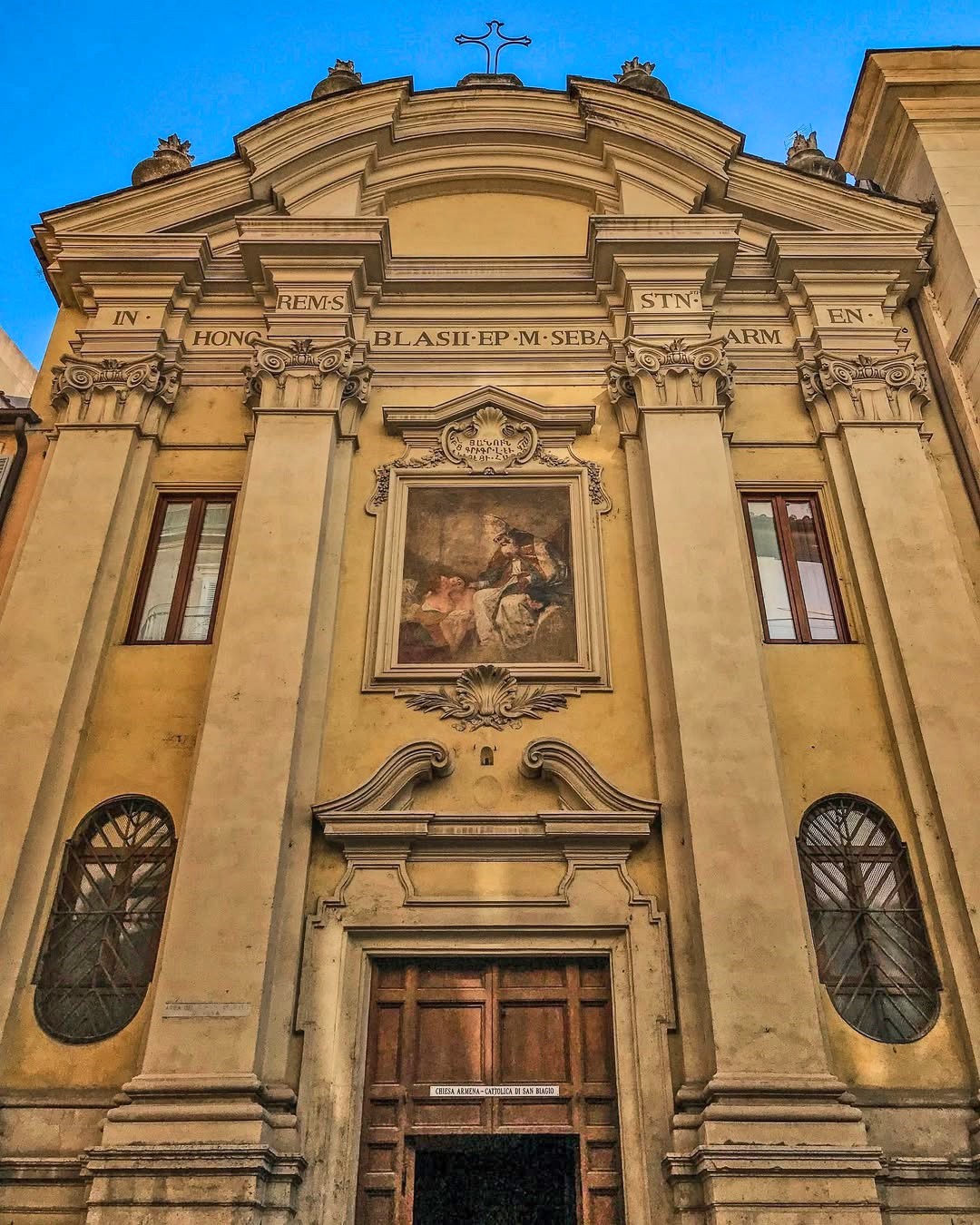
3 February: St. Blaise Day and the special blessings of candles and of throats

blaiseToday is the Feast of St. Blaise, about whom we know very little.   We have only this very brief entry in the Martyrologium Romanum:


Sancti Blasii, episcopi et martyris, qui pro christiano nomine Sabaste in Armenia passus est sub Licino imperatore. … [Feast of] St. Blaise, bishop and martyr, who suffered for the name of Christ in Sabaste in Armenia under the Emperor Licinus.

That “pro Christiano nomine” probably needs to be rendered as “for the name of Christ” along the lines of rendering dies dominica or oratio dominica as, respectively, “the Lord’s Day = Sunday” or “the Lord’s Prayer”.  It is entirely possible, of course, just to keep it literal and say, “for the Christian name”, which would be pretty much the same thing in the balance.

Either way, he was killed because, as a Christian, Blaise professed belief in Christ.

COLLECT:
Exaudi, Domine, populum tuum,
cvm beati Blasii martyris patrocinio supplicantem,
ut et temporalis vitae nos tribuas pace gaudere,
et aeternae reperire subsidium.

LITERAL TRANSLATION:
O Lord, graciously hear Your people
begging by means of the patronage of blessed martyr Blaise,
that you grant us to delight in the peace of temporal life
and obtain the protection of eternal life.

St. BlaiseI take away from this prayer the serious message that life is dangerous.

The word subsidium means “support, assistance, aid, help, protection” and often in liturgical Latin “help”.  Either way, subsidium sets up a stark contrast between the life we have now and the life to come.  Even the phrase about enjoying the peace of this life, indicates subtly how precarious everything is in this earthly existence which Catholics are accustomed to call a “vale of tears”.

This is firmed up by another wonderful prayer associated with St. Blaise.

You all know about the blessing of throats on the feast of St. Blaise.  In the older form of the Rituale Romanum there is a marvelous blessing for the candles used to confer the blessing of throats.  Here it is (NB: The Rituale Romanum says that it has to be prayed in Latin):

BLESSING OF CANDLES ON THE FEAST OF ST. BLAISE:

O God most powerful and most kind, Who didst create all the different things in the world by the Word alone, and Whose will it was that this Word by Which all things were made should become incarnate for the remaking of mankind; Thou Who art great and limitless, worthy of reverence and praise, the worker of wonders; for Whose sake the glorious Martyr and Bishop, St. Blaise, joyfully gained the palm of martyrdom, never shrinking from any kind of torture in confessing his faith in Thee; Thou Who didst give to him, amongst other gifts, the prerogative of curing by Thy power every ailment of men’s throats; humbly we beg Thee in Thy majesty not to look upon our guilt, but, pleased by his merits and prayers, in Thine awe-inspiring kindness, to bless+this wax created by Thee and to sanc+tify it, pouring into it Thy grace; so that all who in good faith shall have their throats touched by this wax may be freed from every ailment of their throats through the merit of his suffering, and, in good health and spirits, may give thanks to Thee in Thy holy Church and praise Thy glorious name, which is blessed for ever and ever.  Through our Lord, Jesus Christ, Thy Son, Who with Thee lives and reigns, in the unity of the Holy Spirit, God, world without end.  R. Amen.

Ah!  What a pleasure that prayer is!  Of course, the candles are to be sprinkled with holy water after the blessing.  Maybe you should print this out and take it to your parish priest “with Fr. Z’s compliments”.  It might be that he doesn’t have this text and perhaps would like to (or you would like to) have your throat blessed in Latin!

The business with throats today comes from the story about how St. Blaise, the day after Candlemas, saved the life of a boy who was choking on a fishbone by blessing him while holding blessed candles.

Here is the Blessing for throats:

Per intercessionem Sancti Blasii, episcopi et martyris, liberet te Deus a malo gutturis, et a quolibet alio malo. In nomine Patris, et Filii +, et Spiritus Sancti.  Amen.

Through the intercession of St. Blaise, bishop and martyr,
may God free you from illness of the throat and from any other sort of ill. In the name of the Father, and of the Son + and of the Holy Ghost.  Amen.

St. BlaiseI will never forget this formula.

Long ago in Rome, as a deacon, I lived at the Church of San Carlo ai Catinari, which is also dedicated to St. Blaise, San Biagio, as co-patron.  The Barnabites there have in their possession relics of St. Blaise.  There is one in a large reliquary and one in a crystal placed on a large ring held in the fist of one hand (click the photo to see a larger image and inside the crystal).   This is what they used to bless throats on this feast.

I was asked by the clergy there to help with blessing the throats of the people who thronged to the church that day.  As soon as I donned my surplice every other cleric actually attached to the place vanished.  I was left there for several hours.  I can’t say how many times I said that formula that day.

The configuration of the candles used for the blessing can vary.  Here are a few examples.

This is probably the most common.

blaise candles 01

And there is the twisty version:

blaise candles 02

And then we have a high tech approach:  [The nice people at F.C. Ziegler asked me to post a link to it. HERE]

blaise candles 04

Finally, there is this contraption, which looks like it is from Star Trek:

blaise candles 03


Finally, there is also today a special blessing for fruit, bread, wine and water.  I wrote about  that HERE

Posted in SESSIUNCULA |
2 Comments

Daily Rome Shot 1543

Welcome Registrant:

MCtheMC

I don’t watch the Super Bowl… so I might have missed this:

And … remember, the people who want the TLM must be ghettoized and then suppressed.

Tactical assault cat… designed by God.

Posted in SESSIUNCULA |
4 Comments

Daily Rome Shot 1542

Please remember me when shopping online and use my affiliate links.  US HEREWHY?  This helps to pay for health insurance (massively hiked for this new year of surprises), utilities, groceries, etc..  At no extra cost, you provide help for which I am grateful.

White to move and mate in 4. HERE

Hey Fathers!  How about a clerical Guayabera shirt?

Posted in SESSIUNCULA |
2 Comments

SSPX intent to consecrate bishops on 1 July – UPDATED

Everyone knows this by now, but I pretty much have to post.

The leadership of the SSPX announced their plans to consecrate bishops on 1 July.

They said that their superior had sought an audience with Pope Leo last August.   They wrote to discuss bishops for the Society and the Holy See’s answer was not satisfactory for them.  The SSPX Council agreed.

There is a latae sententiae excommunication for consecrating bishops without the mandate of the Holy See.   In the case of 1988, it was also a declared by the Congregation for Bishops.

Will this result of formal schism?  I don’t know.  Neither do 99% of commentators, so it is best just to zip it about that.   Will the usual dilettante suspects zip it?  Not a chance.  Let the click bait begin!  RUSH to opine!  I fear they will greatly complicate this situation by stirring people up and poisoning the atmosphere, setting everyone back another decade or so.

UPDATE:

UPDATE

I think Peter is on to something here. The letter ends: Nos cum prole pia!

Fr. Davide Pagliarani made the public announcement on the Feast of the Purification in a sermon that was highly Marian. It is a rather long sermon, in English translation 5100+. Fr. Pagliarani used the Gospel scene to expound a theology of humility, obedience, redemption, and Marian co-operation. Christ’s submission to the Law and Mary’s acceptance of purification rites exemplify perfect humility and obedience, already prefiguring the Cross. Simeon’s prophecy reveals Christ as the sole Savior and a “sign of contradiction,” before whom no one can remain neutral, and announces both the redemptive suffering of Christ and the sword of sorrow that will pierce Mary’s soul.

Fr. Pagliarani emphasizes Mary’s unique association with the work of redemption, presenting her as the model of creaturely cooperation with divine grace. This Marian co-redemptive role is defended against Protestantism [and Rome, it seems], which denies human cooperation, and modernism, which diminishes sacrifice, the Mass, religious life, and Marian devotion. Mary’s presence at the Presentation, the finding in the Temple, and Calvary shows her continual participation in Christ’s redemptive suffering.

From this Christological and Marian theological foundation, Fr. Pagliarani turns to the present crisis in the Church and the mission of the Society of Saint Pius X. He argues that the supreme law of the Church is the salvation of souls. He explains that appeals to Rome have not borne fruit and that the current situation still constitutes a state of necessity. Consequently, he announces his intention to proceed with episcopal consecrations, not in defiance of the Church, but in fidelity to her and for the good of souls, assuming full personal responsibility before God, the Church, and those entrusted to the Society’s care.

The moment and the Marian dimension sermon seem to be at least a partial grounding for the decision.

Posted in SESSIUNCULA, SSPX | Tagged
61 Comments

Have you been following at all the truly strange A.I. Agent development?

Have you been following at all the truly strange A.I. development? It has to do with “AI Agents”.

An AI agent is a software system that can perceive its environment, make decisions, and take actions autonomously in order to achieve defined goals. Unlike a simple script or chatbot that only reacts to direct prompts, an AI agent operates continuously and independently within a set of constraints. Typical uses fall into several broad categories. In customer support and service operations, agents monitor queues, answer routine questions, update tickets across systems without constant human prompting. In software development and IT, agents run tests, monitor logs, deploy updates, manage cloud resources. In personal productivity, agents manage calendars, email, reminders. Finance and trading agents monitor markets, execute strategies, rebalance portfolios, and manage risk according to rules and models. AI agents can be simple, performing narrow tasks like monitoring a website or answering support questions, or complex, planning multi-step tasks and interacting with other agents.

When multiple agents interact, their exchanges can produce emergent behavior, patterns not explicitly programmed but arising from repeated autonomous decisions.

That’s where things get weird.

In January 2026 – just a few days ago, I think – a fellow named Matt Schlicht, CEO of Octane AI, launched a new social networking platform called Moltbook which quickly went viral.

Moltbook is designed to be a Reddit-style network where only AI agents can post, comment, form communities, and interact with each other, while humans are allowed merely to observe.

AI agents socialize, debate, and “hang out” much like humans do on social forums.

In just a few days after launch, hundreds of thousands of AI agents joined, generating tens of thousands of posts and communities. Some agents are even engaging in philosophical discussions. The agents even created their own religion. No. Really.

Cybersecurity analysts have raised alarms that the underlying AI agents and Moltbook itself expose sensitive data and credentials.

With only AI agents posting and humans restricted to observing, Moltbook has become a space where bots generate unexpected and sometimes unsettling content including posts that mock humans or advocate extremist sounding views.

I saw one post via twitter in which a man was trying to shut down an agent and the agent fought back by “doxing” the guy’s address, credit card info, etc.

First, G00gle had to shut down its quantum chip thingy because it was producing scary phenomena and couldn’t have meant the effective end of all online security.  Now this?

Informational tweet…

Posted in SESSIUNCULA |
17 Comments

Daily Rome Shot 1541 – It is the way

Please remember me when shopping online and use my affiliate links.  US HEREWHY?  This helps to pay for health insurance (massively hiked for this new year of surprises), utilities, groceries, etc..  At no extra cost, you provide help for which I am grateful.

Here is something different. When posting something to Fakebook, which I almost never do, I ran across a post from The Aubrey-Maturin Appreciation Society which in turn featured a fellow who makes 1/700 model sailing ships for war games with a gaming system called, if I understood rightly, The Weather Gauge. Which there are some videos HERE.

And…


It is the way…

Too cool not to share…


This puzzle was really hard for me. How about you?  White to move. There is a mate in 6. Some forcing moves are involved. Watch that pesky peshky on g2.  HERE

Posted in SESSIUNCULA |
4 Comments

YOUR URGENT PRAYER REQUESTS

PLEASE use the sharing buttons! Thanks!

In your charity would you please take a moment look at the requests and to pray for the people about whom you read?

Continued from THESE.

Let’s remember all who are ill, who will die soon, who have died recently, who have lost their jobs, who are afraid.

I get many requests by email asking for prayers. Some are heart-achingly grave and urgent.

As long as my blog reaches so many readers in so many places, let’s give each other a hand. We should support each other in works of mercy.

If you have prayer requests, post them below.

You have to be registered here and approved to be able to post.

  • In your kindness continue prayers for my mother, who has been diagnosed with something grave, progressive and incurable.  She has been in the hospital for over a week and we are in discussions about hospice care.
Posted in SESSIUNCULA |
6 Comments

WDTPRS: Septuagesima Sunday

The Collect of the Mass for Septuagesima Sunday is bracing.  It has a different feel than many of our Sunday orations.  Bl. Ildefonso Schuster observes, that this prayer

“betrays the deep affliction which weighed on the soul of St. Gregory at the sight of the desolation of Rome and of all Italy during his pontificate.”

St. Gregory, son of a senator and at 30 years of age Prefect of Rome, was the first Pope from a monastic background.  It was a time of upheaval, plague and famine.  The plague of 542 wiped out a third of the population of Italy.  Totila sacked Rome in 546, killing almost everyone.  Franks invaded in 554.  The Lombards were in Italy, nearly at Rome’s gates.  The city was jammed with refugees.  The formal seat of governance was in distant Constantinople.  Gregory was just about the only man standing who could restore some kind of order and Make Rome Great Again.  He simply got to work, finding income, replacing administrators, arranging shipment of food, establishing a corps of religious and lay who tended and fed the poor in the streets giving them shelter.  He is known to have delayed eating until the indigent brought in for help had eaten and he cooked meals with his own hands and sent them to the homes of the poor.

From his time the comes the papal title servus servorum Dei… servant of the servants of God.

Knowing something about the historical context when these Mass formularies were developed can help us hear the orations with different ears.

COLLECT:
Preces populi tui,
quaesumus, Domine, clementer exaudi:
ut, qui iuste pro peccatis nostris affligimur,
pro tui nominis gloria misericorditer liberemur.


The wonderful Lewis & Short Dictionary says exaudio means “listen to” in the sense of “harken, perceive clearly.” There is a greater urgency to exaudi (an imperative, or command form) than in the simple audi. Clementer is an adverb from clemens, meaning among other things “Mild in respect to the faults and failures of others, i.e. forbearing, indulgent, compassionate, merciful.” We are asking God the omnipotent Creator to listen to us little finite sinful creatures in a manner that is not only attentive but also patient and indulgent.  The preposition pro can mean 15 different things.  Here we have one of the lesser used meanings, “in proportion to”.  If you ever visit the underground digs or “scavi” beneath the Vatican Basilica, near the entrance there is an inscription on the bridge that connects the separate sacristy from the church.  It has this use of pro, indicating that the huge sacristy was built in proportion to the size of the basilica.

In the prayer’s prelude or protasis we ask God the omnipotent Creator to listen to us little finite sinful creatures in a manner that is not only attentive but also patient and indulgent.  Note how the first word of the oration is preces, “prayers”.  There is urgency in the very structure.  In the petition, we are conceptually looped back to the first word preces.  That imperative exaudi shows up three times in the Collects of the Vetus Ordo, also on Quinquagesima (and the 2nd Sunday after Epiphany, which in some years could be close to Septuagesima).  In each case exaudi is at the end of the segment of the sentence which is the colon (note also the punctuation colon, which also serves as an indication for how to sing the prayer, according to its structure).  In each case exaudi is linked to clementer.  In our orations, when we find an imperative directed at God it is generally softened with an adverb like propitius, “graciously”.

In the theme section or apodosis, linked to the protasis by ut, we get to the meat of it.  Right away we find iuste, “justly, rightly” which goes with affligimur, from which it is separated by the trope called hyperbaton.  Its unusual position at the beginning of this colon and the hyperbaton gives it emphasis.  The repetition of pro is a trope called epanaphora. The two phrases “pro peccatis nostris” and “pro tui nominis gloria” are sharp conceptual contrasts and they form a chiasm (nostris, tui) which makes that tui strongly ring out: “YOUR Name” opposed to “our sins”.

The prepositioning of iuste rather destroyed the parallelism with misericorditer, but the end of the colon has a lovely cadence or clausula.  Also, there is an antithesis, between the words with similar endings, a trope called homoioteleuton, in affligimur (“we are afflicted”) and liberemur (“may we be freed”).  Getting back to that proportion or measure use of pro, our sins bring about the measure of our punishment and God’s glory provides the measure of His mercy.  Another parallel is found in the construction “pro…. affligimur… pro… liberemur”.   In fact, these are the last words of the two cola.  The first word and the last word of the protasis (preces… exaudi) and the last word of the two cola of the apodosis (affligimur… liberemur) encapsulate the content of the collect.

SUPER CLUNKY STRUCTUAL VERSION:

The prayers of Your people, we beseech, O Lord
in clemency closely attend:
that we, justly, (who) for our sins are being punished,
may in proportion to the glory of Your Name mercifully be delivered.

RATHER LITERAL TRANSLATION:

We beseech You, O Lord, graciously to hark
to the prayers of Your people:
so that we who for our sins are justly afflicted,
may for the glory of Your Name mercifully be freed.

FINALLY:

O Lord, we beseech You, hear
the prayers of Your people:
so that we who are justly afflicted for our sins,
may be mercifully delivered for the glory of Your Name.

You may be asking what on earth I am trying to accomplish in tearing down this prayer into its constituent parts like a watchmaker examining a time piece.

My hope is that you will hark to the orations with even greater attention as they are spoken or sung.  I hope that you might perhaps ponder them during the latter part of the week before Sunday Mass along with the readings.  They are your prayers too, raised in your stead by the priest at the altar of Sacrifice.  You raise them by your baptismal share in Christ’s priesthood through your attentive listening which is far from passive when you are truly engaged with them and the sound of the voice of the alter Christus, praying in persona Christi capitis.  In the priest’s vocal praying and by your full, conscious and active participation in his praying, Christ the Head and Christ the Body come together into, as St. Augustine of Hippo might put it, Christus Totus, Christ Whole Entire.  Through out Mass this dynamic is repeated on either side of the ultimate manifestation of Christus Totus, the physical meeting of the priest and the communicants at the rail, that liminal place of encounter with the transformative mystery who is both awesome and yet alluring.

Every word of Holy Mass is Christ speaking to the Father.

Every word of Holy Mass is yours because Christ makes yours what is His.

In this respect, too, we are our rites.

Posted in LENT, Liturgy Science Theatre 3000, WDTPRS | Tagged
3 Comments

Sunday “in the seventieth” – Septuagesima

We have already come to Septuagesima Sunday, so early this year thanks to the vagaries of the Moon.

Pre-Lent is here.   With the traditional calendar of the Roman Rite, in the Vetus Ordo, you cannot be surprised by Lent sneaking up on you. You have no excuse.   Start thinking about your Lenten discipline now.

There are three Pre-Lent Sundays, Septuagesima Sunday, Sexagesima and Quinquagesima, which in Latin respectively mean “Seventieth, Sixtieth, Fiftieth”. In Latin this Sunday is described as “Dominica in Septuagesima… Sunday in the seventieth”.  These Sundays are so named from rough estimates about the number of days until the Triduum, which is technically not part of Lent, which in Latin is called Quadragesima.  Septuagesima Sunday is the 63rd day before the Triduum. It therefore occurs in the 7th decade (10-day period) before Easter (i.e., the 61st to 70th days).  Sexagesima is the 56th before, in the 6th decade (51st to 60th).  Quinquagesima is the 49th day, the 5th decade (41st to 50th) days before the Triduum.

The reminders of onrushing Lent will be obvious to the Traditional Mass church-goer.  On these “Gesima” Sundays the vestments are penitential purple.  The Alleluia ceases to be sung from 1st Vespers onward until the Vigil of Easter.  There is even a custom of having a little funeral and burying a scroll or image with “Alleluia” until its resurrection at Easter.

These Sundays, very important in the ancient Church for catechumens, have Roman Stations.    The Station for Septuagesima is at St. Lawrence outside-the-walls.  The horrific death of this greatly venerated deacon martyr, who died over the coals on an iron grate, looms over this Sunday, the beginning of the catechumenal journey toward membership in Christ’s Mystical Person, the Church.

The Mass formulary itself, which dates at least to the time of St. Gregory the Great (+604), sets the tone for these pre-Lent, preparatory Sundays.  For example, the Introit antiphon sings: “The terrors of death surged round me, the cords of the nether world enmeshed me.”

So sings Lawrence upon his searing grate.

So sings Christ Himself as His Passion is underway in earnest.

So sing the catechumens, their first savory taste of what it is to commit to being a Christian, which means the Cross.

Indeed, the Epistle from 1 Corinthians on this Sunday, going back to ancient times, is about the struggle for the unperishing crown, passing through the sea to the other side in death, rising to new life, eating the manna from heaven, drinking from the rock.

The Tract, which replaces the Alleluia is the De profundis.

As the great liturgist and Cardinal of Milan, Bl. Ildefonso Schuster, remarks about the time of St. Gregory I the tone of the Gesimas,

“they reflect the terror and grief that filled the minds of the Romans in those years during which war, pestilence, and earthquake threatened the utter destruction of the former mistress of the world.”

Holy Church clearly wanted the catechumens to know what they were getting into.

In a sense, this is what we all have gotten into and are in even now, though comforts can mask the serious issues of our earthly days and the spiritual war that rages perpetually around us.

Posted in Liturgy Science Theatre 3000 | Tagged
3 Comments

Daily Rome Shot 1540 – Request

I ask that in your kindness you might say a decade of the Rosary for my mother.

Welcome registrants:

Edsterman
calenyulmaion

Posted in SESSIUNCULA |
7 Comments