Would the young Joseph Ratzinger – or I – have had the same reaction if….

As I often write, we are our rites.

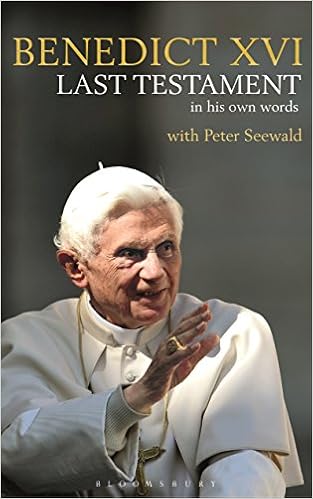
In the new interview book with Peter Seewald, Benedict XVI was asked how the son of a Bavarian policeman became a priest. I have a measure of sympathy with Benedict’s answer. I, too, am the son of a cop and I, too, was first moved by Catholic liturgical worship.

BTW… the English won’t be available until November, but it is available to readers in these USA in ITALIAN on Kindle. UK HERE (UK get a Kindle HERE – US get a Kindle HERE)

Benedict wrote:

It was in order to enter more and more into the liturgy. To recognize that that the liturgy was truly the central point and to try to comprehend it, together with the whole historical development undergirding it. . . .Because of this, then, I became generally interested in religious questions. It was the world in which I felt myself at ease.

I wonder if young Joseph Ratzinger would have had the same reaction to…

YouTube thumbnailYouTube icon

And in an ugly church?

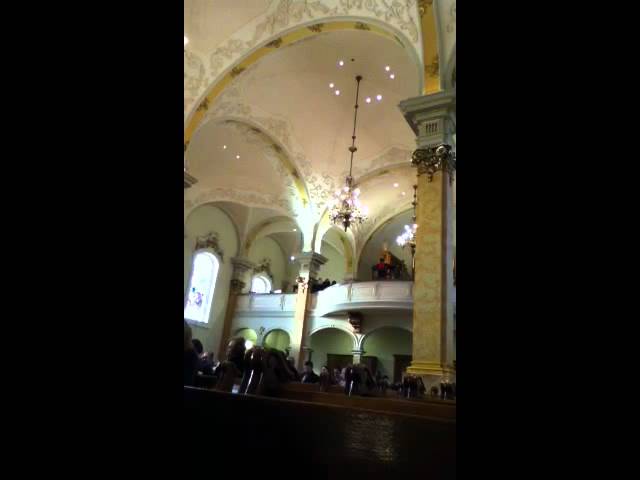
What I first experienced the first time I walked into a Catholic Church was …

Now, as it appears after its decoration in the 1980’s.

st agnes church st paul

There was never an ironing-board altar in there.

And what you hear inside …

YouTube thumbnailYouTube icon

No, wait…. that’s the High School choir!

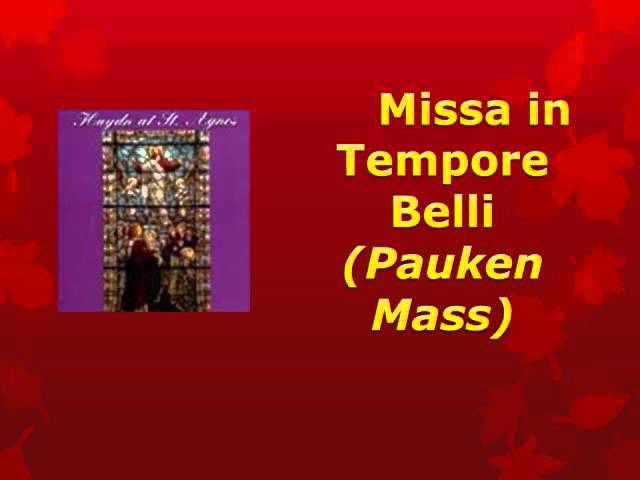
Here is the Gloria from Haydn’s Paukenmesse, also called the “Mass in Time of War”. This is a recording from St. Agnes Church, by the Twin Cities Catholic Chorale. I am in the choir in this recording.

YouTube thumbnailYouTube icon

This is the sort of thing you hear on 30 Sundays of the Year.

Would I have entered into communion in the Catholic Church had my first experience of Catholicism been in some dreadful municipal airport with My Little Pony music and dopey preaching by Father (now Bishop) Fatty McButterpants that wouldn’t have dented my rejected Lutheran catechism? I can’t say for sure, but God brought me to St. Agnes and not to the “Engendering Togetherness Community of Welcome” and “On Eagle’s Wings.” I had been a musician for a while by the time I walked into that church, and a good one. I had Latin and Greek by then. Like I say, I don’t know for sure what a church service with “Joy Is Like The Rain” would have done for me… or “Gather Us In”, but I suspect things would have turned out differently.

We are our rites.  How we pray shapes what we believe.  What we believe shapes how we pray.

I wonder how many priestly vocations have been annihilated by crappy music, ugly churches, and bad preaching from feckless and dissident priests.

At St. Agnes, during the 33 years that Msgr. Schuler was pastor, there were 30 First Masses.

Not. Rocket. Science.

PRE-ORDER NOW!

US Hardcover – HERE
UK Hardcover – HERE
US Paperback – HERE 
UK Paperback  – not yet

Posted in "How To..." - Practical Notes, Benedict XVI, Hard-Identity Catholicism, Liturgy Science Theatre 3000, Mail from priests, Priests and Priesthood, Seminarians and Seminaries, The future and our choices, Turn Towards The Lord | Tagged , , , ,
23 Comments

Did Pope Francis really write that letter?

UPDATE:

I have found a “news story” (but not really) at the site of Vatican Radio by Philippa Hitchen saying something about the letter. HERE

Also, in today’s L’Osservatore Romano of 12-13 September there is an unsigned piece on p. 7 which makes reference to the letter. HERE

Does this entirely put the question to bed?

Probably.  Unsigned articles in L’Osservatore are usually quasi-demi-semi-hemi official.  This is not quite as good as a response directly from the Holy See Press Office, but I think we have to go with it.  Yes, the Pope really wrote that letter.

And, yes, the Pope really endorsed the Argentinian document which opens the door to the divorced and remarried who do not use the brother and sister option to both the Sacrament of Penance and, hence, to reception of Communion.

Pope Francis, in his letter to the Argentinian bishop, the seeming chairman of the bishops who composed the document, confirms that the document “nella sua pienezza… in its entirety” shows “il senso del capitolo VIII dell’esortazione apostolica … the intent of chapter VIII of the Apostolic Exhortation”.

Here is the deal.   Again, we do NOT  have here the doors thrown open to official approval of Communion for anyone in any circumstance whatsoever.  This is not carte blanche.

As a matter of fact, if we want to be fair to what has been written (rather clumsily and unclearly), were someone, some couple, to read and take seriously – with the help of a good, faithful priest – what Amoris said, and what the Argentinian thing said, not many people would be able to discern that they can honestly receive Communion.

I’ll also repeat that, those who are rightly disposed toward the Church’s teaching and laws will work with all of this in continuity with the Church’s entire body of teaching, in obedience and fidelity.  Those who are not inclined to obedience and fidelity will continue to do whatever the heck they want, no matter what any Pope writes.

However, it seems to me that the way that this has all been handled, and the way this all will surely be reported, will open the door to abuses, abuses which I – for one – cannot fathom that any Pope would intend!

More on this later.

____ ORIGINAL Published on: Sep 12, 2016 @ 11:03

A complicated game is being played between those who defend the Church’s doctrine about matrimony and Communion, and the Kasperites who want to overturn the Church’s concerning doctrine matrimony and Communion for the divorced and remarried.

This game is being played in the Gray Zone.

First, it is important that we do NOT have a spittle-flecked nutty about what’s happening, or appears to be happening.  Spittle-flecked nutties don’t do us any good and, frankly, they are the right of the Left.  There is surely a lot that we simply do not know.

We have an alleged papal letter which appears to communicate Pope Francis’ approval of the content of a document of a region of bishops in Argentina. That document has some dodgy things in it, including a really bad section – 6.   The Pope is alleged to have written to a bishop in Argentina saying that that Argentinian regional document is in keeping with the Post-Synodal Apostolic Exhortation Amoris laetitia, that the regional document accurately interprets Amoris laetitia.  Section 6 of the regional document from Argentina effectively says that the divorced and remarried who are still together for whatever reason and who are not abstaining from sexual relations CAN be admitted to Communion.

Yes, I wrote “alleged”. The “Vatican” hasn’t acknowledged that it is real. The Press Office was asked about the letter, but no response was given. So, we can’t affirm that the letter is from the Pope or whether someone in the shadows made it up as part of a campaign of disinformation.

The Francis Forgery?

Why is the Holy See Press Office unavailable for comment?

Why should we believe that the Pope wrote this?  Because it appeared on InfoCatolica (which speaks for whom)?  Ditto LifeSite.

Isn’t there a Holy See Press Office and Social Communications dicastery?

We do not have all the facts in this matter.

The problem is section 6 of the Argentinian document. One could throw mud at other sections of the Argentinian document, but 6 is the bad one.  To wit (trans. at LifeSite):

6) In other, more complex circumstances, and when it is not possible to obtain a declaration of nullity, the aforementioned option may not, in fact, be feasible. Nonetheless, it is equally possible to undertake a journey of discernment. If one arrives at the recognition that, in a particular case, there are limitations that diminish responsibility and culpability (cf. 301-302), particularly when a person judges that he would fall into a subsequent fault by damaging the children of the new union, Amoris Laetitia opens up the possibility of access to the sacraments of Reconciliation and the Eucharist (cf. notes 336 and 351). These in turn dispose the person to continue maturing and growing with the aid of grace.

BTW… the Argentinian document has been removed from where I saw it first at InfoCatolica… removed “for revision”. It is available at LifeSite.

Note also that in the alleged papal letter the writer does not explicitly condone anything.  Read it carefully (without the spittle-flecks).

I will repeat what I wrote before. Nothing that has come out – authentic or not, real or forgery – changes anything. The Pope has not changed anything. Church doctrine and law are not changed through letters to individual bishops in reaction to local documents that have no real authority.  Has anything been promulgated in the proper way?

If the Pope wants to change something, or try to change something, he must do it explicitly with the proper form and promulgation.  Private letters and off-the-cuff remarks on airplanes don’t change law or doctrine.

The moderation queue is really ON this time!

Posted in Hard-Identity Catholicism, I'm just askin'..., One Man & One Woman, The Drill | Tagged , , ,
83 Comments

Benedict XVI’s Regensburg Address: 10 years later

Has it been 10 years already?   Job 7:6!  John Allen at Crux reminded me of the anniversary.

Ten years ago Benedict XVI delivered his famous Regensburg Address which sparked huge controversy over his inclusion of the example of Islam and their view of Allah in regard to reason and will.

You will want to review the essay by Sam Gregg of ACTON INSTITUTE about the Regensburg Address.  HERE

Here is a slice of Gregg’s article:

One of the basic theses presented by Benedict at Regensburg was that how we understand God’s nature has implications for whether we can judge particular human choices and actions to be unreasonable. Thus, if reason is simply not part of Islam’s conception of the Divinity’s nature, then Allah can command his followers to make unreasonable choices, and all his followers can do is submit to a Divine Will that operates beyond the categories of reason.

Most commentators on the Regensburg Address did not, however, observe that the Pope declined to proceed to engage in a detailed analysis of why and how such a conception of God may have affected Islamic theology and Islamic practice. Nor did he explore the mindset of those Muslims who invoke Allah to justify jihadist violence. Instead, Benedict immediately pivoted to discussing the place of reason in Christianity and Western culture more generally. In fact, in the speech’s very last paragraph, Benedict called upon his audience “to rediscover” the “great logos”: “this breadth of reason” which, he maintained, orthodox Christianity has always regarded as a prominent feature of God’s nature. The pope’s use of the word “rediscover” indicated that something had been lost and that much of the West and the Christian world had themselves fallen into the grip of other forms of un-reason. Irrationality can, after all, manifest itself in expressions other than mindless violence.

That irrationality is loose and ravaging much of the West—especially in those institutions which are supposed to be temples of reason, i.e., universities—is hard to deny. Take, for instance, those presently trying to turn Western educational institutions into one gigantic “safe space.” [cf. precious snowflakes] In this cocoon, those who maintain, for instance, that gender theory fails basic tests of logic, or that the welfare state has negative cultural effects, or that not all forms of inequality are in fact unjust (to name just some propositions which many today consider offensive), are regularly designated as “haters” or some word to which the suffix “phobe” is attached. [cf. democrats and their candidates]

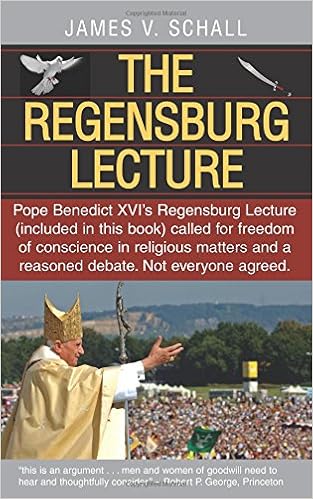
You also want to read about Benedict XVI’s amazing Regensburg Address with the help of James Schall.

US HERE – UK HERE

Here is the audio of the talk.

YouTube thumbnailYouTube icon

I haven’t been able to find a full video of the Address. Odd.

With Italian voice over:

YouTube thumbnailYouTube icon

Another with Italian voice over, but decent video.

YouTube thumbnailYouTube icon

Posted in Benedict XVI, The Drill, The Religion of Peace | Tagged , , , , ,
10 Comments

Would Millard Fillmore’s VP pick be preferable to Tim Kaine?

Taylor Fillmore posterAs I have often said and written, I would vote for the corpse of Millard Filmore (the last Whig President and an anti-Catholic No Nothing) to keep Hillary Clinton out of the White House. And now, with Tim Kaine (can. 915 NOW!) on the dem ticket, I would extend my preference for Fillmore’s cadaver also to Fillmore’s VP’s cadaver… except that Fillmore didn’t have one, that is, he didn’t have a VP.

Fillmore ascended (descended?) to the presidency upon the untimely death of Zachary Taylor (+1850) from a nasty gastric malady after eating, they say, iced milk and raw fruit. (Be wary of milkshakes!) There was a theory that he was assassinated with arsenic or some such. As a matter of fact, in 1991 they would dig him up, Taylor, that is, to test his remains for arsenic.  They determined that it wasn’t arsenic.  It was probably the gastroenteritis that got him after all. Gastroenteritis got him with the help of his doctors, of course.  They bled and blistered him and gave him massive doses of an emetic to induce vomiting called ipecac (I’ll bet that’s as nasty as it sounds), opium, quinine and calomel (aka mercury chloride) which was used as both a laxative and a horticultural fungicide. What could go wrong?

Yes… that paragraph, with its emetics and laxatives and gastric problems, the bitterness of the quinine and the delirium of opiates, surely sets the tone for what follows.

And now to Tim Caine, or, No. 2 (on the ticket).

Spotted at The Stream:

Catholic Church Will Change on Marriage, Kaine Tells Radical LGBT Group

WASHINGTON (AP) — Democratic vice presidential nominee Tim Kaine is predicting that the Roman Catholic Church may eventually change its opposition to gay marriage. [Can’t be done.]

Kaine is a Roman Catholic [catholic] as well as a U.S. senator from Virginia and a former governor of that state. He told the Human Rights Campaign during its national dinner Saturday in Washington that he had changed his mind about gay marriage and that his church may follow suit one day.  [Quisling.]

[Watch this!  You may need to squint in the sight of his theological brilliance.] “I think it’s going to change because my church also teaches me about a creator who, in the first chapter of Genesis, surveyed the entire world, including mankind, and said, ‘It is very good,’” Kaine said. He then recalled Pope Francis’ remark that “who am I to judge?” in reference to gay priests.  [This is little better than word salad.  Wasn’t it in Genesis that we read that God created man male and female?  Genesis 1 says:  “And God created man to his own image: to the image of God he created him: male and female he created them. And God blessed them, saying: Increase and multiply”,  Right?  God seems to have had a reason for the two sexes thing: increase and multiply.  What’s the old phrase?  God created Adam and Eve, not Adam and Steve.  No “increase and multiply” that way.  Kaine seems to have fallen into the trap that God made people homosexual and that the homosexuality is one of the things God said was good.]

“I want to add: Who am I to challenge God for the beautiful diversity of the human family? I think we’re supposed to celebrate it, not challenge it,” Kaine said.  [As an aside: Kaine was educated by Jesuits.  I’m just sayin’.]

While he pledged to fight for increased rights for lesbian, gay, bisexual, transgender and queer Americans, Kaine admitted that he had opposed gay marriage until 2005.  [What a guy.]

“For a long time while I was battling for LGBT equality, I believed that marriage was something different,” he said. Virginia’s lieutenant governor when state lawmakers pushed for a constitutional amendment to keep marriage between one man and one woman, he recalled speaking to amendment supporters who said they hoped LGBT people would feel so unwelcome that they would move out of Virginia.

“When I heard the proponents describe their motivations, it became clearer to me where I should stand on this,” he said.  [THAT’s a reason to change your mind about sodomy?]

[…]

Brilliant.

At the urging of Daniel Webster, Fillmore the Whig appointed the only Whig Supreme Court Justice: Benjamin Robbins Curtis.  If you are not a Whig, you might not have know that.  Don’t infer from this that I am a Whig, which would be Kaine/Jesuit/Fishwrap reasoning (= fallacious).  Here’s another interesting factoid.  Curtis, the first on the SCOTUS bench to have a degree from a law school, was one of only two Justices who dissented from SCOTUS Dred Scott v Sanford in 1857.  He was so put off by that decision that he resigned from the Court.

Fillmore’s pick for SCOTUS turned out to be not too bad!

Speaking of the SCOTUS and really bad decisions, I am convinced in my marrow that Hillary Clinton, if given the chance, would appoint disastrous Justices who will set the compass of the SCOTUS for a generation and more to the accelerated ruin of these USA.

Fillmore’s corpse would surely choose better Justices than either Hillary or Kaine.

And, in answer to the question I facetiously posed, Fillmore’s VP choice would also probably be better than Hillary’s.

Again…  I’m all in!

FILLMORE CORPSE
AND
[….]
2016!  

Posted in I'm just askin'..., Liberals, Lighter fare, Sin That Cries To Heaven, The Coming Storm, The future and our choices | Tagged , , , ,
42 Comments

ACTION ITEM! Norcia Earthquake Relief Effort

CLICK HERE

16_08_10_Norcia_ad

To donate CLICK HERE

Posted in ACTION ITEM! | Tagged ,
2 Comments

An interesting Sunday Mass on 11 September – Mass in Time of War

16_08_28_WI_Dells_consecration_01

Bp. Morlino blesses new shrine of St. Cecilia in the Wisconsin Dells.  Vestments lent by the Tridentine Mass Society of the Diocese of Madison.

Something a little unusual.  In the Diocese of Madison, His Excellency Most Reverend Robert C. Morlino (aka The Extraordinary Ordinary) has given permission to use, for the Novus Ordo, one of the “Masses for Various Needs and Occasions” on Sunday 11 September, such as the Mass for the Preservation of Peace and Justice (no. 30) or the Mass In Time of War or Civil Disturbance (no. 31).  Violet vestments would be used and the readings for the 24th Ordinary Sunday  can be used.  The General Instruction of the Roman Missal no. 374 allows the diocesan bishop to permit or direct the use of one of the “Masses for Various Needs and Occasions” on a Sunday in Ordinary Time.

For the Extraordinary Form, however, can this be done?  YES!

According to the 1962 rubrics, a votive Mass for a matters of public concern can be celebrated on a 2nd Class Sunday using violet vestments, without a Gloria but with a Creed (by reason of it being Sunday cf. 343).   Take a look at Rubrics 366-368 (De Missa votiva pr re gravi et publica simul causa) in the 1962 Missale Romanum.  The rule about Sundays is implicit in 341 where it says that Masses for Bride and Bridegroom and the 25th or the 50th Anniversaries of Marriage cannot be on a Sunday (meaning that the others can be).

So, at St. Mary’s in Pine Bluff (and I hope at other places in the diocese where the TLM is regularly celebrated), we will have the Mass in Time of War, with violet vestments, a Creed and no Gloria with commemorations of the 17th Sunday after Pentecost.

The schola will be prepared with the votive Propers:

  • IN. Reminiscere (Liber Brevior 184)
  • GR. Tu es Deus (LB 170)
  • AL. Eripe me (LB 324)
  • OF. Populum humilem (LB 322)
  • CO. Inclina (LB 320)
  • Common: Asperges. Mass XVII. Credo III. End: Salve Regina (simple).

Meanwhile, here is something for your listening pleasure as you surf about.

Posted in Liturgy Science Theatre 3000, The Coming Storm | Tagged , , , ,
5 Comments

How to pray the “Cursing Psalms” against our enemies

field daySaturdays are my field days.  I field strip my computers (scan, defrag, update etc.), police the Cupboard Under The Stairs, do laundry, try to fill up a garbage bag or two (that’s satisfaction), police both the fridge (especially on a wake-up) and my conscience.  Well, that last one I do everyday.  Which it ain’t easy in these days of political electioneering and ecclesiastical goat rodeos on nearly every front.

This morning a couple friends with whom I have an instant message group going – often hilarious – mentioned the “maledictory psalms”, also known as the “cursing psalms” and “imprecatory psalms”. They call for judgment and disaster to fall upon the enemies of God and God’s people.

Since I’ve been using the Bux Protocol™ a lot these days, the reference to the maledictory psalms got me thinking about posting on this difficult topic: how to pray for enemies.

Christ the Lord commanded us to love our enemies (Matthew 5:44).  And yet a couple dozen or so psalms – which all Christians can use for prayer – seem to wish some pretty dire things on our enemies.  And, yes, we have enemies.

Love for “enemy” can be expressed different ways.  Love for our enemies does not mean that we must hope that they prosper or succeed in their wicked ways.  Love, charity, means that we will their true good. We pray for their salvation.  We ask God to use the necessary corrections, chastisements, whatever, to punch through their pride and turn their minds and hearts, even if that means suffering unto loss of limb and life.

A standard list of the maledictory psalms will include – and alert that Psalms are numbered differently in various editions of Scripture and in newer and older books you might consult – 5, 6, 11, 12, 35, 37, 40 52, 54, 56, 58, 69, 79, 83, 137, 139, and 143.  Many of these psalms were “edited” or even wholly excluded from the revised psalter used in the Liturgy of the Hours.   However, there are lot’s of maledictions, curses and imprecations throughout the Psalter: 5:10; 6:10; 7:9-16; 10:15; 17:13; 18:40-42; 18:47; 26:4-5; 28:4; 31:17, 18; 35:3-8; 40:14; 54:5; 55:9, 19; 56:7; 58:6-10; 59:ll-15; 68:2; 69 (most of the psalm); 70:2-3; 71:13; 79:6, 12; 83:9-17; 104:35; 109:6-20; 129:5; 137:7-9; 140:8-11; 141: 10; 143:12; 149:6-9.  Of special note are Ps 55, 108, and 136 which give libs a serious case of the collywobbles (except perhaps if they use it against defenders of doctrine and law).

So, what to make of these psalms? First, since they are the inspired word of Almighty God, we can safely say that they are not bad and they can be used for prayer.   St. Augustine believed that every word of the Psalms was Christ speaking to the Father, but in different voices, as the Head, the Body and both together, Christus Totus.  I’ll go with Augustine.

That said, it might make the Christian scratch her head when we pray “Blessed be he that shall take and dash thy little ones against the rock” (Ps 137:9).

How to use these psalms in prayer in a way that is pleasing to God and that does not imperil our own salvation by spurring us to soul killing hatred?  Isn’t this a serious consideration in these times of aforementioned political circuses and ecclesial misadventure?

One of the best explanations of the maledictory psalms – and therefore how to pray for our enemies – I’ve run across came in a comment made on this very blog under another entry I wrote about the maledictory psalms (thanks Henry Edwards!). Namely, …

In the Introduction (by Pius Parsch) to the Baronius edition of the 1962 Roman Breviary [UK HERE], we read that

As Christians we may never wish evil upon a sinner directly and personally, but [NB] these [curse] psalms have nothing to do with personal enmities. The theme of all our praying is God’s kingdom and sin, and the curse passages in the psalms are expressions of absolute protest against evil, sin and hell. Try changing the curses into an expression of divine justice and you pronounce them no longer with your own mouth, but with the mouth of Christ and the Church. The curse thus resembles the woes that our Lord addressed against the Pharisees. There is something quite stirring and grand about these curses. The all-just God steps before us as we pray and warns us of the punishments of hell.  [NB: warns us!]

In regard to Psalm 108 (109)—perhaps the most maledictory of all the so-called curse psalms and omitted entirely from the LOH psalter—he says that

Psalm 108 is a curse formula and very difficult to reconcile with the Christian idea of prayer. Let us suppose that the Church or Christ Himself is praying this psalm. Then the curses become no longer wishes, but rather the solemn sentence of divine justice upon unwillingness to repent. With tears in her eyes the Church prays these terrible words–just as Jesus once declaimed his eightfold “Woe is you . . .” against the Pharisees. At the opening of the psalm, the Church laments. In the following two sections, where curses and punishments are asked for, a picture of the everlasting hell is painted for us. The petition which comprises the fourth part of the psalm can be a prayer of the individual soul; I stand terrified before the picture I have seen: “Have mercy on me, a poor weak mortal!”.

While there is a great deal more to be said about the maledictory psalms, that seems a good place to pause so that I can do my job and admonish you.

We members of the Church Militant have enemies.  There are the relentless, ineluctable foes which are the world, the flesh and the Devil.  There are also the agents of the Devil among us, outside the Church and, verily, inside.

We must strive not to hate enemies, to love enemies with the love that is charity, the love that desires what is truly good for them.  If they are doing great harm to our persons, families, nation and Church, yes, we can pray for their conversion or for their ruin lest they continue to do harm and lest they go to Hell.  For example, HERE. And while we pray for and against our enemies (and bear wrongs patiently), we must see to it that we don’t go to Hell, either.

As we soldier on through this vale of tears, we must constantly field strip our consciences while asking God for all the graces we need to do His will and to conform ourselves to His will and ways.

And now, from St. Paul’s Second Letter to Timothy 3:11-17:

Persecutions, afflictions: such as came upon me at Antioch, at Iconium, and at Lystra: what persecutions I endured, and out of them all the Lord delivered me.  And all that will live godly in Christ Jesus, shall suffer persecution.  But evil men and seducers shall grow worse and worse: erring, and driving into error.  But continue thou in those things which thou hast learned, and which have been committed to thee: knowing of whom thou hast learned them;  And because from thy infancy thou hast known the holy scriptures, which can instruct thee to salvation, by the faith which is in Christ Jesus. All scripture, inspired of God, is profitable to teach, to reprove, to correct, to instruct in justice, That the man of God may be perfect, furnished to every good work.

Finally, since I am trying to fulfill my mission to keep as many of you out of Hell as I can…

GO TO CONFESSION!

Posted in "How To..." - Practical Notes, GO TO CONFESSION, Hard-Identity Catholicism, Preserved Killick, The Drill, What are they REALLY saying? | Tagged , , ,
21 Comments

PARIS: Notre Dame Terror Suspect Engaged To Murderer of Fr. Hamel

This is interesting.

Remember, this is coming your way wherever you are.

From Sky News:

Paris Terror Plot Suspect Was Engaged To Priest Killer

A woman accused of plotting a Paris rail station bombing was legedly linked to a man behind a deadly church attack.

One of the women arrested over a foiled terror attack in Paris had been engaged to a man who slit a priest’s throat, it has emerged.

Adel Kermiche, 19, murdered Father Jacques Hamel, who was in his 80s, during a morning mass in July.

Kermiche and his accomplice Abdelmalik Petitjean were then shot by police as they left the church in Saint-Etienne-du-Rouvray, Normandy, using nuns as human shields.

On Friday, Paris prosecutor Francois Molins said the detained woman, referred to as Sarah H, was also betrothed to another extremist who carried out a deadly attack in June.

Larossi Abballa killed two police officials in Magnanville and filmed the aftermath on Facebook Live before being shot dead in a raid on his home.

Sarah H’s current fiance was arrested on Thursday, Mr Molins said.

She and two other females – one a teenager – were detained after a car full of gas cylinders was discovered close to Notre Dame Cathedral in the French capital on Sunday morning.

The Peugeot 607 also contained three jerry cans of diesel and was found with its hazard lights on.

The three women are accused of planning to attack a railway station in Paris this week.

Mr Molins said the suspects were guided by Islamic State (IS) commanders in Syria.

“The terrorist organisation uses not only women, but young women, who get to know them and develop their plot from a distance,” he told a news conference.

An interior ministry statement said: “An alert has been issued to all stations but they had planned to attack the Gare de Lyon on Thursday.”

The youngest of the women, Ines Madani, 19, is said to have written a letter pledging allegiance to IS.

Shouts of ‘Allahu Akbar’ – Arabic for God is Greatest – can be heard on video footage of the women’s arrests.

Madani apparently stabbed a police officer in the leg before being shot and wounded. She is being treated in hospital.

[…]

There’s more.

Sts. Nunilo and Alodia, pray for us.
St. Lawrence of Brindisi, pray for us.
St. Pius V, pray for us.
Martyrs of Otranto, pray for us.
St. Michael the Archangel, defend us in battle.
Our Lady of Victory, intercede for us with your Divine Son.

Posted in The Coming Storm, The future and our choices, The Religion of Peace | Tagged , , ,
6 Comments

Pope Francis writes to a bishop about the proper interpretation of Chapter 8 of #AmorisLaetitia

pope francis pointingPope Francis wrote to the Bishop of San Miguel of his old haunts Argentina, about the proper interpretation of Chapter 8 of the Post-Synold Apostolic Exhortation Amoris laetitia.
Let’s test your Spanish.

Via InfoCatólica with my emphases:

Carta del Papa Francisco en respaldo a los criterios de aplicación del capítulo VIII de «Amoris laetitia»

Vatícano, 5 de septiembre de 2016

Mons. Sergío Alfredo Fenoy
Delegado de la Regíón Pastoral Buenos Aires [He is Bp. of San Miguel but also the Delegate for the Pastoral Region of Buenos Aires.  I don’t fully understand the role of the Pastoral Regions.  Do they relate to other regions in Argentina or to the CELAM?  But I digress.]

Querido hermano:

Recibí el escrito de la Región Pastoral Buenos Aires «Criterios básicos para la aplicación del capítulo VIII de Amoris laetítia». Muchas gracias por habérmelo enviado; y los felicito por el trabajo que se han tomado: un verdadero ejemplo de acompañamiento a los sacerdotes… y todos sabemos cuánto es necesaria esta cercanía del obispo con su clero y del clero con el obispo. El prójimo «más prójimo» del obispo es el sacerdote, y el mandamiento de amar al prójimo como a sí mismo comienza para nosotros obispos precisamente con nuestros curas.

El escrito es muy bueno y explícita cabalmente el sentido del capítulo VIII de Amoris laetitia . No hay otras interpretaciones. Y estoy seguro de que hará mucho bien. Que el Señor les retribuya este esfuerzo de caridad pastoral.

Y es precisamente la caridad pastoral la que nos mueve a salir para encontrar a los alejados y, una vez encontrados, a iniciar un camino de acogida, acompañamiento, discernimiento e integración en la comunidad eclesial. Sabemos que esto es fatigoso, se trata de una pastoral «cuerpo a cuerpo» no satisfecha con mediaciones programáticas, organizativas o legales, si bien necesarias. Simplemente acoger, acompañar, discernir, integrar. De estas cuatro actitudes pastorales, la menos cultivada y practicada es el discernimiento; y considero urgente la formación en el discernimiento, personal y comunitario, en nuestros Seminarios y Presbiterios.
Finalmente quisiera recordar que Amoris laetitia fue el fruto del trabajo y la oración de toda la Iglesia, con la mediación de dos Sínodos y del Papa. Por ello les recomiendo una catequesis completa de la Exhortación que ciertamente ayudará al crecimiento, consolidación y santidad de la familia.

Nuevamente les agradezco el trabajo hecho y los animo a seguir adelante, en las diversas comunidades de las diócesis, con el estudio y la catequesis de Amoris laetitia.

Por favor, no se olviden de rezar y hacer rezar por mí.
Que Jesús los bendiga y la Virgen Santa los cuide.

Fraternalmente,

Francisco

A careful and thoughtful reading of this letter produces neither heat nor light.

First, this is not to the bishops of Latin America, but to one bishop.  It seems that in Buenos Aires they are giving Communion to the divorced and remarried.  But that isn’t really addressed in the letter, except by some sort of inference.  This isn’t a smoking gun either for the liberals or conservatives, for dissidents or the faithful.  It is written in a code. For example, “Simplemente acoger, acompañar, discernir, integrar.”  What do those words really say?  They are simply not so simple.

In any event, just watch.  Dissenters and libs will get their sweaty hands on this and, in the throes of a hyperparoxsysmic spittle-flecked nutty of elation, claim that the Pope told the entire body of bishops of the CELAM – nay, rather, the whole world – that they must give Holy Communion to the divorced and remarried.

As I have stated before, those who are faithful to the Church’s teachings will probably continue to do what they did before the advent of Amoris laetitia and dissenters and liberals will continue in their own way as well.

The Pope doesn’t not change doctrine or discipline in letters to individual bishops nor in off-the-cuff remarks during airplane pressers.  As one of my priestly friends quipped, in a jocular moment, “The Holy Father is the Vicar of Christ on earth.”

After all, as Card. Müller stated both clearly and accurately in a speech in Madrid, Pope Francis did not intend in any way to cancel the previous discipline, because “if he had wanted to eliminate such a deeply rooted and significant discipline (i.e., no Communion for those living in manifestly, objectively sinful situations), he would have said so clearly and presented supporting reasons,” … something he did not do.  In other words, if the Pope wants to change something, he knows how to do it properly.   HERE

Remember: Our study of Amoris laetitia must be done through the lens of the Church’s whole magisterial body of perennial, previous teaching, including but not limited to the Catechism of the Catholic Church and Familaris consortio.

Also, may I recommend once again this supremely useful tool?  Priests, especially, should have it.  I have heard that some priests are using this book with great effect in their preparation of couples for matrimony.


Now in TEN languages!

US HERE – UK HERE  – ITALY HERE

Comment moderation queue is ON, as you might guess it would be.

UPDATE 12 Sept:

Interesting.

Screen Shot 2016-09-12 at 10.49.05


Posted in Francis, One Man & One Woman | Tagged ,
24 Comments

Just Too Cool: Medieval Cathedral of Amiens was decorated in bright colors

Church architecture reflects the belief of the people, their ecclesiology, what they believe about the Church (or at least what their pastors believe).

Compare churches built by our forebears and the structures built these days, hardly to be distinguished from municipal airport terminals.

I saw this super cool info at ChurchPop.

When the exterior of the Cathedral Basilica of Our Lady of Amiens in France was cleaned, it was found that it was decorated in bright colors.

Wow! Medieval Cathedrals Used to Be Full of Brilliant Colors

For being the “dark ages,” medieval Europeans were sure able to produce some of the world’s most beautiful and intricate buildings ever made.

It turns out they were even more beautiful than we knew.

First, here’s a picture of how the Cathedral Basilica of Our Lady of Amiens in France looks today:

Back in the 1990s, there was a cleaning program underway on the exterior. Midway through the project, scientists discovered something pretty intriguing on the western facade: traces of paint. Further tests were done, and they were able to determine how the western facade was painted back in the 13th century! Then they figured out a way to project the light of the colors very precisely onto the building.

The result? A breath-taking view of how the cathedral looked when it was first finished.

[…]

Posted in Just Too Cool | Tagged
23 Comments