QUAERITUR: Should priests be appointed for six year terms?

From a reader:

I am curious about the appointment of pastors (specifically diocesan priests). The bishop in the diocese I grew up in (usually) assigns pastors for life. The bishop of the diocese I now live in assigns them to six year terms which can be renewed for an additional 6 years. What does canon law say about this matter? I can see advantages to both systems.

Thank you for your service to the Church!

In the universal (Latin) law, pastors (parish priests) are appointed “for an indeterminate period of time,” (can. 522) and can only be removed for specific reasons and following a set procedure for doing so (canons 1740-1752). However, canon 522 does permit the Bishops’ Conference to establish a “specified period of time” for a pastor’s term of office. In the United States, the Bishops’ Conference set the norm that pastors can be appointed either indefinitely, or “to a six year term of office. The possibility of renewing this term is left to the discretion of the diocesan bishop.” This norm was approved by the Holy See and promulgated on 24 September 24 1984.

In my opinion the notion of a “term” for a pastor is an unhealthy thing overall.

It seems to me that the main reason for term-limits is to relieve the bishop from having to deal with conflict.

If a pastor is ineffective, or problematic, or simply ill-suited to that particular parish, the juridical procedure for removing him from office is fairly straight-forward.  However, it the procedure allows a pastor to argue his case as to why he should not be moved. The bishop then has to make a decision about how to proceed.  Press and fight or compromise? He is forced to deal with an unhappy pastor.

With the term-limited-pastor scenario, all a bishop has to do is wait out the problematic priest and then inform him that be is being moved. No room for discussion. No appeal.  No loose ends. No conflict.  Easy peasy.  Great for the bishop.

Good for the priest and parish?  Probably not.

Term-limits, from what I understand from priests who are pastors of parishes, undermine the priest’s ability to develop a sense of spiritual fatherhood in regard to his parish. If he’s only going to be there for six years, he spends one or two years settling in, finding the keys, learning the streets, etc.  He spends a couple years actually “pastoring” the place. Then he figures he’ll be moved and starts hesitating about undertaking projects.  He starts getting in head and heart ready to move.

Think of how long it took St. John Vianney to put his “pastoral program” into effect in Ars.  What would have happened had he only been there for six years?

Furthermore, the term-limit gives people the impression that the priest really isn’t running the parish.  The priests come and go, but the parish secretary, book keep, council, liturgist, etc., stay.  Who is running the place?  Not the priest, apparently.

I know priests who say that they think are getting to know the place well when they start baptizing the children of the first children they baptized.

I also have the impression that more priestly vocations come from parishes were there has been stability in the pastorate.  In my own case, Msgr. Schuler was at St. Agnes for 33 years as pastor.  In that time, there were 30 First Masses at St. Agnes.  Coincidence?  I think not.

Pros? Yes. A few.  Cons? More.

Thumbs down.


Posted in ASK FATHER Question Box, Our Catholic Identity, Priests and Priesthood, The Drill | Tagged , , , ,
41 Comments

QUAERITUR: Are priests required to wear clerical dress at all times?

From a reader:

Are preist required to wear them at all times?
Im sure you’ve been asked this before. I’m a new reader I cant find the answer on your blog. I’ve tried for two months. Can you answer or refer me to it? Thank you. P.S I really like your site.

I have indeed written about this.

No… and yes.

I’ll explain.

First, let it be said that  there is a relationship between habitus  (dress) and habitus (character, disposition).  This is one reason why Holy Church does lay down some guidelines for priests without making them iron-clad dictates.  They are for the good of the priest himself and for the good of the Catholic people and for the good of society as a whole.

At all times?  Let’s make some distinctions.  When I, a cleric, put on clothing, it is therefore clerical clothing insofar as I, a cleric, am wearing it.  But that is not what you mean.  Moreover, most clerics I know don’t wear clerical clothing when sleeping or bathing or swimming, etc.  We are not, after all, old-school jansenistic Sulpicians who required that sort of thing.  I have worn a cassock when riding a bicycle… carefully.

Let’s see some guidelines.

The Directory for the Ministry and Life of Priests, issued in 1994 by the Congregation for the Clergy and approved by Pope John Paul II states:

In a secularized and tendentiously materialistic society, where even the external signs of sacred and supernatural realities tend to be disappearing, the necessity is particularly felt that the priest – man of God, dispenser of His mysteries – should be recognizable in the sight of the community, even through the clothing he wears, as an unmistakable sign of his dedication and of his identity as a recipient of a public ministry. The priest should be recognizable above all through his behavior, but also through his dressing in a way that renders immediately perceptible to all the faithful, even to all men, his identity and his belonging to God and to the Church.

For this reason, the cleric should wear “suitable clerical clothing, according to the norms issued by the Episcopal Conference and according to legitimate local customs.” (Canon 284) This means that such clothing, when it is not the cassock, [NB: the cassock is the norm, the default, for the whole Latin Church.] should be distinct from the manner in which laymen dress, and in conformity with the dignity and sacredness of the ministry.

Apart from entirely exceptional circumstances, the non-use of clerical clothing on the part of the cleric can manifest a weak sense of his own identity as a pastor completely dedicated to the service of the Church (# 66).

On 18 November 1998, the Latin Rite de iure members of the National Conference of Catholic Bishops (now the USCCB) approved complementary legislation for canon 284 of the Code of Canon Law for the Latin Rite dioceses of the United States. This was granted recognitio by the Holy See.

Complementary Norm: The National Conference of Catholic Bishops, in accord with the prescriptions of canon 284, hereby decrees [So, this is not merely a recommendation.] that without prejudice to the provisions of canon 288 [“Permanent deacons are not bound by the provisions of canon 284”], clerics are to dress in conformity with their sacred calling.

In liturgical rites, clerics shall wear the vesture prescribed in the proper liturgical books. [NB:] Outside liturgical functions, a black suit and Roman collar are the usual attire for priests. The use of the cassock is at the discretion of the cleric. [This is interesting, because of the history of the use of the cassock in the USA.  And I believe it is still illegal to wear a cassock in England.]

In the case of religious clerics, the determinations of their proper institutes or societies are to be observed with regard to wearing the religious habit.

As President of the National Conference of Catholic Bishops, I hereby decree that the effective date of this decree for all the Latin Rite dioceses in the United States will be December 1, 1999.

Given at the offices of the National Conference of Catholic Bishops in Washington, DC, on November 1, 1999.

Most Reverend Joseph A. Fiorenza
Bishop of Galveston-Houston
President, NCCB

Reverend Monsignor Dennis M. Schnurr
General Secretary

“Usual” attire. There are, of course, reasonable exceptions to wearing the black suit and military collar (that’s what it is, by the way, a development of the collar of old military uniforms) or cassock.

The cassock remains the proper dress of a Catholic priest in all circumstances everywhere, though regional/culture differences are taken into account.  Moreover, the color of clerical garb will vary from region to region.  In hot countries, white can be used.  In Italy the bishops conference approved black, dark blue, and gray.

There can be particular law established by the local bishop.  In Rome, for example, John Paul II directed his Vicar General for the Diocese of Rome, Cardinal Poletti, to issue a decree that all secular priests in Rome must wear the cassock and religious their proper habits.  This was pretty much ignored, but the law is on the books.

Moreover, a priest should know what clerical garb to wear in each circumstance.  These days, Father can get by even at a formal occasion by wearing a black suit and Roman, military collar, usually with a shirt having doubled cuffs and links.  However, the proper dress for a formal occasion (“black tie”, “white tie”, “evening wear”, etc.) would really be the appropriate house cassock and sash and ferraiolo.

The custom of the U.S. was not for the secular priest to use the cassock in public, on the street as it were.  This is from the time of great anti-Catholicism in the USA.  A Council of Baltimore determined that priests would instead wear the frock coat.  The older generation of priests I was formed by instilled in me a resistance to wearing the cassock around town in the USA.  I pretty much lived in my cassock in Rome.  I note with interest that some young American priests these days are using the cassock as their street dress too.

Of course there are reasonable exceptions to wearing your “clerics”.  If I am going to climb a ladder to fix a window, or change the oil in the car, or hide as a fugitive from Obama’s Domestic Security Force during his administration’s fourth term, I won’t wear clerical clothing.  If I am going to be with a non-formally convened group priests only, depending on the reason for the gathering, I go in mufti, to borrow a military term.  When I do some heavy cooking, I wear clothes I can get dirty and that will protect me from burns, hot spills, etc.  As a matter of fact, sitting here in my B.O.Q. – aka The Steam Pipe Trunk Distribution Venue – as I bash away at my keyboard, I have on blue jeans and a t-shirt.  My Duluth Trading Company t-shirt and my Bates 8″ Durashock boots are both black, however!  Does that count?

Remember: There are good priests who are lax in wearing their clerical clothing in public and there are bad priests who wear it all the time.

Don’t rush to judgment about priests in this regard.

I would pay more attention to whether or not they hear confessions, say Mass properly, preach well, etc.

Posted in "How To..." - Practical Notes, ASK FATHER Question Box, New Evangelization, Our Catholic Identity, Priests and Priesthood | Tagged , ,
49 Comments

Brick by Brick in Brazil … Indiana. Priest starts up a TLM. People come.

For your Brick by Brick file,

Fr. John Hollowell in the Archdiocese of Indianapolis at his blog On The Rock says he has started celebrating Holy Mass in the Usus Antiquior of the Roman Rite… once a week.

I quibble with him calling it the “Latin Mass”, because the Novus Ordo can and ought to be said in Latin. But, that aside, his news is positive.

He has several videos in his blog entry.  In one of them, you can hear that the congregation is making the responses during the prayers at the foot of the altar.  Some of you will pounce on that.  That is a discussion for a different entry.  No rabbit holes.  This is about the happy event of a priest starting up the TLM in a parish.

He also says:

We’ve had a great turnout so far – we probably have two or three times the number of regular daily Mass attendees who come out for the Mass in Latin.

This is a concrete step for the New Evangelization.

Friends, I think we will be seeing more and more of this.

If the implementation of Summorum Pontificum has been slower than some would prefer, more and more young priests, the newly ordained, seminarians are interested in saying the older form of Holy Mass.  As they get ordained and as they are made pastors of parishes, we will see quite a few more places where TLM is celebrated.

The gravitational pull will increase even as the biological solution clears the way.


Posted in "How To..." - Practical Notes, Brick by Brick, Liturgy Science Theatre 3000, Mail from priests, New Evangelization, Our Catholic Identity, SUMMORUM PONTIFICUM | Tagged , ,
20 Comments

Beautiful “Adoration of the Magi” by artist Daniel Mitsui

As Christmas approaches, the esteemed artist Daniel Mitsui sent me another print, this time of the Adoration of the Magi. Very nice!

20121114-100915.jpg

A few details.

It was inspired by a 15th c. panel by the Master of the AH Monogram.

The Circumcision is depicted in the upper left.

20121114-100922.jpg

There is a millefleur pattern inspired by late-Medieval tapestry.

20121114-100927.jpg

He followed Ven. Bede’s explanation of the wisemen as representing all the races.

20121114-100932.jpg

I’m glad he included the critters.

20121114-100937.jpg

There are lots of great little details, such as OT foreshadowings of the Adoration by the Magi: three heroes bringing water to David, The Queen of Sheba at Solomon’s throne.

Beautiful colors.  As usual the photos don’t do them justice.

This would make a great Christmas present for someone (including yourself).

Contact Mr. Mitsui HERE.  Check out the other great religious art he has made.

Posted in Just Too Cool, The Campus Telephone Pole | Tagged , , ,
11 Comments

New bishop of Lincoln will maintain tradition

From Omaha.com

A new take on tradition for incoming Lincoln bishop
By Joe Duggan
WORLD-HERALD BUREAU

LINCOLN — He’s got folk rockers Mumford & Sons and the Avett Brothers on his iPod.

He’s on Twitter and Facebook.

And he’s passionate about poetry, art and classical English literature.

But when it comes to Roman Catholic doctrine, Lincoln’s incoming bishop says he’s ready to carry the torch of his predecessors who have made the Lincoln Diocese one of the most traditional in the country.

“The Diocese of Lincoln has never suffered an identity crisis,” said Auxiliary Bishop James Conley of the Denver Archdiocese. “In other words, the church in Lincoln has always known who she is. People want to be a part of this because people want to know where the church stands.”

The 57-year-old native of Overland Park, Kan., will be installed Nov. 20 as the ninth bishop of Lincoln, a diocese that includes 96,000 Catholics in 135 parishes across southern Nebraska.

He will replace retired Bishop Fabian Bruskewitz, 77, who led the diocese for two decades.

The diocese is known for traditional church practices, such as boy-only altar servers and distributing Communion in the form of consecrated bread, not, as a general rule, from the cup. And unlike in many other Catholic churches, women in the Lincoln Diocese are not permitted to give the Eucharist to their fellow worshippers.

Conley said he has no plans to change those practices.

Bruskewitz, who has said he strove to preserve the “undistorted” Catholic faith, also made decisions and took actions that generated controversy.

For example, in 1996, he excommunicated Catholics who belonged to a list of 10 organizations he said opposed fundamental church teachings, such as opposition to abortion, gay marriage and assisted suicide. Among the listed groups were Planned Parenthood and Call to Action, an organization seeking church reforms such as ordination of women.

The excommunications will remain in force, Conley said.

“It can have a medicinal purpose,” Conley said. “The purpose is to not cut them off, but to persuade them to come back.”

[…]

The incoming bishop said he also wants to keep and strengthen the impressive track record Lincoln has in promoting vocations to the priesthood and the religious life. With 44 men currently studying for the priesthood, the diocese has the highest ratio of seminarians to Catholics in the nation, he said.

[…]

Posted in Brick by Brick | Tagged , ,
16 Comments

Ed Peters on civil effects of Church marriages

The Canonical Defender, the distinguished Ed Peters, has some comments on his fine blog In The Light Of The Law about civil consequences of Catholic marriage ceremonies. In the USA marriage ceremonies are also the civil act. In Italy, there are two steps, ecclesiastical and civil.

Some first thoughts on Weigel’s call to reconsider civil consequences for Catholic weddings

November 14, 2012

George Weigel writes in a thought-provoking essay that we should, among other things, “accelerate a serious debate within American Catholicism on whether the Church ought not pre-emptively withdraw from the civil marriage business, its clergy declining to act as agents of government in witnessing marriages for purposes of state law.”

Okay, a few thoughts toward that acceleration.

First for precision: the Church is not in the civil marriage business, we are in the religious marriage business. [Bingo.] Our clergy act fundamentally as ecclesiastical officers at our weddings. The few clerics who from time to time (notwithstanding 1983 CIC 285 § 3) attempt to act as purely civil agents at weddings do so with virtually no canonical support. See e.g., CLSA Advis. Op. 1984-55 Provost, CLSA Advis. Op. 1988-98 Wallace, and CLSA Advis. Op. 2005-76 Jorgensen (all rejecting civil-only agency) vs. CLSA Advis. Op. 1987-128 Cuneo (who leaves open a small possibility for such service).

Second and more important, it is not strictly speaking for the Church to “withdraw” from “civil marriage”, for the decision to accord civil recognition to ecclesiastical ceremonies like weddings is the State’s to make, not the Church’s. [hmmm…. well… a bishop could, probably, decide to tell his priests not to do anything with civil marriage papers/licences.] As Catholics we do what we do, namely, solemnize weddings as we think fit, while the State does what the State does, namely, accord civil recognition to those events (like, e.g., letting spouses file joint tax returns and inherit property) as it thinks fit. Now, I grant it’s very convenient for the State to recognize Catholic weddings, but if the State decides not to do so, well, okay.* Catholics are still going to marry in the eyes of the Church and ecclesiastical consequences will still flow from such religious acts—or not, as the case may be—but, in any event, independently from whether the State chooses to recognize that ceremony. In short, I’m not sure how the Church can “withdraw” civil recognition of its ceremonies or, for that matter, demand it. [Again, can’t a bishop tell priests not to do anything with civil paperwork?]

It is painful, of course, to watch the State’s definition of marriage careen toward something unrecognizable under natural or ecclesiastical law, but eliminating true marriages from the pool of unions treated as marriage by the State is not the solution to the State’s errors. [Hmmm… could it keep us from being sued by homosexual activists who want to harass the Church into obedience?] Moreover, if the day arrives wherein State power is turned against a pastor who refuses a “gay wedding”, we must and will refuse cooperation with that simulation of a sacrament (e.g. 1983 CIC 841, 1379) as best we can (e.g. 1983 CIC 1370 § 3, 1373). But, that day has not arrived yet [It will.] and I see no need to surrender societal goods (such as the convenience, and even meetness, [!  For those of you from Fridley, that means “suitability”, “propriety”.] of civil recognition of Catholic weddings) that have not yet been demanded of us.

Third, the Church’s interest in marriage predates and transcends the State’s, obviously, but the Church nevertheless recognizes the legitimate interests of the State in marriage and tries, in a myriad of ways, to accommodate those interests (see e.g. 1983 CIC 1071 § 1, n. 2). Sorting through those modi vivendi is not something for individuals to take upon themselves and to accelerate this discussion is not to go pedal-to-the-metal, folks! (Weigel did not suggest that, but we are posting before a public that does not always observe his prudence).

Fourth . . . well, there are several other aspects of this matter that need to be discussed, but this is just a blog post, and one can’t cover everything. + + +

* The American State does not recognize ecclesiastical annulments (even those declared on grounds identical to the State’s) yet no one seem the worse off for it. Canonists disagree, by the way, about whether the Church should grant canonical recognition to civil annulments. See e.g. CLSA Advis. Op. 1995-84 Ingels and CLSA Advis. Op. 1988-100 Provost (arguing yes) vs. CLSA Advis. Op. 1995-86 McKenzie (arguing no); either way, though, the granting of ecclesiastical effects to civil actions is clearly the Church’s decision to make, not the State’s. Mutatis mutandis, I suggest it is for the State to decide whether to grant civil effects to Catholic weddings.

It WILL happen that homosexuals harass the Church with law suits.  A foreshadowing was certainly the way poor Fr. Guarnizo was set up and then thrown to the wolves.  It is just a matter of time.

Again, could not bishops determine that priests will not concern themselves with any of the civil paperwork?  I don’t know.


Posted in One Man & One Woman, Our Catholic Identity, The Drill, The future and our choices | Tagged , , ,
42 Comments

Russian Orthodox Metropolitan’s grim letter to the new Anglican Archbishop of Canterbury

Here is the Russian Orthodox Metropolitan Hilarion’s letter to the new Anglican Archbishop of Canterbury:

Dear Brother and Lord Bishop,
I would like to extend to you wholehearted congratulations on your election as Head of one of the oldest episcopal chairs founded by St. Augustine of Canterbury in the 7th century. [Problematic statement, that, since Anglican bishops aren’t really bishops at all … but let’s go on.]
You have been entrusted with the spiritual guidance of the entire Anglican Communion, a unique [shrinking] union of like-minded people, which, however diverse the forms of its existence in the world may be, needs one ‘steward of God’ (Tit. 1:7) the guardian of the faith and witness to the Truth (cf. Jn. 18:37).
The Russian Orthodox Church and the Churches of the Anglican Communion are bonded by age-old friendly relations initiated in the 15th century. [! Indeed.] For centuries, our Churches would preserve good and truly brotherly relations encouraged both by frequent mutual visits and established theological dialogue and certainly by a spirit of respect and love which used to accompany the meetings of our hierarchs, clergy and ordinary believers [, and anti-papists].
[Watch this…] Regrettably, the late 20th century and the beginning of the third millennium have brought tangible difficulties in relations between the Russian Orthodox Church and the Churches of the Anglican Communion. The introduction female priesthood and now episcopate, the blessing of same-sex ‘unions’ and ‘marriages’, the ordination of homosexuals as pastors and bishops – all these innovations are seen by the Orthodox as deviations from the tradition of the Early Church, which increasingly estrange Anglicanism from the Orthodox Church and contribute to a further division of Christendom as a whole.
We hope that the voice of the Orthodox Church will be heard by the Church of England and Churches of the Anglican Communion, and good fraternal relationships between us will revive.
I wish you God’s help in your important work.
“May the God of love and peace be with you” (2 Cor. 13:11).
+Metropolitan Hilarion of Volokolamsk

A little grim, but, hey… who can deny that Anglicans are going off the cliff?

Benedict XVI is the Pope of Christian Unity.

Posted in "How To..." - Practical Notes, Pope of Christian Unity | Tagged , , , ,
16 Comments

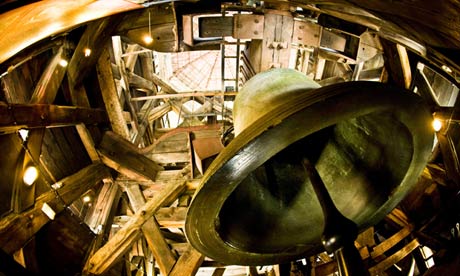
Notre-Dame de Paris to change its bells!

From The Guardian:


Notre Dame's famous Emmanuel bell - not one of those being replaced - rings in the south belltower of the Paris cathedral. Photograph: Peter Barritt/Alamy

Ding dang … Notre Dame moves to scrap out-of-tune bells

Paris cathedral’s move to replace its old bells with new ones for its 850th anniversary fails to chime with heritage lobby

Their names sound pretty enough – Angélique-Françoise, Antoinette-Charlotte, Hyacinthe-Jeanne and Denise-David – but the noise they make together has been described as “discordant” and enough to drive Quasimodo deaf all over again.

Some have gone as far as to call them cheap, old and ugly.

Thus, there were expected to be few tears shed when the four bells, whose tolling has marked the march of time and a funereal adieu for the great and good at Notre Dame cathedral for 156 years, were taken from their belfry and consigned to the scrapheap.

Made and hung in 1856 to replace those torn from the cathedral during the French Revolution and melted down to make cannon – a fate that befell 80% of France’s church bells at the time – they were, declared the French campanologist and music expert Hervé Gouriou, “one of the most dreadful sets of bells in France … damaged and badly tuned”.

To mark the cathedral’s 850th anniversary next year, a new set of eight bells, intended to recreate the sound of the 18th-century bells made famous by Victor Hugo’s fictional Hunchback of Notre Dame, are being struck at a foundry in Normandy.

Now, however, dozens of cultural associations from France and abroad and at least one religious group have been going like the proverbial clappers to stop the bells being destroyed.

Father Alain Hocquemiller, the prior of a religious community in Normandy, went as far as to bring in the bailiffs to serve a legal notice to save them. He claims he was prompted to act after learning of plans to declassify the bells and melt them down for scrap.

Under a law dating back to 1905, Notre Dame belongs to the French government, which gives the Catholic church the exclusive right to use it, so the bells, which weigh between 767kg and 1.91 tonnes each, belong to the state.

“I consulted a lawyer who told me it was the gratuitous destruction of France’s religious heritage and that’s not allowed by law,” Hocquemiller told reporters.

The four grandes dames are currently at the French bell foundry Cornille-Havard, which is making the new bells using medieval methods, including pouring bronze into moulds made from clay, horse manure and horsehair. They will be named after eight important figures in French history, with the design reflecting their namesakes.

Notre Dame’s great south tower bell, the 13-tonne Emmanuel installed in 1685 and widely considered the most remarkable in Europe – which rang for the coronation of kings and to mark the end of the two world wars – was cut down by revolutionaries, but escaped destruction and was rehung on the orders of the Emperor Napoleon in 1802.

Father Patrick Jacquin, rector and archpriest at Notre Dame, told Le Parisien newspaper: “Forty cultural organisations have requested the dilapidated bells, but they don’t belong to the church. End of story.

“The bells are not for sale, not for destruction, not for melting down. On 2 February 2013 we will unveil eight new bells that will be blessed. Everything we have done has been in the open, nothing is hidden.”

He added: “This isn’t the first time the cathedral is the theatre for stories and fantasies, but given the choice, I prefer those of Victor Hugo.”

Did you that the blessing of a bell is not, traditionally, not like other blessings.  It is far more complex.  It is usually done by a bishop.  It is actually referred to as a “baptism”.  Bells are given names, like people. They speak with a voice.

In the Roman Ritual there is a blessing for any old bell.  Bells for church use are consecrated with a rite in the Roman Pontifical.  Here is one of the blessing prayers from the Roman Ritual:

The priest puts incense into the thurible, and sprinkles the bell with holy water while walking around it. While he does so the choir sings the Asperges. Then he incenses it, again walking around it, as the choir sings the following antiphon (for the music see the music supplement):

Antiphon: Lord, let my prayer come like incense before you.

Then the celebrant continues:

Let us pray.

O Christ, the almighty ruler, as you once calmed the storm at sea when awakened in the boat from the sleep of your human nature, so now come with your benign help to the needs of your people, and pour out on this bell the dew of the Holy Spirit. Whenever it rings may the enemy of the good take flight, the Christian people hear the call to faith, the empire of Satan be terrified, [Can you imagine a phrase like that in the dreadful, watered-down Book of Blessings?] your people be strengthened as they are called together in the Lord, and may the Holy Spirit be with them as He delighted to be with David when he played his harp. And as onetime thunder in the air frightened away a throng of enemies, while Samuel slew an unweaned lamb as a holocaust to the eternal King, so when the peal of this bell resounds in the clouds may a legion of angels stand watch over the assembly of your Church, the first-fruits of the faithful, and afford your ever-abiding protection to them in body and spirit. We ask this through you, Jesus Christ, who live and reign with God the Father, in the unity of the Holy Spirit, God, forever and ever.

All: Amen.
P: To the honor of St. N.

All: Amen.

If the bell is for a consecrated church, there is a Rite in the Roman Pontifical.

Also, here is something from the Catholic Encyclopedia:

Points of law

In medieval England it was distinctly laid down that the church bells and ropes had to be provided at the cost of the parishioners. The canon law assumed that cathedral had five or more bells, a parish church two or three, while the churches of the medicant orders, like public oratories, were originally limited to one. The solemn ceremony of benediction provided in the Pontifical can only be carried out by a bishop or by a priest specially empowered, and it is only to be employed in the case of bells intended for church use. For other bells, a simpler blessing is provided in the “Rituale”. Numerous prohibitions exist against the church bells being used for “profane” purposes, e.g. for summoning meetings or for merely secular festivities and in particular for executions. In Catholic ecclesiastical legislation the principle is maintained that the control of the bells rests absolutely with the clergy. In cathedral churches according to the Cermoniale Episcoporum” this jurisdiction is vested in the Sacrista. Theoretically, the actual ringing of the bells should be performed by the ostiarius and in the conferring of this minor order the cleric is given a bell to ring, but for centuries past his functions have everywhere become obsolete, and lay bell-ringers have been almost exclusively employed. Finally, we may note a decision of the secular courts given in an action brought against the Redemptorists of Clapham, England, in 1851, whereby an injunction was granted to restrain these Fathers from ringing their bells at certain hours, at which, as it was complained, such ringing caused unreasonable annoyance to residents in the neighbourhood.

Posted in Brick by Brick, Just Too Cool, Liturgy Science Theatre 3000, Our Catholic Identity | Tagged , , , ,
19 Comments

Anything missing from this otherwise spiffy video?

My big question is: At what point do the cylons show up?

[wp_youtube]ZSt9tm3RoUU[/wp_youtube]

Posted in Lighter fare, Look! Up in the sky! | Tagged , ,
13 Comments

Video of programmer’s testimonyabout rigging Vote Counting Machines

Did you see this video?

YouTube description:

Clinton Eugene Curtis testified under oath, before the Ohio State legislature, that he wrote a program to rig elections. This program would flip the total vote from the real winner to the candidate who had been pre-selected to win by the electronic vote counting machines….

[wp_youtube]Hbf3iaEbAuY[/wp_youtube]

Posted in I'm just askin'..., The Drill | Tagged , ,
35 Comments