Homer bombed.

Sometimes Homer – or vice Homer – the spell-checker nods.

This was in a parish bulletin in Arkansas.  The parish priest laudably is worried about his flock and wanted them to have, it seems, a civil defense drill.

Duck and cover.  I’ll clean this up a bit to reduce the hilarity on Father’s voice mail.

OPEN TO THE PUBLIC

Mark your calendar now! A special presentation on
the New English Translation of the Roman Missile
will be presented by ___ to clergy
and liturgists of the ___ Deanery on
Tuesday, August 2nd at 6:30 p.m. in the St. ___
Church Worship Space. All parishioners within
the Deanery are invited to attend.

Typos get through any number of readings and pairs of eyes without being torpedoed.

Posted in Lighter fare |
24 Comments

Protected: NCR owes Bp. Finn an apology for an insulting analogy – follow-up

This content is password-protected. To view it, please enter the password below.

Posted in SESSIUNCULA | Tagged , , ,
Enter your password to view comments.

1 July: Day for the Sanctification of Priests

20110701-113420.jpg

20110701-113427.jpg

Today is, in the post-Conciliar calendar, the Feast of the Sacred Heart.

It is also the Day for the Sanctification of Priests.

Please, friends and enemies alike, pray for priests.  I ask a prayer for myself.

Posted in Our Catholic Identity | Tagged ,
5 Comments

More on the Etymology of Kumbaya

From the Laudator:

More on the Etymology of Kumbaya

Eric Thomson writes:

I found Michael Cervesarius’ Isidorian conjecture on the etymology of Kumbaya (LTA, May 31st) wholly convincing. Now I know why I need a drink every time I overhear the song. Johannes Goropius Becanus, of course, would argue that you could go still further back in time, Greek ‘kumbíon’ being itself merely a corrupt form of a much older and simpler lexeme. ‘Kom’ in Dutch means ‘bowl, basin’ and Dutch, as we all know and he conclusively proved, was the language of Paradise. Could Adam and Eve have been expelled from the Garden of Eden for singing (or even humming) Kumbaya? Perhaps not for that alone, but it would definitely have aggravated the original sin.

Posted in Lighter fare | Tagged ,
6 Comments

Can Catholics preserve, for our own flock, true marriage?

One of the reasons I go on and on about a renewal of liturgical worship is without such a renewal, there can be no renewal of Catholic identity.  And if we don’t have a strong Catholic identity within the Church, then no one without the Church is going to bother to pay attention to us.  Why should they?

My harping on renewal of liturgical worship must embrace proper use the sacraments.  I am not only talking about properly executed rubrics.  Sacraments.  For example, let the sacrament of matrimony truly be the sacrament of matrimony.

John Zmirak at Crisis magazine has a piece on how the Catholic Church in the USA capitulated to the proponents of contrary-to-nature unions.  Here is the last part of his piece.

Along the way, Zmirak used the comparison of “Frenchmen willing to collaborate with Germany — supposedly to preserve some shred of French sovereignty and save the country from even more ruthless treatment.”  Zmirak argues that we must stand up to evil instead of seeking “opt-out” clauses.  “The little “opt-outs” we win in return amount to little more than the bones that the Nazis threw Marshal Petain; we got to keep our police chief in Casablanca.”  And also, “Political philosopher and convert Hadley Arkes explains that when we cease to say, “This is evil, and no one must engage in it,” and instead say, “This goes against our religion,” we as good as admit that our position is not based in reason and justice.”

My emphases.

[…]

Well, it’s all over now. We have lost the support of the law. Our conquerors are singing “Lili Marlene” as they march past the Arc de Triomphe. Having crawled back into the sacristy and won the reluctant toleration that is all we dared to ask for, is there anything Catholics can do to preserve at least among our own flock the real understanding of marriage?

Oh yes. There is plenty, all of it long overdue. I recall that in the 1990s some Evangelical activists proposed laws (one passed in Louisiana and two other states) allowing couples the option of contracting “covenant marriage.” This amounts in essence to marriage as it had been defined before the onslaught of lax divorce laws — with few conditions permitting divorce (abandonment, abuse, and adultery), with custody preferences for mothers and guarantees of alimony for wives and children. Once it was enacted in Louisiana, bishops lauded it — but issued a statement assuring Catholic couples that it was merely optional.

It is time for us to revive this idea and encode still stricter provisions that mirror Canon Law, eschewing divorce and remarriage, in a standard prenuptial covenant that must be signed by Roman Catholics if they wish to be married in the Church. No pastor should be allowed to witness the Catholic marriage of any couple who will not sign such a pact — since, by refusing to do so, they would be in essence confessing that they intend not a sacrament but a charade. Rogue marriages conducted without this agreement should be, in the Church’s eyes, null and void. Catholics who still wanted elaborate ceremonies in Gothic environs could go off and rent some empty Episcopalian building.

These covenants, in their intent, should be legally enforceable — though, of course, American courts might throw them out. (The freedom of contract is only applied when it furthers leftist goals.) Still, even if judges invalidate our prenups, the Church should still demand them — and use their existence as prima facie evidence blocking future attempts at annulment. If we could make of marriage an obligation as solemn as, say, one’s credit card debt, we’d go a long way toward making it seem almost…sacred. The day that divorce is tougher and rarer than bankruptcy is the day that our values are rightly aligned.

Alongside these prenuptial covenants, American dioceses must make training in natural family planning a non-negotiable part of every pre-Cana course — since the routine use of contraception by Catholics is one of the key factors undermining lasting marriage. In fact, the way many churchmen respond with dissent or neglect to Humanae Vitae is one of the reasons that no one else takes us seriously. How dare we tell same-sex couples that they have no right to wed, when we barely trouble to teach our own congregations which kinds of sex it’s a sin to have? We wonder why no one listens to us. It could be because we are winking.

And we wonder why no one listens to us.

Posted in One Man & One Woman, Our Catholic Identity, The Drill, The future and our choices, The Last Acceptable Prejudice | Tagged , , , , , , ,
34 Comments

Bp. Tobin of Providence on contrary-to-nature unions: “Almighty God will, in His own time and way, pass judgment upon our state”

His Excellency Most Rev. Thomas Tobin, Bishop of Providence, whom we have seen before in these electronic pages, issued a statement about the legislative approval of contrary-to-nature unions.

Roman Catholic Diocese of Providence
Office of Communications

June 30, 2011Statement of Bishop Tobin on the Approval of Civil Unions in Rhode Island

(PROVIDENCE, R.I.)-The Most Rev. Thomas J. Tobin, Bishop of the Roman Catholic Diocese of Providence, today released the following statement relative to the passage of legislation approving civil unions in Rhode Island.

“I am deeply disappointed that Rhode Island will establish civil unions in our state. The concept of civil unions is a social experiment that promotes an immoral lifestyle, is a mockery of the institution of marriage as designed by God, undermines the well-being of our families, and poses a threat to religious liberty. [That last is a point which must be constantly kept in mind.]

In this context it is my obligation to remind Catholics of the teachings of the Church on this matter. First, the Church continues to have respect and love for persons with same-sex attraction; they are indeed children of God and our brothers and sisters in the human family. We pray for their well-being and offer them spiritual guidance and pastoral care. We also extend our love and support to families of homosexual persons who sometimes struggle with this difficult emotional issue.

At the same time, the Church reminds its members that homosexual activity is contrary to the natural law and the will of God and, therefore, is objectively sinful. Persons with same-sex attraction are required to live the Christian virtues of chastity and modesty, as all persons are. The importance of these virtues is clearly established in the Holy Scriptures and in the constant tradition of the Church.

Because civil unions promote an unacceptable lifestyle, undermine the faith of the Church on holy matrimony, and cause scandal and confusion, Catholics may not participate in civil unions. To do so is a very grave violation of the moral law and, thus, seriously sinful. A civil union can never be accepted as a legitimate alternative to matrimony.

Can there be any doubt that Almighty God will, in His own time and way, pass judgment upon our state, [Do I hear an “Amen!”?] its leaders and citizens, for abandoning His commands and embracing public immorality? I encourage Catholics to pray for God’s patience, mercy and forgiveness in these distressing times.”

Posted in One Man & One Woman, Our Catholic Identity, SESSIUNCULA, The future and our choices | Tagged , ,
17 Comments

Magister on the Pontificate of Benedict XVI

Sandro Magister has on his site his interpretation of the six years of the pontificate of Benedict XVI.  I highly recommend that you read the whole thing.  Here below, is just the last part which touches on the Pope’s view of the role of liturgical worship in a renewal of the Church applied with a hermeneutic of continuity and reform, rather than of rupture and discontinuity.

[…]

That Vatican Council II should have dedicated its opening and its first document to the theme of the liturgy “revealed itself as also the most intrinsically just thing,” pope Ratzinger wrote in the preface to the first volume, intentionally liturgical through and through, of his “opera omnia.” Because God is the absolute priority. Because the orthodoxy of the faith, as the etymology of the word says, is “doxa,” the glorification of God. And therefore the right way of adoration is the true measure of faith: “lex orandi, lex credendi.”

For this same reason, Ratzinger has repeatedly maintained that the crisis of the Church in recent decades has its origin in the disarray precisely in the field of the liturgy, and in particular in the widespread opinion that the new liturgy produced by the conciliar reforms marked a radical break with the previous liturgy.

In effect, the variations introduced in the liturgy starting at the end of the 1960’s here and there marked an evident rupture with the past. The Mass understood above all as sacrifice of redemption and celebrated “facing the Lord” has been replaced with a Mass as fraternal meal, on an altar in the form of a table brought as close as possible to the faithful. The liturgy as “opus Dei” has been replaced with an assembly dynamic with the community as protagonist.

In some places and at certain times, these variations have been pushed to the extreme. One exemplary case is that illustrated by the booklet “Kerk en Ambt,” Church and ministry, distributed in 2007 in the Dutch parishes by the Dominicans of that country. It proposed making a general rule of what was already being practiced, and is being practiced, in various places: the Mass presided over by a priest or a layperson, “it does not matter whether man or woman, homosexual or heterosexual, married or single.” With the Eucharistic words of institution pronounced by one or another of those present, designated “from below,” or even by the assembly as a whole, and freely replaced with “expressions easier to understand and more in harmony with the modern experience of the faith.”

So it comes as no surprise that Benedict XVI gave this alarming description of the liturgical disarray following the Council, in a letter addressed in that same 2007 to the bishops of the whole world:

“In many places celebrations were not faithful to the prescriptions of the new Missal, but the latter actually was understood as authorizing or even requiring creativity, which frequently led to deformations of the liturgy which were hard to bear. I am speaking from experience, since I too lived through that period with all its hopes and its confusion. And I have seen how arbitrary deformations of the liturgy caused deep pain to individuals totally rooted in the faith of the Church.”

The letter just cited is the one with which Benedict XVI accompanied the promulgation of the motu proprio “Summorum Pontificum” of July 7, 2007, with which he liberalized the celebration of the Mass according to the missal of 1962, the one prior to Vatican II, which moreover was used peacefully during the entire conciliar assembly.

Benedict’s intention, expressed in the letter, is that the two forms of the Roman rite, ancient and modern, in coexisting “can be mutually enriching.”

In particular, the pope’s wish is that “the celebration of the Mass according to the Missal of Paul VI will be able to demonstrate, more powerfully than has been the case hitherto, the sacrality which attracts many people to the former usage.”

Which is exactly what is happening, before the eyes of all, every time pope Ratzinger celebrates the Mass: in the “modern” rite, but in a style faithful to the riches of tradition.

In the instruction “Universæ Ecclesiæ” released last May 13, as a further clarification and application of the motu proprio “Summorum Pontificum,” this other passage from Benedict XVI’s 2007 letter is cited:

“There is no contradiction between the two editions of the Roman Missal. In the history of the liturgy there is growth and progress, but no rupture. What earlier generations held as sacred, remains sacred and great for us too, and it cannot be all of a sudden entirely forbidden or even considered harmful.”

And vice versa – the instruction “Universæ Ecclesiæ” reiterates – the faithful who celebrate the Mass in the ancient rite “must not in any way support or belong to groups which show themselves to be against the validity or legitimacy of the Holy Mass or the Sacraments celebrated in the ‘forma ordinaria’.”

*

It is clear from this citation that the “reform in continuity” is also in the liturgical field the hermeneutic criterion by which Benedict XVI wants to lead the Church out of the current crisis.

The uneven welcome seen in the Church for both the motu proprio and the subsequent instruction is proof of how serious and urgent Benedict XVI’s proposal is.

In the liturgical field, in fact, the hermeneutic of rupture is the daily bread, still, both of those traditionalists who see in the new rite of the Mass the emergence of heretical elements, and of the progressives who see in the liberalization of the ancient rite the renunciation of the ecclesial “new beginning” inaugurated by Vatican II.

Among liturgists, this latter opinion is very widespread. For them the modern form of the rite has supplanted the ancient one, and cannot bear that the other should continue. Proof of this is the recent polemical “vis” with which Andrea Grillo, a liturgist, reacted to PierAngelo Sequeri, a theologian, this latter guilty of having defended the “Catholic-style lesson” imparted by Benedict XVI on restoring “ecclesial hospitality” to the ancient form of the Roman rite.

Sequeri had written on the front page of “Avvenire” on May 14:

“From now on, joining forces to restore to the liturgy the powerful spell of the faith that stands in the presence of the one Lord must appear to us, in these difficult times, as the only truly necessary thing for the splendor of the tradition of the faith. And what if this were exactly what we were missing? What is the source – and where does it lead us – of this habituation to do-it-yourself investiture, which sets up anyone as savior of Christianity, and certain guide of its uncertain guides?”

Benedict XVI’s intention – as is known, and was reiterated on May 14 by Cardinal Kurt Koch, president of the pontifical council for Christian unity, at a conference in Rome on the motu proprio “Summorum Pontificum” – is not, in fact, that of making the two forms of the rite, modern and ancient, coexist indefinitely. In the future, the Church will again have a single Roman rite. But the journey that the pope sees ahead in order to integrate the two current forms of the rite is long and difficult. And it demands the birth of a new, high-quality liturgical movement like the one prepared by Vatican Council II and drawn on by Raztinger himself, the liturgical movement of Guardini and Jungmann, of Casel and Vagaggini, of Bouyer and Daniélou, of those greats who were not by accident even severe critics of the postconciliar liturgical developments.

Just as the liturgy has been in recent decades the field of the most evident ruptures between the present of the Church and its tradition, so also the hermeneutic of “reform in continuity” has in the liturgy, with Benedict XVI, its most dramatic testing ground.
Posted in SESSIUNCULA | Tagged ,
6 Comments

Dr. Krauthammer on Pres. Obama’s attack on “corporate jets”

Were Charles Krauthammer to run for President I might just vote for him.  Just think of the great press conferences and State of the Union addresses.

Yesterday, Dr. K had provide Special Report on Fox News Channel a blistering and at the same time hilarious analysis of something Pres. Obama claimed during his seemingly endless press conference, which I watch for penance for my many sins.

I wanted a video but NRO transcribed it, ne pereat.

From Wednesday night’s Fox News All-Stars.

On President Obama’s attack on the corporate jet tax break to achieve debt reduction:

He himself, as we just heard, said you can’t reduce the deficit to the levels we need without raising revenues. Then he talks about the [tax break for] corporate jets, which he mentioned not once but six times.

I did the math on this. If you collect the corporate jet tax every year for the next 5,000 years, you will cover one year of the debt that Obama has run up. One year.

To put it another way, if you started collecting that tax at the time of John the Baptist and you collected it every year — first in shekels and now in dollars — you wouldn’t be halfway to covering one year of the amount of debt that Obama has run up.

As for the other one, he mentions again and again, the oil depreciation tax break — if you collect that one for 700 years, you won’t cover a year of Obama deficits.

And then here’s my favorite. I worked it out in the car on the way here. If you collect the corporate jets and the oil tax together — get all the bad guys and the fat cats at once — and you collect it for 100 years, it covers the amount of debt Obama added… in February!

And he pretends that he’s the serious adult at the table.

Posted in Just Too Cool, The Drill | Tagged , , , , , ,
65 Comments

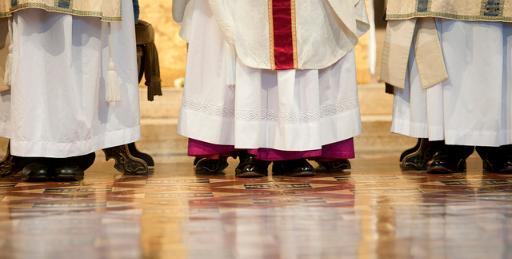
Feet

From 17-18 June in England there was an “Invocation Weekend“.

Here is a shot that causes, at least caused me, a double-take.

Feet

His Hermeneuticalness has more on the event.

Posted in Lighter fare | Tagged ,
13 Comments

Spiffy

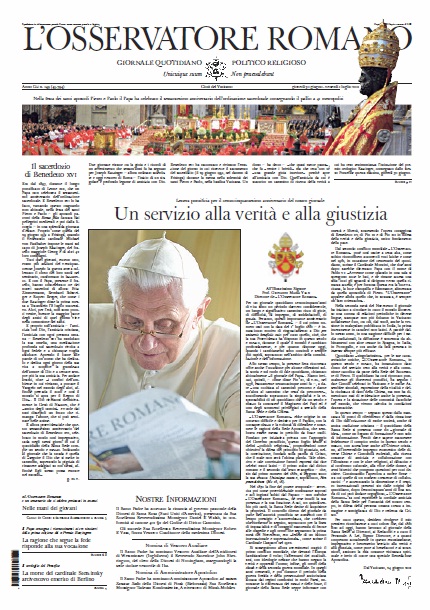
L’Osservatore Romano is going for baroque.

Spiffy

Now about that … content.

Posted in SESSIUNCULA | Tagged
6 Comments